
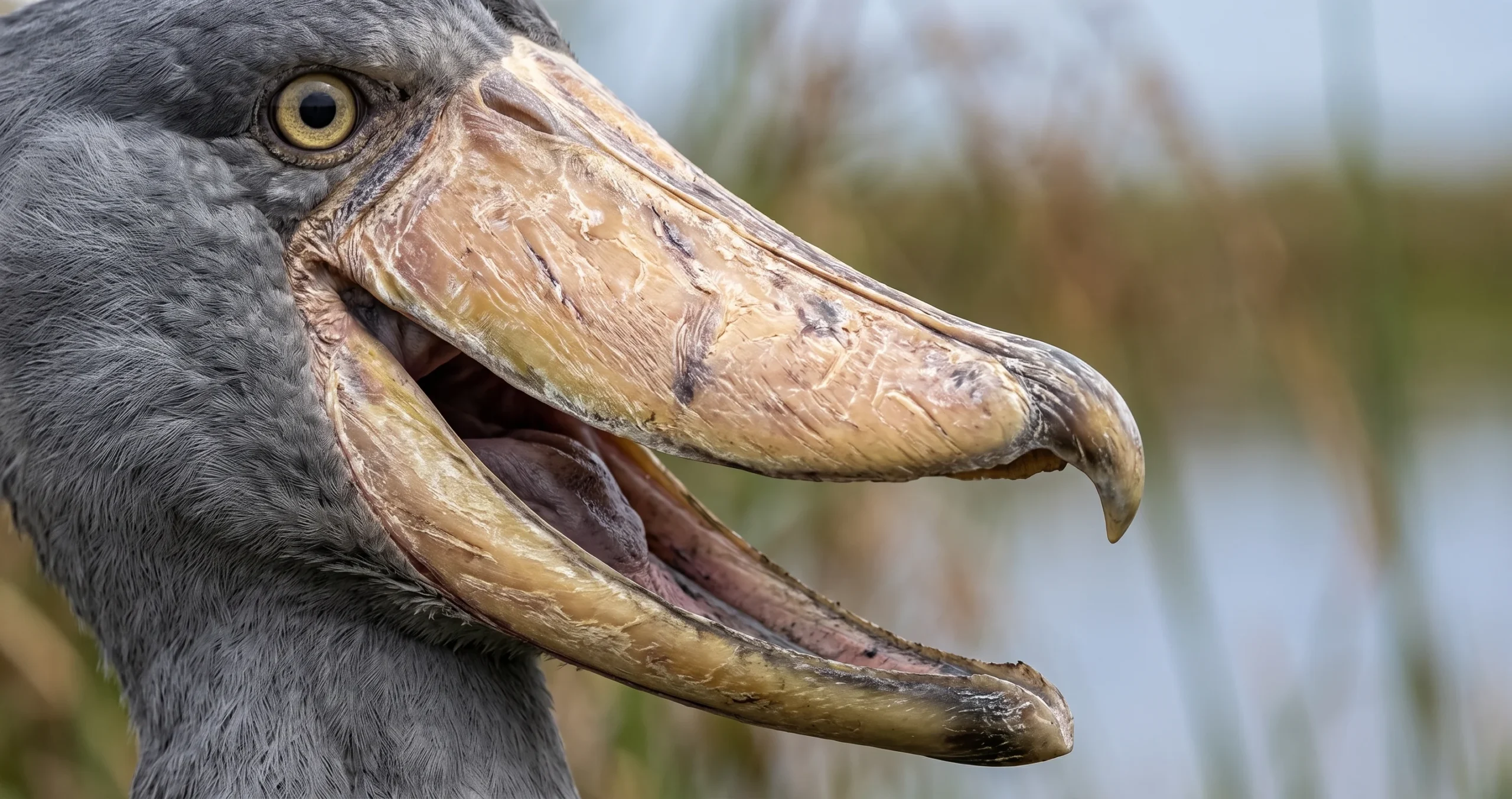
Standing almost motionless in a tropical African swamp, the shoebill can look more like a creature reconstructed from a fossil than a living bird. Its enormous shoe-shaped bill, pale staring eyes, gray plumage, and extraordinary patience have made it one of Africa’s most recognizable wetland predators.
The secret behind shoebill stork ambush hunting is not speed over long distances. Instead, the bird combines specialized anatomy with an exceptionally patient sit-and-wait strategy. It may remain nearly motionless until fish or another aquatic animal moves within striking distance, then suddenly launch its head and bill forward.
Despite the familiar name “shoebill stork,” the shoebill (Balaeniceps rex) is not considered a true stork. Modern classification places this unusual species closer to pelicans. BirdLife International recognizes just one living shoebill species and places it in the family Balaenicipitidae.
Table of Contents
- What Is a Shoebill?
- Why the Shoebill’s Bill Is So Unusual
- What Shoebills Actually Eat
- How Shoebill Stork Ambush Hunting Works
- Why Shoebills Stand Still Like Statues
- Where Shoebills Live
- Why Swamp Conditions Matter
- Conservation Status and Major Threats
- Common Shoebill Myths
- Frequently Asked Questions
- Conclusion
What Is a Shoebill?
The shoebill is a large freshwater wetland bird native to tropical Africa. Adults commonly stand well over three feet tall, with long legs, broad wings, gray plumage, and an oversized head dominated by an unmistakable bill.
BirdLife reports that shoebills can reach roughly 152 centimeters, or about five feet, in height. Males can weigh around 5.6 kilograms, while females average somewhat less.
Its scientific name, Balaeniceps rex, roughly reflects the bird’s remarkable head. The combination of a massive bill, forward-facing appearance, and slow deliberate movements gives the shoebill the “prehistoric” appearance frequently associated with it.
That description is visual rather than taxonomic. Shoebills are modern birds, not surviving dinosaurs in any special sense beyond the evolutionary connection that all living birds have with theropod dinosaurs.
Why the Shoebill’s Bill Is So Unusual
Everything about the shoebill’s face seems designed around one enormous structure.
Its bill can measure roughly a foot long and is broad, deep, and powerful. Rather than ending in a simple point, it has a conspicuous curved hook at the tip. The mandibles also possess sharp edges that help the bird capture and handle slippery prey.
This combination gives the bird an effective tool for grabbing relatively large aquatic animals.
When a shoebill strikes, however, it often collects more than its intended prey. Water, vegetation, and mud may enter the bill as well. The bird must manipulate the catch and discard unwanted material before swallowing its meal.
The bill is therefore more than an oversized pair of jaws. It works as part of an entire feeding system involving the bird’s neck, body position, eyesight, balance, and patience.
What Shoebills Actually Eat
Fish form an important part of the shoebill diet.
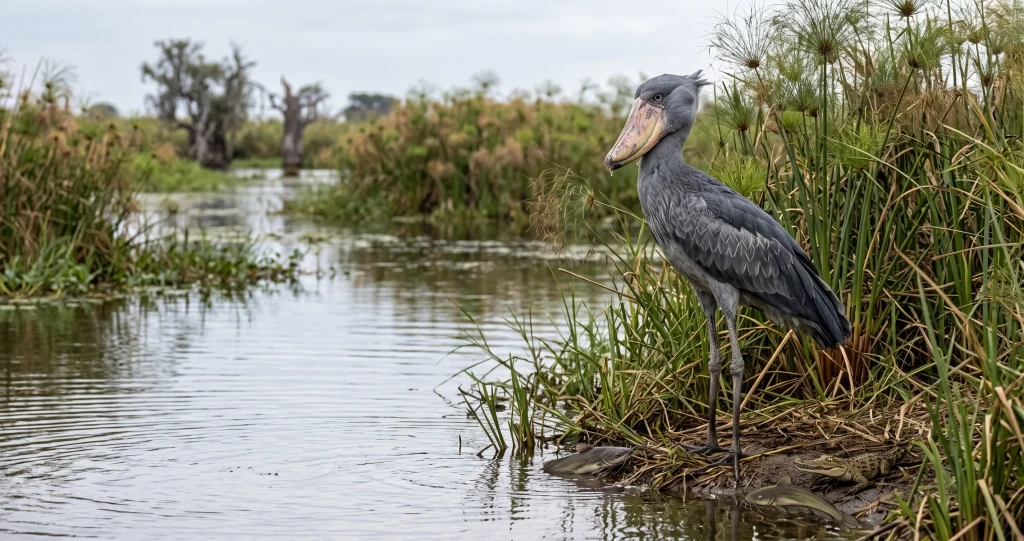
Lungfish are particularly associated with shoebill habitat and feeding behavior. Other recorded prey includes bichirs, catfish, tilapia, frogs, water snakes, and other aquatic animals. Animal Diversity Web also reports occasional consumption of monitor lizards, turtles, mollusks, carrion, and young crocodiles.
That last item has helped create an exaggerated internet reputation.
Shoebills can take surprisingly substantial prey, but this does not mean they routinely battle large crocodiles. Reports involve young crocodiles small enough to be captured, not full-grown adults.
The bill allows the shoebill to exploit prey that would be difficult for many smaller wading birds to handle.
How Shoebill Stork Ambush Hunting Works
The most remarkable aspect of shoebill stork ambush hunting may be how little the bird appears to do before the strike.
A shoebill often uses a strategy researchers describe as “stand and wait.” It positions itself near productive water and remains extremely still while watching for prey.
Another method involves slowly wading through suitable habitat.
When prey is detected, the calm scene changes almost instantly. The bird thrusts its head and neck forward and downward in a powerful movement sometimes described as a “collapse.”
The movement can cause the shoebill to pitch much of its body forward as its bill enters the vegetation or water. Once the strike is completed, the bird has to regain its balance before returning to its hunting posture.
This creates a striking contrast: prolonged stillness followed by an explosive attack.
BirdLife notes that shoebills may remain motionless for hours and reports high success from their ambush strikes.
Why Shoebills Stand Still Like Statues
Remaining motionless is not laziness. It is part of the hunting strategy.
Moving repeatedly through shallow water can reveal a predator’s location and disturb potential prey. Waiting allows the shoebill to minimize unnecessary movement while monitoring a promising feeding area.
The strategy is especially effective in environments where prey periodically becomes accessible.
Lungfish provide an excellent example. Shoebills are often associated with poorly oxygenated wetlands where some aquatic animals need to approach the surface to breathe. Animal Diversity Web notes that this behavior can increase opportunities for shoebills to capture fish.
In that setting, patience becomes an advantage.
The bird does not necessarily need to chase a fish through vegetation. It can wait near a likely location and attack when the prey moves into range.
This helps explain the unusual rhythm of shoebill stork ambush hunting: watch, wait, strike, recover, and begin waiting again.
Where Shoebills Live
Wild shoebills have a surprisingly restricted distribution.
They occur primarily in large freshwater wetlands across east-central tropical Africa. Important populations are associated with countries including South Sudan, Uganda, the Democratic Republic of the Congo, Rwanda, Tanzania, and Zambia.
The vast Sudd wetlands of South Sudan are particularly important, as are wetlands in Uganda and Zambia’s Bangweulu region.
Shoebills favor extensive freshwater swamps containing reeds, grasses, papyrus, and floating vegetation.
Their distribution is therefore not simply determined by latitude or temperature. They require a particular combination of water depth, vegetation structure, prey availability, nesting opportunities, and relatively undisturbed wetland habitat.
For another fascinating example of an African bird with an extraordinary feeding adaptation, read our article on greater honeyguide human cooperation, which explains how wild honeyguides can cooperate with human honey hunters.
Why Swamp Conditions Matter
A productive shoebill wetland is more complex than an expanse of open water.
Shallow areas provide hunting opportunities, while tall vegetation can help conceal a waiting bird. Where water is deeper, floating vegetation can provide the physical platform a shoebill needs for hunting.
Poorly oxygenated water may also influence prey behavior.
Lungfish and certain other aquatic animals must approach the surface for air, creating predictable moments when an otherwise hidden animal becomes accessible to a waiting predator.
This relationship demonstrates why conserving a species means conserving ecological processes, not merely protecting individual animals.
A wetland might remain visible on a map while becoming less suitable if water flow, vegetation, disturbance, or prey communities change.
Conservation Status and Major Threats
The shoebill is currently classified as Vulnerable, meaning it faces a high risk of extinction in the wild.
BirdLife International estimates approximately 3,300–5,300 mature individuals and describes the population as declining. Because BirdLife serves as the Red List Authority for birds, its assessments contribute directly to the IUCN Red List process.
Several pressures contribute to the species’ vulnerability.
Wetland habitat can be altered or lost through human land use and changes in water management. Disturbance around nesting and feeding areas can create additional problems.
Hunting and capture also matter.
Shoebills have been targeted for the illegal live-bird trade, and BirdLife notes that mortality associated with capture, transportation, and captivity can be high. Nest disturbance and hunting add further pressure.
Climate-related drought represents another concern because shoebills depend so heavily on freshwater wetland systems.
Conservation therefore requires protecting not only the birds but the large swamp ecosystems that support their prey, breeding sites, and hunting behavior.
BirdLife’s shoebill conservation overview provides additional information on the species, population, behavior, and threats.
Common Shoebill Myths
Myth 1: Shoebills are dinosaurs
Shoebills certainly look prehistoric, but they are living modern birds.
Like all birds, their distant evolutionary history connects them with theropod dinosaurs. Calling the shoebill itself a living dinosaur is useful as colorful popular language, not as a unique scientific classification.
Myth 2: Shoebills are true storks
Despite the widespread name “shoebill stork,” the bird is not a member of the true stork family Ciconiidae.
Current classification places Balaeniceps rex in its own family, Balaenicipitidae, and recognizes a closer relationship with pelicans.
Myth 3: Shoebills routinely hunt crocodiles
This claim needs context.
Young crocodiles have been documented among shoebill prey, but fish—especially lungfish—are much more characteristic foods. A shoebill does not routinely attack adult crocodiles.
Myth 4: Their motionless behavior means they are slow hunters
Their waiting behavior is slow.
Their actual strike is not.
The effectiveness of shoebill stork ambush hunting depends on switching from extraordinary stillness to a rapid forward attack when prey reaches the right position.
Myth 5: Their intimidating appearance means they constantly attack people
A shoebill’s enormous bill and intense stare create an imposing appearance, but its feeding adaptations are directed primarily toward aquatic prey.
As with any wild animal, people observing shoebills should avoid approaching or disturbing them, particularly around nesting or feeding sites.
Frequently Asked Questions
What is a shoebill?
The shoebill (Balaeniceps rex) is a very large African wetland bird and the only living species in the family Balaenicipitidae. It is famous for its enormous shoe-shaped bill and patient hunting behavior.
Is the shoebill really a stork?
No. “Shoebill stork” is a familiar common name, but shoebills are not true storks. Current classification places them closer to pelicans.
What does a shoebill eat?
Its diet consists largely of aquatic prey, especially fish such as lungfish, bichirs, catfish, and tilapia. Shoebills can also consume frogs, snakes, turtles, and occasionally other vertebrates, including young crocodiles.
How does a shoebill hunt?
Shoebill stork ambush hunting usually involves standing nearly motionless or moving very slowly while watching the water. Once suitable prey is detected, the bird rapidly thrusts forward and downward with its enormous bill.
Why do shoebills stand still for so long?
Stillness allows them to wait near productive feeding areas without constantly disturbing potential prey. Their habitat may contain air-breathing fish that periodically approach the surface, giving the waiting bird an opportunity to strike.
Where do shoebills live?
They inhabit large freshwater swamps and marshes in east-central tropical Africa, with important populations occurring from South Sudan southward through countries including Uganda, Tanzania, and Zambia.
Are shoebills endangered?
Their current global classification is Vulnerable, rather than Endangered. BirdLife reports a declining population estimated at approximately 3,300–5,300 mature individuals.
Why are shoebills threatened?
Major pressures include wetland habitat loss and degradation, disturbance, hunting, illegal capture for live trade, and climate-related drought. Their specialized dependence on large freshwater wetlands makes habitat protection particularly important.
Conclusion
Few birds demonstrate the power of patience as dramatically as the shoebill.
Its enormous hooked bill, long legs, strong neck, and extraordinary ability to remain motionless all contribute to one specialized predatory system. Instead of pursuing prey continuously, shoebill stork ambush hunting turns stillness into a weapon.
The strategy is perfectly suited to African wetlands where lungfish and other aquatic animals may eventually reveal themselves near the surface.
Yet the same specialization that makes the shoebill so remarkable also contributes to its vulnerability.
Shoebills depend on extensive, functioning freshwater swamps across a relatively restricted African range. When those wetlands are degraded, disturbed, drained, or affected by changing water conditions, the bird loses far more than somewhere to stand. It loses the ecological system that makes its unusual hunting strategy possible.
Protecting the shoebill therefore means protecting the wetlands behind the spectacle: the papyrus, floating vegetation, shallow water, fish communities, nesting areas, and ecological processes supporting one of Africa’s most distinctive predators.