
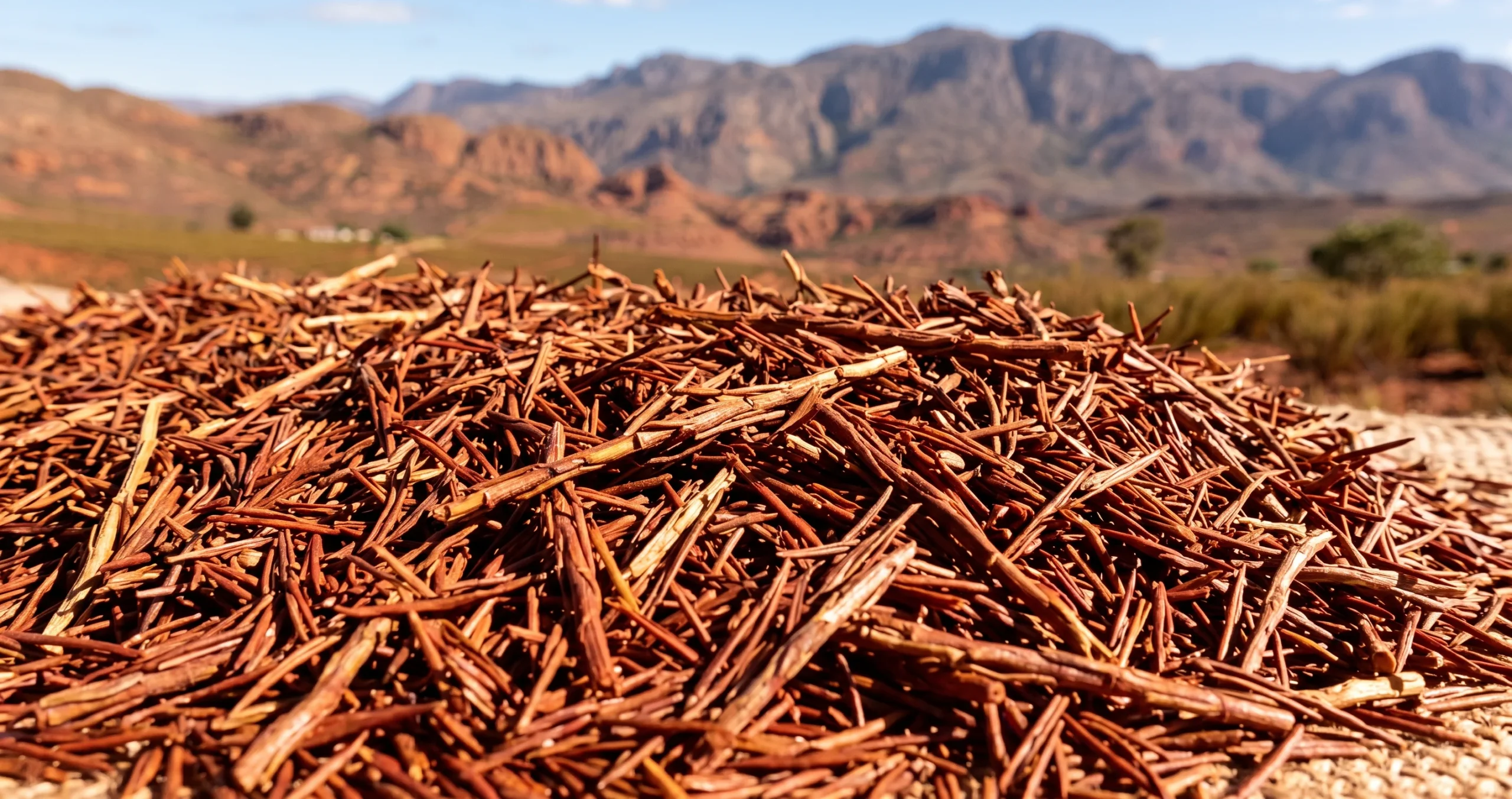
Rooibos seems as though it should be easy to grow. It is a tough, shrubby legume adapted to heat, drought, and relatively poor soil. Yet anyone interested in growing rooibos tea plant outside South Africa quickly discovers that toughness does not mean adaptability to every environment.
True rooibos, Aspalathus linearis, is native to South Africa’s Cape Floristic Region and is most strongly associated with the Cederberg and surrounding rooibos-producing districts. Its success there comes from an unusually specific combination of acidic sandstone-derived soil, winter rainfall, hot dry summers, seasonal temperature changes, and local ecology.
That combination helps explain why rooibos has become one of the world’s most geographically distinctive herbal crops.
Table of Contents
- What Exactly Is Rooibos?
- Why the Cederberg Is So Important
- The Unusual Soil Rooibos Prefers
- A Climate Built Around Winter Rain
- Geography Matters More Than It Seems
- How Rooibos Is Grown and Harvested
- Why “Fermentation” Turns Rooibos Red
- Why Rooibos Is Naturally Caffeine-Free
- Growing Rooibos Tea Plant in the United States
- Common Rooibos Myths
- Frequently Asked Questions
- Conclusion
What Exactly Is Rooibos?
Rooibos is not a true tea plant.
Black, green, white, and oolong teas come from Camellia sinensis. Rooibos comes from Aspalathus linearis, a member of the legume family Fabaceae. The plant forms a shrub with slender branches and narrow, needle-like leaves that are harvested along with portions of the young stems.
Commercial rooibos has been cultivated since the early 20th century, although local Indigenous knowledge of the plant predates the modern industry. Today, cultivated rooibos is closely tied to South Africa’s Western and Northern Cape production regions.
The European Union has even recognized “Rooibos/Red Bush” as a protected designation of origin. The official specification defines a production area across designated municipalities in the Western Cape and Hantam in the Northern Cape and links the product’s characteristics directly to its geography.
So although the familiar phrase “rooibos only grows in the Cederberg” simplifies the plant’s actual native and protected production range, the underlying idea is sound: authentic commercial rooibos is remarkably geographically restricted.
Why the Cederberg Is So Important
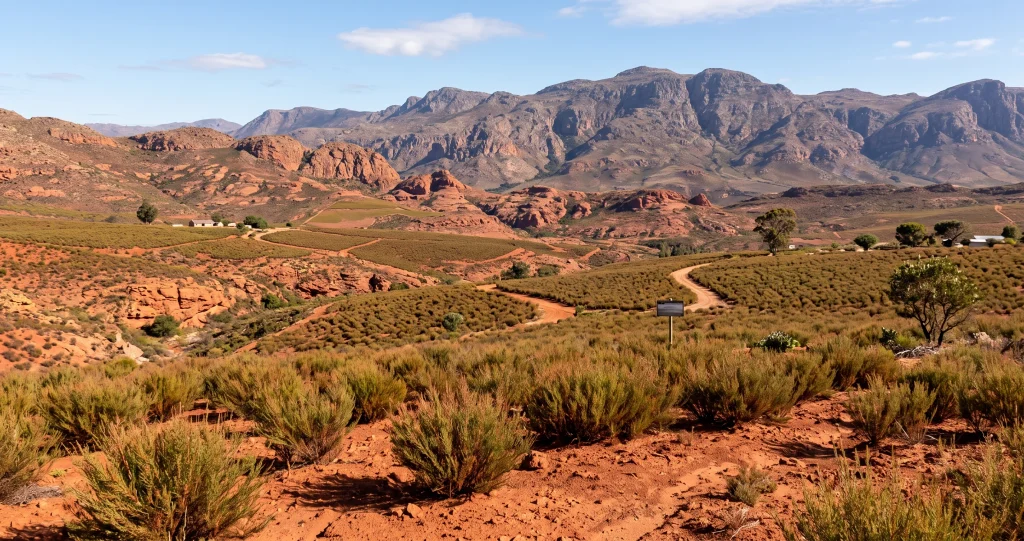
The Cederberg region north of Cape Town sits within an extraordinary botanical landscape dominated by fynbos vegetation.
Conditions can appear harsh. Summers are hot and extremely dry, while much of the rainfall arrives during the cooler winter months. Rooibos has evolved around this seasonal rhythm rather than the summer-rainfall pattern common across much of North America.
According to South African agricultural guidance, rooibos performs well under dryland conditions with wet winters and relatively low annual rainfall. Recommendations describe approximately 250–400 mm of rainfall and deep, well-drained sandy soil.
This seasonal stress is not merely something the plant survives.
It influences how the plant develops and can affect its chemical composition. The EU specification for rooibos describes cold, wet winters followed by spring and early-summer growth, then increasingly hot and dry conditions as the crop matures and accumulates polyphenols.
Trying to duplicate the plant without duplicating that environmental cycle is one reason growing rooibos elsewhere can be challenging.
The Unusual Soil Rooibos Prefers
Many garden plants would struggle in traditional rooibos country.
The soils are generally coarse, sandy, acidic, low in nutrients, and exceptionally well drained. South African agricultural guidance gives a preferred soil pH of roughly 4.5–5.5 and emphasizes deep sandy soil that allows extensive root development.
These soils are associated with ancient sandstone geology. The EU geographical specification describes soils derived from Table Mountain Sandstone as coarse, sandy, nutrient-poor, and acidic.
Rooibos has adapted to this environment rather than demanding rich agricultural soil.
That creates a counterintuitive problem for gardeners. Improving the planting site with generous amounts of rich compost or using a moisture-retentive general-purpose potting soil may produce conditions farther from the plant’s natural habitat.
Drainage is particularly important.
Rooibos develops a substantial root system suited to extracting moisture from deep soil during prolonged dry periods. Historical South African agricultural material notes that its taproot can extend several meters into sandy soil.
For a broader look at how growing media affect drainage and root conditions, see Secrets of the Green Garden’s guide to peat versus peat-free compost.
A Climate Built Around Winter Rain
Rooibos country has a Mediterranean-type climate.
Instead of receiving regular summer rainfall, the region experiences cool, wetter winters followed by increasingly dry summers. Annual rainfall varies across the production area, but prolonged summer dryness is one of the defining environmental features.
The plant therefore experiences its moisture and temperature cycles in a particular sequence: winter moisture supports establishment and growth, spring brings vigorous development, and summer introduces heat and water stress as the crop approaches harvest.
That timing matters.
A region receiving the same total annual rainfall but receiving most of it during humid summers is not ecologically equivalent to the Cederberg.
High summer humidity combined with consistently wet soil can create very different root-zone and disease pressures. Conversely, severe winter freezes may exceed what plants from rooibos-producing landscapes normally encounter.
This is why matching a plant’s annual rainfall total alone tells only part of the story.
Geography Matters More Than It Seems
Rooibos is endemic to the Cape Floristic Region, one of the world’s exceptional centers of plant diversity. Its distribution developed within a landscape of sandstone mountains, nutrient-poor soils, seasonal drought, fire, and highly localized ecological conditions.
Even wild rooibos populations are not chemically identical. Research has identified differences among wild ecological populations, demonstrating that Aspalathus linearis itself contains substantial ecological and chemical diversity.
This is an important distinction.
A gardener might succeed in keeping an Aspalathus linearis plant alive somewhere outside South Africa. That does not automatically mean the plant will grow, yield, or develop exactly like commercially produced South African rooibos.
The plant, soil, seasonal climate, local genetics, and processing tradition work together.
How Rooibos Is Grown and Harvested
Commercial production begins with seed, but germination presents another obstacle.
Rooibos seeds possess hard coats that restrict water uptake. Scarification—physically weakening that outer coat—can greatly improve germination. Botanical guidance from the South African National Biodiversity Institute specifically notes that seeds should be scarified before being planted in acidic, sandy soil.
Commercial seeds are typically sown in nursery beds before young plants are transplanted into fields.
The South African Rooibos Council reports that seeds are generally sown around February and March and seedlings transplanted several months later. Plants require roughly 18 months before their first harvest.
Harvesting occurs during the dry summer season.
The upper growth is cut, while enough vegetation remains for the shrub to recover. Leaves and fine stems are bundled and transported for processing.
Commercial plantations do not remain productive indefinitely. After several harvests, fields may need to be re-established.
Why “Fermentation” Turns Rooibos Red
Fresh rooibos is green.
The familiar deep amber-red material inside a rooibos tea bag appears only after processing.
Harvested stems and leaves are chopped and bruised, increasing exposure of plant tissues to oxygen. The material is moistened and traditionally piled or arranged on a processing floor.
The industry commonly calls this stage “fermentation,” but oxidation is the more accurate description.
Phenolic compounds undergo oxidative changes, and the plant material gradually develops its characteristic reddish-brown color and distinctive aroma. Research on rooibos processing confirms that phenolic compounds change during this oxidation or “fermentation” stage.
The oxidized material is then spread thinly and dried, traditionally using the South African sun. Official production specifications describe freshly cut rooibos being bruised, wetted, turned during oxidation, and subsequently spread out for drying.
Green rooibos comes from essentially the same plant.
The major difference is processing: oxidation is prevented or minimized by drying the harvested material promptly. That preserves a greener appearance and produces a different chemical and flavor profile.
Why Rooibos Is Naturally Caffeine-Free
One of the most persistent misconceptions about rooibos is that manufacturers somehow remove its caffeine.
They do not.
Rooibos is naturally caffeine-free because Aspalathus linearis does not produce caffeine in the way caffeine-containing tea and coffee plants do. Scientific reviews consistently describe rooibos as a naturally caffeine-free herbal infusion.
That means both traditional red rooibos and unoxidized green rooibos are naturally caffeine-free.
Decaffeinated black or green tea is different. Those products begin with caffeine-containing Camellia sinensis leaves and undergo processing intended to remove much of the caffeine.
Rooibos never needs that step.
Growing Rooibos Tea Plant in the United States
For an adventurous gardener, growing rooibos tea plant in the United States is possible as an experiment, but expectations should remain realistic.
The first challenge is seed germination. Scarified seed is considerably easier to germinate than untreated hard seed, although excessive scarification can damage seedlings.
Next comes the growing medium.
A loose, acidic, sandy mix with excellent drainage is a closer approximation to natural rooibos soil than rich garden loam. Aim for an acidic root zone near the approximately 4.5–5.5 range described in South African production guidance rather than assuming that ordinary vegetable-garden soil will work.
Climate presents the larger difficulty.
Parts of coastal California and other regions with Mediterranean-type climates may come closer to rooibos conditions than humid eastern states or regions with severe winter freezes. Even there, local soil chemistry, rainfall timing, summer humidity, and temperature patterns will not perfectly duplicate South Africa.
Containers offer another option because gardeners can control drainage and soil composition. However, a container restricts the extensive root system that helps mature rooibos tolerate drought in its native environment.
A greenhouse can protect the plant from excessive cold, but high humidity and overwatering should be avoided.
Most American gardeners should therefore treat rooibos as an unusual botanical experiment rather than expect a backyard plantation capable of producing tea identical to commercial South African rooibos.
Common Myths About Rooibos
Myth: Rooibos literally cannot survive anywhere outside South Africa
The plant can potentially be cultivated elsewhere under carefully managed conditions. The more accurate statement is that its natural range and recognized commercial production are exceptionally localized, and reproducing the complete combination of soil, climate, genetics, and seasonal stress is difficult.
Myth: Rooibos needs rich soil because it is harvested as a crop
Rooibos is adapted to nutrient-poor, acidic sandy soils. Making soil richer does not automatically make conditions better for the plant.
Myth: Red and green rooibos come from different species
Both can come from Aspalathus linearis. The major distinction is post-harvest oxidation.
Myth: Rooibos is decaffeinated tea
Rooibos is an herbal infusion from a different plant family than conventional tea and is naturally caffeine-free.
Myth: “Fermentation” means microbes turn rooibos red
The traditional industry term can be misleading. The transformation is primarily an oxidative process involving compounds and enzymes within the damaged plant tissues.
Frequently Asked Questions
Where does rooibos naturally grow?
Aspalathus linearis is endemic to South Africa’s Cape Floristic Region. Commercial rooibos production is concentrated within a defined area of the Western and Northern Cape provinces, including the Cederberg and surrounding districts.
What soil does rooibos need?
Rooibos favors deep, acidic, sandy, exceptionally well-drained soil. South African agricultural guidance gives an approximate preferred pH range of 4.5–5.5.
Can rooibos grow in pots?
Potentially, especially while young. A large container filled with an acidic, fast-draining medium allows greater control over moisture, but long-term container culture cannot perfectly reproduce the deep root environment available in the Cederberg.
How long before rooibos can be harvested?
Commercial plants generally reach their first harvest at around 18 months under South African production conditions.
Why is rooibos red?
Traditional rooibos turns reddish brown after harvested leaves and stems are chopped, bruised, moistened, and allowed to oxidize. Green rooibos is processed to limit this oxidation.
Is rooibos really caffeine-free?
Yes. Rooibos is naturally caffeine-free rather than artificially decaffeinated.
Can I produce homemade rooibos tea from a U.S.-grown plant?
In principle, harvested leaves and tender stems could be processed experimentally. However, reproducing the flavor, chemistry, consistency, sanitation standards, and controlled oxidation of professionally produced South African rooibos is another matter.
Conclusion
Rooibos is a striking example of how deeply a crop can belong to a landscape.
Its success in South Africa is not explained by one magical ingredient in the soil or a single temperature threshold. It comes from the interaction of ancient sandstone-derived acidic soils, exceptional drainage, winter rainfall, hot dry summers, drought-adapted roots, local plant genetics, and generations of cultivation and processing knowledge.
That makes growing rooibos tea plant outside its traditional region an intriguing challenge rather than an impossible one. A determined U.S. gardener may be able to germinate the seed and maintain a healthy specimen by recreating acidic, sandy, low-nutrient conditions while avoiding excessive moisture and severe cold.
Producing something truly comparable to Cederberg-grown rooibos is much harder.
The red cup familiar around the world is therefore more than the product of a plant. It reflects a distinctive South African ecosystem—and one of the clearest examples of how geography can shape what eventually ends up in our cup.