
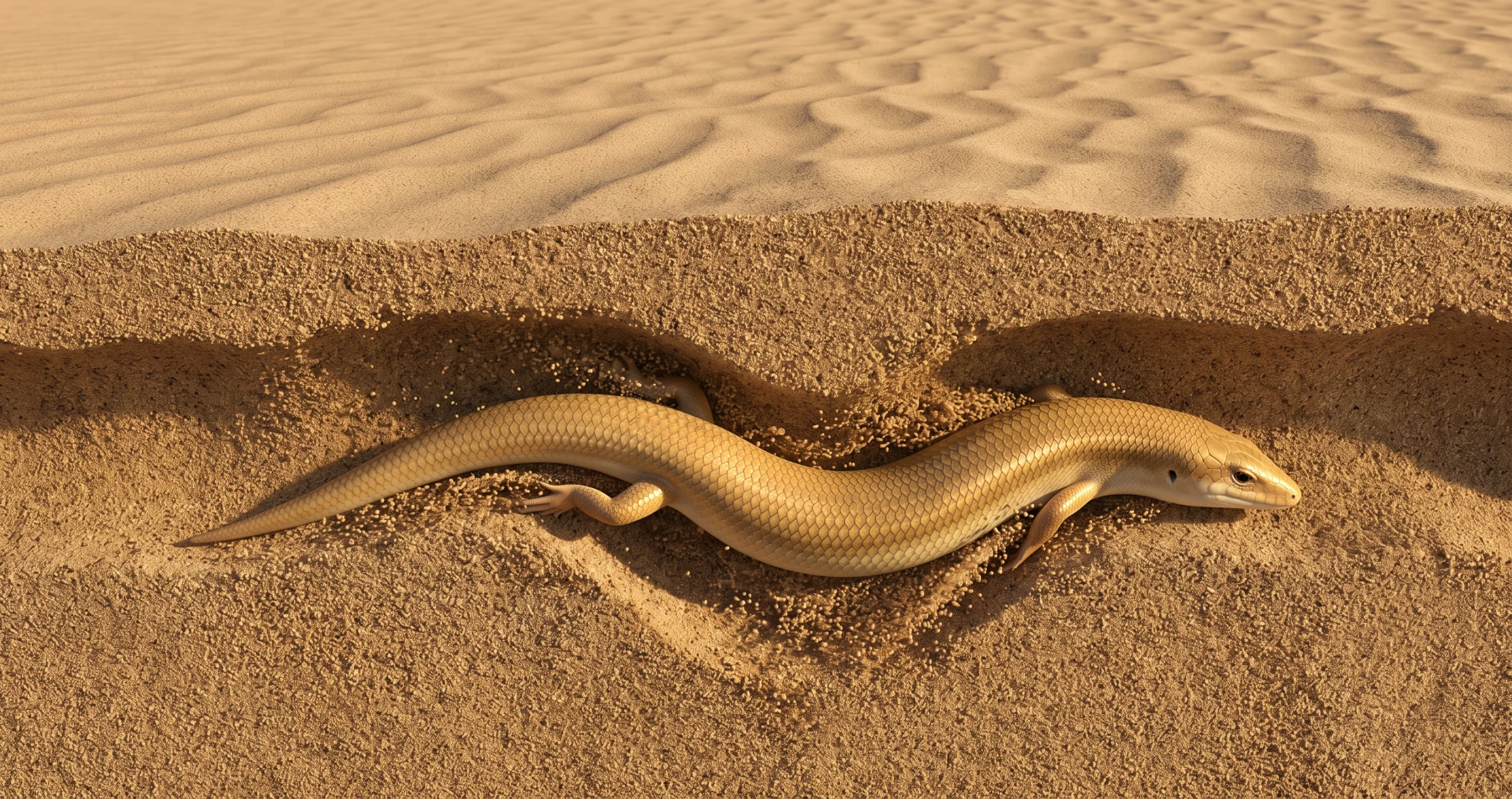
On the surface of a North African dune, a small golden skink pauses for an instant. Then it lowers its wedge-shaped head into the loose sand, drives forward, and disappears. Within moments, the surface settles behind it, leaving little evidence that a lizard is moving underneath.
This remarkable sandfish lizard sand swimming is more than an evocative nickname. High-speed X-ray experiments have shown that once Scincus scincus is submerged, it does not simply crawl underground or excavate a permanent tunnel. Instead, it folds its limbs against its body and sends coordinated waves of bending from head to tail, generating forces against the surrounding grains that propel it forward.
The motion resembles swimming—but the material surrounding the lizard is granular sand, not water.
Table of Contents
- Meet the Sandfish Skink
- Why It Is Called a Sandfish
- The Moment It Disappears Underground
- What Happens to the Legs
- Swimming With the Whole Body
- How Body Waves Generate Forward Motion
- Sand Is Neither a Normal Solid nor a Liquid
- Why the Sand Does Not Need to Form a Tunnel
- The Importance of Body Shape
- Smooth Scales and Sand
- How Fast Can a Sandfish Move Underground?
- How Scientists See an Animal Hidden in Sand
- Robots Inspired by Sandfish
- Why Go Beneath the Sand?
- Life in a Harsh Desert Environment
- Sand Swimming vs. Ordinary Burrowing
- Other Animals That Move Through Sand
- Frequently Asked Questions
- Conclusion
Meet the Sandfish Skink
The sandfish, Scincus scincus, is a skink specialized for life in loose desert substrates.
It occurs across parts of North Africa and the Middle East, particularly in landscapes containing dry, loose, wind-blown sand. Its range includes portions of the Sahara and adjoining desert regions.
At first glance, the animal’s adaptations are visible in its shape.
The body is compact and streamlined, the snout is flattened and wedge-shaped, the limbs are relatively short, and the scales form a smooth outer surface. Its coloration typically blends sandy yellows and browns with darker markings.
But its most unusual specialization becomes apparent only after the lizard vanishes underground.
Why It Is Called a Sandfish
The name “sandfish” refers to the striking resemblance between its underground movement and the undulatory swimming of aquatic animals.
That comparison is useful, but it has limits.
Water is a fluid whose molecules move continuously around a swimmer. Dry sand is a collection of individual solid particles that interact through friction, collisions, and contact forces.
Granular materials can sometimes behave like solids and under other conditions flow somewhat like fluids.
The sandfish exploits this unusual mechanical behavior.
Instead of digging out a tunnel and moving through an open cavity, it pushes directly through the grains while generating a traveling wave along its body.
That is why biomechanics researchers commonly call the behavior “sand swimming.”
The Moment It Disappears Underground
Entering the sand is different from swimming once fully submerged.
At the surface, the sandfish uses its limbs as part of the burial process. It angles its head downward and combines body movement with rapid limb activity to force itself beneath the grains.
Once enough of the body enters, the surrounding sand begins flowing over the lizard.
Within seconds, it can disappear completely.
The transition is remarkably rapid, an obvious advantage for an animal that may use the subsurface environment as refuge.
But once the sandfish is fully underneath, its locomotor strategy changes.
Image 1 placement — 1200 × 630 px, photorealistic, no text or graphic overlays
Alt text: Sandfish lizard sand swimming as a skink dives beneath desert sand
What Happens to the Legs
One of the most important discoveries from high-speed X-ray experiments was what the sandfish does with its limbs underground.
It does not paddle through sand with four feet.
During burial, the limbs initially participate in moving the animal below the surface. Once submerged, however, the sandfish adducts its limbs—drawing them against the sides of its body.
The legs then contribute little or nothing directly to propulsion during steady subsurface swimming.
This streamlined posture reduces protruding structures that would otherwise interact strongly with the surrounding grains.
Forward movement instead comes primarily from the trunk.
Swimming With the Whole Body
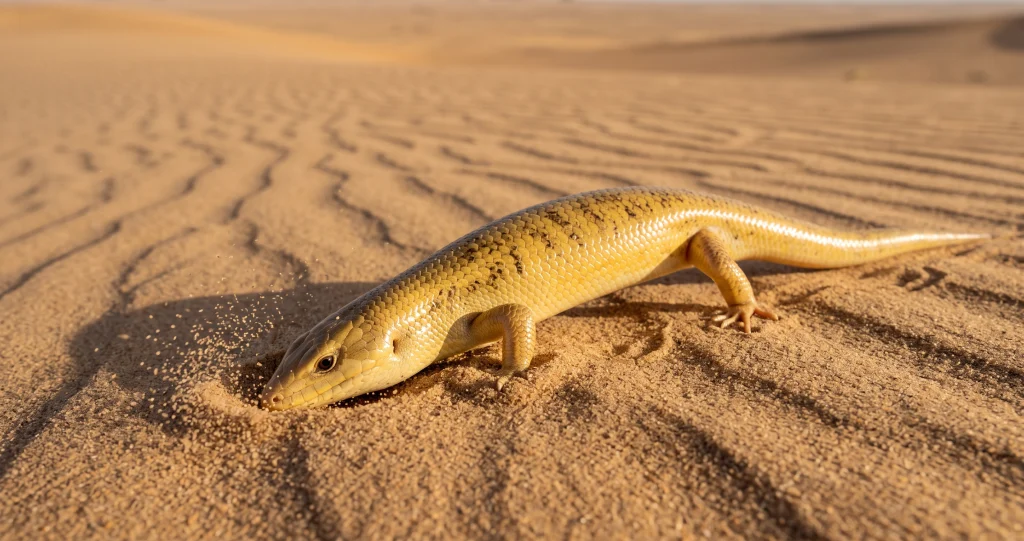
The submerged sandfish bends from side to side.
These bends do not remain fixed in one position. A wave travels from the front of the body toward the tail.
Viewed from above, the body forms an approximately sinusoidal shape.
As the wave moves backward along the animal, the lizard advances forward through the granular material.
High-speed X-ray measurements found that sandfish generally maintain roughly one complete wave along the body while swimming.
The frequency of that undulation can change with speed.
Faster body oscillations generally produce faster forward movement while the overall waveform remains relatively consistent.
Image 2 placement — 1200 × 630 px, photorealistic, no text or graphic overlays
Alt text: Sandfish skink moving through loose sand using body undulations
How Body Waves Generate Forward Motion
A moving body segment pushes against surrounding grains.
The sand pushes back.
Because each portion of the curved body is oriented at a different angle relative to its direction of movement, these granular reaction forces contain components that can contribute to forward thrust.
Across the entire body, useful propulsive forces must overcome resistance from the grains.
Researchers have modeled this process using a granular form of resistive force theory.
The approach estimates the forces acting on different portions of the animal and combines them to predict overall motion.
Experiments, numerical simulations, and physical robotic models have produced similar results, supporting the idea that the sandfish’s characteristic waveform is highly effective for locomotion through loose granular material.
Sand Is Neither a Normal Solid nor a Liquid
Granular materials occupy a fascinating mechanical middle ground.
A pile of dry sand can support weight like a solid.
Tilt that pile far enough, however, and the grains begin flowing.
Push an object through it and the grains rearrange, slide, rotate, and form temporary networks of contact forces.
That behavior makes sand fundamentally different from water.
A swimmer in water mainly deals with fluid forces generated by a continuous medium. A sandfish must continuously rearrange discrete grains while overcoming frictional resistance.
The original sandfish experiments showed that under the conditions studied, its subsurface locomotion could nevertheless be described effectively using a friction-dominated model of granular resistance.
Calling the movement swimming therefore describes the lizard’s undulatory locomotion—not a claim that sand literally becomes water.
Why the Sand Does Not Need to Form a Tunnel
Many burrowing animals excavate material.
A mole, for example, can push soil aside while constructing a passage that remains open behind it.
The sandfish operates differently in loose dry sand.
As its body advances, grains immediately around it are displaced and rearranged. After the animal passes, gravity and granular movement allow the material to settle again.
The lizard therefore does not require a permanent air-filled tunnel.
Its body occupies a temporary space within the grains as it moves.
Once the body has passed, that space collapses.
This ability is particularly suited to loose dune sand, where maintaining an open tunnel would be difficult anyway.
The Importance of Body Shape
The sandfish’s morphology complements its movement.
Its wedge-shaped snout helps it enter loose substrate.
The streamlined body presents relatively few projections once the limbs have been tucked against the sides.
A compact cross-section also influences the amount of sand that must be displaced.
Body flexibility is equally important.
A rigid streamlined object could penetrate sand, but it could not produce the traveling lateral wave responsible for continuous propulsion.
The sandfish therefore combines an appropriate external shape with a musculoskeletal system capable of generating rapid, coordinated bending.
Its morphology and movement cannot be separated when explaining its performance.
Smooth Scales and Sand
The sandfish’s scales have attracted considerable attention because repeated movement through abrasive sand might be expected to produce substantial wear.
Some studies have reported low friction, low adhesion, and impressive resistance to abrasion. Biochemical research has also investigated glycans associated with the scale surface and their possible role in reducing adhesion and friction.
The picture is not completely straightforward.
Later microscopic experiments using atomic force microscopy found that individual sandfish scales did not possess exceptionally low friction or wear compared with every other reptile or technical surface tested.
Those researchers concluded that scale properties alone cannot explain sand swimming.
The locomotor dynamics, body mechanics, epidermal properties, and interaction of the complete animal with granular material must also matter.
That is an important correction to the appealing but oversimplified claim that the sandfish swims underground merely because it has exceptionally slippery scales.
How Fast Can a Sandfish Move Underground?
Sandfish are surprisingly fast beneath loose material.
The landmark 2009 experiments used high-speed X-ray imaging to track S. scincus swimming through dry granular media.
Under controlled laboratory conditions, typical subsurface speeds were roughly 10–15 centimeters per second, depending on the granular material and movement frequency.
Other research and observations have reported maximum sand-swimming velocities approaching approximately 30 centimeters per second.
These numbers should not be interpreted as one universal speed.
Performance depends on grain size, packing, depth, animal size, temperature, and experimental conditions.
Research has shown that the lizard can increase swimming velocity mainly by increasing the frequency of its body undulations rather than radically changing its waveform.
The original peer-reviewed study, “Undulatory Swimming in Sand: Subsurface Locomotion of the Sandfish Lizard”, established the experimental foundation for understanding this remarkable locomotion.
How Scientists See an Animal Hidden in Sand
Studying underground locomotion creates an obvious problem.
Ordinary cameras cannot see through sand.
Researchers solved this by using high-speed X-ray imaging.
The X-rays allowed investigators to record the lizard’s skeleton and body position while it moved beneath the granular surface.
These recordings revealed details that surface observations could not provide.
Scientists could measure body-wave amplitude, wavelength, undulation frequency, swimming velocity, burial depth, and limb position.
Other research on sandfish has also used imaging methods including nuclear magnetic resonance techniques to examine movement and the interaction between the animal and surrounding substrate.
Combined with force measurements and computer modeling, these tools transformed the sandfish from an unusual natural-history observation into a sophisticated experimental system for studying granular locomotion.
Robots Inspired by Sandfish
Researchers have also built machines that imitate aspects of sandfish movement.
An undulatory robot can be placed beneath granular material and programmed to generate traveling waves along its body.
These robots allow scientists to change variables that are difficult to manipulate in a living animal.
Wave amplitude, wavelength, frequency, body flexibility, and shape can all be systematically adjusted.
One major study combined biological observations, resistive force theory, computer simulations, and a physical sand-swimming robot.
The results showed that effective subsurface movement depends strongly on the relationship between wave amplitude and wavelength.
The biological sandfish operates near a highly effective region of this parameter space.
The engineering implications extend beyond copying a lizard.
Machines capable of moving through sand or other granular materials could eventually help researchers understand locomotion in soils, debris, grains, and environments where conventional wheels or legs perform poorly.
Why Go Beneath the Sand?
For a desert animal, the subsurface environment can provide several advantages.
The most obvious is concealment.
A sandfish can vanish from the exposed surface within seconds, making it more difficult for a visually hunting predator to follow.
Burial can therefore function as an escape response.
Sand also creates a different microclimate from the exposed dune surface.
Desert surfaces experience extreme temperature fluctuations under intense sunlight and during cool nights. Even shallow burial can reduce direct solar exposure and place an animal in a more buffered thermal environment.
Subsurface retreat may consequently contribute to thermoregulation and shelter.
Researchers should still distinguish plausible ecological advantages from the experimentally measured mechanics of swimming.
X-ray studies demonstrate how the animal moves underground. Determining exactly how much each ecological factor—predation, temperature, resting, or foraging—contributes to natural burial behavior requires field observations as well.
Life in a Harsh Desert Environment
Sand swimming is only one part of Scincus scincus biology.
The species inhabits arid landscapes where loose sand strongly influences nearly every aspect of life.
Sandfish feed largely on small invertebrates, including insects and other arthropods.
They can emerge onto the surface to forage before retreating into the substrate.
Their sandy coloration provides camouflage when exposed, while rapid burial provides another form of protection.
The wedge-shaped head, compact body, reduced external projections, flexible trunk, and specialized integument all complement a lifestyle centered on loose granular substrates.
Rather than representing one miraculous adaptation, the sandfish is a combination of anatomical, behavioral, and biomechanical traits.
Sand Swimming vs. Ordinary Burrowing
The difference between swimming and digging is important.
A conventional digger removes substrate from the space it intends to occupy.
It may scrape material backward, push soil aside, or excavate a tunnel.
The sandfish certainly displaces grains as it moves, but it does not need to excavate and maintain an open passage.
Once submerged, its limbs are folded alongside the body rather than being used continuously as digging tools.
The traveling body wave supplies propulsion.
Sand moves around the lizard and then collapses behind it.
The term “sand swimming” therefore captures a real biomechanical distinction: locomotion occurs directly within a deformable granular medium through body undulation rather than through a preconstructed tunnel.
Other Animals That Move Through Sand
The sandfish is not the only animal specialized for loose substrates.
Several desert reptiles can rapidly bury themselves or move beneath sand.
Shovel-snouted lizards, some snakes, amphisbaenians, geckos, and other skinks show different forms of subterranean or sand-associated locomotion.
Invertebrates also provide numerous examples.
Certain desert insects can bury rapidly, while worms and other animals move through granular substrates using elongation, contraction, or body bending.
These animals should not all be described as biomechanically identical.
Different body plans interact with grains in different ways.
The sandfish is particularly important scientifically because its subsurface movement has been quantified through X-ray experiments, force measurements, theoretical models, computer simulations, and robots.
For another desert reptile with an unusual adaptation to its physical environment, see our article on thorny devil water transport.
Frequently Asked Questions
Does the sandfish really swim through sand?
Researchers use “swimming” because the submerged lizard propels itself with traveling waves of body bending that resemble undulatory swimming. It is nevertheless moving through discrete solid grains, not liquid water.
Does a sandfish use its legs underground?
The limbs help during entry into the sand. Once fully submerged and swimming steadily, experiments show that the sandfish folds its limbs against its body and generates propulsion primarily through body undulation.
How fast can a sandfish swim underground?
Controlled experiments have recorded typical speeds around 10–15 centimeters per second, while other studies and observations report speeds reaching roughly 30 centimeters per second. Exact performance varies with experimental and substrate conditions.
Does the sandfish leave a tunnel behind it?
Not a stable open tunnel during normal sand swimming. Grains move around the animal as it advances and settle behind it.
Why doesn’t the sand crush the lizard?
At the shallow depths used by sandfish, loose grains surround and contact the body rather than behaving like a rigid block. The animal’s morphology and movements continuously rearrange this granular material.
Are smooth scales responsible for sand swimming?
They may contribute to the animal’s interaction with sand, but scale properties alone do not explain the behavior. Experimental work shows that body shape, undulatory kinematics, granular forces, and other properties are also essential.
How can scientists film a lizard underneath sand?
High-speed X-ray imaging allows researchers to track the animal through opaque granular material. This technique revealed the tucked limbs and traveling body waves characteristic of subsurface locomotion.
Conclusion
The sandfish’s disappearance beneath a dune looks almost effortless from above.
Underneath the surface, however, a sophisticated biomechanical interaction is taking place.
The lizard initially uses its body and limbs to enter the substrate. Once submerged, it folds the legs alongside its streamlined body and generates a traveling wave of lateral bending from front to back.
Each moving body segment pushes against surrounding grains.
Those grains resist the motion, and the geometry of the undulating body converts part of that resistance into forward thrust.
The sand shifts around the animal and settles again after it passes, eliminating the need to excavate a permanent open tunnel.
Its wedge-shaped head, compact profile, flexible body, integument, and movement pattern all contribute to the process.
Yet the surrounding material is just as important.
Dry sand can support loads like a solid but can also yield and rearrange under sufficient force. The sandfish has evolved a locomotor strategy remarkably well suited to that unusual granular physics.
That is the real meaning of sandfish lizard sand swimming.
The lizard is not turning sand into water, nor is it simply digging through a tunnel. It is using wave-like body movements to propel itself directly through a shifting mass of grains—an adaptation so effective that it has become a model for physicists, biomechanists, and engineers trying to understand how animals and machines can move where ordinary walking, crawling, and swimming no longer apply.