
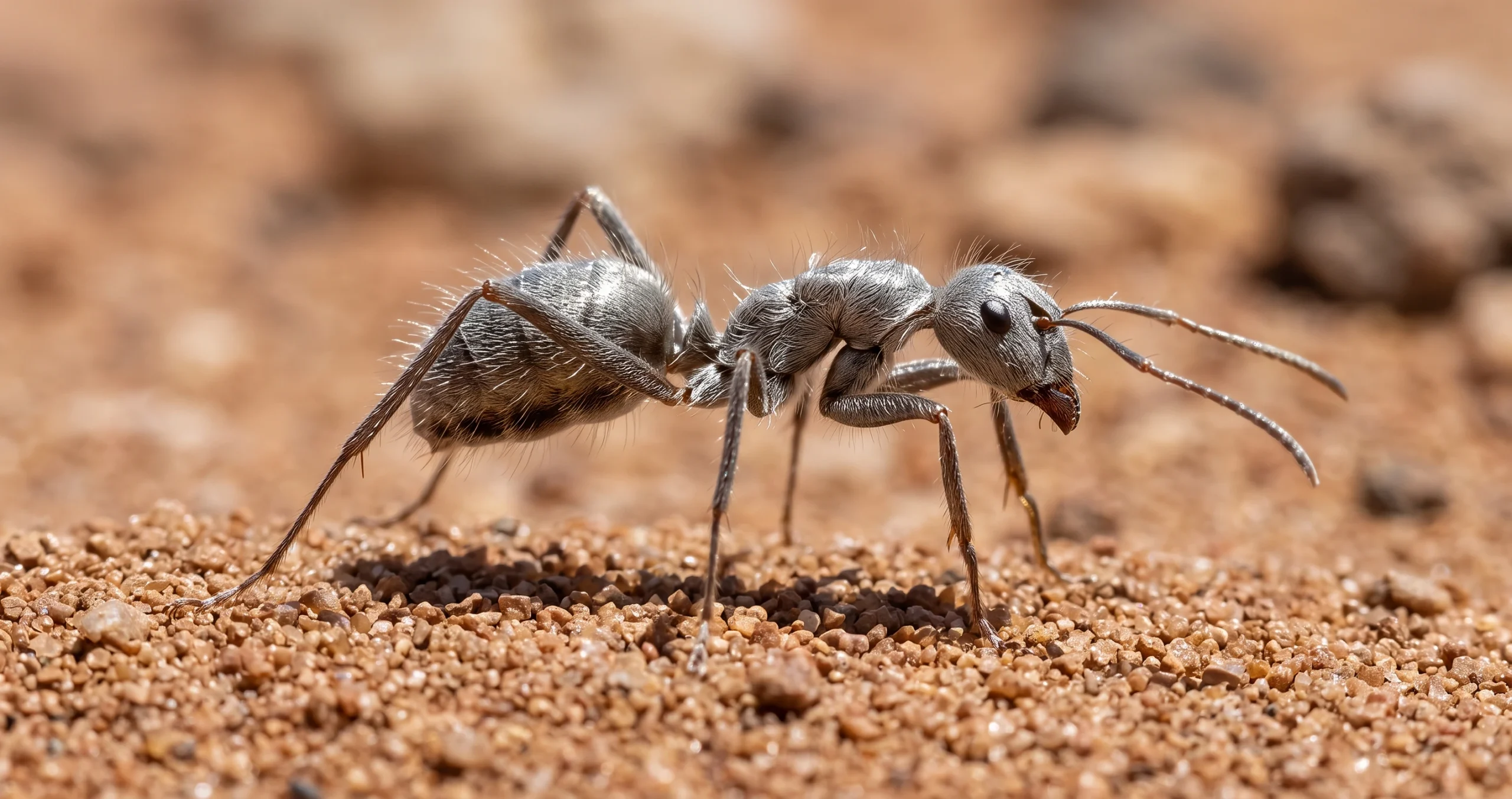
At midday in the Sahara, sunlight beats down on exposed dunes and surface temperatures can climb toward 60–70°C (140–158°F). During this dangerous period, tiny silver ants emerge from underground and race across the sand, searching for arthropods that have died or become incapacitated in the heat before hurrying back to their nest.
The extraordinary Saharan silver ant heat adaptation is not based on one biological trick. In Cataglyphis bombycina, reflective hairs, elevated body posture, extremely rapid locomotion, exceptional physiological heat tolerance, and tightly restricted foraging periods work together. The ants can exploit conditions that exclude many competitors and predators—but only while remaining below their own lethal thermal limits.
Table of Contents
- Meet the Saharan Silver Ant
- Foraging During an Extreme Heat Window
- Why Forage When the Desert Is So Hot?
- The Silver Coat Is Made of Tiny Hairs
- Triangular Hairs With Unusual Optical Properties
- How the Hairs Reflect Solar Radiation
- More Than Visible-Light Reflection
- Long Legs Lift the Body Above the Sand
- Why Height Matters
- Extraordinary Running Speed
- How Fast Can Saharan Silver Ants Run?
- A Race Against Thermal Limits
- Finding Food Quickly
- Finding Their Way Home
- Why They Cannot Stay Outside Indefinitely
- How the Nest Provides Refuge
- Multiple Adaptations Working Together
- What Scientists Learned From Their Reflective Hairs
- Frequently Asked Questions
- Conclusion
Meet the Saharan Silver Ant
The Saharan silver ant, Cataglyphis bombycina, inhabits some of the hottest landscapes of North Africa.
Workers are famous for their metallic appearance. In bright sunlight, the head, thorax, and abdomen can shine like droplets of mercury racing across the desert.
That silver appearance is functional rather than simply decorative.
The ants belong to Cataglyphis, a genus containing desert specialists famous for heat tolerance, rapid movement, and sophisticated navigation.
Unlike ants that spend long periods following shaded trails, C. bombycina workers venture onto exposed desert surfaces where environmental conditions can approach their physiological limits.
Their objective is largely scavenging.
The extreme heat that threatens the ants also produces much of the food they seek.
Foraging During an Extreme Heat Window
Saharan silver ants operate within a narrow thermal opportunity.
Older field studies described workers becoming active when surface conditions were already extremely hot. At peak activity, desert ground temperatures can approach 60–70°C.
That does not mean the ants themselves reach 70°C.
Surface temperature, air temperature, and body temperature are different measurements. An ant running above the sand exchanges heat with sunlight, air, ground, and the surrounding environment, so its body temperature does not simply equal the temperature measured at the sand surface.
The distinction is critical because C. bombycina has a measured critical thermal maximum of approximately 53.6 ± 0.8°C body temperature.
Beyond that physiological boundary, normal function cannot be maintained.
The ants therefore forage extraordinarily close to danger without becoming immune to it.
Image 1 placement — 1200 × 630 px, photorealistic, no text or graphic overlays
Alt text: Saharan silver ant heat adaptation while running across hot desert sand
Why Forage When the Desert Is So Hot?
Midday seems like the worst possible time for a small insect to leave shelter.
For silver ants, however, extreme heat creates an ecological opportunity.
One advantage involves predators.
Research on Cataglyphis indicates that an important lizard predator retreats when surface conditions become too hot for it. The ants can then exploit a brief period in which predator pressure is reduced.
Heat also creates food.
Other arthropods caught on exposed sand can become incapacitated or die under extreme thermal conditions. Silver ants rapidly search for these remains and carry them back to the colony.
Their dangerous midday activity is therefore not pointless endurance.
It allows them to exploit a temporary food supply while some predators and competitors are unable to remain active.
The Silver Coat Is Made of Tiny Hairs
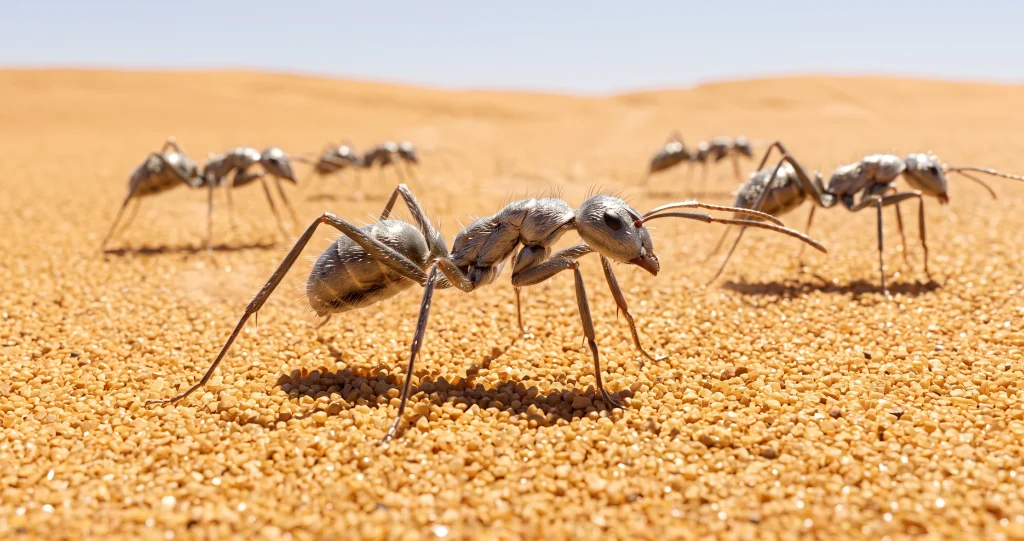
The metallic shine comes from a dense covering of microscopic hairs.
These hairs occur particularly across the upper and lateral surfaces of the ant’s body.
They do not contain metallic material.
Instead, their shape and arrangement alter the way incoming electromagnetic radiation interacts with the ant.
Researchers comparing normal ants with specimens from which hairs had been removed demonstrated that the hair layer substantially changes both optical reflection and heating.
Image 2 placement — 1200 × 630 px, photorealistic, no text or graphic overlays
Alt text: Reflective hairs covering a Saharan silver ant in intense desert sunlight
Triangular Hairs With Unusual Optical Properties
Under an electron microscope, the hairs reveal an unusual geometry.
Rather than being circular cylinders, individual hairs possess approximately triangular cross-sections.
Two sides of the triangle are corrugated, while another surface is comparatively flat.
That microscopic geometry gives the hair layer unusual optical properties.
Research using electron microscopy, spectroscopy, optical modeling, and thermal experiments has shown that the structures interact differently with different wavelengths of electromagnetic radiation.
Their triangular form is therefore central to both the silver appearance and the thermoregulatory effect.
How the Hairs Reflect Solar Radiation
Sunlight contains more than the wavelengths humans perceive as visible light.
A substantial amount of solar energy reaching an ant also occurs in the near-infrared portion of the spectrum.
The hairs increase reflectivity in both visible and near-infrared wavelengths—regions containing much of the incoming solar energy.
That means less of this radiation is absorbed by the ant’s body.
Experiments and optical modeling found that the hairs can increase light reflection dramatically. Later work reported an almost tenfold increase in reflection attributable to the hair layer under the experimental conditions.
Total internal reflection within the triangular hairs contributes to this effect.
Light entering the structures can encounter internal surfaces at angles that cause it to be reflected back outward rather than transmitted toward the ant’s body.
The result is the brilliant silver sheen visible to human observers—and a reduction in solar heat gain.
More Than Visible-Light Reflection
Calling the hairs “tiny mirrors that reflect heat” is incomplete.
The 2015 Science study found two complementary thermal effects.
First, the hairs increase reflection in the visible and near-infrared wavelengths where incoming solar radiation is strong.
Second, they enhance the ant’s emissivity in the mid-infrared.
Any warm object emits thermal radiation. At the temperatures relevant to a silver ant, much of this outgoing thermal radiation occurs at longer mid-infrared wavelengths.
The hair layer helps the ant radiate thermal energy to its surroundings in this spectral region.
So the coat does not simply reflect “all heat.”
Its effectiveness depends on wavelength: it reduces absorption of important incoming solar wavelengths while also facilitating radiative heat loss in the mid-infrared.
The original peer-reviewed study, “Keeping cool: Enhanced optical reflection and radiative heat dissipation in Saharan silver ants”, provides the experimental evidence for these complementary optical effects.
Long Legs Lift the Body Above the Sand
The ants’ body shape provides another advantage.
Their relatively long legs elevate the main body above the desert surface.
That seemingly small difference in height can matter greatly.
Sand exposed to intense sunlight absorbs energy and heats the air immediately above it.
By carrying its body several millimeters above the substrate, a desert ant can reduce its exposure to the most extreme near-surface conditions.
The legs themselves still contact the hot sand, but the thorax and abdomen—the bulk of the animal—are held higher.
Why Height Matters
Desert temperatures are not uniform from the sand upward.
On intensely heated surfaces, steep vertical temperature gradients can develop within the first few millimeters and centimeters above the ground.
The hottest conditions occur closest to the substrate.
Temperatures decline with increasing height as the influence of the heated surface diminishes.
For an animal as small as an ant, a few millimeters therefore represent a meaningful change in microclimate.
Long-legged desert ants effectively exploit this microscopic vertical landscape.
Body elevation alone would not make 60–70°C sand safe, but combined with rapid locomotion and other adaptations, it helps reduce thermal loading.
Extraordinary Running Speed
Silver ants do not stroll across the dunes.
They race.
Rapid movement is especially valuable because every second spent outside increases the opportunity for body temperature to approach dangerous levels.
High speed allows workers to cover more ground during their narrow foraging window.
It also helps them return quickly after locating food.
Researchers investigating their locomotion discovered that the ants achieve remarkable speeds through extremely rapid leg movements and distinctive gait dynamics.
At their highest speeds, periods occur when all six feet are simultaneously off the ground.
How Fast Can Saharan Silver Ants Run?
Laboratory and field measurements have documented maximum speeds approaching one meter per second.
A detailed 2019 study measured a top speed of 855 millimeters per second, or about 0.855 meters per second.
Relative to body size, the figure is even more striking.
The researchers calculated a maximum of approximately 108 body lengths per second.
That places C. bombycina among the fastest-running animals known when speed is scaled to body length.
Its legs can cycle at extraordinary frequencies, with stride frequencies approaching about 47 strides per second at maximum speed.
Speed here is not simply an athletic curiosity.
It is part of the ant’s thermal survival strategy.
A Race Against Thermal Limits
Saharan silver ants are exceptionally heat tolerant, but exceptionally tolerant does not mean invulnerable.
Experiments found a critical thermal maximum of approximately 53.6 ± 0.8°C body temperature for C. bombycina.
Workers can forage with body temperatures exceeding 50°C.
That leaves very little safety margin.
Their proteins and cells must continue functioning at temperatures that would disable many other insects.
Research on Cataglyphis has also identified unusual heat-shock responses. Heat-shock proteins help protect cellular components from damage associated with thermal stress.
But physiological defenses have limits.
If heat enters the ant faster than it can be avoided or dissipated, its body temperature eventually crosses a threshold from which normal locomotion and survival cannot be maintained.
The strategy is therefore about managing heat, not ignoring it.
Finding Food Quickly
Silver ants are primarily scavengers during these extreme foraging excursions.
They search for dead or incapacitated arthropods scattered across the sand.
A small insect exposed to lethal surface conditions can rapidly become a food resource.
The silver ant’s higher thermal tolerance effectively gives it temporary access to a desert landscape from which less tolerant arthropods have been eliminated.
Finding a carcass quickly is critical.
The worker must locate food, collect what it can transport, and return underground before accumulating too much heat.
A successful foraging trip is therefore a tightly timed operation.
Finding Their Way Home
Speed is useful only if an ant knows which direction to run.
Desert ants in the genus Cataglyphis have become classic models for animal navigation.
In barren landscapes, long-lasting pheromone trails can be unreliable or impractical. Instead, these ants possess sophisticated navigational mechanisms.
A major mechanism is path integration.
As an ant travels, it continuously updates information about the direction and distance of its movements. This allows it to maintain an internal estimate of the direct route back toward the nest.
Sun-based compass information and polarized light patterns in the sky are important directional references in extensively studied Cataglyphis species.
Desert ants can also use visual landmarks and other environmental information where available.
Research specifically comparing C. bombycina with the closely related C. fortis has confirmed highly developed path integration and nest-search behavior in the silver ant.
For a worker operating close to its thermal maximum, navigation accuracy has immediate survival value.
Wandering unnecessarily across the sand costs precious time.
Why They Cannot Stay Outside Indefinitely
The entire strategy depends on limiting exposure.
Reflective hairs reduce solar heating, but they do not create perfect insulation.
Long legs reduce exposure to the hottest near-ground air, but the ant remains surrounded by an extreme thermal environment.
Heat tolerance extends the usable temperature range, but only to a physiological ceiling.
And running quickly does not prevent heat gain—it reduces the amount of time during which dangerous heat can accumulate.
This is why silver-ant foraging is concentrated into extremely brief bouts.
The ants exploit the interval between conditions becoming too hot for some predators and becoming too hot for the ants themselves.
Researchers have described this as a narrow thermal window, with classic field work placing activity within an exceptionally hot range bounded above by the ants’ own thermal tolerance.
How the Nest Provides Refuge
The nest offers a radically different microenvironment from the exposed surface.
Soil buffers temperature fluctuations.
Solar radiation heats the uppermost sand intensely, but that energy does not penetrate instantly or equally to greater depths.
Underground chambers therefore provide thermal refuge from the surface extremes.
Workers can retreat into the nest after their short foraging excursions.
This contrast between hostile surface and protected underground environment is fundamental to their lifestyle.
The colony does not endure maximum midday surface temperatures continuously.
Instead, workers make brief incursions into them.
Multiple Adaptations Working Together
It is tempting to explain the silver ant with one spectacular adaptation—usually its reflective coat.
That misses the biology.
The hairs reduce incoming solar energy and enhance radiative cooling. Long legs elevate the body away from the hottest surface layer. Exceptional physiological tolerance allows cellular function at very high body temperatures.
Rapid running reduces exposure duration.
Accurate navigation helps workers return without wasting time.
Behavior restricts activity to an ecological window in which food is available and some predators are excluded, yet conditions have not completely exceeded the ants’ physiological capacity.
The ant succeeds because these traits operate together.
Remove enough components from that system and the extreme midday niche becomes much harder to exploit.
What Scientists Learned From Their Reflective Hairs
The hair coat has attracted interest beyond entomology.
Its structure provides an example of passive thermal management at microscopic scale.
Unlike conventional cooling systems, the ant does not need an external power source to make the hairs reflect incoming solar radiation.
Their physical geometry provides the optical effect.
That has inspired research into biomimetic materials.
Scientists and engineers have investigated artificial structures inspired by silver-ant hairs for passive radiative cooling, thermal-management surfaces, coatings, and related technologies.
One experimental design mimicking the ant’s hair-like photonic structures increased solar reflection and improved mid-infrared emission, reducing daytime temperature in a proof-of-concept system.
Biomimetics does not mean simply copying an ant hair at larger scale.
Researchers instead identify physical principles that evolved in the biological structure and explore whether similar principles can solve engineering problems.
For another remarkable example of an insect exploiting physics to survive a difficult environment, see our article on weaver ant nest building.
Frequently Asked Questions
How hot is the sand when Saharan silver ants forage?
Studies and field observations report desert surface temperatures reaching approximately 60–70°C (140–158°F) during extreme midday conditions. This is sand-surface temperature, not the ant’s body temperature.
How hot can a Saharan silver ant become?
Experimental research measured a critical thermal maximum of approximately 53.6 ± 0.8°C body temperature in C. bombycina. Workers can operate with body temperatures above 50°C, but exceeding their thermal limits can be lethal.
Do the silver hairs reflect all heat?
No. The hairs strongly increase reflection in visible and near-infrared wavelengths, reducing absorption of incoming solar energy. They also enhance mid-infrared emissivity, helping the ant radiate thermal energy.
How fast can Saharan silver ants run?
A 2019 study recorded a maximum of 855 mm/s, equivalent to approximately 108 body lengths per second. Earlier observations had reported speeds approaching 1 m/s.
Why do the ants forage at midday?
Extreme midday heat creates access to arthropods killed or incapacitated by thermal stress and can reduce activity by important predators. The ants exploit this opportunity only within their own narrow thermal limits.
Do long legs keep their bodies cooler?
They contribute to thermal management by elevating much of the body away from the extremely hot sand and the hottest layer of air immediately above it. They are only one part of a larger suite of adaptations.
Are Saharan silver ants immune to extreme heat?
No. Their heat tolerance is exceptional but finite. If body temperature exceeds physiological limits, normal function fails and the ant can die.
Conclusion
At Saharan midday, the environment briefly becomes both opportunity and threat.
Extreme surface heat can incapacitate other arthropods and drive some predators into shelter. For a few minutes, that creates a food-rich landscape with reduced competition and predation.
But the silver ants must survive the same conditions.
Their solution is not a single evolutionary invention.
Microscopic triangular hairs reflect substantial visible and near-infrared solar radiation while enhancing thermal emission at longer mid-infrared wavelengths. Long legs elevate the body above the most extreme near-surface microclimate.
Their physiology allows them to function at body temperatures exceeding 50°C, although their measured critical thermal maximum of roughly 53.6°C leaves little room for error.
Their remarkable speed—up to 855 millimeters per second, or around 108 body lengths every second—helps keep each dangerous excursion short. Sophisticated navigation then allows workers to return efficiently to the cooler refuge of the nest.
Together, these traits explain the extraordinary Saharan silver ant heat adaptation.
The ants do not conquer desert heat or become immune to it. They exploit a narrow thermal window by balancing remarkably close to their physiological limits.
For a tiny insect racing across sand hot enough to disable many other animals, survival depends on reflecting some incoming energy, shedding heat where possible, keeping the body away from the hottest surface layer—and getting home before time runs out.