
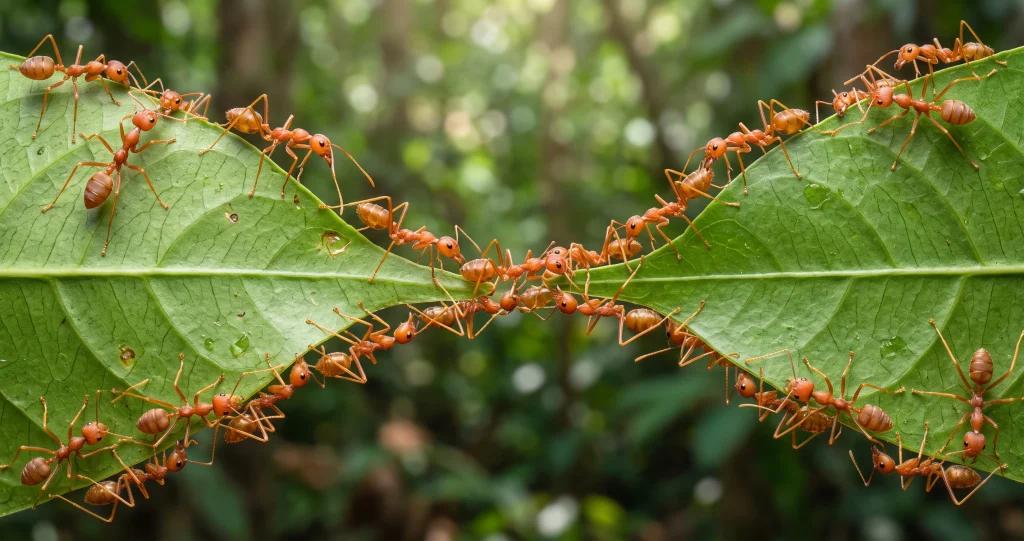
High in a tropical tree, several worker ants grip the edges of separate living leaves with their mandibles and pull. When the gap is too wide for a single worker, more ants join, sometimes forming chains of bodies that extend their collective reach. Once the vegetation has been drawn into position, other workers arrive carrying something unexpected: ant larvae.
This is weaver ant nest building, one of the most remarkable examples of collective construction among insects. Adult Oecophylla workers coordinate the work, manipulate the leaves, and carry the larvae along the surfaces being joined—but the silk that binds the nest together is produced by the larvae, not the adult workers.
The result is a living structure made from leaves that remain attached to the tree.
Table of Contents
- Meet the Weaver Ants
- A Nest Made From Living Leaves
- Finding Suitable Leaves
- Workers Pull the Leaves Together
- Living Chains of Ants
- The Most Unusual Construction Tool: Their Own Larvae
- Why Adult Workers Need the Larvae
- Workers Carry the Larvae Like Silk Dispensers
- How the Silk Is Applied
- From Individual Threads to a Strong Seam
- Why Do the Larvae Produce Silk?
- A Remarkable Division of Labor
- Collective Intelligence Without a Blueprint
- What Happens Inside a Weaver Ant Nest
- One Colony Can Occupy Many Nests
- Aggressive Defense of Their Territory
- Weaver Ants and Tropical Ecosystems
- Humans Have Used Weaver Ants for Biological Control
- Two Living Weaver Ant Species
- Frequently Asked Questions
- Conclusion
Meet the Weaver Ants
The genus Oecophylla contains two recognized living species: the Asian weaver ant Oecophylla smaragdina and the African weaver ant Oecophylla longinoda.
O. smaragdina occurs from South and Southeast Asia through parts of Australasia, including northern Australia and islands of the western Pacific. O. longinoda occurs across tropical Africa.
Both are strongly arboreal ants.
Their colonies occupy vegetation above the ground, where workers forage, defend territories, tend brood, and construct the leaf nests for which the genus is famous.
Weaver ants are also conspicuous predators. Workers capture numerous arthropods moving through the vegetation and can dominate substantial portions of the tree canopy.
Their most extraordinary behavior, however, appears when a colony needs another nest.
A Nest Made From Living Leaves
Weaver ants do not normally construct their characteristic nests by gathering piles of detached leaves.
Instead, they manipulate living leaves that remain connected to a plant.
Workers bend and draw neighboring leaves together until their edges overlap or approach closely enough to be fastened.
This strategy gives the ants a ready-made structural material.
The leaf itself becomes much of the nest wall, while silk creates seams that hold neighboring surfaces together.
A completed nest may consist of several folded or connected leaves forming an enclosed chamber.
Because the leaves remain alive and attached to branches, a weaver-ant colony effectively modifies existing vegetation rather than constructing its entire nest from transported building material.
Finding Suitable Leaves
Construction begins with workers exploring the surrounding vegetation.
Not every leaf presents the same opportunity. Its position, size, stiffness, orientation, and distance from neighboring leaves can affect whether workers can manipulate it into a usable structure.
Experiments with O. smaragdina show that the selection of pulling positions is not completely random.
When presented with artificial leaves, individual workers were more likely to grasp certain accessible features, such as tips, than broad edges.
Once one ant begins pulling, its activity can influence others.
Additional workers are more likely to join an existing pulling individual or group, producing positive feedback that concentrates effort where construction has already started.
Workers Pull the Leaves Together
An individual worker can begin by gripping a leaf edge with its mandibles.
It then braces itself and pulls.
One ant alone may bend a small or flexible section, but a large leaf or substantial gap demands more force.
Nestmates gather at the work site.
Several ants can grasp the same edge and pull simultaneously, increasing the total force exerted on the vegetation.
Experimental research has shown that Oecophylla construction emerges from this combination of individual actions and recruitment.
Workers do not need to measure the complete future nest before beginning. They respond to local geometry and the behavior of nearby nestmates.
Image 1 placement — 1200 × 630 px, photorealistic, no text or graphic overlays
Alt text: Weaver ant nest building as workers pull living leaves together
Living Chains of Ants
Sometimes the next leaf is beyond the reach of a worker standing at the edge.
Weaver ants solve this problem through self-assembly.
A worker can grasp another ant while additional individuals attach in sequence, creating a chain that extends across the gap.
The ants effectively use their own bodies to increase the colony’s reach.
These chains are not merely dramatic-looking formations. They allow groups to transmit forces over distances that a single ant could not bridge.
Research on O. smaragdina has shown that pulling groups form through local interactions. Ants preferentially join existing workers and chains, causing useful pulling formations to grow.
Recent biomechanical research has revealed another impressive feature: larger pulling teams can achieve extremely efficient force production through coordination between active pullers and workers resisting the opposing force.
Once leaf edges have been brought sufficiently close together, the next stage can begin.
The Most Unusual Construction Tool: Their Own Larvae
Adult weaver ants now recruit a completely different member of the colony.
A worker picks up a mature larva.
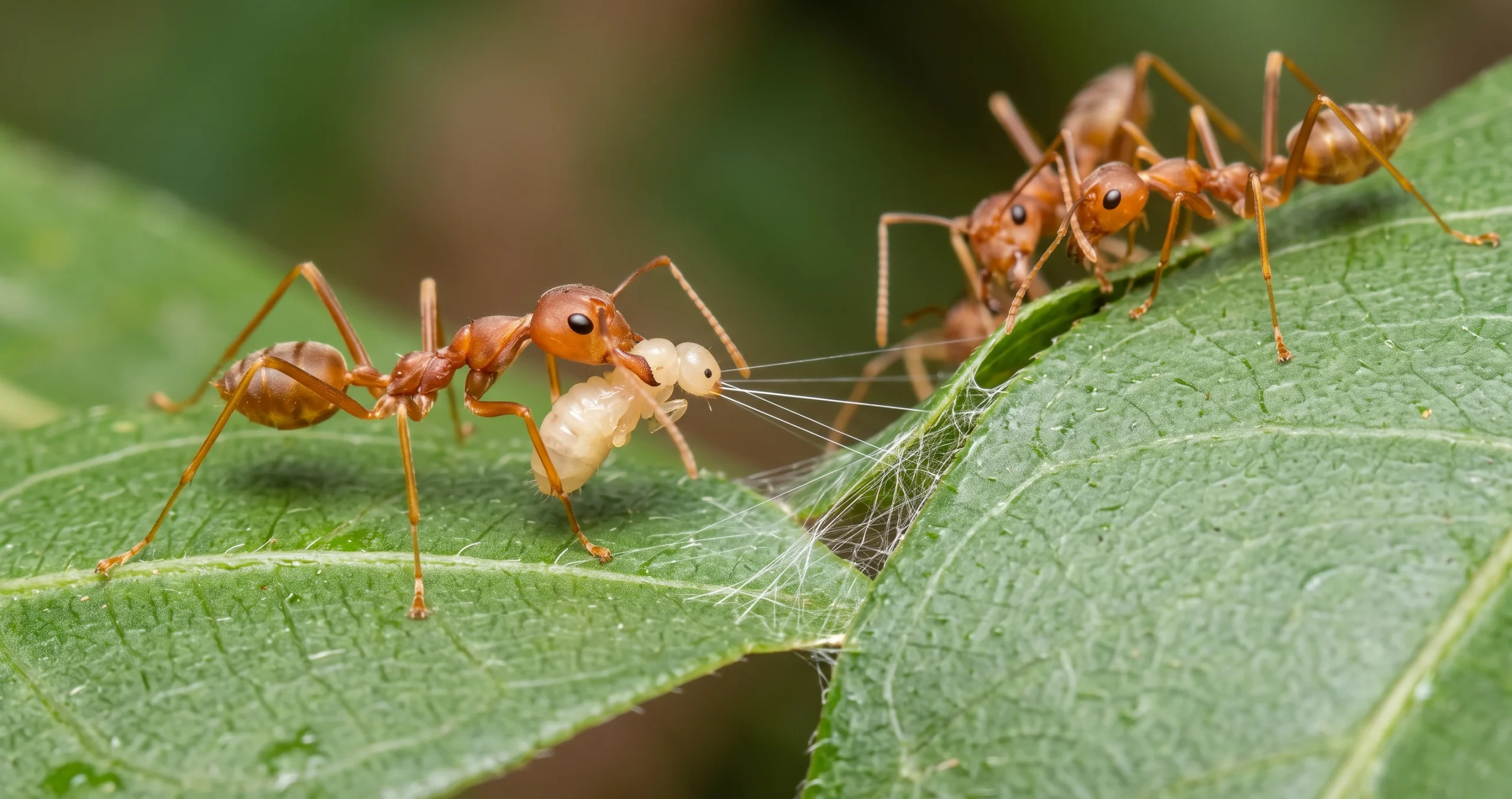
Instead of carrying it to safety or feeding it, the worker brings the larva to the construction seam and holds it between its mandibles.
The larva possesses functional silk glands.
Workers exploit that ability by manipulating the larva over the surfaces that need to be connected.
The often-used description “living silk dispenser” captures the appearance of the behavior, but the biological reality is more precise: an adult worker controls the larva’s position while silk produced by the larva is deposited onto the nest material.
The larva is not a needle, and it does not pierce the leaf.
Why Adult Workers Need the Larvae
Adult Oecophylla workers do not produce the silk used for weaving their leaf nests.
The appropriate silk-producing organs occur in larvae.
This creates an extraordinary division of labor between life stages.
Adults possess strong legs and mandibles suited to exploring, gripping, pulling, carrying, and defending. Larvae are comparatively immobile, but their silk glands provide a material the colony can use for construction.
Mature larvae are particularly important.
Classic research on O. longinoda showed that final-instar larvae contribute silk to nest construction. Researchers also found sex-related differences in silk production, with female larvae possessing larger silk glands and contributing substantially more construction silk than male larvae.
Workers Carry the Larvae Like Silk Dispensers
Once workers have brought leaf surfaces together, silk-bearing larvae are carried to the seam.
A worker holds a larva carefully in its mandibles and positions its head near the leaf.
The worker then moves the larva between surfaces.
Repeated movements cause silk to be laid across the junction.
From a human perspective, the action can resemble using a tube of adhesive or a shuttle carrying thread. Neither comparison should be taken literally.
The larva is a living colony member producing silk biologically, while the adult worker controls where that silk is applied.
Image 2 placement — 1200 × 630 px, photorealistic, no text or graphic overlays
Alt text: Weaver ant worker using a larva to bind leaves with silk
How the Silk Is Applied
Workers manipulate larvae back and forth along the surfaces being joined.
As the larva contacts one location and then another, silk is drawn out and deposited between them.
Repeated passes add additional fibers.
The process creates visible white silk patches and seams along the nest.
Importantly, workers are not pushing the larva through the leaf as though it were a sewing needle.
The vegetation is bound by silk deposited across and between the surfaces.
This difference makes the familiar phrase “ants sewing leaves together” a useful shorthand but not a literal anatomical description.
From Individual Threads to a Strong Seam
A single strand would provide limited structural support.
Weaver ants compensate by applying silk repeatedly.
Numerous strands accumulate into dense silken connections between the leaves. Together, they hold the manipulated vegetation in its new position.
Construction can occur at multiple points around the developing chamber.
The result is a nest whose outer walls are largely living plant tissue but whose critical connections have been reinforced with larval silk.
If the nest becomes damaged, workers can also participate in repairs.
The strength of the architecture therefore comes from combining materials with very different properties: flexible leaves provide large structural surfaces, while silk secures the necessary junctions.
Why Do the Larvae Produce Silk?
Silk production is widespread among holometabolous insects, whose life cycle includes larval, pupal, and adult stages.
In many ants, mature larvae use silk when forming cocoons around themselves before pupation.
Oecophylla represents an unusual evolutionary modification of this capacity.
Classic work on weaver ants showed that mature larvae contribute their silk to the colony’s nest rather than using it to construct individual cocoons in the conventional manner.
A biological product associated ancestrally with individual development has therefore become incorporated into collective architecture.
This does not require larvae to understand the architecture of the nest.
The sophisticated outcome results from interactions between larval silk production and highly organized worker behavior.
A Remarkable Division of Labor
Nest construction is not one behavior performed by one kind of participant.
Some workers explore and initiate pulling.
Others join pulling groups. Workers can form chains, maintain tension, transport larvae, and manipulate those larvae along the seams.
Larvae supply the silk.
Different worker sizes may also contribute differently to activities throughout the colony, including territorial defense, brood care, and foraging.
This division of labor allows the colony to perform tasks far beyond the physical capacity of an individual ant.
The nest is therefore a colony-level product.
Collective Intelligence Without a Blueprint
A completed weaver-ant nest looks organized enough to suggest that somebody must have planned it.
There is no evidence that an individual worker possesses a mental blueprint of the final structure.
Instead, experiments support a decentralized process.
Workers respond to local information: leaf geometry, tension, accessible edges, gaps, existing workers, and changes produced by earlier construction.
Those local responses can generate large-scale organization.
A 2014 experimental study found that workers preferentially joined existing pulling groups, producing positive feedback during construction.
Even more recent three-dimensional research has shown that local ant-scale behavioral rules interacting with the physical geometry of leaves can produce stable closed nest structures.
This is what scientists mean when they discuss self-organization or emergent collective behavior.
Complex architecture can arise from many individuals following comparatively local rules without requiring a central architect.
A peer-reviewed study of this process, “Physical and biological determinants of collective behavioural dynamics in complex systems: pulling chain formation in the nest-weaving ant Oecophylla smaragdina”, provides experimental evidence for how workers select pulling sites and assemble into cooperative chains.
What Happens Inside a Weaver Ant Nest
Once completed, leaf nests provide protected spaces for colony life.
Workers occupy the chambers, and nests can contain developing brood such as eggs, larvae, and pupae.
The queen’s location depends on colony organization and developmental stage. In mature colonies, not every nest contains a queen.
Instead, individual nests form parts of a much larger social system.
Workers move along branches and established routes between different sections of the colony’s territory.
This networked organization is essential for understanding Oecophylla: the conspicuous leaf structure visible in one branch is often only one component of the colony.
One Colony Can Occupy Many Nests
Large Oecophylla colonies are polydomous.
That means a single colony can occupy multiple nests rather than living inside one central structure.
Leaf nests may occur on numerous branches and sometimes extend across several neighboring trees.
Workers maintain connections among them.
This arrangement allows a large colony to occupy an extensive three-dimensional territory in the canopy, with nests positioned near useful foraging areas and across defended vegetation.
Historical observations describe mature colonies containing many separate leaf nests.
The architecture of a weaver-ant colony is therefore better imagined as a distributed network than as a single ant “house.”
Aggressive Defense of Their Territory
Weaver ants are famous for vigorous territorial behavior.
Workers patrol branches and foliage and react quickly to intruders.
Chemical communication helps coordinate these responses.
Research on O. longinoda demonstrated that workers use pheromonal signals to recruit nestmates into new areas and to mobilize additional ants when intruders appear.
Their defense can involve many workers attacking simultaneously.
This behavior helps colonies maintain access to nesting sites and food resources within the canopy.
Aggression also contributes to their ecological and agricultural importance because numerous other arthropods entering occupied vegetation may be attacked.
Weaver Ants and Tropical Ecosystems
Oecophylla are important arboreal predators.
Workers hunt a broad range of arthropods and can exert substantial pressure on insect communities within trees occupied by their colonies.
They also participate in mutualistic relationships.
Like many ants, weaver ants can tend sap-feeding insects that produce honeydew, protecting them while collecting their sugary secretions.
These interactions mean their ecological effects are complex.
Predation may suppress some herbivorous insects, while protection of certain honeydew-producing insects can alter other relationships on the same plant.
Their nests also physically transform the canopy.
Living leaves become enclosed chambers, trails connect multiple nest sites, and defended territories can span large areas.
Humans Have Used Weaver Ants for Biological Control
People recognized the predatory behavior of weaver ants long before modern ecology existed.
Historical records from China describe their use in citrus cultivation, making Oecophylla one of the oldest documented examples of an animal deliberately managed for biological pest control.
Farmers encouraged colonies because workers attacked many insects that damaged fruit trees.
The practice has a long history in parts of Asia, and modern researchers have investigated weaver ants as biological-control agents in crops including citrus, cashew, mango, and others.
African O. longinoda has likewise been studied for pest suppression in tropical agriculture.
Their presence is not automatically beneficial in every farming situation.
Because weaver ants are aggressive generalist predators and interact with numerous other insects, their effects depend on crop, pest community, management practices, and local ecology.
A historical scientific review of Oecophylla biological control documents centuries of human use and subsequent agricultural research.
Two Living Weaver Ant Species
Only two living species are currently recognized in Oecophylla.
Oecophylla smaragdina occurs across southern and southeastern Asia, northern Australia, and parts of the western Pacific.
Oecophylla longinoda is African, occurring widely in tropical regions of the continent.
Both are arboreal, territorial, predatory ants famous for constructing leaf nests with larval silk.
But they should not be treated as ecologically identical.
Geographic environments, prey communities, host vegetation, colony characteristics, morphology, and aspects of behavior can vary between species and among populations.
Even O. smaragdina shows substantial geographic variation.
Australian workers, for example, are widely known as green tree ants because of their distinctive greenish gasters, whereas populations elsewhere can look noticeably different.
The shared leaf-weaving system unites the genus, but local ecology still matters.
For another example of extraordinary arthropod communication and coordinated behavior, see our article on peacock spider courtship.
Frequently Asked Questions
Do weaver ants really sew leaves together?
Not literally in the way a human uses a needle and thread. Workers pull living leaves into position and manipulate silk-producing larvae along the surfaces, depositing silk that binds the vegetation together.
Which ants produce the silk?
The adult workers do not produce the nest-binding silk. Mature larvae possess the silk glands used during construction, while adult workers carry and position them.
Are the larvae harmed when workers use them?
The behavior is a normal part of Oecophylla colony organization. Workers carefully manipulate mature larvae so that their silk can be applied to nest surfaces; the larvae are colony members rather than disposable construction material.
How do ants pull leaves that are too far apart?
Workers can cooperate in pulling groups and form chains by gripping one another. These self-assembled chains extend their reach and help transmit force across larger gaps.
Do weaver ants cut leaves from trees first?
Their characteristic nests are generally constructed from living leaves that remain attached to the plant. Workers bend and pull those leaves together before fastening them with silk.
Does one colony live in only one leaf nest?
No. Mature colonies can be polydomous, occupying numerous interconnected leaf nests distributed among branches and sometimes across multiple trees.
Where do weaver ants live?
O. smaragdina occurs through much of tropical Asia and into northern Australia and parts of the western Pacific. O. longinoda occurs in tropical Africa.
Conclusion
A weaver-ant nest is built from an unusual partnership between different members and life stages of the same colony.
Adult workers explore the canopy and locate usable vegetation. They grip living leaves with their mandibles, recruit nestmates, pull collectively, and sometimes assemble their own bodies into chains capable of bridging gaps.
Then the construction process changes completely.
Workers collect mature larvae and carry them to the leaf margins. By manipulating these silk-producing larvae along the surfaces being joined, the adults deposit repeated strands of silk until the vegetation is securely bound.
Neither participant performs the entire task.
The larvae possess the biological machinery for producing silk but cannot construct the nest independently. Adult workers possess mobility, strength, and coordinated behavior but do not produce the silk used for the seams.
Together they produce architecture that neither could create alone.
Research on weaver ant nest building also demonstrates how elaborate structures can emerge without a central architect or complete blueprint. Individual workers respond to nearby ants, leaf edges, tension, distance, and other local conditions. Their actions reinforce one another until a functional structure emerges at colony scale.
The finished nest remains part plant and part animal construction: living leaves provide the walls, larval silk provides the connections, and hundreds or thousands of coordinated worker actions provide the labor.
High above the tropical forest floor, a colony turns the tree itself into architecture.