
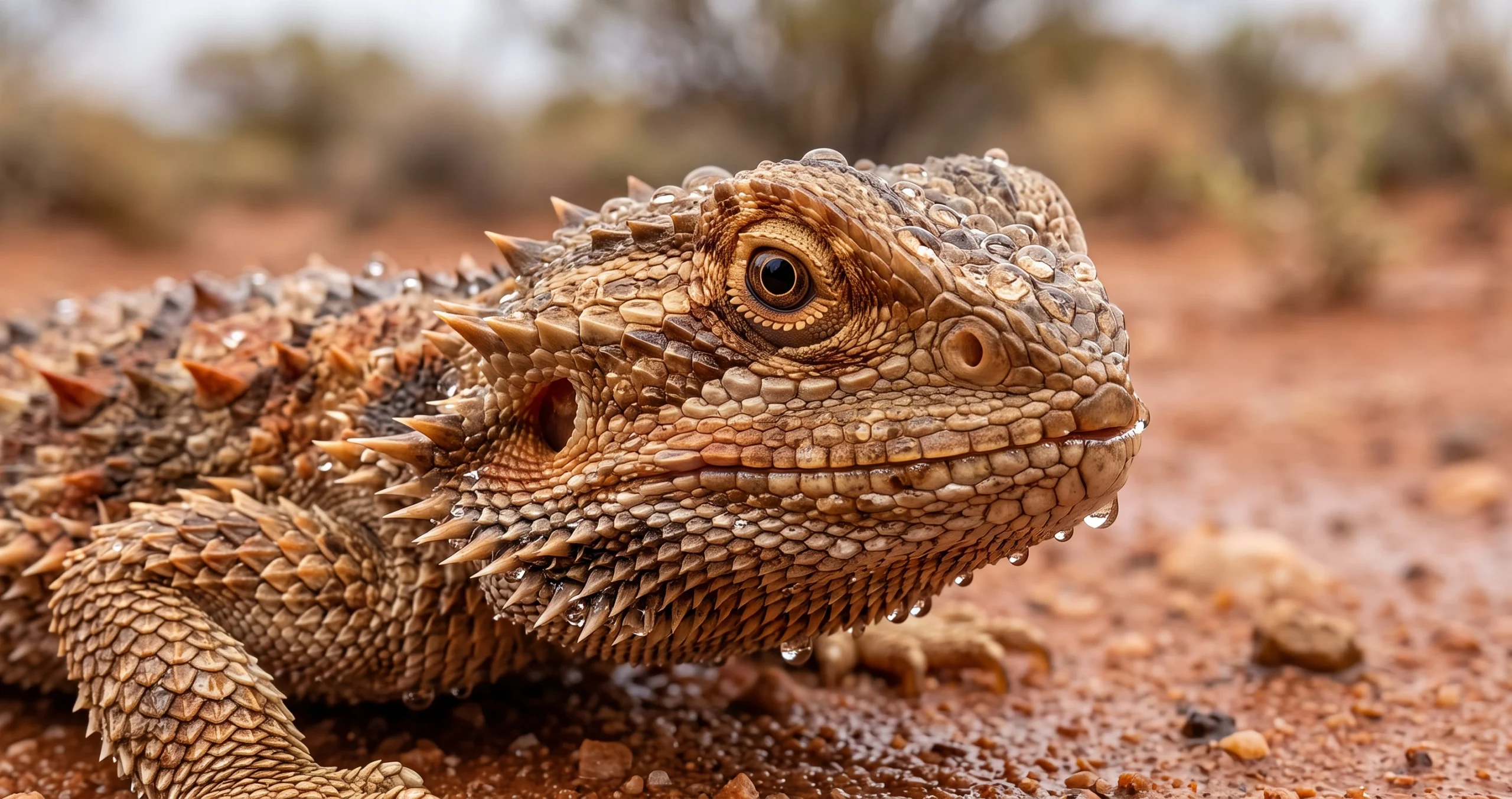
Rain has darkened a patch of red Australian desert sand. A thorny devil moves across the wet surface, and liquid touching its body disappears into microscopic spaces associated with its scales. Within seconds, capillary forces begin spreading that moisture through an interconnected network across the skin.
This remarkable thorny devil water transport system can eventually deliver liquid toward the mouth, where the lizard drinks it. Despite popular descriptions of the animal “drinking through its skin,” the skin is not functioning like a sponge that transfers most of this water directly into the bloodstream. Instead, its surface is an extraordinarily specialized water-collection and transport system.
Table of Contents
- Meet the Thorny Devil
- Finding Water in an Arid Landscape
- A Skin Surface Built to Move Water
- How Capillary Action Works
- From the Body Toward the Mouth
- What Happens When Water Reaches the Mouth
- The Skin Is Not Simply a Sponge
- Rain, Wet Surfaces and Other Moisture Sources
- Can Thorny Devils Really Drink From Damp Sand?
- Why Scale Structure Matters
- No Pump Required
- Similar Adaptations in Other Lizards
- Other Desert Adaptations
- What Scientists Are Still Investigating
- Frequently Asked Questions
- Conclusion
Meet the Thorny Devil
The thorny devil (Moloch horridus) is one of Australia’s most distinctive reptiles. This small agamid lizard inhabits arid and semi-arid landscapes across much of central and western Australia.
Its appearance is unmistakable.
The body is covered with pointed scales and spines, while its mottled colors include combinations of brown, tan, reddish, yellowish, and gray tones. These colors help break up the animal’s outline against sand, soil, dry vegetation, and desert debris.
Despite its formidable appearance, the thorny devil is a small, specialized ant predator rather than an aggressive hunter.
Its diet consists overwhelmingly of ants, particularly small species that can be collected in large numbers along trails. A thorny devil can remain near an active ant trail and rapidly pick off individual workers.
Its specialization extends far beyond feeding.
Living in dry Australian landscapes also means coping with irregular access to liquid water—and this is where the microscopic architecture of its skin becomes particularly important.
Finding Water in an Arid Landscape
For a small terrestrial animal, Australia’s arid interior presents an obvious problem.
Rainfall can be infrequent and unpredictable. Standing water may disappear rapidly, while high temperatures, dry air, and exposed conditions can increase water loss.
A thorny devil therefore benefits from exploiting moisture whenever suitable opportunities appear.
Rain is one obvious source. Water may strike the animal directly or wet the surfaces over which it travels.
Moist soil and sand can provide another possible source under suitable conditions. Researchers have also investigated dew and condensation as potential contributors.
But collecting a few scattered droplets would not be especially useful if the water simply remained wherever it touched the animal.
The thorny devil has a solution: a network of microscopic channels capable of redistributing liquid across its body surface. Experimental studies show that these structures collect water through capillary forces and can ultimately make it available at the mouth for ingestion.
Image 1 placement — 1200 × 630 px, photorealistic, no text or graphic overlays
Alt text: Thorny devil water transport during rainfall in the Australian desert
A Skin Surface Built to Move Water
At ordinary viewing distance, the thorny devil’s skin looks like an armored landscape of scales and spines.
Under magnification, another structure becomes apparent.
Overlapping scales are separated by narrow spaces that form an interconnected network of channels. The scale surfaces themselves also possess microscopic ornamentation that influences how readily water spreads across them.
Research using scanning electron microscopy, micro-computed tomography, high-speed video, and other methods has revealed that the channel system is even more elaborate than a simple groove between neighboring scales.
Large channels contain protrusions that subdivide portions of them into smaller sub-capillaries.
This hierarchical architecture affects how quickly and how far liquid moves.
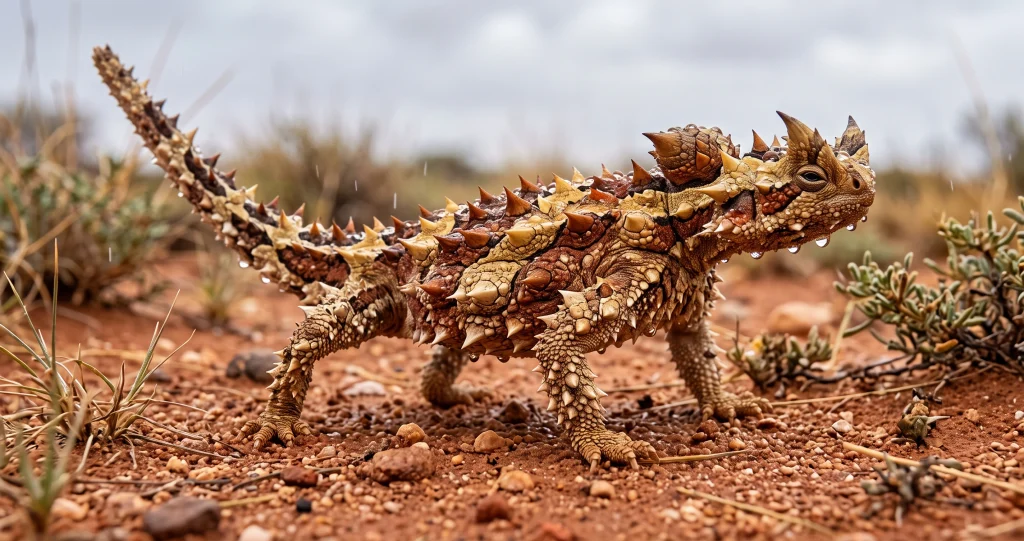
Image 2 placement — 1200 × 630 px, photorealistic, no text or graphic overlays
Alt text: Water droplets collecting between the scales of a thorny devil lizard
How Capillary Action Works
The thorny devil does not need a mechanical pump to draw water into these channels.
Instead, it exploits capillary action.
Water molecules attract one another, producing surface tension. At the same time, interactions between water and a wettable solid surface can draw liquid along that surface.
When a sufficiently narrow channel has appropriate surface properties, these forces can pull water into it.
A familiar example occurs when the edge of a paper towel touches spilled water. Liquid can travel upward and outward through tiny spaces in the material even though gravity alone would not move it that way.
The thorny devil’s system operates on related physical principles, although its biological microstructure is much more organized.
Researchers have described the scale surfaces as highly wettable. Water readily enters the spaces between scales and spreads through the interconnected capillary network.
From the Body Toward the Mouth
Popular illustrations sometimes depict the thorny devil as possessing simple pipelines that carry every drop directly toward its mouth.
Experiments reveal a more interesting picture.
When researchers placed tiny colored water droplets on living thorny devils, the liquid rapidly entered channels and spread radially away from the point of application.
A 7-microliter droplet could spread more than 9.2 millimeters through the network.
Importantly, researchers did not find strong directional transport toward the head in these local droplet experiments. Dorsal and ventral water spread occurred in different directions at broadly similar rates.
That does not mean the system cannot deliver water to the mouth.
The network extends across the animal and connects with the mouth region. When enough of the capillary system contains water, liquid becomes accessible for ingestion.
The distinction is important: local movement through Moloch skin is largely passive and multidirectional rather than every individual channel acting as a one-way microscopic pipe pointed toward the mouth.
What Happens When Water Reaches the Mouth
Transport is only part of the process.
The lizard still has to ingest the water.
Experiments in which thorny devils stood in shallow water demonstrated that their capillary systems could fill and supply water for drinking. Researchers measured approximately 0.7 microliters of water ingested per jaw movement under these experimental conditions.
Repeated movements of the jaws help the animal take in liquid made available around the mouth.
The complete process can therefore be understood as two linked stages.
First, specialized skin structures collect and redistribute liquid by capillary action. Second, once sufficient water reaches the mouth region, the lizard actively ingests it.
The Skin Is Not Simply a Sponge
This distinction corrects one of the most persistent descriptions of the thorny devil.
The lizard does not simply “absorb water through its skin” in the sense of transferring drinking water directly across the skin and into its internal tissues.
Its skin instead functions as a cutaneous water-transport surface.
Water enters channels associated with the scales, travels through that external capillary system, reaches the mouth region, and can then be swallowed.
Even the scientific term “cutaneous water collection” can sound confusing outside its technical context.
Here, cutaneous refers to collection and transport involving the skin surface. It should not be interpreted as evidence that water is being taken directly into the bloodstream across the body surface.
The mouth remains essential.
Rain, Wet Surfaces and Other Moisture Sources
A capillary system is useful only if liquid can enter it.
Rain appears to be one ecologically plausible source. Direct rainfall can wet the body, while rain also creates puddles and moistens the substrate.
Researchers have examined several other possibilities.
Condensation can form on the skin when a relatively cool lizard encounters warmer, humid air. Under experimental conditions, this process did produce water in the capillary system.
But the amount was small.
In one study, condensation filled the system with water equivalent to only about 0.22% of the lizard’s body mass—insufficient to produce drinking under the experimental conditions.
That makes dramatic claims about thorny devils routinely obtaining all the water they need simply by condensing humidity onto their bodies difficult to justify.
Rain and sufficiently moist substrate currently have stronger experimental support as ecologically meaningful sources.
Can Thorny Devils Really Drink From Damp Sand?
This claim requires particular care.
Researchers tested thorny devils standing on nearly saturated wet sand. Water did move from the substrate into their ventral capillary system.
But it did not completely fill the network.
The channels reached approximately 59% of their capacity, and the animals did not drink.
So the popular image of a thorny devil simply standing on any slightly damp patch and effortlessly drinking through its feet is misleading.
However, the story does not end there.
Researchers tested replicas of thorny devil skin and found that moist sand placed onto the surface could supply the capillary network more effectively when gravity assisted the process.
Field observations have also described thorny devils shoveling or rubbing moist sand onto their backs.
The researchers therefore proposed that this behavior could help transfer enough water from moist sand into the capillary network to support drinking.
That is a plausible, experimentally informed interpretation—but it should not be exaggerated into a claim that the animal can extract useful liquid from ordinary dry sand.
The substrate must contain accessible moisture.
Why Scale Structure Matters
The geometry of the skin is central to the system.
Research indicates that the larger channels between scales can rapidly accept water. Smaller subdivisions within those channels help extend transport farther across the body.
In experiments and modeling, these sub-capillary structures increased transport distance by about 39%.
There is an important tradeoff involved.
A large channel can hold plenty of water but requires more liquid to fill. Very narrow channels produce stronger capillary effects and can transport water effectively with less volume.
Combining large and small structures provides advantages of both.
The researchers proposed that this hierarchical design allows rapid uptake while extending the distance water can travel and potentially reducing the volume required before drinking becomes possible.
No Pump Required
There is no miniature muscular pump underneath each scale.
The basic transport mechanism is passive.
Once liquid contacts a suitable part of the surface, interactions among water, the wettable skin, and the geometry of the channels generate capillary movement.
That is energetically useful in a desert.
The lizard does not need to expend muscular energy continuously pulling each droplet across its body.
This does not mean behavior is irrelevant.
The animal still determines where it moves, whether it contacts wet substrate, how it positions itself, and ultimately when it swallows available water.
Physical transport and animal behavior work together.
Similar Adaptations in Other Lizards
The thorny devil is not the only reptile capable of cutaneous water transport.
Researchers have investigated comparable moisture-harvesting structures in the Texas horned lizard (Phrynosoma cornutum) and the Arabian toad-headed agama (Phrynocephalus arabicus).
These lizards also possess microscopic surface features and channels associated with their scales.
But the systems are not identical.
Experiments found that the Texas horned lizard exhibits more directional transport toward the mouth, whereas localized droplets on the thorny devil spread radially rather than showing comparable directional flow.
This comparison is scientifically valuable because it shows how broadly similar environmental problems can be addressed by related physical principles without requiring identical anatomical solutions.
Other Desert Adaptations
Water harvesting is only one element of the thorny devil’s desert lifestyle.
Its coloration provides effective camouflage against sandy and stony backgrounds. The body’s irregular outline, covered with spines, can make the animal difficult to distinguish from surrounding debris.
Its specialized diet is another defining feature.
Thorny devils feed heavily on ants, exploiting a food resource abundant in many Australian arid environments. Historical and modern observations consistently characterize the species as an extreme ant specialist.
Behavior also helps manage environmental extremes.
Like other desert reptiles, thorny devils can alter activity and use microhabitats rather than remaining continuously exposed to the hottest conditions.
Their unusual form therefore reflects several overlapping challenges: avoiding predators, locating food, regulating body temperature, and securing scarce water.
For another example of how unusual physiology helps an animal exploit a demanding environment, see our article on how octopuses use camouflage.
What Scientists Are Still Investigating
The basic physics of thorny devil water transport is well demonstrated.
Researchers have directly visualized droplets entering and moving through channels, measured transport rates and distances, examined channel anatomy, and experimentally tested potential water sources.
Some popular ecological explanations remain less certain.
For example, the ability of the surface to collect condensation does not prove that dew or atmospheric condensation supplies a major fraction of the animal’s daily water requirements in nature.
Likewise, experiments confirm that wet sand can supply water to the capillary system, but simply standing on nearly saturated sand was insufficient to make experimental animals drink.
Laboratory demonstrations tell scientists what is physically possible.
Determining how frequently each mechanism is actually used by free-ranging thorny devils under different weather, soil, and seasonal conditions requires additional ecological observations.
The most accurate description therefore avoids both extremes.
The thorny devil is neither magically extracting water from dry desert air nor equipped with meaningless decorative grooves. Its microstructured skin is a genuine, experimentally demonstrated water-harvesting system whose effectiveness depends on how much liquid is available and how it contacts the animal.
The peer-reviewed study “Cutaneous water collection by a moisture-harvesting lizard, the thorny devil” provides detailed experimental evidence on rain, moist sand, condensation, capillary filling, and drinking behavior.
Frequently Asked Questions
Does a thorny devil drink through its skin?
Not in the usual meaning of that phrase. Its skin surface collects and transports liquid through microscopic capillary channels toward the mouth, where the water is ingested.
How does water move across a thorny devil’s body?
Water enters narrow interconnected channels between overlapping scales. Surface tension, wettability, and capillary forces cause it to spread passively through this network.
Does all water flow directly toward the mouth?
No. Experiments with individual droplets found radial spreading in several directions rather than strongly directional flow toward the head. The interconnected system can nevertheless distribute sufficient water to the mouth region for drinking.
Can a thorny devil drink by standing on wet sand?
Water can enter its ventral channels from sufficiently wet sand, but experiments using nearly saturated sand filled only about 59% of channel capacity and did not result in drinking. Other contact with moist sand, including getting it onto more of the body, may improve collection.
Can thorny devils obtain water from dew?
Dew and condensation have been proposed as possible sources. Experiments confirmed that condensation can enter the capillary network, but the quantity generated under tested conditions was insufficient to trigger drinking.
Does the lizard actively pump water through its scales?
No mechanical pump is needed for the basic surface transport. Capillary forces generated by water interacting with the microscopic channel architecture drive the passive movement.
Are thorny devils the only lizards with this adaptation?
No. Comparable moisture-harvesting systems occur in several arid-land lizards, including the Texas horned lizard and Arabian toad-headed agama, although the details of their water-transport systems differ.
Conclusion
The thorny devil’s famous ability to collect water is even more interesting when described accurately.
Its skin is not simply an absorbent surface carrying water directly into the animal’s tissues. Instead, overlapping scales, microscopic ornamentation, interconnected channels, and smaller sub-capillaries form a sophisticated external transport network.
When liquid contacts this surface, capillary forces pull it into the network and redistribute it across the body. If enough water becomes available around the mouth, the thorny devil can then ingest it through repeated jaw movements.
Rain and sufficiently wet surfaces appear to be especially important potential sources, while experiments reveal important limitations to claims involving damp sand and condensation.
The thorny devil water transport system is therefore an elegant partnership between anatomy, physics, and behavior.
Microscopic structures provide the pathway. The physical properties of water provide much of the transport force. The lizard’s behavior brings its body into contact with available moisture and completes the process by drinking.
For a small reptile living where liquid water can be unpredictable, even scattered moisture becomes a resource worth collecting.
SEO & Metadata
SEO Title: Thorny Devil Water Transport: How Its Skin Channels Water
Meta Description: Discover how microscopic channels between a thorny devil’s scales use capillary forces to transport precious water across its body toward its mouth.
Primary Keyword: thorny devil water transport
Related Keywords: thorny devil drinking water, Moloch horridus, lizard capillary channels, thorny devil skin, desert lizard adaptations, cutaneous water transport
URL Slug: /thorny-devil-water-transport/
Category: Wildlife
Tags: thorny devil, lizards, reptiles, desert wildlife, animal adaptations, Australia