
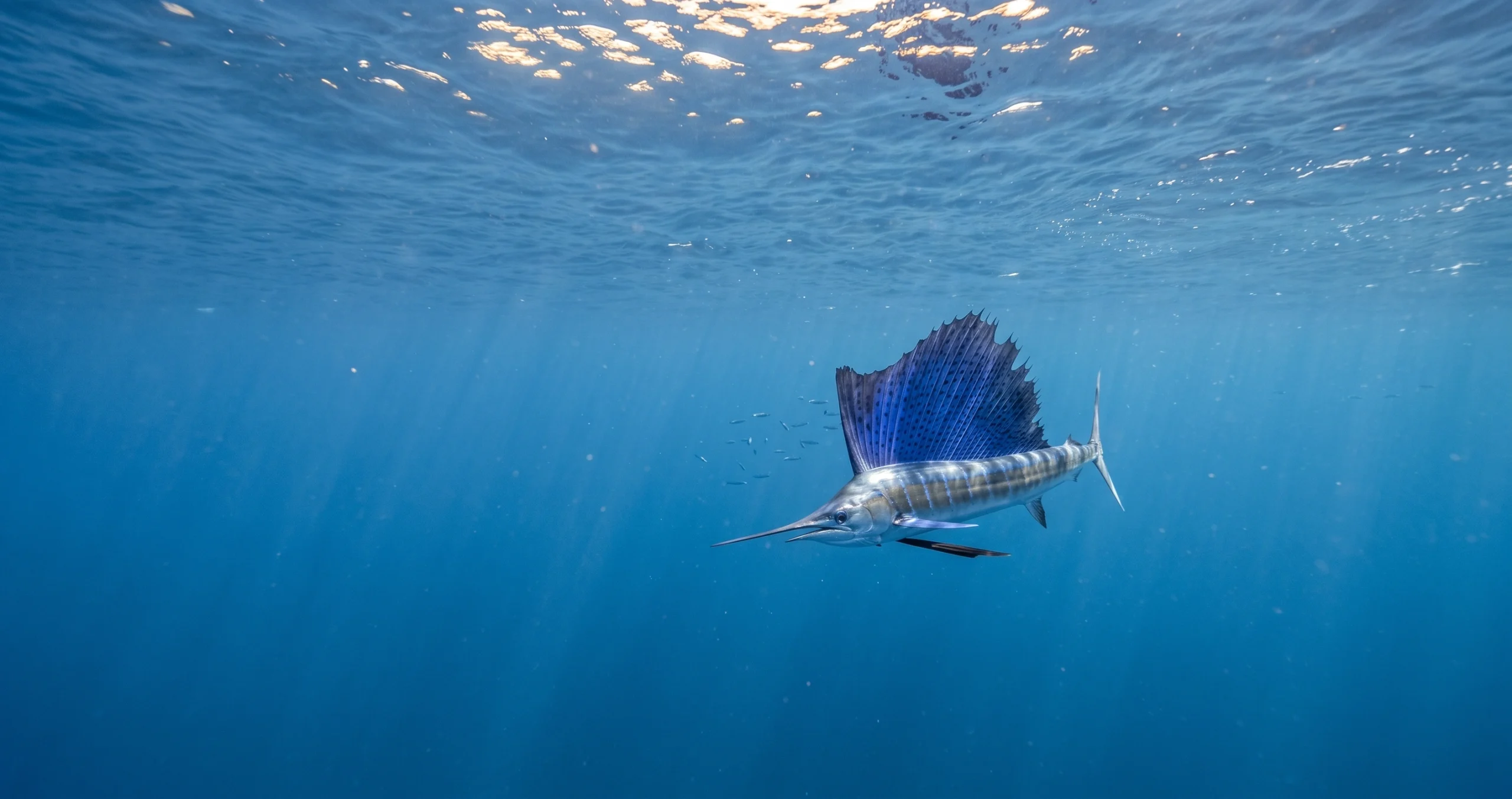
For decades, wildlife books have introduced the sailfish as the fastest swimmer in the sea, often attaching an astonishing figure of about 68 miles per hour to the claim. Modern research has made the story more complicated. The sailfish fastest fish reputation has a reasonable foundation—these billfish are extraordinarily fast predators—but scientists have found that the famous top-speed figures are much harder to verify than popular accounts suggest.
Speed is only part of what makes a sailfish remarkable. Its enormous dorsal “sail” can change its apparent size and maneuvering profile, while its elongated bill becomes a precision hunting weapon. Sailfish working around schools of sardines and other small fish can slash or tap prey with that bill before consuming injured or disoriented individuals.
Understanding the sailfish therefore requires separating measured biology from a few very persistent ocean myths.
Table of Contents
- What Is a Sailfish?
- Why Is the Sailfish Called the Fastest Fish?
- Where the Famous 68 mph Figure Came From
- What Modern Speed Research Shows
- Why Measuring Fish Speed Is So Difficult
- How the Sailfish Body Is Built for Speed
- The Function of the Giant Dorsal Sail
- How Sailfish Hunt Schooling Fish Together
- How the Bill Is Used as a Weapon
- Why Schooling Fish Are Vulnerable
- Do Sailfish Actually Stab Their Prey?
- Other Fast Fish and the Speed Debate
- Common Myths
- FAQ
- Conclusion
What Is a Sailfish?
Sailfish are large, highly mobile predatory fish belonging to the billfish family Istiophoridae.
Modern taxonomic treatments generally recognize the sailfish as Istiophorus platypterus, a species distributed through tropical and subtropical waters of the Atlantic, Indian, and Pacific Oceans.
The animal is immediately recognizable.
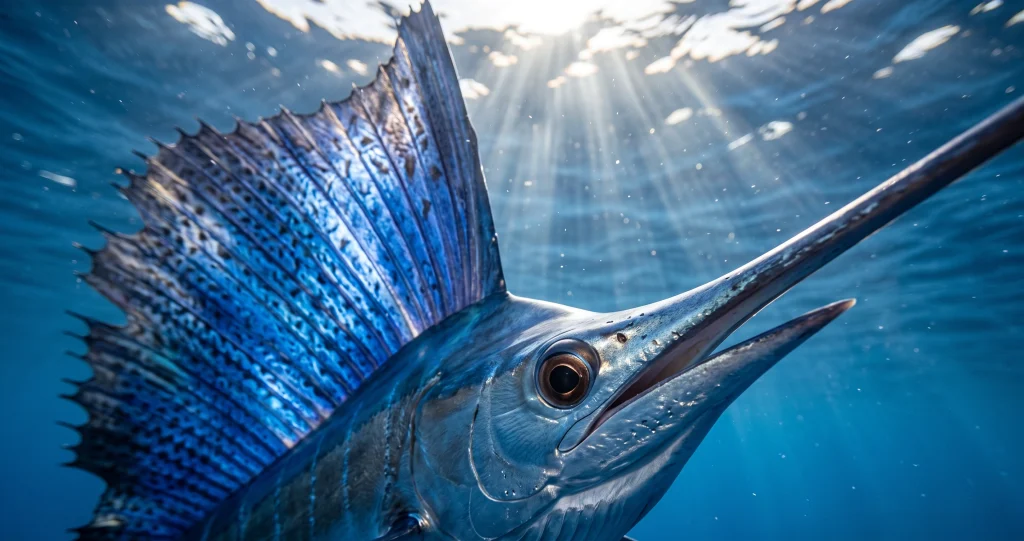
Its upper jaw extends into a long pointed bill, its body is streamlined and muscular, and an enormous first dorsal fin rises from the back like a sail.
That fin can be folded down when not needed.
Sailfish primarily prey on smaller fishes and cephalopods and are capable of rapid acceleration when attacking schooling prey.
The Smithsonian’s Ocean Portal overview of billfish describes billfishes as fast, powerful ocean predators distinguished by their elongated upper jaws.
Why Is the Sailfish Called the Fastest Fish?
The statement appears almost everywhere: sailfish can swim at approximately 68 mph, or 110 km/h.
That would make them extraordinarily fast even compared with other elite marine predators.
The problem is that this number was not established by modern high-resolution tracking of a freely swimming sailfish sustaining that velocity.
Historical estimates of extreme fish speeds were sometimes derived indirectly.
In the case of sailfish, widely repeated high-speed claims have been associated with observations involving hooked fish and the rapid removal of fishing line.
Such observations can demonstrate extraordinary activity, but converting them into precise swimming velocity is problematic.
Boat movement, line angle, drag, fish direction, current, and other variables can affect the calculation.
As a result, the sailfish fastest fish title is better understood as a traditional description of an exceptionally fast animal than as the outcome of a definitive ocean-wide speed competition.
Where Did the Famous 68 mph Figure Come From?
The roughly 68 mph figure has been repeated for generations.
Yet repetition does not transform an uncertain estimate into a precise measurement.
Early estimates of high fish speeds frequently relied on fishing observations, timed movements over uncertain distances, or calculations based on anatomy.
These methods lacked technologies now available to researchers, such as high-speed video, accelerometers, biologging tags, and sophisticated hydrodynamic modeling.
One historical sailfish estimate was associated with a fish stripping line from a reel at a remarkable rate.
But line leaving a reel is not necessarily equivalent to the fish’s speed through water.
A hooked fish is also behaving under highly unusual circumstances.
This does not prove sailfish are slow.
It means the precision implied by “68 mph” is difficult to justify scientifically.
What Modern Speed Research Shows
Modern research has produced much more conservative measurements.
A frequently cited study published in Biology Open used high-resolution accelerometer tags to investigate the swimming performance of sailfish.
Researchers estimated maximum swimming speeds of around 8.3 meters per second during high-acceleration events.
That is approximately 18.5 mph, or 30 km/h.
At first glance, this sounds dramatically slower than the legendary 68 mph.
However, the researchers did not claim that 8.3 meters per second represents the absolute maximum velocity physically possible for every sailfish under every condition.
Biologging studies measure particular animals during particular observation periods.
The important result is that direct modern measurements have not validated the spectacular historical number.
The scientific answer to “How fast can a sailfish swim?” is therefore less satisfying than a simple record.
We do not yet have a universally established maximum.
Why Measuring Fish Speed Is So Difficult
Measuring the speed of a terrestrial animal can be relatively straightforward.
Researchers can establish a known distance, record movement with calibrated cameras, and calculate velocity.
The ocean is different.
A sailfish moves through a three-dimensional environment where currents themselves are moving.
The fish may accelerate vertically, horizontally, or diagonally. The observer may also be moving.
Researchers must distinguish speed through water from speed relative to the seafloor.
Tags add another challenge.
They can record acceleration and other movement information, but converting those signals into exact instantaneous swimming speed requires calibration and assumptions.
Maximum speed may also occur only briefly.
If a tag is not attached during that rare burst, the event is never recorded.
These difficulties explain why the sailfish fastest fish debate remains open.
How the Sailfish Body Is Built for Speed
Whatever its exact maximum velocity, the sailfish is clearly adapted for rapid swimming.
Its body is long, muscular, and streamlined.
A narrow caudal peduncle connects the body to a powerful crescent-shaped tail, which generates thrust.
The large dorsal sail can be folded into a groove along the back.
This matters because a permanently raised fin of that size would create substantial drag during fast forward movement.
Other fins can also be positioned close to the body.
The overall design reduces resistance when acceleration matters.
Sailfish are also regional endotherms.
Specialized tissues help keep certain structures, particularly the brain and eyes, warmer than surrounding water under some conditions.
This may support sensory performance while hunting across varying temperatures.
Speed, however, is not useful without control.
That is where the famous sail becomes particularly interesting.
What Does the Sailfish’s Dorsal Fin Do?
The first dorsal fin is enormous relative to the fish’s body depth.
When fully raised, it produces the sailfish’s characteristic silhouette.
During straightforward rapid swimming, the fin can be folded down to reduce drag.
During feeding interactions, it may be raised.
Researchers studying sailfish hunting sardines have observed changes in fin position associated with prey attacks and maneuvering.
A raised sail increases lateral surface area.
That can potentially help stabilize rapid turns and reduce unwanted rolling as the predator changes direction around a dense school.
The sail may therefore function partly as a maneuvering structure during hunting rather than simply as decoration.
Does the Sail Also Frighten Fish?
Another popular explanation says sailfish raise their fins to make themselves look larger and frighten prey into tighter schools.
It is possible that the visual presence of a large predator influences schooling fish.
But statements that the sail evolved specifically to “scare fish together” go beyond what has been firmly demonstrated.
Sailfish coloration and fin position can change rapidly during hunting.
Researchers have also investigated whether temporary changes in body coloration communicate information among nearby sailfish during group attacks.
The behavior is complex.
It is safer to say that the dorsal sail is associated with maneuvering and behavioral displays during feeding than to assign it one simplistic purpose.
How Sailfish Hunt Schooling Fish Together
Some of the most revealing research on sailfish behavior has come from observations of predators attacking sardine schools.
Rather than every sailfish charging simultaneously into the school, individuals can take turns approaching and attacking.
This creates an unusual form of group hunting.
The predators collectively maintain pressure on the prey school, but individual attacks may be sequential.
For the sardines, remaining tightly grouped reduces an individual’s chance of being singled out.
For the sailfish, however, the dense formation creates an opportunity.
Hundreds of potential targets are packed within reach of a long bill.
The predator does not necessarily need to seize one fish directly with its mouth.
It can attack the school first with its rostrum.
How the Sailfish Bill Is Used as a Weapon
The elongated upper jaw is often imagined as a spear.
High-speed observations reveal something more versatile.
Sailfish can use their bills in at least two broad types of attack: slashing movements and targeted taps.
During a slash, the predator rapidly moves its bill sideways through part of the fish school.
The motion can strike multiple prey.
Some fish may be injured, stunned, or otherwise impaired.
The sailfish can then turn and capture an affected individual.
Targeted attacks can be more precise.
A sailfish may tap or strike a single fish with the tip or side of its bill before consuming it.
This allows the predator to separate the act of disabling prey from swallowing it.
For another remarkable example of a fish using unusual physics to capture prey, read our article about how archerfish shoot water at insects above the surface.
Why Schooling Fish Are Vulnerable to the Bill
Schooling is normally an excellent defense.
A predator facing hundreds of rapidly moving fish has difficulty selecting and tracking one target.
This is sometimes described as a confusion effect.
Sailfish appear capable of exploiting the very density that makes the school protective.
A long bill can pass through a group without requiring the predator’s entire body to enter it.
That matters.
Charging the whole body into a dense, rapidly maneuvering school would make precise targeting difficult.
The narrow rostrum can move through the prey aggregation extremely quickly.
Research published in Proceedings of the Royal Society B found that sailfish slashing attacks can injure multiple sardines and that injured individuals subsequently face greater capture risk.
The bill is therefore not merely ornamental hydrodynamic equipment.
It is an active hunting weapon.
Do Sailfish Actually Stab Their Prey?
Sometimes—but “stabbing” is an incomplete description.
The bill can contact prey in different ways.
Sailfish have been observed using rapid lateral slashes as well as more targeted movements.
A strike does not necessarily impale the fish.
It may knock, injure, or disorient prey.
That distinction matters because illustrations often show billfish spearing fish cleanly through the body.
Real hunting is faster, messier, and more varied.
The objective is not necessarily to skewer prey.
It is to turn an agile healthy fish into an easier target.
Does Group Hunting Mean Sailfish Cooperate?
Sailfish aggregating around a prey school can produce collective benefits without behaving like wolves following a rigid cooperative plan.
Sequential attacks allow multiple predators to exploit the same school.
One fish attacks, withdraws, and another may move in.
Researchers have proposed that group hunting can allow sailfish to benefit from prey injured during earlier attacks, even when the fish that ultimately captures an injured sardine was not necessarily responsible for the original injury.
That makes the hunting system especially interesting from an evolutionary perspective.
Individual predators create effects that can alter later opportunities for the entire aggregation.
Other Fast Fish and the Speed Debate
Sailfish are not the only candidates for the title of fastest fish.
Black marlin, swordfish, wahoo, tuna, and other powerful pelagic species are also capable of remarkable swimming performance.
Unfortunately, their maximum speeds are subject to many of the same measurement problems.
Historical numbers often come from different methods and therefore cannot be compared as though all fish participated in the same controlled experiment.
This is why declaring a definitive champion is scientifically difficult.
The sailfish fastest fish reputation remains culturally and biologically meaningful, but the precise ranking should be presented with a qualification.
Sailfish are unquestionably among the ocean’s elite high-performance swimmers.
Whether one species can be proven to possess the highest instantaneous maximum speed remains unresolved.
Common Myths About Sailfish
Myth 1: Scientists Have Proven Sailfish Swim Exactly 68 mph
They have not.
The famous figure is based on historical estimates rather than modern direct measurement under controlled conditions.
Myth 2: Modern Research Proved Their Maximum Is Only 18 mph
Also incorrect.
Tagged sailfish have produced speed estimates around that level during measured events, but those observations do not establish an absolute physiological maximum for the species.
Myth 3: The Sail Is Always Raised
It is not.
The large dorsal fin can be folded down, especially when reducing drag is advantageous.
Myth 4: Sailfish Use Their Bills Only as Spears
High-speed observations show slashing and tapping behaviors.
Prey can be injured or stunned without being impaled.
Myth 5: The Sail Exists Only to Frighten Prey
The dorsal fin has likely served multiple functions.
Its large lateral area can contribute to maneuvering and stability, and it is conspicuous during behavioral interactions.
Myth 6: Sailfish Hunt Completely Alone
They can hunt individually, but groups are also observed attacking schooling prey.
Sequential attacks around dense schools can create a collective hunting system.
Myth 7: Being the Fastest Is the Sailfish’s Main Hunting Advantage
Raw speed is only part of its toolkit.
Acceleration, maneuverability, sensory ability, group interactions, fin control, and bill strikes all contribute to successful hunting.
FAQ
Is the sailfish really the fastest fish in the ocean?
It is traditionally described as the world’s fastest fish and is unquestionably an exceptionally fast swimmer.
However, the exact maximum speed of sailfish and competing species has not been established with enough standardized direct measurements to declare an unquestionable record holder.
Can a sailfish swim 68 mph?
The 68 mph figure is widely repeated, but it is not supported by modern direct speed measurements of free-swimming sailfish.
It should be treated as a historical estimate rather than a verified maximum.
What is the fastest sailfish speed actually measured?
Biologging research has estimated speeds of around 8.3 meters per second, approximately 18.5 mph, during high-acceleration events.
Researchers caution that recorded values should not automatically be interpreted as the species’ absolute maximum capability.
Why does a sailfish have such a large dorsal fin?
The sail can be folded down during streamlined swimming and raised during other behaviors.
Evidence suggests the increased lateral area may assist stability and maneuverability during prey attacks, while the fin can also have signaling or visual functions.
Do sailfish use their bills to kill fish?
They use their bills to strike prey.
Slashes and targeted taps can injure or stun small schooling fish, making them easier to capture.
Do sailfish spear fish on their bills?
Impaling can occur, but it is misleading to describe spearing as their standard hunting technique.
Many observed attacks involve sideways slashes or rapid taps rather than deliberate skewering.
Do sailfish hunt in groups?
Yes, sailfish can gather around schooling prey and make sequential attacks.
The resulting pressure can create feeding opportunities for multiple predators.
What do sailfish eat?
Their diet consists primarily of fish and cephalopods.
Schooling fishes such as sardines provide particularly useful opportunities for the bill-based hunting techniques researchers have studied.
Are sailfish faster than sharks?
Sailfish are capable of extremely rapid swimming and are generally considered faster than most sharks.
Precise comparisons are difficult because reliable maximum-speed measurements are unavailable for many large marine species.
Conclusion
The sailfish fastest fish title survives because there is genuine biological truth behind the legend—but not necessarily the precision implied by the famous numbers.
Sailfish are extraordinary swimmers.
Their streamlined bodies, powerful tails, retractable fins, and rapid acceleration clearly place them among the highest-performance predators in the ocean.
What science has challenged is the familiar claim that their maximum speed has been definitively measured at 68 mph.
Modern biologging has recorded considerably lower values, while researchers acknowledge that those observations may not represent the species’ true physiological maximum.
For now, the responsible conclusion is more nuanced.
Sailfish are among the fastest fish known, but science has not established a universally verified top speed that allows every contender to be ranked precisely.
More importantly, focusing entirely on speed overlooks their remarkable hunting system.
The enormous dorsal sail can disappear into a streamlined profile when folded, then rise during maneuvering and feeding interactions.
The elongated bill becomes a weapon capable of slashing through dense prey schools or striking individual fish.
Some victims are injured or stunned before being swallowed.
When several sailfish gather around schooling prey, sequential attacks create another advantage.
The predators repeatedly pressure the same aggregation, exploiting both the defensive behavior of schooling fish and injuries produced during earlier strikes.
A sailfish therefore does not survive simply by being fast.
It combines speed with precision.
Its body accelerates.
Its fins control.
Its bill attacks.
And its behavior allows it to exploit one of the ocean’s most effective prey defenses—the school itself.
That makes the real sailfish more interesting than a single disputed number ever could.
Related Reading
Continue exploring remarkable hunting adaptations and behaviors in the animal world:
- How Archerfish Shoot Water at Insects Above the Surface — A closer look at the remarkable precision archerfish use to knock insects from vegetation above the water.
- How Pistol Shrimp Produce One of the Loudest Sounds in the Ocean — Discover how a tiny crustacean uses cavitation as an extraordinary underwater hunting mechanism.
References and Further Reading
The scientific information in this article can be explored further through these authoritative resources:
- Smithsonian Ocean Portal — Billfish — Background information on billfish anatomy, ecology, and predatory adaptations.
- Biology Open — Maximum Swimming Speed of Sailfish and Other Large Marine Predators — Peer-reviewed research examining measured swimming speeds and the reliability of traditional maximum-speed estimates.
- Proceedings of the Royal Society B — Sailfish Bill Use During Hunting — Peer-reviewed research examining how sailfish use their bills when attacking schooling prey.