
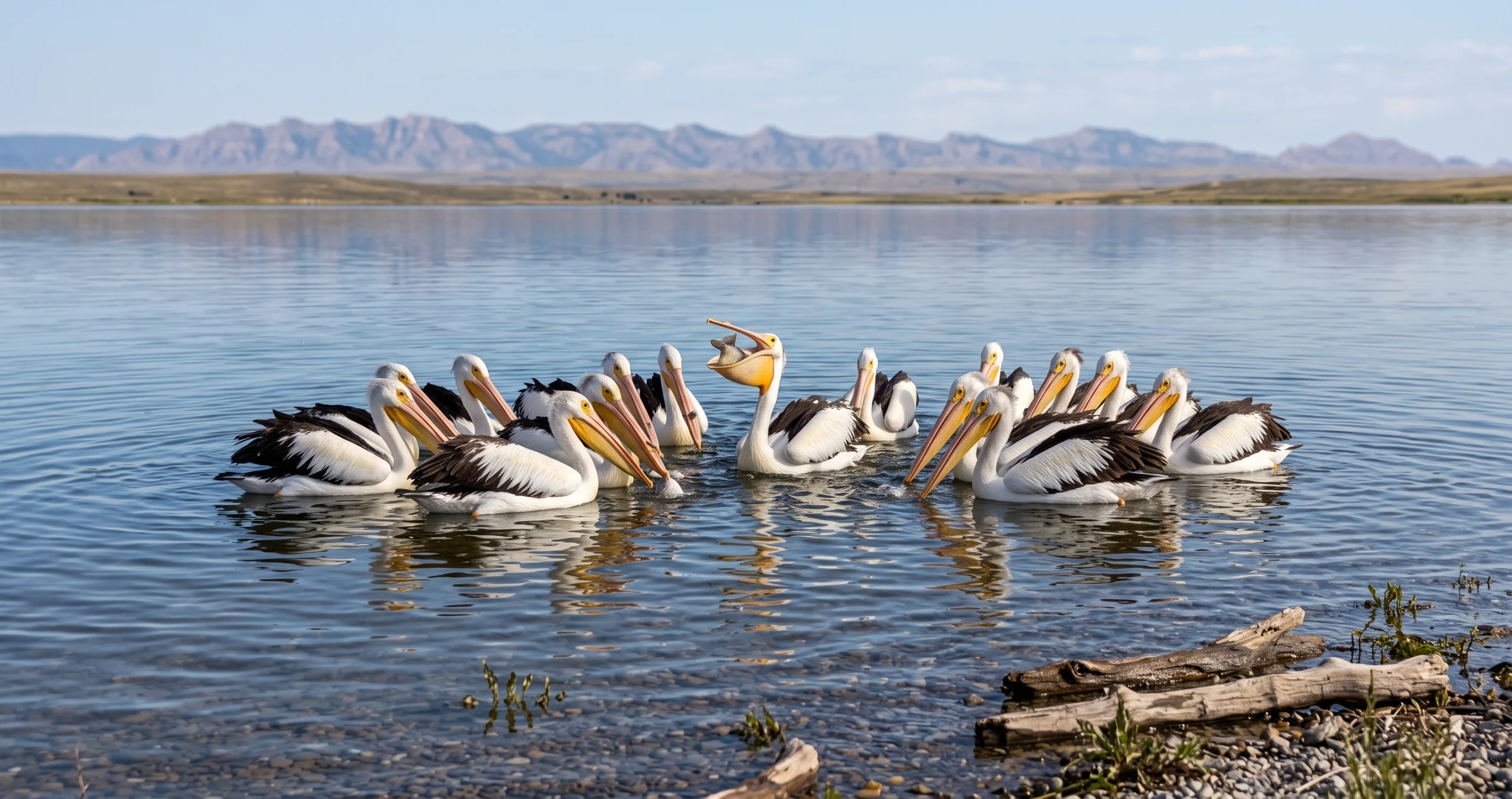
A flock of great white pelicans moving across a shallow lake can suddenly become something more organized than a gathering of hungry birds. Individuals align in a line, arc, or semicircle and advance through the water, concentrating fish ahead of them before dipping their enormous bills. This remarkable example of pelican cooperative fishing allows multiple birds to transform an open patch of water into a narrowing feeding zone.
Great white pelicans (Pelecanus onocrotalus) do not always hunt this way. They can feed alone, and group size and formation vary with local conditions. But where schooling fish can be pushed into shallow or confined water, collective feeding gives these highly social birds an effective way to make prey easier to capture.
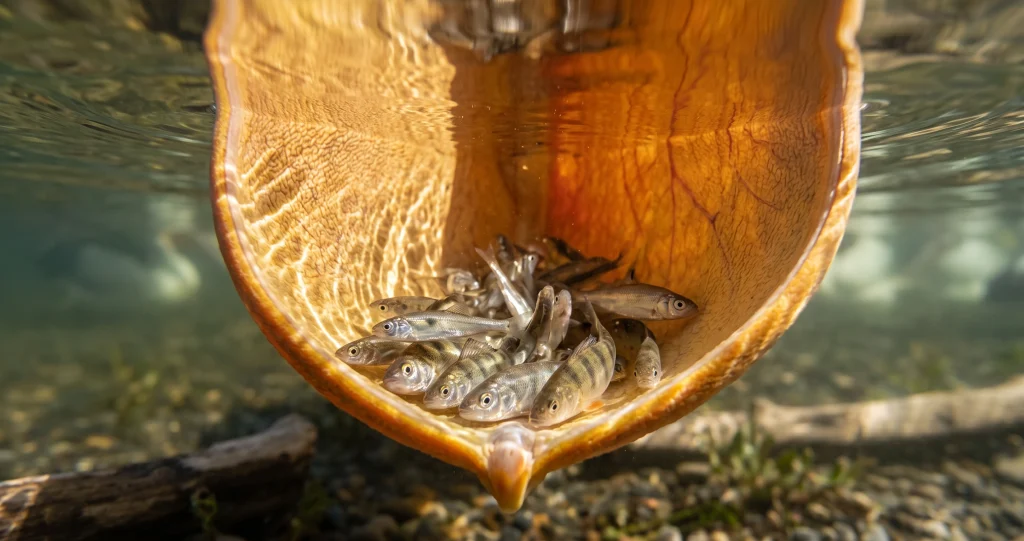
Their famous throat pouch then completes the job—not as a storage bag, but as an expandable fishing net.
Table of Contents
- What Is a Great White Pelican?
- How Pelican Cooperative Fishing Works
- What Triggers Group Coordination?
- How Pelicans Herd Fish
- Why Shallow Water Makes the Strategy Effective
- How the Pelican’s Pouch Actually Works
- How Much Can the Pouch Hold?
- Do Pelicans Store Fish in Their Pouches?
- Cooperative Fishing vs. Solitary Feeding
- Why Pelicans Do Not Need to Dive Deep
- Great White Pelicans as Social Birds
- Their Enormous Breeding Colonies
- Why Colonies Need Reliable Feeding Areas
- Common Myths
- FAQ
- Conclusion
What Is a Great White Pelican?
The great white pelican is one of the world’s largest waterbirds. It occurs across parts of Africa, southeastern Europe, and Asia, using lakes, marshes, lagoons, deltas, estuaries, reservoirs, and other productive wetlands.
Adults are predominantly white, with black flight feathers that become especially obvious when the enormous wings are extended.
The bill is even more distinctive.
Beneath the long upper bill hangs a flexible yellowish gular pouch. This structure has become so strongly associated with pelicans that it is sometimes incorrectly imagined as a permanent grocery bag full of fish.
Its actual purpose is more dynamic.
The pouch is a temporary scoop that works particularly well during pelican cooperative fishing.
According to the BirdLife International seabird handbook, great white pelicans have been documented fishing communally, while natural-history references describe groups advancing in organized formations to capture fish.
How Pelican Cooperative Fishing Works
The basic strategy is surprisingly easy to understand.
A single pelican attempting to capture fish in open water faces a problem: fish can escape in several directions.
A group changes the geometry.
Great white pelicans can form a line, arc, semicircle, or horseshoe-like formation. The birds swim forward together, reducing the open space available to the fish ahead of them.
As the formation advances, prey becomes increasingly concentrated.
The pelicans may use their bodies, bills, feet, and sometimes wing movements to disturb the water and push fish toward a shoreline, shallow area, or the center of the group.
Once prey is within reach, multiple birds dip their bills.
Each pelican is still capturing food for itself.
But the collective movement makes the prey less difficult for everyone to catch.
What Triggers Pelican Cooperative Fishing?
It would be misleading to imagine a leader giving instructions to the rest of the flock.
Pelican coordination is more likely to emerge from birds responding to the same prey concentration and to the movements of neighboring pelicans.
When fish are abundant and concentrated in accessible shallow water, several birds can begin feeding in the same area.
As neighboring individuals align and move, their combined movements herd prey.
A fish attempting to escape one pelican may encounter another.
This creates a feedback process in which coordinated movement can become more effective than scattered attempts at capture.
The exact formation is not fixed.
Local water depth, shoreline shape, prey distribution, number of birds, and fish behavior can all influence what the group does.
That flexibility is important.
Pelican cooperative fishing is coordinated behavior, but it does not require every feeding event to follow an identical script.
How Pelicans Herd Fish
Imagine a school of fish in a shallow lake.
If one pelican approaches, the fish can scatter around it.
Now place several large pelicans in an arc.
As the birds move forward, the available escape routes become narrower.
Fish that turn away from one bill may move toward another bird. Continued pressure can push the school toward water where swimming depth and escape options are reduced.
This is particularly effective when the formation can use the shoreline as an additional barrier.
The pelicans have effectively created a moving wall.
Natural history accounts describe great white pelicans advancing in semicircles and dipping their bills as a group.
The strategy does not guarantee that every bird catches the same amount.
Instead, it changes prey distribution in a way that can improve feeding opportunities for the group.
Why Shallow Water Makes the Strategy Effective
Great white pelicans are surface-feeding specialists rather than deep-diving pursuit predators.
That makes water depth important.
In deep water, fish have more vertical space in which to escape.
In shallow water, the pelicans can reach much of the available feeding zone with their bills and pouches.
Fish crowded toward shore have even fewer options.
This helps explain why communal feeding is frequently associated with shallow lakes, lagoons, wetlands, and similar habitats.
The birds do not need to swim beneath their prey.
They bring the prey into the part of the water column where their anatomy works best.
How the Pelican’s Pouch Actually Works
The great white pelican’s lower bill supports a remarkably expandable gular pouch.
When the bird pushes its bill into the water, the pouch can expand dramatically.
Water and fish enter together.
The bird then raises its head and allows excess water to drain from the pouch before positioning and swallowing the captured fish.
This means the pouch functions more like a flexible fishing net than a bucket.
BirdLife International specifically notes that pelican pouches scoop fish and that the prey is swallowed after excess water drains rather than being stored there.
This distinction matters because the popular image of pelicans carrying large supplies of fish around in their pouches is inaccurate.
The pouch is a capture device.
How Much Water Can a Great White Pelican Pouch Hold?
The numbers are impressive.
Zoo references for Pelecanus onocrotalus report a maximum pouch capacity of approximately 13 liters—more than three U.S. gallons.
Some zoological references also state that the expanded pouch can accommodate several kilograms of fish under exceptional circumstances.
Those figures describe capacity, not the amount of fish a pelican routinely carries.
During a normal feeding attempt, much of the material entering the pouch is water.
That water is drained before the fish is swallowed.
A pelican therefore does not routinely swim around with 13 liters of water hanging beneath its bill.
The enormous capacity gives the pouch enough expansion to function as a very effective scoop.
During pelican cooperative fishing, that wide capture area becomes particularly useful because multiple birds may be dipping into a concentrated school simultaneously.
The Pouch Has More Than One Function
Although feeding is its most famous role, the gular pouch can serve additional purposes.
Pelicans can use movements of the pouch and throat area in thermoregulation.
The thin, vascularized tissues provide a surface from which heat can be exchanged.
The pouch also changes appearance during breeding condition and can contribute to visual signaling.
So, like many exaggerated animal structures, it should not be understood as serving only one purpose.
Its fishing function, however, remains extraordinary.
Few birds possess a feeding structure that can change volume so dramatically within seconds.
Do Pelicans Store Fish in Their Pouches?
No—not as a normal long-term storage strategy.
This is one of the most persistent pelican myths.
After capturing fish, a pelican drains the water and swallows its prey.
The pouch is not a lunch box used to transport a day’s catch.
This also explains why seeing a hugely expanded pouch does not necessarily mean the bird has captured an enormous quantity of fish.
Much of that volume may simply be water.
The distinction becomes obvious when watching a feeding pelican carefully.
Scoop, drain, swallow.
The pouch repeatedly changes shape during the process.
Cooperative Fishing vs. Solitary Feeding
Great white pelicans do not require a group every time they eat.
They can forage alone.
A solitary bird can move through shallow water, locate accessible fish, dip its bill, and capture prey without assistance.
The Food and Agriculture Organization has described great white and Dalmatian pelicans as displaying a range of feeding behaviors from cooperative to solitary.
Whether group feeding is advantageous depends heavily on conditions.
A dense school of fish in shallow water creates an excellent opportunity for collective herding.
A scattered prey item that one bird can capture easily provides less reason for coordinated movement.
Food distribution therefore helps shape social behavior.
A pelican does not cooperate simply because it belongs to a social species.
It uses the feeding strategy appropriate to the opportunity.
Why Great White Pelicans Don’t Plunge-Dive Like Brown Pelicans
Pelican species do not all fish in the same way.
Brown pelicans are famous for spectacular plunge-dives from the air.
Great white pelicans usually take a different approach.
They primarily capture prey from the surface by dipping or sweeping their bills through accessible water.
This is one reason pelican cooperative fishing suits them so well.
Instead of pursuing fish vertically from above, several birds can manipulate the horizontal movement of a school.
The strategy demonstrates how closely feeding behavior is connected to habitat and anatomy.
Even closely related animals can solve the same problem—catching fish—in dramatically different ways.
Great White Pelicans Are Highly Social Birds
Group fishing is not an isolated social behavior.
Great white pelicans regularly gather in flocks, travel together, roost communally, and breed colonially.
Their large size makes these gatherings spectacular.
Groups can also travel considerable distances between breeding or roosting locations and productive feeding areas.
In flight, pelicans make extensive use of rising air currents.
By soaring on thermals, they can reduce the energetic cost of moving their enormous bodies across long distances.
BirdLife notes that pelicans may travel more than 100 kilometers to productive feeding grounds.
This mobility allows a breeding colony to exploit wetlands far beyond the immediate nesting site.
Their Enormous Breeding Colonies
Great white pelicans are colonial breeders.
Rather than each pair defending a large isolated nesting territory, many pairs gather at suitable sites.
Colonies are typically located where nesting birds receive some protection from terrestrial predators, such as islands, inaccessible shorelines, wetlands, or protected platforms.
The scale can be remarkable.
Historical scientific work at Ethiopia’s Lake Shala described breeding concentrations involving thousands of pairs. Researchers found that even these enormous colonies could contain smaller nesting units in which hundreds of pairs laid eggs during similar periods.
More recent studies continue to describe the species as a colonial ground-nesting bird.
In southern Africa, BirdLife South Africa notes that great white pelicans can form breeding colonies ranging from hundreds to many thousands of pairs.
These concentrations create both advantages and vulnerabilities.
Why Colonies Need Reliable Feeding Areas
A large pelican colony represents an enormous demand for fish.
Adults need food for themselves and, during breeding, for growing chicks.
Classic research at Lake Shala demonstrated how closely successful breeding depends on reliable fish resources.
A nesting island may be perfectly protected from predators, but that alone is not enough.
The surrounding landscape must contain productive feeding waters within practical traveling distance.
This creates an important ecological connection between colonies and wetlands that may be many kilometers apart.
Protecting only the nesting site can therefore miss part of the species’ requirements.
Pelicans need functioning feeding habitats as well.
Disturbance, wetland degradation, changes in fish populations, entanglement, and collisions with infrastructure can all affect particular populations.
For another example of a bird with highly specialized feeding behavior, read our article about how bee-eaters remove the stings from dangerous insect prey.
Group Living Does Not Mean Perfect Cooperation
The word “cooperative” can make animal behavior sound more generous than it really is.
During pelican cooperative fishing, each bird ultimately benefits by catching food for itself.
Individuals can compete within the group.
A fish captured by one bird is not necessarily shared equally among the others.
The cooperation lies in the herding process.
By participating in a coordinated formation, each pelican helps create a feeding situation that can make fish easier to catch.
Evolution can favor this kind of behavior when the individual benefit of participating exceeds the cost.
No human-style agreement is required.
Common Myths About Great White Pelicans
Myth 1: Pelicans Keep Fish Stored in Their Pouches
They generally do not.
The pouch captures fish and water. Water is drained and the prey is swallowed.
Myth 2: The Pouch Is a Stomach
It is not.
The gular pouch is an expandable structure attached to the lower bill. Digestion occurs after prey has been swallowed into the digestive tract.
Myth 3: Pelicans Always Fish in Groups
Great white pelicans can feed both cooperatively and alone.
Group fishing becomes especially effective where fish can be concentrated in shallow water.
Myth 4: One Pelican Commands the Fishing Formation
There is no evidence that every group requires a permanent leader directing the others.
Coordination can emerge as individuals respond to prey and neighboring birds.
Myth 5: Cooperative Fishing Means Pelicans Share Their Catch
The birds cooperate in concentrating prey, but individuals generally capture and swallow their own fish.
Myth 6: Great White Pelicans Dive From the Sky for Fish
That behavior is more strongly associated with species such as the brown pelican.
Great white pelicans normally feed from the surface.
Myth 7: A Huge Pouch Means a Pelican Can Carry Huge Quantities of Fish Around
Capacity should not be confused with normal load.
The pouch may expand to around 13 liters, but much of its volume during capture is water that is quickly expelled.
FAQ
How does pelican cooperative fishing work?
Great white pelicans form lines, arcs, or semicircles and advance through shallow water.
Their combined movement concentrates fish into a smaller area, where the birds scoop prey with their bills and expandable throat pouches.
Why do pelicans fish together?
Group feeding can reduce the escape routes available to schooling fish.
It is particularly useful when prey can be herded toward shore or into shallow water.
What triggers coordinated fishing?
There is probably no single trigger for every event.
Concentrated prey, suitable shallow water, the presence of other feeding pelicans, and the movements of neighboring birds can all encourage a coordinated formation.
How much can a great white pelican’s pouch hold?
Zoological sources commonly give a maximum capacity of around 13 liters.
This refers largely to the volume available for water and captured prey during scooping, not a normal long-term fish load.
Do pelicans swallow the water they scoop up?
They drain most of it.
After lifting the bill, the bird contracts or positions the pouch so water escapes before the fish is swallowed.
Can great white pelicans fish alone?
Yes.
They use both solitary and cooperative feeding strategies depending on prey and environmental conditions.
Do great white pelicans dive underwater?
They are primarily surface feeders rather than deep pursuit divers.
They typically reach fish by dipping their heads and bills into relatively shallow water.
Are great white pelicans social?
Very much so.
They commonly feed, travel, roost, and breed in groups and can establish extremely large nesting colonies.
Where do great white pelicans live?
They occur across large parts of Africa and portions of southeastern Europe and Asia.
Important habitats include shallow lakes, deltas, lagoons, marshes, estuaries, reservoirs, and other productive wetlands.
Conclusion
Pelican cooperative fishing transforms a familiar bird into part of a remarkably effective collective hunting system.
One great white pelican can catch fish alone.
Several working in the same formation can change the behavior of an entire school.
By advancing in a line, arc, or semicircle, the birds reduce escape routes and push fish toward shallow or confined water.
Their enormous bills then take over.
The expandable gular pouch opens beneath the lower jaw like a temporary net, capturing both fish and water. Once the bill rises, excess water drains and the prey is swallowed.
With a reported maximum volume of around 13 liters, the pouch is an impressive structure—but it is not the food-storage bag of popular imagination.
Its purpose is capture.
Great white pelicans also show that cooperation in nature does not have to mean deliberate sharing.
Each bird wants its own meal. Yet by participating in the group, individuals help create conditions that improve the opportunity for successful feeding.
The same social tendencies appear elsewhere in their lives.
Great white pelicans travel in flocks, gather at communal roosts, and breed in colonies that can contain thousands of pairs.
Those colonies depend on far more than safe nesting ground.
They require productive wetlands capable of supplying enormous quantities of fish, sometimes forcing adults to travel long distances between nest and feeding site.
A coordinated line of pelicans moving across a lake is therefore more than an impressive wildlife spectacle.
It is the visible result of anatomy, prey behavior, wetland ecology, and social behavior working together.
The fish try to scatter.
The pelicans make scattering harder.
And for a surface-feeding bird equipped with one of the largest natural fishing nets in the animal world, that can be all the advantage it needs.
Related Reading
Explore other remarkable bird feeding strategies, breeding behaviors, and adaptations:
- How Bee-Eaters Remove the Stings From Dangerous Insect Prey — Discover how bee-eaters handle bees and other stinging insects before swallowing them, reducing the risk posed by their prey.
- The Unusual Courtship Behavior of Blue-Footed Boobies — Explore the distinctive displays blue-footed boobies use during courtship and how their famous blue feet play a role in mate selection.
References and Further Reading
For additional scientific information about great white pelicans, cooperative feeding, colonial breeding, ecology, and conservation:
Journal of Avian Biology / PMC — Breeding Biology of Great White Pelican at Lake Tana, Ethiopia — Peer-reviewed research examining colonial nesting, breeding seasons, nest density, and the reproductive ecology of Pelecanus onocrotalus.
BirdLife International — West Africa Seabird Handbook — Authoritative conservation handbook covering seabird ecology and documenting communal fishing behavior in great white pelicans.
BirdLife South Africa — Great White Pelican — Species assessment covering the great white pelican’s habitats, feeding ecology, breeding colonies, population status, and conservation pressures.