
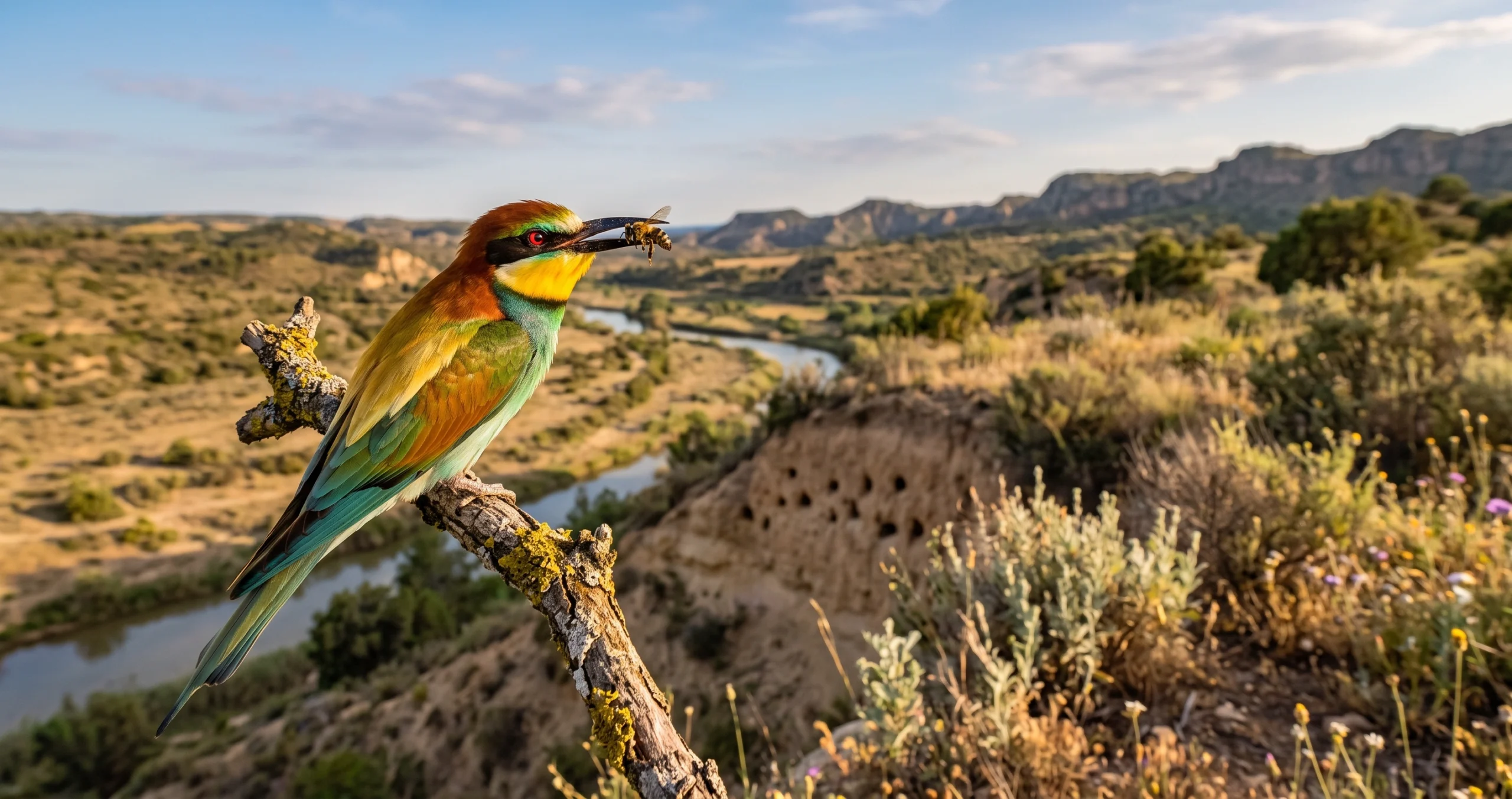
Catching a bee in midair is impressive. Swallowing one without being stung requires another level of specialization. The famous bee-eater sting removal behavior solves that problem through a carefully coordinated sequence: the bird catches a bee or wasp in flight, returns to a perch, immobilizes it by beating it against the branch, then manipulates and rubs the abdomen against the perch to remove or disable the stinger and reduce the venom threat before swallowing.
Bee-eaters do not perform exactly the same sequence with every insect or in every species, but the basic strategy is remarkably consistent. Stinging prey receives additional handling before it becomes dinner. Young birds also need time and experience to master these skills, which is one reason parents may continue feeding fledglings while they develop competent hunting and prey-handling behavior. (Animal Diversity Web)
This combination of aerial agility, precise bill control, and learned refinement allows bee-eaters to exploit insects that many predators would rather avoid.
Table of Contents
- What Are Bee-Eaters?
- How Bee-Eaters Catch Flying Insects
- How Bee-Eater Sting Removal Works
- Why Beating the Bee Matters
- How Rubbing Helps Remove the Stinger and Venom
- Why the Bird Holds the Bee So Carefully
- How Young Bee-Eaters Learn the Technique
- Bee-Eaters Eat Much More Than Bees
- Why Their Aerial Hunting Is So Effective
- Do Bee-Eaters Harm Bee Populations?
- Their Ecological Role
- Common Myths
- FAQ
- Conclusion
What Are Bee-Eaters?
Bee-eaters are colorful insect-eating birds belonging to the family Meropidae. They occur across Africa, Europe, Asia, Australia, and parts of the Middle East, depending on species.
Many are instantly recognizable.
They tend to have slender bodies, long pointed bills, bright combinations of green, blue, yellow, chestnut, or red plumage, and long wings suited to agile flight.
Some species also have elongated central tail feathers.
But their most important adaptation is behavioral.
Bee-eaters specialize in capturing flying insects.
They frequently hunt from exposed perches such as branches, shrubs, fences, or wires. From these lookout points, they scan the surrounding air.
When a suitable insect appears, the bird launches.
The chase can involve sudden turns and rapid adjustments before the bee-eater captures its target with the bill.
European bee-eaters, for example, take bees and other hymenopterans but also consume dragonflies and numerous other flying insects. (Animal Diversity Web)
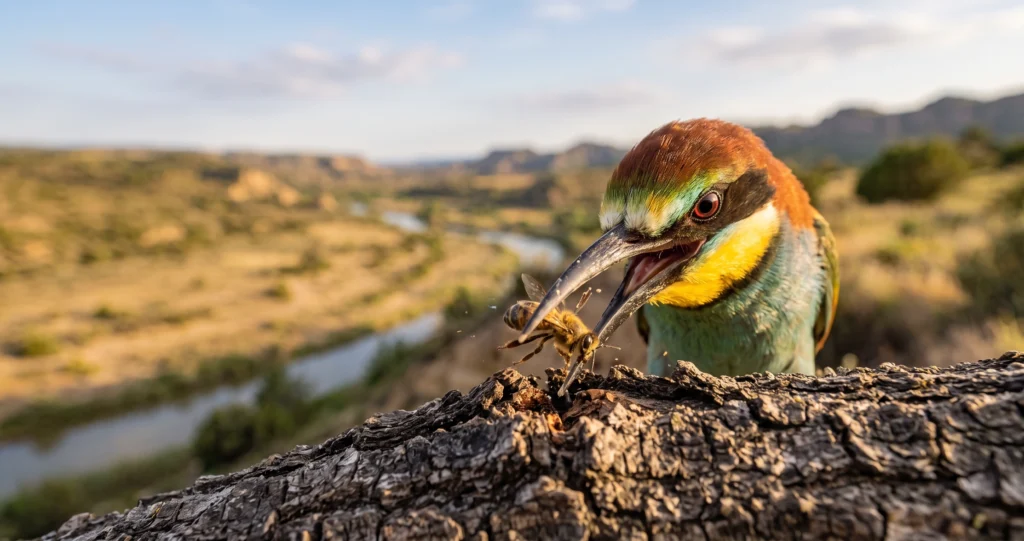
How Bee-Eaters Catch Bees in Midair
A bee-eater’s feeding sequence usually begins from a perch.
The bird watches the surrounding air rather than searching leaves one by one.
Once an insect enters an appropriate position, the bee-eater launches from the perch and pursues it.
The long, slightly curved bill acts like precision forceps.
Successful aerial hunting requires excellent vision, rapid reactions, and the ability to calculate a moving target’s trajectory while the bird itself is moving.
Once the insect has been captured, the bee-eater may return to the same perch or another nearby landing point.
If the prey is harmless, handling may be relatively simple.
A dangerous insect creates another problem.
Catching a bee does not automatically neutralize its sting.
That is where the specialized behavior begins.
How Bee-Eater Sting Removal Works
The exact details vary among bee-eater species and according to prey, but the general sequence is well documented.
First, the bird secures the insect in its bill.
It then strikes or beats the prey against a hard perch.
This helps immobilize it.
When dealing with a bee or wasp, the bird carefully repositions the insect so that the dangerous end can be manipulated against the branch.
The abdomen is then rubbed or pressed against the perch.
This treatment can remove, damage, or discharge the stinging apparatus and reduce the amount of venom available before the insect is swallowed.
European bee-eaters have been observed hitting stinging prey against the perch and manipulating the sting before swallowing. Rainbow bee-eaters perform an especially elaborate sequence involving stunning the bee, repositioning it, manipulating the abdomen, and rubbing the stinging end against the perch. (Animal Diversity Web)
The result looks almost like food preparation.
For the bird, that is exactly what it is.
Why Bee-Eaters Beat Their Prey Against a Branch
Beating performs several functions.
First, it immobilizes the insect.
A living bee struggling inside the bill is harder to manipulate safely than one that has been stunned or killed.
Second, striking helps the bird orient its prey.
A bee-eater needs precise control over which end of the insect is near the bill and which is contacting the perch.
That becomes particularly important when the prey possesses a venomous sting.
Northern carmine bee-eaters also manipulate insects at a perch, with bee stingers removed through rubbing and other insects subdued by beating. (Animal Diversity Web)
This shows that beating is not simply a dramatic way of killing prey.
It is part of a broader food-processing system.
Different insects require different handling.
The Most Important Step: Dealing With the Sting
A honey bee worker’s sting is associated with venom-producing structures in the abdomen.
Against many mammals, its barbed sting can remain embedded after the bee attacks, with the sting apparatus and venom structures tearing away from the bee. (Animal Diversity Web)
Bee-eaters avoid simply swallowing an active stinging insect whenever possible.
The bird manipulates the bee against a hard surface before ingestion.
In green bee-eaters, captured bees are hit and rubbed repeatedly against the perch to deal with the stinger before being swallowed. (Animal Diversity Web)
Rainbow bee-eaters show an even more detailed sequence. After incapacitating the prey, they can manipulate the abdominal end so venom is discharged and then rub that end along the perch before consumption. (Animal Diversity Web)
This is the heart of bee-eater sting removal.
The bird is not magically immune to everything a bee can do.
It reduces the danger before swallowing.
Do Bee-Eaters Actually Squeeze the Venom Out?
Descriptions sometimes simplify the behavior by saying bee-eaters “squeeze all the venom out.”
Reality is more nuanced.
In some observed species, pressure and rubbing of the abdominal or stinging end can discharge venom and help remove or damage the sting apparatus. (Animal Diversity Web)
But bee-eaters are diverse, and prey-handling sequences vary.
It is therefore safer to describe the process as immobilizing the insect, manipulating the stinging end, and removing or disabling the sting while reducing the venom hazard.
That distinction prevents an interesting behavioral adaptation from becoming an exaggerated mechanical claim.
The important point remains unchanged.
Bee-eaters actively process dangerous prey differently from harmless insects.
Why Doesn’t the Bee Sting the Bird During Capture?
Sometimes the most dangerous moment occurs before the bird reaches its perch.
The bee is still alive.
Yet the bird’s long bill provides valuable separation between the prey and sensitive areas around the face.
Precise grip matters too.
Bee-eaters can hold and reposition insects in ways that limit the prey’s ability to bring its abdominal sting into effective contact.
Speed also works in the bird’s favor.
Capture, transport, stunning, and manipulation can happen quickly.
This does not mean a bee-eater is biologically incapable of ever being stung.
The article title captures the remarkable effectiveness of their strategy, not a literal guarantee that no individual bee-eater has ever experienced a sting.
Evolution does not require perfect protection.
It requires a system effective enough to make stinging insects profitable prey.
Young Bee-Eaters Are Not Born as Perfect Hunters
A juvenile bee-eater leaves the nest with the anatomy required to become an aerial insect hunter.
That does not mean it immediately possesses adult-level skill.
Hunting a moving insect is difficult.
Capturing a bee is harder.
Processing that bee safely adds another layer.
Young birds need opportunities to refine coordination, prey recognition, capture timing, and handling behavior.
European bee-eater parents continue provisioning fledglings while the young develop the feeding skills required for independence. Animal Diversity Web specifically notes that the birds’ feeding behaviors are difficult for young individuals to learn. (Animal Diversity Web)
This extended care creates a bridge between dependence and competent independent hunting.
How Do Young Birds Learn Bee-Eater Sting Removal?
“Learning” in animal behavior can involve several processes.
Some components of prey handling may be strongly influenced by instinct.
Others improve through practice and experience.
A particularly interesting historical observation involved a captive-raised white-fronted bee-eater presented with bees. The bird progressively developed an effective handling sequence over repeated attempts, including holding the bee appropriately, stunning it against a hard surface, and dealing with the stinging end before eating it. (Animal Diversity Web)
That does not prove that every bee-eater simply invents the technique from scratch.
Instead, it illustrates how innate behavioral tendencies and individual practice can combine.
Parents also continue providing food after fledging in several bee-eater species, giving juveniles time to develop competent independent foraging. (Animal Diversity Web)
A young bird has the biological equipment.
Experience makes it effective.
Bee-Eaters Don’t Only Eat Bees
Their name creates one of the biggest misconceptions about the family.
Bees can be important prey, but bee-eaters are broadly insectivorous.
Depending on species and habitat, they may capture wasps, hornets, beetles, dragonflies, damselflies, butterflies, moths, flies, grasshoppers, locusts, and other insects.
Rainbow bee-eaters, for example, consume bees and wasps as well as butterflies, moths, damselflies, dragonflies, beetles, and other flying insects. (Animal Diversity Web)
Northern carmine bee-eaters can show a preference for locusts and grasshoppers and exploit insects disturbed by fires or large moving animals. (Animal Diversity Web)
Green bee-eaters likewise consume several insect orders rather than living exclusively on bees. (Animal Diversity Web)
“Bee-eater” describes a conspicuous feeding ability.
It does not describe the entire menu.
Aerial Hunting Specialists
Bee-eaters belong to a broader ecological category of birds that capture insects in flight.
Their hunting method is often called hawking or sallying.
A bird waits at a vantage point.
It detects a moving insect.
It launches, intercepts the target, captures it, and often returns to a perch.
This strategy avoids the energy cost of flying continuously while searching.
The perch becomes a surveillance platform.
Some species take advantage of environmental disturbances that make insects easier to find.
Northern carmine bee-eaters, for example, can follow large mammals whose movement through vegetation flushes insects into the air. They may also gather where fire disturbs insects, although approaching fire obviously carries risks. (Animal Diversity Web)
These birds are opportunists as well as specialists.
The Ecological Role of Bee-Eaters
Bee-eaters occupy an important position in terrestrial food webs.
They convert abundant flying insects into energy that supports birds, eggs, and chicks.
At the same time, bee-eaters themselves become part of the food web.
Eggs and chicks can be taken by snakes, monitor lizards, mongooses, and other nest predators depending on the region and species. (Animal Diversity Web)
Their nesting behavior can also modify physical habitat.
Many species excavate tunnels in sandy banks, cliffs, or similar substrates.
These colonies create disturbances and cavities in places where erosion, soil structure, predators, and other organisms interact.
Bee-eaters are therefore neither isolated “bee killers” nor decorative birds existing outside ecosystem processes.
They are insect predators participating in complex ecological networks.
Do Bee-Eaters Threaten Honey Bees?
Because bee-eaters consume bees, conflict with beekeepers can occur in regions where birds forage around apiaries.
But the ecological question requires context.
Bee-eaters evolved alongside wild bees and other insects long before managed beekeeping existed.
Their diets can include numerous insect groups, and prey composition changes with location, season, and availability.
A bird eating individual bees is not automatically evidence that it is responsible for broad pollinator decline.
Pollinator populations are influenced by multiple pressures, including habitat conditions, food availability, pesticides, parasites, disease, climate, invasive species, and land-use change.
Bee-eaters are native predators within the ecosystems where they naturally occur.
Predation is part of those systems.
The appropriate response to local conflict is evidence-based management rather than persecution of wild birds.
For more on remarkable insect adaptations, see our article Why Katydids Have Ears on Their Front Legs. It explores another example of how predator-prey interactions and communication can shape highly specialized animal behavior.
Bee-Eaters Can Also Help Regulate Insect Populations
An insectivorous bird does not distinguish between species humans label “beneficial” and “pest.”
It responds to available prey.
That means bee-eaters can consume insects that damage vegetation or become locally abundant, as well as pollinating insects.
Carmine bee-eaters feeding heavily on grasshoppers and locusts demonstrate this broader role particularly well. (Animal Diversity Web)
The ecological function is best understood as predation rather than pest control.
Bee-eaters help move energy through food webs and contribute to natural pressures affecting insect populations.
Their presence also tells us something about habitat.
A landscape capable of supporting aerial insectivores needs sufficient prey and suitable places for hunting, resting, and, where applicable, nesting.
Common Myths About Bee-Eater Sting Removal
Myth 1: Bee-Eaters Are Completely Immune to Bee Venom
Their specialized behavior reduces risk before swallowing stinging prey.
That is different from proving complete physiological immunity to venom.
Myth 2: They Swallow Live Bees Immediately
Stinging insects commonly receive additional processing at a perch.
The bird may beat, reposition, press, or rub the prey before swallowing. (Animal Diversity Web)
Myth 3: They Always Pull the Stinger Out With Their Beak
The perch itself is an important tool.
Rubbing and manipulating the abdominal end against a hard surface can remove or disable the stinging apparatus.
Myth 4: Bee-Eaters Eat Nothing but Bees
Their diets can include wasps, beetles, dragonflies, flies, butterflies, moths, grasshoppers, locusts, and numerous other insects. (Animal Diversity Web)
Myth 5: Young Bee-Eaters Perform the Entire Technique Perfectly Immediately
Juveniles require time to develop competent independent foraging, and prey-handling performance can improve with experience. (Animal Diversity Web)
Myth 6: Bee-Eaters Are Major Drivers of Global Bee Decline
There is no scientific basis for reducing the complex global issue of pollinator decline to predation by bee-eaters.
They are natural insect predators within their native ecosystems.
FAQ
How does bee-eater sting removal work?
After capturing a stinging insect, a bee-eater typically returns to a hard perch and immobilizes the prey by striking it.
The bird then manipulates and rubs the stinging end against the perch, helping remove or disable the stinger and reduce the venom hazard before swallowing. (Animal Diversity Web)
Do bee-eaters really remove the venom?
In some observed prey-handling sequences, pressure and rubbing can discharge venom as the stinging apparatus is processed.
The exact technique varies among species and prey. (Animal Diversity Web)
Why don’t bee-eaters get stung?
Their long bills, precise prey handling, rapid immobilization, and specialized processing of stinging insects greatly reduce the opportunity for an effective sting.
It is better understood as risk management than guaranteed immunity.
How do young bee-eaters learn to eat bees?
Juveniles continue receiving parental food after fledging while developing their own foraging skills.
Observations also indicate that effective prey handling can improve through repeated experience. (Animal Diversity Web)
Do bee-eaters only eat honey bees?
No.
Bee-eaters consume numerous flying insects, including wasps, dragonflies, beetles, butterflies, moths, flies, grasshoppers, and locusts, depending on species and location. (Animal Diversity Web)
Do bee-eaters catch insects while flying?
Yes.
Aerial pursuit is a defining part of their feeding behavior. Many hunt from exposed perches, launch after passing insects, capture them in flight, and return to a perch for processing.
Why are bee-eaters so colorful?
Their plumage is involved in visual signaling and species recognition, while its exact evolutionary functions differ across the family.
Bright coloration does not prevent them from being highly effective predators.
Are bee-eaters harmful to ecosystems?
No. They are native insect predators in their natural ranges and participate in established food webs.
Local conflicts with beekeeping can occur, but that is different from the birds being ecologically harmful.
Conclusion
The bee-eater sting removal technique demonstrates that successful predation is not always about strength.
Sometimes it is about preparation.
A bee comes equipped with a venomous defensive weapon specifically capable of persuading many potential predators to leave it alone. Warning coloration reinforces that protection by making the danger easier to recognize.
Bee-eaters evolved a behavioral solution.
They catch the insect with remarkable aerial precision, carry it to a perch, immobilize it, reposition it, and use the hard surface as a food-processing tool. Stinging prey receives special treatment: the abdominal end can be pressed and rubbed against the perch to remove or disable the stinger and reduce the venom threat.
Only then does the bird swallow.
Young bee-eaters reveal another important part of the story. Possessing the correct bill and wings does not instantly make a bird an expert. Juveniles continue receiving parental support while developing the complex skills required to find, chase, capture, manipulate, and safely consume difficult prey. (Animal Diversity Web)
And despite their name, bee-eaters are not simply bee specialists.
Across the family, they capture a broad range of flying insects. Dragonflies, beetles, wasps, butterflies, moths, flies, grasshoppers, and locusts can all appear on the menu.
That diversity places bee-eaters firmly within the ecological web rather than outside it.
They are predators of insects, prey for other animals, excavators of nesting burrows, and participants in evolutionary relationships that have developed over immense periods of time.
The bee’s sting is an effective defense.
The bee-eater’s achievement is not making that defense useless.
It is evolving—and learning—a remarkably precise way around it.
Internal Link Suggestions:
- Why Katydids Have Ears on Their Front Legs — Link from the section discussing the wider range of insects bee-eaters hunt. This connects predator behavior with unusual insect adaptations.
- The Killdeer’s Fake Broken-Wing Display: A Bird’s Predator Decoy Trick — Link from the section about learned and specialized bird behavior, giving readers another example of an unusual survival strategy in birds.
External Dofollow Authoritative Sources:
- Animal Diversity Web — European Bee-Eater (*Merops apiaster*) — University of Michigan resource covering diet, aerial hunting, prey handling, sting removal, parental care, and juvenile learning. (Animal Diversity Web)
- Animal Diversity Web — Rainbow Bee-Eater (*Merops ornatus*) — Detailed reference for the specialized sequence used to immobilize bees, manipulate the stinging end, discharge venom, and rub the prey against a perch. (Animal Diversity Web)
- BirdLife International — Authoritative global bird-conservation organization with information on bee-eater ecology, migration, breeding behavior, threats, and conservation. BirdLife also describes European bee-eaters removing the sting from dangerous prey by striking it against a hard surface. (climatechange.birdlife.org)