
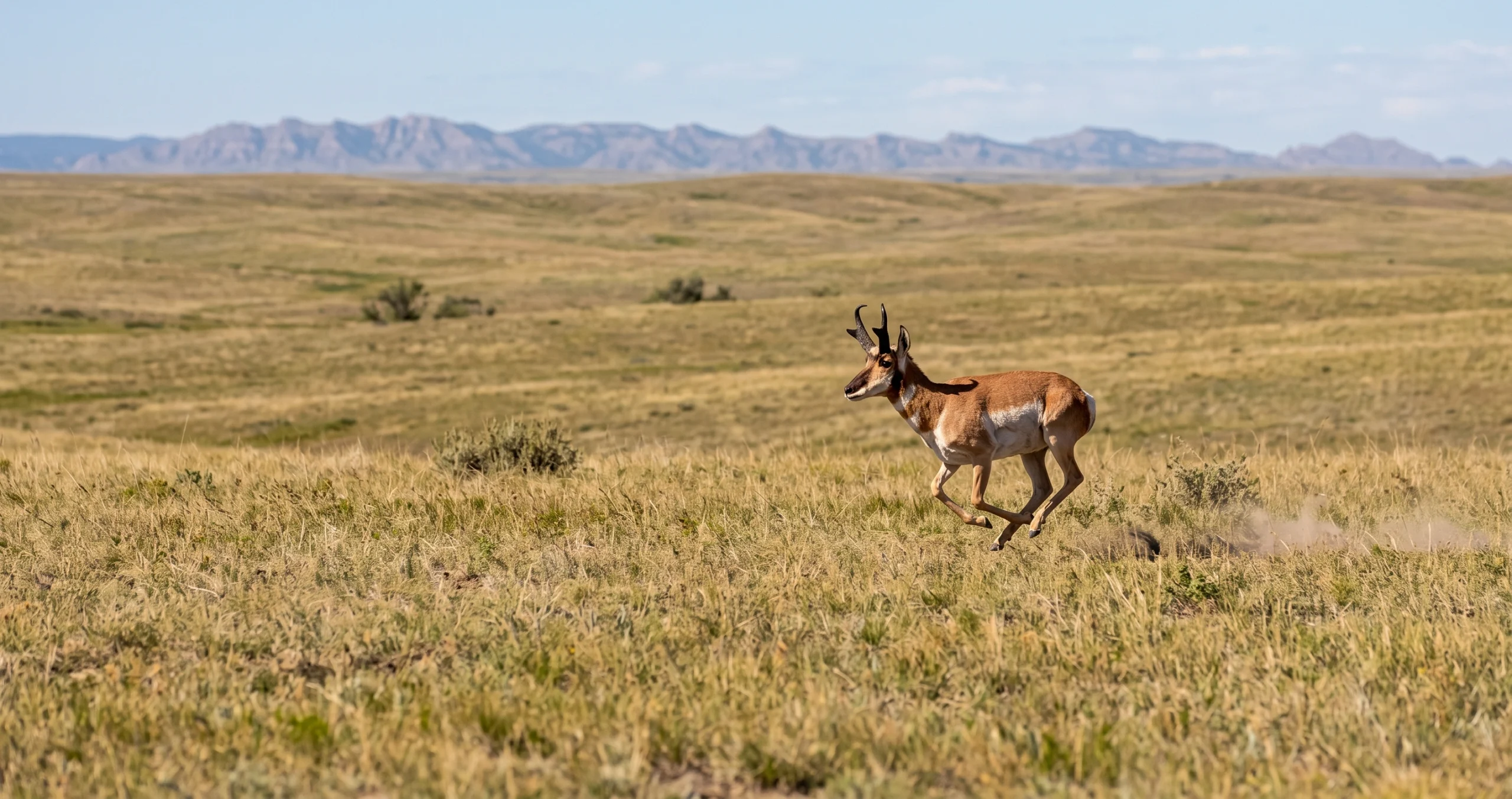
Across the open landscapes of western North America, the pronghorn can accelerate into a run that seems excessive for the predators pursuing it today. That mismatch has inspired one of the most intriguing ideas in evolutionary ecology: pronghorn speed evolution may partly reflect an ancient arms race with predators that disappeared thousands of years ago, particularly the extinct American cheetah-like cat Miracinonyx.
The idea is often summarized as the “ghost predator” hypothesis. Pronghorn may still possess adaptations shaped when North America supported a richer community of fast-running predators. Their extraordinary speed is real, but the extinct-cheetah explanation is best treated as a well-known evolutionary hypothesis rather than a proven one-to-one story.
The pronghorn’s modern challenges are very different. Today, fences, highways, development, and fragmented migration corridors can create obstacles that speed alone cannot solve.
Table of Contents
- What Is a Pronghorn?
- How Fast Can a Pronghorn Run?
- Speed Is Only Half the Story
- Pronghorn Speed Evolution and the Ghost Predator Hypothesis
- What Was the American Cheetah?
- Did American Cheetahs Really Cause Pronghorn Speed?
- Why Evolutionary Traits Can Outlast Extinct Predators
- How the Pronghorn Body Is Built for Running
- Why Modern Predators Still Matter
- Pronghorn Migration
- Why Fences Are Such a Serious Problem
- Roads, Development, and Habitat Fragmentation
- Conserving Migration Corridors
- Common Myths
- FAQ
- Conclusion
What Is a Pronghorn?
The pronghorn (Antilocapra americana) is one of North America’s most distinctive large mammals.
Despite often being called a “pronghorn antelope,” it is not a true antelope. True antelopes belong to the family Bovidae, whereas the pronghorn is the only surviving species in the family Antilocapridae.
Its closest living relatives are therefore not the African antelopes it superficially resembles.
Pronghorn evolved in North America and are highly adapted to open environments where long-distance vision and rapid movement provide major advantages.
They inhabit grasslands, sagebrush country, deserts, and other relatively open landscapes from parts of Canada through the western United States and into Mexico.
Their large eyes provide exceptional awareness of distant movement.
When danger appears, however, their most famous adaptation takes over.
They run.
How Fast Can a Pronghorn Run?
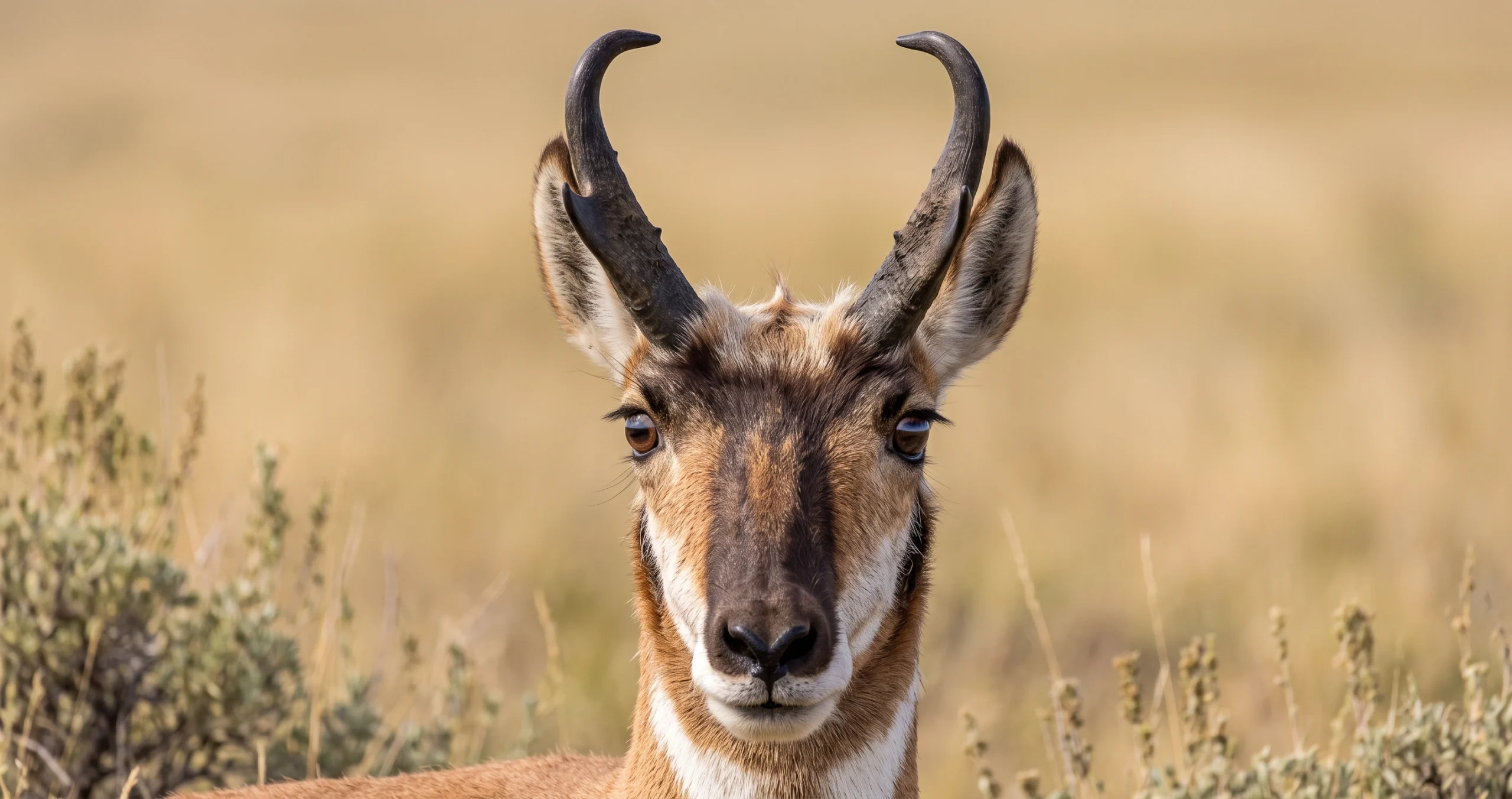
Pronghorn are widely regarded as the fastest land mammals in the Western Hemisphere.
Frequently cited top-speed estimates approach 60 miles per hour, or roughly 95–100 kilometers per hour, although exact maximum speeds vary among sources and measurement conditions.
That puts them behind the cheetah in maximum sprint speed.
But focusing only on the highest number misses what makes pronghorn exceptional.
Cheetahs specialize in explosive acceleration and relatively short high-speed pursuits.
Pronghorn combine speed with endurance.
They can sustain fast running over distances that would be impossible for a cheetah operating at its maximum sprint.
This combination of rapid acceleration, high speed, and endurance is central to understanding pronghorn speed evolution.
Speed Is Only Half the Story
An animal’s escape performance cannot be reduced to a speedometer reading.
How long it can sustain a pace matters.
So do acceleration, maneuverability, heat management, oxygen delivery, terrain, and the predator’s own strategy.
Pronghorn possess unusually large respiratory and cardiovascular capacities relative to their body size.
Their lungs, heart, and muscles support the oxygen delivery required for prolonged high-speed locomotion.
Their lightweight build and long legs further contribute to efficient running.
The result is not simply a mammal capable of one spectacular sprint.
It is an animal built to move very quickly across open country while maintaining that performance longer than many predators can.
That raises an obvious evolutionary question.
Why?
Pronghorn Speed Evolution and the Ghost Predator Hypothesis
Modern North America contains several predators capable of killing pronghorn, including coyotes, wolves, mountain lions, bobcats, and golden eagles that may take young fawns.
Yet adult pronghorn appear capable of speeds far beyond what would seem necessary to outrun most living pursuers.
Evolutionary biologist John A. Byers famously explored this mismatch in his work on pronghorn ecology.
In his book American Pronghorn: Social Adaptations and the Ghosts of Predators Past, Byers argued that modern pronghorn characteristics may preserve adaptations shaped by a much more dangerous Pleistocene predator community.
North America once contained lions, fleet-footed canids, hyena-like predators, and the extinct cat Miracinonyx, commonly called the American cheetah.
The central hypothesis is compelling.
Today’s pronghorn may still be running with adaptations forged in an ecosystem containing predators that no longer exist.
What Was the American Cheetah?
Miracinonyx was an extinct North American cat.
Its popular name, “American cheetah,” reflects anatomical similarities associated with running, but the name can create confusion.
It was not simply a modern African cheetah living in North America.
Fossil and genetic evidence indicates that Miracinonyx belonged to the North American cat radiation and was more closely related to the cougar lineage than to modern cheetahs.
Nevertheless, some anatomical characteristics indicate adaptation for pursuing prey in open habitats.
That makes Miracinonyx an obvious candidate when scientists consider the selective pressures behind pronghorn speed evolution.
Pronghorn ancestors and these fast cats shared North American landscapes for a long evolutionary period.
If fast predators repeatedly captured slower pronghorn, individuals capable of greater speed and endurance would have enjoyed an obvious survival advantage.
Over generations, that difference could produce intense selection for running performance.
Did American Cheetahs Really Cause Pronghorn Speed?
This is where a fascinating evolutionary story requires scientific caution.
It is tempting to state that pronghorn evolved their speed specifically to escape Miracinonyx.
That is plausible, but difficult to prove directly.
Behavior does not fossilize neatly.
Scientists cannot reconstruct a Pleistocene chase and measure the speeds of predator and prey.
Pronghorn also faced multiple extinct predators, not just one.
Byers’ ghost-predator framework considers a broader prehistoric predator community rather than reducing every adaptation to a single cat.
The most accurate interpretation is therefore that Miracinonyx is a leading candidate within a wider hypothesis.
The remarkable mismatch between modern pronghorn speed and the performance of most current predators is consistent with a history of stronger selection from extinct pursuit predators.
It is not definitive proof that one extinct species alone created the modern pronghorn.
Why Evolutionary Traits Can Outlast Extinct Predators
If the predators disappeared, why didn’t pronghorn simply become slower?
Evolution does not automatically erase a trait when the original selective pressure disappears.
For a characteristic to decline substantially, individuals possessing less of that characteristic generally need some reproductive or survival advantage over individuals that retain it.
If being fast does not impose a sufficiently large disadvantage, the trait can persist.
Speed also remains useful.
Modern predators still hunt pronghorn. Fast running helps animals escape threats, move through open terrain, and potentially interact during competition and reproduction.
Natural selection works with existing variation rather than redesigning a species from scratch whenever an ecosystem changes.
A trait can therefore survive long after the environmental circumstances that originally intensified its evolution have disappeared.
This phenomenon is sometimes informally described as an evolutionary legacy.
The modern animal carries evidence of an ecological relationship that no longer exists.
How the Pronghorn Body Is Built for Running
The pronghorn’s speed is not produced by one anatomical trick.
Its entire locomotor system contributes.
Long, slender limbs increase stride length. The body is relatively lightweight, and the feet are adapted for rapid movement across firm, open terrain.
Its cardiovascular and respiratory systems are especially important.
Running muscles require oxygen to sustain aerobic activity, and pronghorn possess adaptations that support exceptionally high oxygen intake and delivery.
This helps explain why endurance is such an important component of their performance.
A predator may accelerate rapidly, but if the pronghorn can maintain a demanding pace longer, the pursuit becomes increasingly unfavorable.
Its eyes contribute as well.
Pronghorn have exceptionally large eyes positioned to provide a broad field of view, allowing them to detect movement at considerable distances across open landscapes.
Early detection gives speed more time to work.
Why Modern Predators Still Matter
The disappearance of Pleistocene predators did not make speed irrelevant.
Coyotes can be important predators, particularly of young pronghorn.
Wolves and mountain lions can also kill pronghorn where their ranges overlap.
Predator avoidance depends on much more than maximum running speed.
Surprise, terrain, snow depth, physical condition, age, group behavior, and escape routes all influence the outcome.
A pronghorn trapped against a fence does not benefit from having a theoretical top speed near 60 mph.
This leads to an important modern paradox.
The animal evolved to escape mobile predators across open landscapes.
Some of its greatest current threats are stationary barriers.
Pronghorn Migration Across the West
Many pronghorn populations move seasonally between ranges.
Migration allows them to respond to changing forage, snow conditions, water availability, and seasonal habitat requirements.
Some journeys are substantial.
Research by the U.S. Geological Survey has documented western Wyoming pronghorn migrating more than 100 miles between seasonal ranges in certain populations.
More recent GPS mapping continues to reveal complicated migration networks across the western United States.
For example, USGS mapping of Wyoming’s Carter Mountain herd found animals migrating roughly 10 to 60 miles between winter and summer ranges, with some climbing thousands of feet in elevation.
These movements show that pronghorn speed evolution exists within an animal built not only for rapid escape but also for movement across enormous landscapes.
The U.S. Geological Survey’s research on western ungulate migration documents how roads, fences, development, and other barriers intersect these seasonal routes.
Why Fences Are Such a Serious Problem
Pronghorn can run exceptionally fast.
They are much less comfortable jumping fences.
Unlike deer, which commonly leap over obstacles, pronghorn often prefer to crawl underneath fences.
That behavior creates serious problems in landscapes covered by livestock fencing.
Woven-wire fencing can become effectively impassable.
Even ordinary strands can create bottlenecks if the bottom wire is too low for animals to pass underneath safely.
A migration route that has been used for generations can therefore be disrupted by a relatively narrow barrier.
Pronghorn may travel along fences searching for an opening, expend valuable energy, become separated from preferred habitat, or become entangled.
Wildlife-friendly fence designs can reduce this problem by providing adequate clearance beneath the bottom wire and improving known crossing points.
Roads and Habitat Fragmentation
Highways create another challenge.
Traffic itself produces collision risk, but associated fencing can turn major roads into nearly continuous barriers.
USGS studies in Wyoming show that Interstate 80 strongly limits movement in several pronghorn populations.
In some landscapes, residential development, energy infrastructure, railroads, and agricultural fencing further divide habitat.
Wind-energy development can also alter habitat selection and migration behavior. USGS research using GPS-collared pronghorn in south-central Wyoming found avoidance responses around wind-energy development at multiple spatial scales.
These findings do not mean every road, fence, or energy project has an identical effect.
They demonstrate why location and landscape connectivity matter.
A structure placed across a critical migration bottleneck can have consequences far greater than the physical area it occupies.
Conserving Migration Corridors
Modern pronghorn conservation therefore requires thinking beyond individual protected areas.
An animal may have excellent summer habitat and excellent winter habitat but still struggle if it cannot move safely between them.
GPS collars have transformed scientists’ understanding of this problem.
Researchers can now map individual movements repeatedly across seasons and identify narrow corridors, stopover areas, road crossings, and barriers.
The information can guide wildlife crossings, fence modification, development planning, and habitat conservation.
USGS migration research has documented cases where wildlife-unfriendly fencing was modified after tracking data revealed a migration blockage.
That is an encouraging example of research producing practical conservation results.
For another North American mammal whose seasonal behavior is strongly shaped by changing food availability, read our article about black bear hyperphagia in late summer.
Common Myths About Pronghorn
Myth 1: Pronghorn Are Antelopes
They are commonly called antelope, but they are not true antelopes.
The pronghorn is the sole surviving member of Antilocapridae.
Myth 2: Pronghorn Are Faster Than Cheetahs
A cheetah has the higher maximum sprint speed.
The pronghorn’s extraordinary advantage is its combination of high speed and endurance.
Myth 3: Scientists Know Pronghorn Speed Evolved Specifically Because of American Cheetahs
The American cheetah hypothesis is compelling but should not be presented as proven fact.
Pronghorn evolved alongside a community of extinct predators, and several could have contributed to selection for exceptional escape performance.
Myth 4: The American Cheetah Was a Modern Cheetah
Miracinonyx was a distinct North American cat.
Despite its cheetah-like adaptations and common name, evidence places it closer to the cougar lineage than to the modern African cheetah.
Myth 5: Pronghorn Can Easily Jump Any Fence
Pronghorn generally prefer moving underneath fences rather than jumping them.
Poorly designed fencing can therefore become a significant migration barrier.
Myth 6: Their Speed Is Useless Today
Modern predators still hunt pronghorn, so rapid escape remains valuable.
A trait can also persist even when the original selective pressure has weakened.
Myth 7: Migration Is the Same for Every Pronghorn
It is not.
Some populations undertake substantial seasonal migrations, while others are resident, partially migratory, nomadic, or migrate differently depending on winter conditions.
FAQ
How fast can a pronghorn run?
Top-speed estimates commonly approach 55–60 mph, or approximately 90–100 km/h.
Exact figures vary according to measurement methods, but pronghorn are unquestionably among the fastest terrestrial mammals.
Is a pronghorn faster than a cheetah?
Not in maximum sprint speed.
Modern cheetahs can reach higher peak speeds, while pronghorn are exceptional for combining very high speed with greater endurance.
Why are pronghorn so fast?
The famous pronghorn speed evolution hypothesis proposes that their exceptional performance was shaped partly by extinct Pleistocene predators capable of fast pursuit.
The American cheetah-like Miracinonyx is frequently highlighted, although other extinct predators may also have contributed.
What is a ghost predator?
In this context, “ghost predator” refers to an extinct predator whose past selective pressure may still be reflected in adaptations of living prey.
The predator is gone, but the evolutionary legacy remains.
When did the American cheetah disappear?
Miracinonyx disappeared near the end of the Pleistocene, roughly around the period when many North American large mammals became extinct more than 10,000 years ago.
Why didn’t pronghorn become slower after it went extinct?
Evolution does not remove an adaptation simply because its original advantage becomes less important.
If maintaining speed is not strongly disadvantageous—and remains useful against living predators—the trait can persist for many generations.
How far do pronghorn migrate?
Migration distance varies enormously among populations.
Some are largely resident, while documented western populations can migrate tens of miles and, in exceptional cases, well over 100 miles between seasonal ranges.
Why are fences dangerous to pronghorn?
Pronghorn often prefer crawling underneath fences instead of jumping over them.
Woven wire, low bottom strands, and other wildlife-unfriendly designs can block migration or cause injury.
What threatens pronghorn today?
Challenges vary regionally but can include habitat loss and fragmentation, fences, highways, energy development, severe weather, disease, and disruption of migration corridors.
Conclusion
The story of pronghorn speed evolution is compelling because it connects two very different versions of North America.
One exists today: open sagebrush and grasslands occupied by pronghorn, coyotes, wolves, mountain lions, livestock, roads, and fences.
The other disappeared near the end of the Pleistocene.
That older landscape contained a more diverse community of large predators, including the cheetah-like Miracinonyx.
The ghost-predator hypothesis proposes that pronghorn still carry adaptations shaped by that vanished world.
Their extraordinary running performance is certainly real.
With peak speeds approaching 60 mph and exceptional endurance, pronghorn possess capabilities beyond what seems necessary to outrun most of their modern predators.
But evolutionary history rarely provides a single, perfectly testable explanation.
Scientists cannot prove that Miracinonyx alone created the modern pronghorn’s speed. Multiple extinct predators probably contributed to the selective environment in which pronghorn ancestors evolved.
What the hypothesis illustrates particularly well is that evolution has memory.
When an ecological pressure disappears, the traits it helped shape do not vanish overnight.
They can remain for thousands of years—especially when they still provide benefits or impose little reason for natural selection to remove them.
Today, however, pronghorn face challenges their speed was never designed to overcome.
A highway cannot be outrun.
A woven-wire fence cannot be exhausted during a chase.
A fragmented migration corridor cannot be crossed simply by having stronger lungs and faster legs.
Protecting pronghorn therefore increasingly depends on preserving connected landscapes, modifying problematic fences, identifying migration bottlenecks, and designing infrastructure with animal movement in mind.
The American cheetah may be gone.
But every time a pronghorn accelerates across the plains, we may be watching an evolutionary legacy of the predators that once ran behind it.
Related Reading
Explore more about the seasonal behavior, survival strategies, and ecology of North American wildlife:
- Black Bear Hyperphagia in Late Summer — Learn how seasonal food availability drives black bears into an intense period of feeding as they prepare for the months ahead.
- How Young Coyotes Disperse Across North American Landscapes — Explore why young coyotes leave their natal territories and how dispersal influences their movement, survival, and interactions with other wildlife.
References and Further Reading
For additional scientific information about pronghorn migration, movement barriers, ecology, and their evolutionary history:
University of Chicago Press — American Pronghorn: Social Adaptations and the Ghosts of Predators Past — John A. Byers’ scholarly work examining pronghorn social and evolutionary adaptations, including the hypothesis that some traits were shaped by a more diverse community of large predators during the Pleistocene.
U.S. Geological Survey — Ungulate Migrations of the Western United States — Extensive GPS-based research documenting pronghorn migration routes, seasonal ranges, movement bottlenecks, highways, fences, development, and other barriers across the American West.
U.S. Geological Survey — Mule Deer and Pronghorn Migration in Western Wyoming — Scientific research documenting major pronghorn migrations and important movement corridors and bottlenecks in western Wyoming.