
Table of Contents
- Introduction
- What Makes the Peregrine Falcon the Fastest Animal?
- How Scientists Measured Peregrine Falcon Speed
- The Anatomy That Makes Extreme Speed Possible
- Nostril Baffles
- The Third Eyelid
- A Streamlined Body
- Powerful Wings and Muscles
- How Peregrine Falcons Compare to Other Fast Animals
- Hunting at Over 200 MPH
- The DDT Crisis and One of Conservation’s Greatest Comebacks
- Common Myths About Peregrine Falcons
- Frequently Asked Questions
- Conclusion
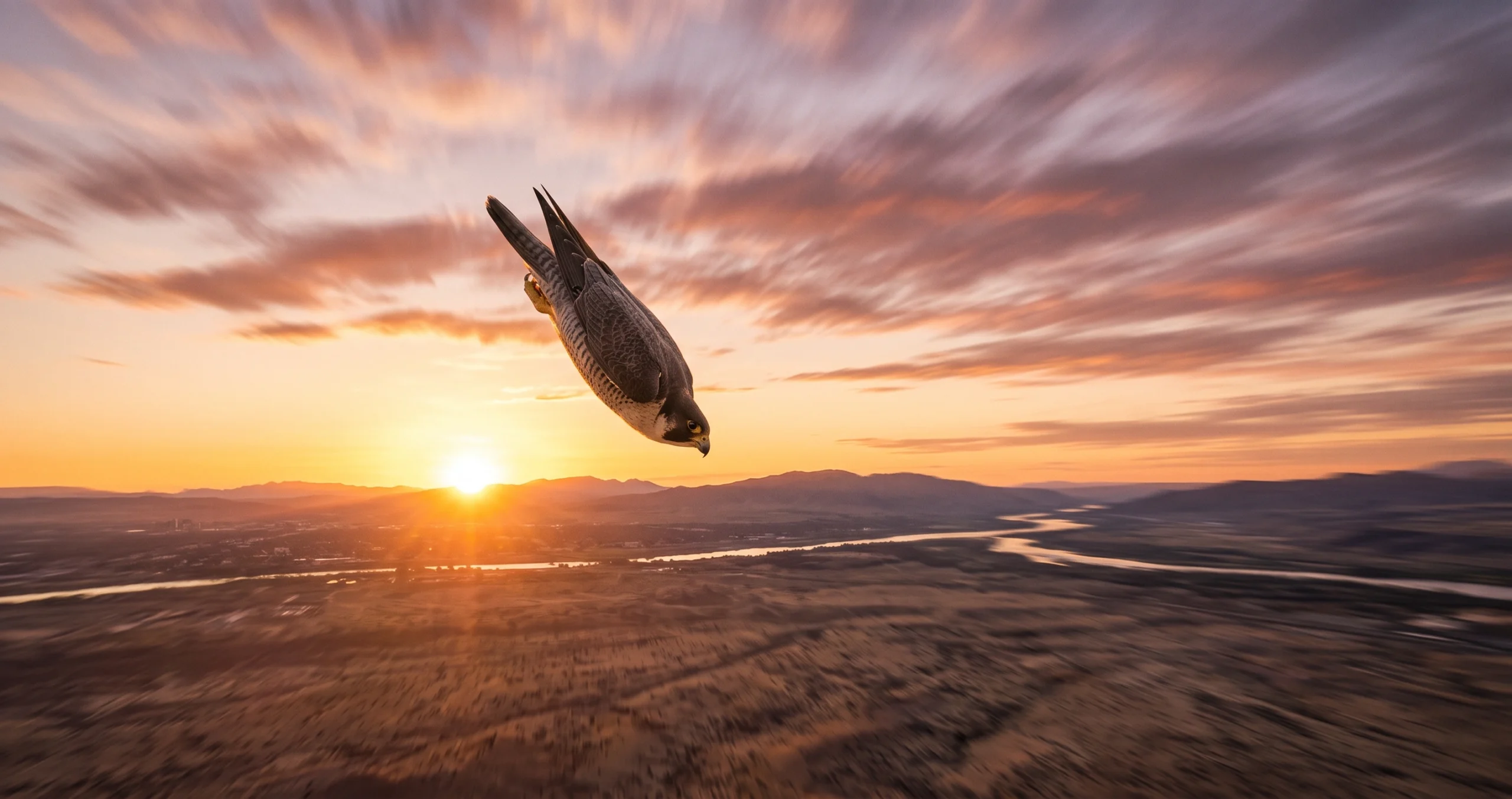
When people hear the phrase peregrine falcon speed, they often think of a bird flying incredibly fast across the sky. But what makes the peregrine falcon truly extraordinary is not its level flight—it is its hunting dive, known as a stoop. During these breathtaking aerial attacks, peregrine falcons can exceed 200 mph (320 km/h), making them the fastest animal on Earth.
This astonishing performance isn’t simply a matter of powerful wings. Every part of the peregrine falcon’s body has evolved to survive extreme speeds, from specialized nostrils that regulate airflow to protective eye structures and an incredibly aerodynamic shape. Combined with razor-sharp hunting instincts, these adaptations have made the peregrine falcon one of nature’s most remarkable predators.
Today, the species also represents one of conservation’s greatest success stories. After populations nearly disappeared across much of North America because of pesticide contamination, dedicated recovery efforts helped restore peregrine falcons to many of their former habitats.
If you’re fascinated by incredible wildlife adaptations, you may also enjoy our article exploring how a cheetah’s spine works like a spring to enable its top speed on secretsofthegreengarden.com.
What Makes the Peregrine Falcon the Fastest Animal?
Unlike many fast animals, peregrine falcons achieve their record-breaking speeds only during specialized hunting dives.
Instead of relying solely on muscle power, they combine gravity, wing positioning, body shape, and precise control to accelerate toward prey from hundreds or even thousands of feet above the ground.
While their normal cruising speed ranges between 40 and 60 mph (64–97 km/h), their speed increases dramatically once they fold their wings into a streamlined profile and begin diving.
During a stoop, the bird transforms into a living missile.
Its compact shape minimizes air resistance while gravity provides additional acceleration, allowing the falcon to reach speeds that no other bird—or any other animal—can consistently match.
How Scientists Measured Peregrine Falcon Speed
For decades, estimates of peregrine falcon diving speed varied widely because accurately measuring an animal moving faster than a racing sports car is extremely difficult.
Early researchers relied on visual observations and calculations based on altitude and dive duration.
As technology improved, scientists began using high-speed photography, radar tracking, GPS devices, laser rangefinders, and onboard telemetry equipment attached temporarily to trained falcons.
One of the most influential studies used trained peregrine falcons carrying miniature recording devices during controlled dives. These instruments recorded altitude, acceleration, and velocity throughout each hunting descent.
Researchers consistently documented diving speeds exceeding 200 mph (320 km/h), with some dives under ideal conditions reaching even higher values. Because speed depends on dive angle, starting height, wind conditions, and prey movement, no single number represents every peregrine falcon.
Organizations such as the Cornell Lab of Ornithology continue to provide reliable information on peregrine falcon biology and behavior:
https://www.allaboutbirds.org/
The Anatomy That Makes Extreme Speed Possible
Extreme velocity creates enormous physical challenges.
Without specialized adaptations, the forces generated during high-speed dives would damage the bird’s eyes, lungs, and respiratory system.
Fortunately, peregrine falcons possess a remarkable collection of evolutionary innovations.
Peregrine Falcon Speed Depends on Specialized Nostril Baffles
At over 200 mph, rushing air could overwhelm the lungs.
To solve this problem, peregrine falcons have small cone-shaped structures called nostril baffles inside each nostril.
These tiny projections regulate incoming airflow and reduce pressure before air reaches the respiratory passages.
The design functions similarly to the intake cones used in high-speed aircraft, preventing dangerous airflow while allowing efficient breathing.
Engineers have even studied this adaptation when designing advanced air intake systems.
The Third Eyelid Protects Vision
Maintaining clear vision during a dive is essential.
The falcon’s prey may be making sudden evasive maneuvers while the predator closes the distance in only a few seconds.
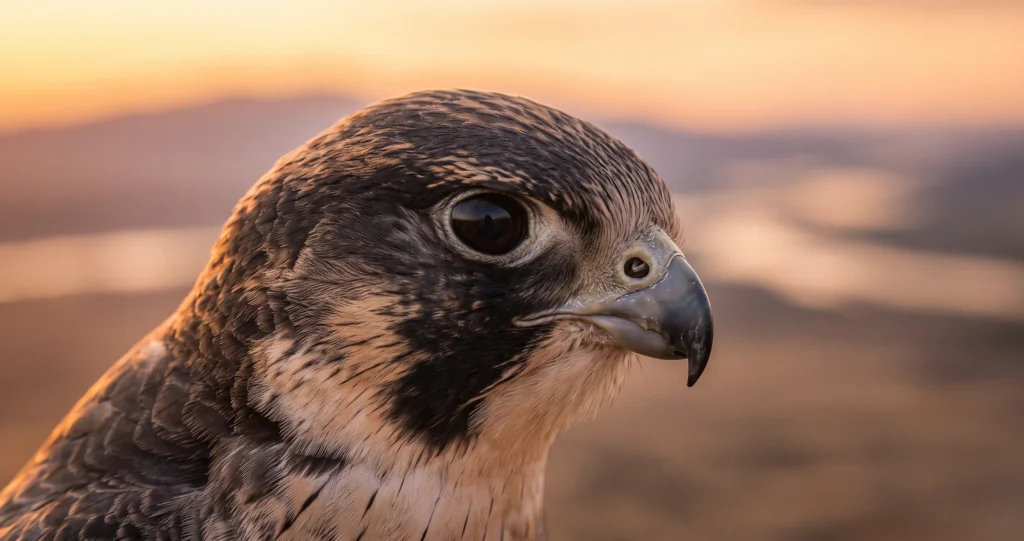
A transparent membrane called the nictitating membrane, often referred to as the third eyelid, sweeps across the eye without blocking vision.
It protects against wind, airborne debris, and dehydration while allowing the bird to maintain focus on its target.
This natural protective shield acts much like a built-in pair of aerodynamic goggles.
A Streamlined Body Reduces Drag
The peregrine falcon’s body resembles a perfectly shaped projectile.
Its pointed wings, tapered tail, compact head, and smooth feather arrangement minimize turbulence as air flows around the bird.
During a stoop, the wings partially fold against the body, dramatically reducing drag.
The tail continuously makes tiny adjustments that stabilize flight while helping steer toward moving prey.
Every feather contributes to aerodynamic efficiency.
Unlike loosely arranged feathers found on many birds, peregrine feathers lock together tightly to produce a smooth outer surface.
Powerful Wings and Muscles
Although gravity contributes significantly during dives, powerful muscles remain essential.
Strong breast muscles allow rapid acceleration before the dive begins and generate tremendous climbing power afterward.
Flexible wing joints also enable precise control.
Rather than simply falling toward prey, peregrine falcons constantly adjust wing position to maintain stability while tracking birds making unpredictable turns.
Hunting at Over 200 MPH
A peregrine falcon’s hunting strategy depends on surprise.
After locating prey—often pigeons, ducks, shorebirds, or starlings—it climbs high above its target before beginning the attack.
The bird then folds its wings and enters a steep dive.
Using extraordinary eyesight, estimated to be several times sharper than human vision, it tracks even small changes in prey movement.
Rather than grabbing prey immediately, peregrine falcons frequently strike with clenched feet.
The tremendous impact can stun or kill the prey instantly before the falcon circles back to retrieve it.
This technique reduces the risk of losing control during extremely fast approaches.
How Peregrine Falcons Compare to Other Fast Animals
Many animals have evolved impressive speed, but each excels in a different environment.
Peregrine Falcon
Maximum speed:
Over 200 mph (320 km/h) during hunting dives.
Type of speed:
Aerial diving.
Cheetah
Maximum speed:
Around 70 mph (113 km/h).
Type of speed:
Short-distance sprinting on land.
Unlike peregrines, cheetahs rely on flexible spines, long strides, and explosive acceleration rather than gravity-assisted movement.
Sailfish
Maximum speed:
Estimated around 68 mph (110 km/h), although exact measurements remain debated.
Type of speed:
Swimming.
Its elongated body and streamlined profile reduce drag underwater.
Golden Eagle
Maximum speed:
Approximately 150 mph (240 km/h) during dives.
Type of speed:
Aerial diving.
Although extremely fast, golden eagles generally do not match peregrine falcons at maximum velocity.
Pronghorn
Maximum speed:
Around 55 mph (88 km/h).
Type of speed:
Endurance running.
Unlike cheetahs, pronghorns maintain high speeds over much longer distances.
The DDT Crisis and One of Conservation’s Greatest Comebacks
Few conservation stories illustrate both environmental damage and successful recovery as dramatically as that of the peregrine falcon.
During the mid-20th century, widespread use of the pesticide DDT caused catastrophic population declines across North America, Europe, and parts of Asia.
Rather than killing adult birds immediately, DDT accumulated through the food chain.
As peregrine falcons consumed contaminated prey, chemical byproducts interfered with calcium metabolism.
The result was eggshell thinning.
Many eggs cracked during incubation, causing breeding failure across entire regions.
By the late 1960s, peregrine falcons had disappeared from large portions of the eastern United States.
Recognizing the crisis, governments banned or severely restricted DDT in many countries beginning in the early 1970s.
At the same time, wildlife agencies, falconers, and conservation organizations launched ambitious captive breeding and reintroduction programs.
Young falcons were carefully raised and released into suitable habitats using methods known as hacking.
Nest boxes were installed on cliffs, bridges, and skyscrapers that resembled natural nesting sites.
These combined efforts proved remarkably successful.
Today, peregrine falcons once again breed in cities, mountains, coastlines, and wilderness areas throughout much of their historical range.
According to the International Union for Conservation of Nature (IUCN), the species is now classified as Least Concern globally, although local threats still exist in some regions.
Common Myths About Peregrine Falcons
Myth 1: Peregrine falcons always fly over 200 mph.
Reality:
Those incredible speeds occur primarily during hunting dives. Normal flight is much slower.
Myth 2: Gravity alone creates their speed.
Reality:
Gravity helps, but specialized anatomy, precise wing control, and aerodynamic body shape are equally important.
Myth 3: Peregrine falcons are the fastest birds in level flight.
Reality:
Several birds, including swifts and some ducks, can rival or exceed peregrines during sustained horizontal flight.
The peregrine holds the speed record specifically during diving.
Myth 4: Peregrine falcons nearly went extinct forever.
Reality:
Thanks to pesticide bans, captive breeding, and habitat protection, populations recovered dramatically across many regions.
Myth 5: They only live on remote cliffs.
Reality:
Modern peregrine falcons thrive in many cities, nesting on skyscrapers, bridges, cathedrals, and industrial buildings that resemble natural cliffs.
Why Their Speed Matters Beyond Hunting
Scientists continue studying peregrine falcons because their adaptations inspire innovations far beyond ornithology.
Aerodynamic engineers analyze feather structure and body shape.
Aircraft designers have drawn inspiration from airflow management around the falcon’s body.
Biologists study their visual processing to better understand high-speed target tracking.
Even robotics researchers examine how peregrine falcons maintain stability during rapid directional adjustments.
Nature frequently develops elegant engineering solutions that modern technology seeks to replicate.
Frequently Asked Questions
How fast can a peregrine falcon fly?
During hunting dives, peregrine falcons regularly exceed 200 mph (320 km/h), making them the fastest animals on Earth.
Why don’t they always fly that fast?
Extreme speeds require steep dives, sufficient altitude, and hunting conditions. Normal flight is far slower and conserves energy.
What are nostril baffles?
They are cone-shaped structures inside the nostrils that regulate airflow during high-speed dives, protecting the respiratory system.
What is the third eyelid?
The transparent nictitating membrane shields the eyes from wind and debris while preserving clear vision.
Are peregrine falcons endangered today?
Globally, no. Thanks to decades of conservation work, populations have recovered significantly in many parts of the world, although habitat protection remains important.
Conclusion
The remarkable peregrine falcon speed that allows this bird to dominate the skies is the result of millions of years of evolutionary refinement. Every adaptation—from nostril baffles that regulate airflow and a transparent third eyelid that protects vision to a streamlined body and precision-controlled wings—works together to create the ultimate aerial hunter.
Equally inspiring is the species’ conservation journey. Once pushed to the brink by DDT contamination, peregrine falcons have rebounded through science-based conservation, habitat restoration, and dedicated breeding programs. Today, they serve as both the fastest animal on Earth and one of the clearest examples of how coordinated conservation efforts can reverse even severe wildlife declines.
2 Internal Link Suggestions:
- https://secretsofthegreengarden.com/how-a-cheetahs-spine-works-like-a-spring-to-enable-its-top-speed/
- https://secretsofthegreengarden.com/vampire-bats-practice-reciprocal-altruism-and-they-remember-who-owes-them/
3 External Dofollow Authoritative Sources:
- Cornell Lab of Ornithology – All About Birds: https://www.allaboutbirds.org/
- BirdLife International – https://www.birdlife.org/
- Smithsonian’s National Zoo – Peregrine Falcon: https://nationalzoo.si.edu/animals/peregrine-falcon