
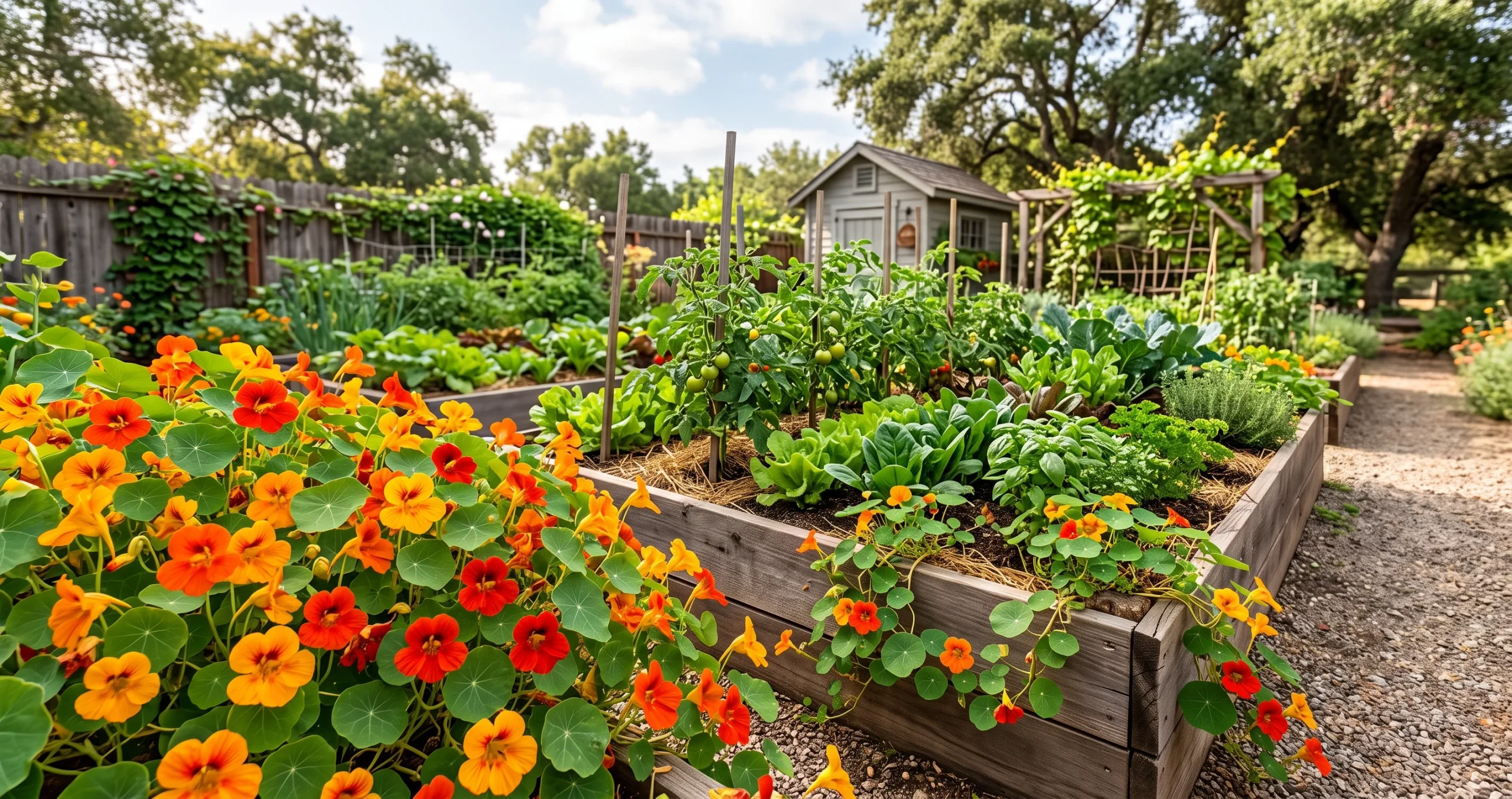
Bright orange, yellow, and red nasturtium flowers may look purely ornamental, but these fast-growing annuals can play a useful role in vegetable-garden pest management. Used correctly, nasturtium trap crop pest control works by making nasturtiums a more attractive target for certain insects, concentrating pest activity on plants you are prepared to monitor or sacrifice instead of relying on the unrealistic idea that companion plants magically repel everything.
Nasturtiums are especially associated with aphids and flea beetles as trap plants, and research also suggests benefits when nasturtiums are grown with some brassicas and cucurbits. The important point is that a trap crop is a management technique, not a passive decoration: placement, timing, monitoring, and what you do after pests arrive determine whether it actually helps. Utah State University Extension specifically lists nasturtiums among trap crops that can attract aphids and flea beetles.
Table of Contents
- What Is a Trap Crop?
- Why Nasturtiums Can Work as Trap Crops
- Nasturtiums and Aphids
- Which Vegetable Crops Can Benefit?
- Where to Plant Nasturtiums
- How to Establish a Nasturtium Trap Crop
- What to Do When Pests Arrive
- Removal vs. Tolerance
- Beneficial Insects Change the Equation
- Other Useful Trap Crop Pairings
- Common Mistakes
- Common Myths
- Frequently Asked Questions
- Conclusion
What Is a Trap Crop?
A trap crop is a plant deliberately grown because a particular pest finds it highly attractive. Ideally, the insect settles or feeds on the trap plant rather than causing as much damage to the crop the gardener wants to harvest.
This is a recognized cultural technique within integrated pest management, or IPM. Utah State University Extension defines trap cropping as growing more pest-attractive plants alongside the target crop, while the University of Minnesota similarly describes trap crops as plants that draw pests away from the main garden plants.
The concept sounds simple, but an effective trap crop system has several parts.
The trap plant needs to be attractive to the specific pest involved. It also needs to be present at the right time, positioned where incoming pests can find it, and monitored so it does not simply become a nursery producing more pests.
That final point is often missing from simplified companion-planting advice.
How Nasturtium Trap Crop Pest Control Works?
Garden nasturtiums, generally Tropaeolum majus and related cultivated forms, are vigorous annual plants with rounded leaves and colorful edible flowers.
They can be attractive to several insects. Utah State University Extension specifically identifies nasturtiums as trap crops for aphids and flea beetles and notes their use with brassicas such as broccoli, cabbage, cauliflower, kale, and Brussels sprouts.
Oregon State University Extension materials also describe nasturtiums as plants that can distract or repel aphids and several other garden pests while attracting predatory insects.
That does not mean every aphid in your garden will abandon a vegetable and move to a nasturtium.
Aphids comprise many species with different host preferences. Trap cropping therefore works best as one component of an IPM strategy rather than as a universal pest barrier.
Nasturtiums and Aphids
Aphids reproduce quickly when conditions suit them.
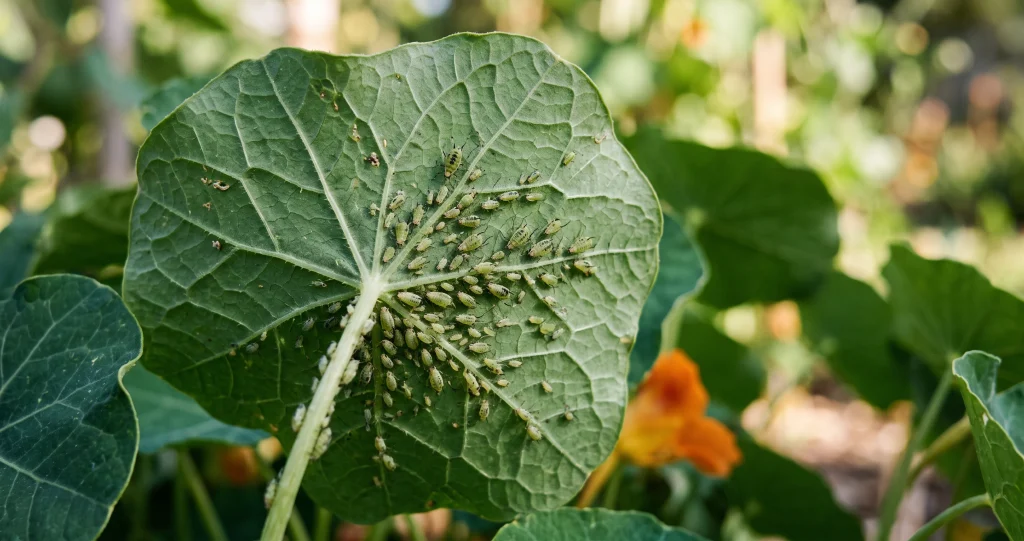
Colonies frequently develop around tender shoots, young leaves, and stems, where the insects feed on plant sap. A gardener may consequently find a nasturtium stem covered with aphids while nearby plants remain much less populated.
When that happens, the trap plant has done something useful: it has made a portion of the pest population easier to locate and manage.
Instead of searching dozens of vegetable plants for scattered colonies, you may be able to concentrate attention on several heavily colonized nasturtiums.
However, success requires observation.
If aphids multiply unchecked and winged individuals begin dispersing, an unmanaged trap crop could cease being helpful. The goal is concentration followed by deliberate management—not unlimited pest reproduction.
Which Vegetables Benefit Most?
Nasturtiums are often discussed alongside brassicas, including:
- Cabbage
- Kale
- Broccoli
- Cauliflower
- Brussels sprouts
Utah State University Extension specifically lists nasturtium as a trap crop associated with brassicas.
There is also evidence that nasturtiums can contribute to pest-management systems beyond aphids. University of Minnesota Extension reports that research found nasturtium useful in reducing cabbage looper and imported cabbageworm damage in broccoli, while nasturtium and marigold reduced those pests in cabbage in another study.
The same Extension review reports research supporting nasturtiums around squash, including reduced squash bug populations and reduced damage involving squash bugs and cucumber beetles in particular studies.
These findings are more useful than broad claims that nasturtiums “protect vegetables from pests.”
The effect depends on the crop, insect, arrangement, location, and growing conditions.
Where to Plant Nasturtiums for the Best Effect
Randomly placing one nasturtium somewhere in a large vegetable garden is unlikely to create a reliable trap-crop system.
Think about interception.
If pests typically arrive from outside the garden, plants along the perimeter can encounter them before they reach the main crop. Perimeter trap cropping is an established strategy for some crop-pest combinations.
In a home garden, practical arrangements include placing nasturtiums near the outer edges of a brassica bed or establishing several plants around particularly valuable crops.
Avoid burying every nasturtium deep inside dense vegetable foliage. You want to be able to inspect the leaves and stems easily.
Spacing also matters.
Nasturtiums can spread substantially, especially trailing varieties. They should attract pests without smothering seedlings or competing excessively with the vegetables they are intended to protect.
Plant Nasturtiums Early Enough
Timing can determine whether a trap crop succeeds.
Ideally, the trap plants should be sufficiently developed and attractive when the target pest arrives. Waiting until an infestation is already severe before sowing nasturtiums is unlikely to provide the same benefit.
This timing principle is well demonstrated in other trap-cropping systems.
For example, University of Minnesota Extension recommends establishing Blue Hubbard squash one or two weeks before the main cucurbit crop when using it against striped cucumber beetles. Utah State University trials similarly planted Blue Hubbard squash before pumpkins so the trap plants were available to early-arriving squash bugs.
The exact schedule for nasturtiums depends on climate and frost dates, but the general lesson is transferable: the trap needs to be operating before the pest overwhelms the crop.
Nasturtiums are frost-sensitive, so gardeners in colder climates should coordinate planting with safe outdoor conditions.
A Simple Nasturtium Trap-Crop Setup
Start with healthy nasturtiums positioned near vegetables vulnerable to the pests you are trying to manage.
Do not treat the entire garden as one system. Choose a specific target—for example, reducing aphid pressure around a small brassica planting.
Then monitor both groups.
Check the underside of nasturtium leaves, growing tips, stems, and flower stalks. At the same time, inspect the vegetables you are trying to protect.
The comparison is important.
Seeing aphids on a nasturtium does not by itself prove the system is protecting another crop. The meaningful observation is whether pests are concentrating on the trap plants while remaining manageable on your vegetables.
For more ideas on building a garden around natural ecological processes, explore the gardening guides at Secrets of the Green Garden.
What to Do Once the Nasturtiums Are Covered With Pests
This is the step that turns a colorful companion planting into actual pest management.
Once large numbers of aphids or another target pest concentrate on a trap plant, decide whether to remove them, remove part of the plant, remove the entire plant, or temporarily tolerate the colony.
The right choice depends partly on what else is happening in the garden.
Option 1: Remove Heavily Infested Growth
If one or two stems contain most of the aphids, pruning those sections can physically remove a substantial portion of the colony.
Bag or otherwise dispose of heavily infested material appropriately rather than dropping it immediately beside susceptible vegetables.
If an entire annual nasturtium has become overwhelmed and pests are beginning to disperse, removing the whole plant may be more useful.
You can replace it with another trap plant if enough growing season remains.
Option 2: Physically Remove the Aphids
For a manageable colony, a strong stream of water can knock many aphids from the plant.
Hand removal is another option for small gardens.
Whatever method you use, continue monitoring. One treatment does not guarantee that another colony will not develop.
Option 3: Tolerate Some Aphids
An aphid-covered stem can look alarming without automatically requiring destruction.
Aphids are food for lady beetles, lacewing larvae, hoverfly larvae, parasitoid wasps, and other beneficial organisms. If predators and parasitoids are already arriving and the nasturtium remains reasonably healthy, tolerating part of the colony may support biological control.
This requires judgment rather than a rigid rule.
A moderate aphid colony surrounded by natural enemies is different from a rapidly expanding population beginning to spread onto young vegetable plants.
Removal Versus Tolerance: Watch the Trend
A useful trap crop does not need to remain cosmetically perfect.
Its purpose is to accept pest pressure.
If most pests remain concentrated on the nasturtiums, your vegetables show little damage, and natural enemies are becoming abundant, immediate removal may be unnecessary.
If colonies are expanding quickly, the nasturtium is severely declining, or pests are spreading onto the crop, intervene.
This illustrates a central principle of integrated pest management: decisions should be based on identification, monitoring, damage, and pest abundance, not simply the presence of an insect.
Nasturtiums Can Support More Than Pest Diversion
Nasturtiums produce flowers that can contribute floral resources in a diverse garden.
Flowering plants can support pollinators and some beneficial insects, although their effects vary among species and environments. Utah State University Extension includes nasturtium among flowering companion plants that can attract pollinators.
This creates an interesting balance.
A nasturtium may simultaneously harbor aphids and provide resources within a garden ecosystem that supports insects involved in pollination or pest suppression.
That is another reason indiscriminately spraying every infested trap plant can undermine the broader goal.
Other Trap Crops Worth Knowing
Nasturtiums are only one option.
The best trap plant depends on the pest and vegetable crop involved.
Blue Hubbard Squash + Cucurbits
This is one of the better-documented examples.
Blue Hubbard squash is highly attractive to pests including squash bugs and striped cucumber beetles. University of Minnesota Extension recommends it as a trap crop for cucumber beetles, while Utah State University field trials found significantly more squash bugs and eggs on pumpkins grown without their Blue Hubbard trap-crop treatment than on pumpkins in treated plots.
The trap crop still needs management. In the Utah trial, insects and eggs on the Blue Hubbard plants were physically removed.
Mustards + Brassicas
Certain mustard plants can serve as trap crops for pests of cruciferous vegetables.
Utah State University’s vegetable IPM guidance lists various mustards for flea beetles on cruciferous crops and for diamondback moth management in cabbage.
Radishes + Cabbage-Family Crops
Utah State University Extension lists radishes among trap-cropping examples for flea beetles, root maggots, and cabbage maggots in relation to cabbage-family plants.
These examples reinforce an important rule: match the trap crop to a specific pest rather than planting random “pest-repelling” flowers.
Common Mistakes With Nasturtium Trap Crop Pest Control
The first mistake is assuming that planting nasturtiums automatically protects everything nearby.
Trap cropping is targeted pest management. It does not create an invisible shield.
Another mistake is failing to inspect the trap plants.
A nasturtium that attracts pests and then receives no attention may simply support a growing population. Research on other trap-crop systems repeatedly emphasizes managing pests after they concentrate on the trap crop.
Gardeners also sometimes use companion planting as a replacement for basic IPM practices.
Continue identifying insects correctly, inspecting leaf undersides, removing badly affected material when appropriate, encouraging beneficial insects, rotating crops when useful, and maintaining healthy plants.
Common Myths About Nasturtiums
Myth: Nasturtiums Repel Every Garden Pest
No plant provides universal pest protection.
Evidence for companion planting is highly specific. University of Minnesota Extension notes that some commonly repeated companion-plant claims are supported by research while others are not.
Myth: More Nasturtiums Always Mean Better Protection
Not necessarily.
Too many vigorous plants can compete for space, shade young vegetables, and make inspection difficult. Trap crops should be strategically placed rather than allowed to overwhelm the bed.
Myth: Aphids on Nasturtiums Mean the Strategy Failed
Often, the opposite may be true.
A trap plant is intended to attract the target pest. Finding aphids concentrated there can be exactly the behavior you hoped to encourage.
The next question is whether the vegetables are experiencing less pressure and whether the aphid population on the trap plant remains manageable.
Myth: Never Remove an Infested Trap Plant
Trap crops sometimes need to be pruned, treated, or removed.
In Utah State University’s Blue Hubbard research, pests concentrated on the trap crop were deliberately removed. The researchers emphasize that managing the pest on the trap crop is important for the system to work effectively.
Myth: Nasturtiums Eliminate the Need for Other Pest Controls
They do not.
Think of nasturtium trap crop pest control as one tool within a larger IPM program, not a complete replacement for monitoring, physical controls, crop rotation, exclusion, sanitation, or biological control.
Frequently Asked Questions
Are nasturtiums really a trap crop for aphids?
Yes, they can be. Utah State University Extension specifically lists nasturtiums as trap plants for aphids and flea beetles.
Results will still vary because aphid species have different host preferences.
Should I plant nasturtiums next to cabbage?
They can be useful around cabbage-family crops.
Utah State University Extension lists nasturtium as a trap crop for brassicas, while University of Minnesota Extension discusses research in which nasturtium helped reduce damage from cabbage pests in certain trials.
Should I destroy nasturtiums covered in aphids?
Not automatically.
If the aphids remain concentrated and predators such as lady beetles, hoverfly larvae, or lacewings are controlling them, some tolerance may be useful. If the population is expanding rapidly toward valuable crops, prune or remove heavily infested growth.
Can nasturtiums make an aphid problem worse?
Potentially, if a trap crop is allowed to support a rapidly growing pest population without monitoring or management.
That is why trap cropping should not be confused with simply planting a companion flower and ignoring it.
Can nasturtiums protect tomatoes?
Avoid making this a general promise.
The evidence and Extension recommendations are stronger for particular crop-pest combinations, especially brassicas and certain cucurbit systems. For tomatoes, first identify the actual pest and select management methods supported for that pest.
Do nasturtiums attract beneficial insects?
Their flowers can contribute resources for visiting insects, and Extension guidance includes nasturtiums among plants useful for attracting pollinators or predatory insects.
A diverse planting generally provides more ecological functions than relying on one flower species alone.
What is another reliable trap crop?
Blue Hubbard squash is one of the best-known examples for cucurbit pests.
Extension recommendations and field research support its use for concentrating squash bugs and cucumber beetles away from other cucurbits.
Conclusion
The value of nasturtium trap crop pest control is not that nasturtiums magically drive insects out of a garden. Their usefulness comes from something more practical: certain pests may prefer or readily colonize them, allowing gardeners to concentrate pest activity where it can be observed and managed.
That distinction changes how nasturtiums should be used.
Plant them strategically near crops you are trying to protect, establish them early enough to be useful, inspect them regularly, and compare pest activity on the trap plants with activity on your vegetables.
Once pests accumulate, respond according to what you see. Small populations can sometimes remain as food for natural enemies, while rapidly expanding colonies may justify pruning, physical removal, or sacrificing an entire trap plant.
Most importantly, keep expectations realistic. Nasturtiums are not universal insect repellents, and trap cropping does not replace integrated pest management.
Used as part of a thoughtful system, however, these colorful plants can do much more than decorate the vegetable garden. They can help turn pest pressure into something visible, concentrated, and easier to manage.
External Sources:
- Utah State University Extension — Companion Planting and Trap Cropping — identifies nasturtiums as trap plants for aphids and flea beetles and discusses their use with brassicas.
- University of Minnesota Extension — Companion Planting in Home Gardens — reviews research on nasturtiums, cabbage pests, squash pests, and other evidence-based companion planting combinations.
- Utah State University Extension — Blue Hubbard Squash Trap-Crop Trial — documents a field trial showing how a properly managed trap crop can concentrate squash bugs and reduce pressure on the primary crop.