
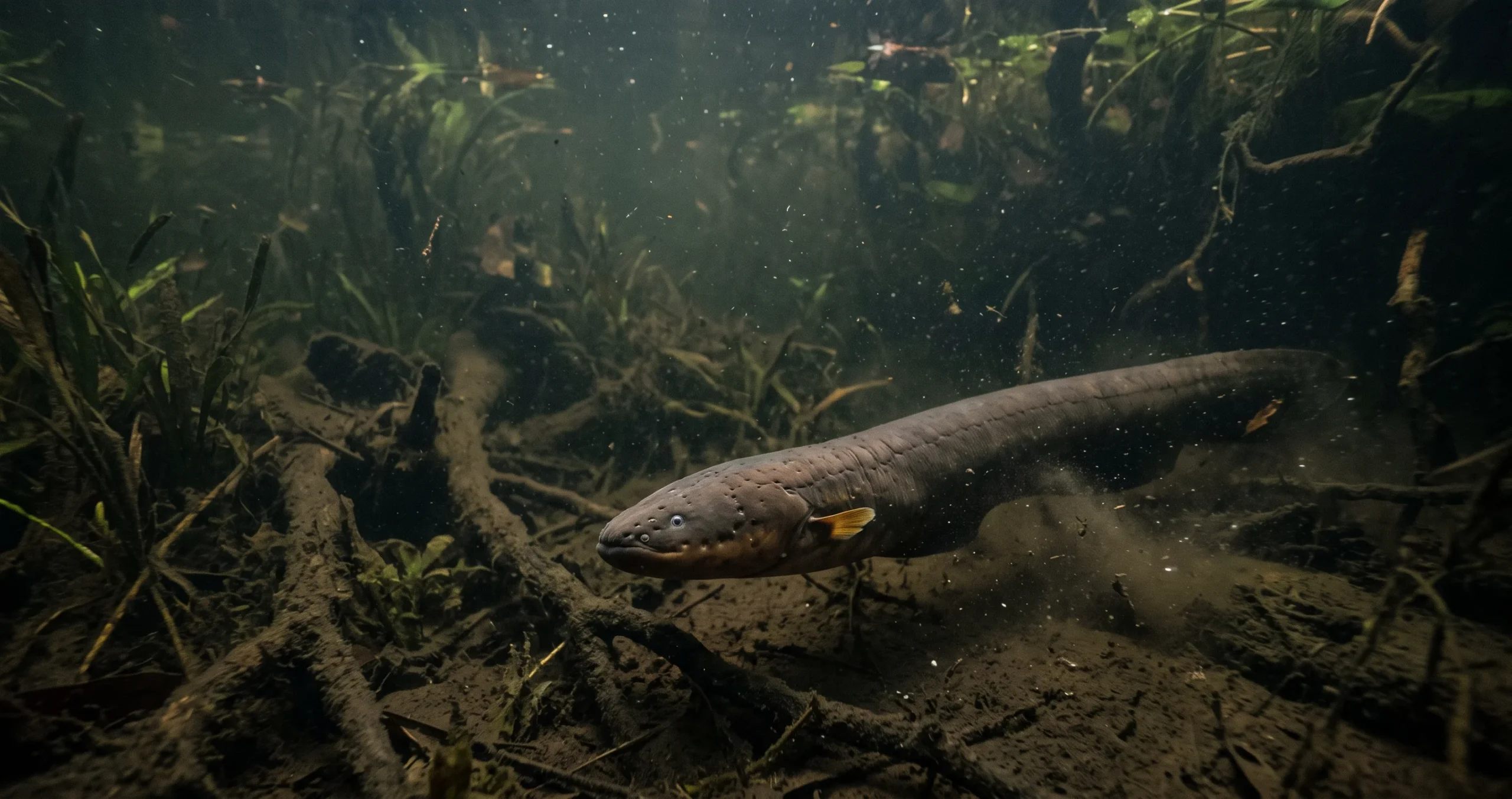
An electric eel does not carry a miniature battery inside its body. Instead, electric eel voltage is produced by thousands of specialized biological cells working together with extraordinary precision. Each cell contributes only a small electrical potential, but when thousands activate almost simultaneously, their voltages add up into a discharge powerful enough to affect the muscles and nerves of nearby prey.
Even more remarkable, electric eels do not use their electrical system only as a weapon. They produce weaker signals for sensing and communication, stronger pulses while hunting, and intense volleys during prey capture or defense. Researchers have even copied aspects of this biological system to design soft, flexible power sources for future bioelectronics.
Table of Contents
- What Is an Electric Eel?
- How Electric Eel Voltage Is Generated
- Electrocytes: Thousands of Tiny Biological Batteries
- Why Stacking Cells Creates High Voltage
- Low-Voltage Pulses vs. High-Voltage Discharges
- How Electricity Helps Electric Eels Hunt
- How Powerful Can an Electric Eel Become?
- Why Electric Eels Do Not Simply Shock Themselves
- Electric Eels and Bio-Inspired Batteries
- Common Electric Eel Myths
- Frequently Asked Questions
- Conclusion
What Is an Electric Eel?
Despite its common name, an electric eel is not a true eel. It belongs to the South American knifefish lineage and the genus Electrophorus.
These elongated freshwater fish inhabit waters of northern South America, where visibility can be poor. Electricity provides an alternative way to gather information about their surroundings and interact with prey.
Scientists once treated electric eels as a single species, Electrophorus electricus. Research published in Nature Communications in 2019 identified three major lineages recognized as species, including Electrophorus voltai, which produced a measured discharge of 860 volts.
That discovery also corrected a common oversimplification: there is no single maximum electric eel voltage that applies to every species and every individual.
How Electric Eel Voltage Is Generated
The electrical system begins with specialized cells called electrocytes.
Electrocytes are modified muscle-derived cells. Instead of contracting to produce mechanical movement, they are specialized for generating electrical potential through controlled movements of ions across their cell membranes.
The principle resembles what happens in nerves and muscles throughout the animal kingdom. Cell membranes maintain differences in concentrations of charged ions, and specialized channels control their movement.
Electric eels have taken this basic biological mechanism to an extreme.
Their electric organs contain thousands of electrocytes arranged in organized stacks. When the eel’s nervous system activates large numbers of them together, their small electrical contributions combine into a much larger output.
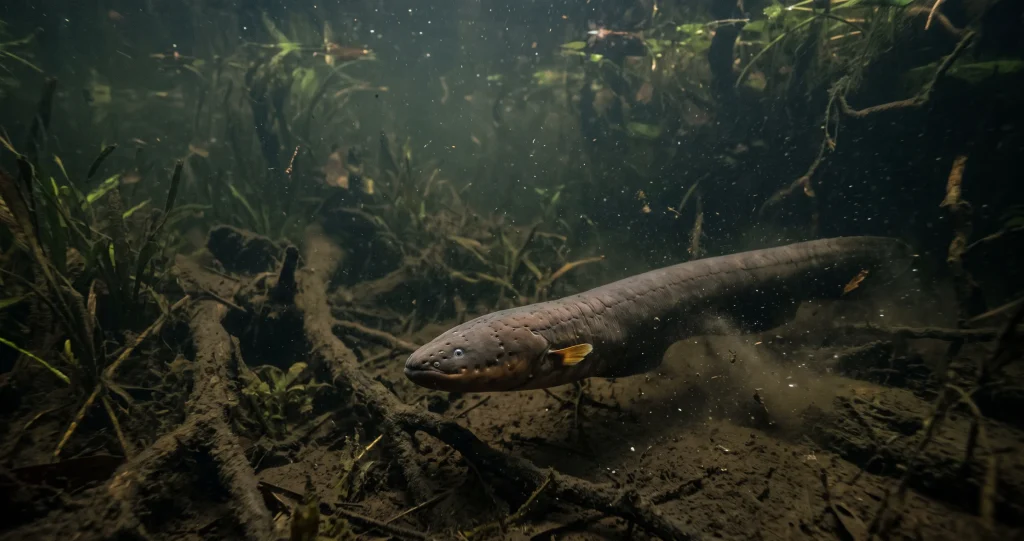
Electrocytes: Thousands of Tiny Biological Batteries
A useful analogy is a stack of batteries.
A single small battery provides limited voltage. Connect multiple batteries in series, however, and their voltages add together.
Electric eel electrocytes operate according to a comparable principle, although the underlying biology is far more sophisticated than a manufactured battery.
An individual electrocyte produces only a relatively small voltage across its membrane. The eel solves this limitation through scale and organization: thousands of electrocytes can be activated together.
Research into eel-inspired power systems describes these cells as arranged in series, allowing their potential differences to add. The same basic concept has inspired engineers to arrange artificial ion-gradient compartments in stacks.
Why Stacking Creates High Electric Eel Voltage
Imagine one electrocyte contributing a tiny electrical push.
That alone is not enough to incapacitate a fish.
Now imagine thousands arranged so that each electrical potential adds to the next. The combined potential difference can become enormous.
This arrangement is one reason the electric organs occupy so much of the animal’s elongated body. Electric eels have evolved a large biological structure dedicated to electrogenesis.
Activation must also be tightly coordinated. The nervous system triggers large populations of electrocytes so their electrical contributions occur together rather than randomly.
That synchronization turns many tiny biological electrical events into one powerful discharge.
Low-Voltage Pulses vs. High-Voltage Discharges
Electric eels do not operate at maximum power all the time.
They have multiple patterns of electrical discharge suited to different jobs. Research led by Vanderbilt University neurobiologist Kenneth Catania documented low-voltage pulses used in sensing, brief high-voltage doublets or triplets during hunting, and high-frequency volleys of high-voltage pulses during prey capture and defense.
Low Voltage for Sensing
In dark or muddy water, vision is limited.
Weak electric signals help the fish perceive its surroundings through electrolocation. Objects and organisms can distort the electric field around the animal, providing information that the eel can detect.
The 2019 study describing three electric eel species characterized weaker discharges used for electrolocation and communication at roughly 10 volts, compared with hundreds of volts for strong discharges.
This means electric eel voltage is not simply an on-or-off weapon. It is part of a sophisticated sensory system.
High Voltage for Hunting
The high-voltage system has a dramatically different purpose.
When hunting, electric eels can emit very brief doublets or triplets. Experiments found that these pulses can trigger involuntary muscle contractions in hidden prey.
That movement gives away the prey’s location.
Once a target is located, the eel can release a rapid volley of high-voltage pulses. Experiments showed that prey can become immobilized within only a few milliseconds after such a volley begins.
In effect, the eel can use electricity both to find an animal and to disable it.
How Electricity Lets an Eel Control Prey
The effect is not simply a vague “shock.”
Electrical pulses affect excitable tissues, including the nerves controlling muscles.
Catania’s experiments demonstrated that an electric eel’s high-voltage discharge can remotely activate prey motor neurons, causing involuntary muscle contractions. This gives the predator an extraordinary form of remote control over another animal’s muscles.
When the eel suspects prey is hiding nearby, a short electrical sequence can cause the hidden animal to twitch.
The resulting movement creates water disturbances that the eel can detect. Once the prey has revealed itself, a sustained high-frequency volley can produce intense involuntary contractions and immobilization.
Electric eels can even curl around difficult prey after grasping it.
This maneuver positions the prey between the eel’s electrically important head and tail regions, concentrating the electrical field through the target. Experiments found that this behavior can more than double the electrical effect received by prey.
For another example of an animal evolving an unusual biological system for survival, explore our wildlife articles at Secrets of the Green Garden.
How Powerful Can an Electric Eel Become?
Older descriptions commonly state that electric eels produce approximately 600 volts.
That figure is not universally wrong, but it is incomplete.
Different Electrophorus species have different recorded maximum outputs. In 2019, researchers reported approximately 650 volts for E. electricus and recorded up to 860 volts from E. voltai. The latter was described as the strongest known living bioelectricity generator.
Voltage alone, however, does not tell the entire story.
The biological effect of an electrical discharge depends on factors such as current, pulse duration, frequency, electrical resistance, contact conditions, and the pathway the current takes.
This is why comparing an electric eel directly with a household electrical outlet based solely on voltage can be misleading.
Why Electric Eels Don’t Simply Shock Themselves
This question sounds paradoxical. If an electric eel is surrounded by conductive water and generates hundreds of volts, why isn’t its own body incapacitated?
The answer is more complicated than the popular claim that electric eels are simply “immune to electricity.”
Their electric organs and body are part of the electrical circuit, and the animal’s anatomy influences where current flows. The elongated arrangement of the electrical organs establishes a potential difference along the body, while surrounding water provides possible current paths.
An electric eel therefore does experience electrical conditions associated with its own discharge. What it does not experience is the same concentrated electrical exposure that a small prey animal may receive when positioned in the eel’s external electric field.
Its specialized anatomy, large body, tissue properties, and geometry help distribute current differently than it is distributed through small nearby prey.
Researchers still have reasons to investigate the precise physiological protections involved. It is safer scientifically to say electric eels are adapted to producing and tolerating their own discharges, rather than claiming they are completely insulated or electrically immune.
Their behavior also allows them to manipulate where the strongest field occurs.
The curling maneuver used against prey is a striking example. By bringing the head and tail closer together with prey between them, the eel concentrates the electrical effect through its victim rather than merely releasing an undirected shock into the surrounding water.
Electric Eels Are Inspiring New Battery Designs
Electric eel research extends well beyond zoology.
Engineers are interested in the animal because ordinary batteries can be rigid, chemically aggressive, and poorly suited to direct integration with living tissue.
The electric organ offers a different model: generate electrical energy using ions, selective membranes, concentration gradients, soft biological materials, and repeated units.
In 2017, researchers reported an artificial electric-organ concept in Nature. Instead of electrocytes, they used hydrogel compartments with different ion concentrations and ion-selective membranes.
Stacking the artificial units allowed their electrical potential to accumulate, just as many electrocytes work together in an eel. The system reached 110 volts at open circuit in one configuration.
The long-term goal is not simply to create an artificial eel.
Researchers are exploring soft power sources that could eventually be useful for technologies such as implantable sensors, prosthetic systems, medical devices, and soft robotics.
More recent research published in Nature developed a miniaturized ionic power source using networks of tiny hydrogel droplets. The device was designed to mimic key principles of the eel’s ion-gradient system and was able to influence neuronal activity experimentally.
In 2024, researchers also reported flexible, printable biomimetic ionic hydrogel power sources inspired by electric eels, demonstrating how the underlying principle continues to influence materials science and flexible electronics.
The electric eel therefore offers engineers an intriguing lesson: high biological voltage does not require metal electrodes and conventional battery chemistry. Nature can generate useful electrical energy using water, ions, membranes, and precisely organized soft tissues.
Common Myths About Electric Eel Voltage
Myth 1: Electric Eels Are True Eels
They are not.
Electric eels are South American knifefishes. Their eel-like appearance explains the common name, but it does not indicate their closest biological relationships.
Myth 2: Every Discharge Is an 860-Volt Shock
No.
The record of 860 volts was measured in Electrophorus voltai. Electric eels also deliberately produce much weaker electrical signals, including low-voltage discharges associated with sensing and communication.
Myth 3: Electricity Is Used Only to Kill Prey
Research paints a far more interesting picture.
Electrical discharges can assist with electrolocation, communication, detecting hidden prey, tracking prey, immobilization, and defense. High-voltage signals can therefore serve both sensory and offensive functions.
Myth 4: Electric Eels Store Electricity Like a Charged Household Battery
The battery comparison is useful for explaining stacked electrocytes, but it should not be taken literally.
Electric organs generate potential through biological ion gradients and membrane processes. They are living electrochemical systems, not conventional batteries hidden inside the fish.
Myth 5: Electric Eels Are Completely Immune to Electricity
That is another oversimplification.
Their bodies are highly specialized for producing and tolerating electrical discharges, but this is not equivalent to being universally immune to electrical current.
Frequently Asked Questions
What is the highest recorded electric eel voltage?
A 2019 study reported a discharge of up to 860 volts from Electrophorus voltai. Researchers described it as the strongest known living bioelectricity generator.
How does an electric eel make electricity?
Specialized cells called electrocytes use ion gradients across their membranes to produce electrical potential.
Thousands of these cells are arranged so their electrical contributions can add together. Coordinated activation allows the electric organ to generate a powerful discharge.
Does an electric eel use maximum voltage continuously?
No.
Electric eels produce different discharge patterns. Weak electrical signals can assist with sensing and communication, while stronger pulses are associated with hunting, prey capture, and defense.
Can an electric eel detect hidden prey?
Yes.
Experiments showed that brief high-voltage doublets or triplets can cause hidden prey to twitch. The eel can detect the resulting water movement, helping reveal the prey’s position.
Can electric eels shock themselves?
They are not simply electrically immune. Their specialized anatomy and the geometry of their electrical system allow them to tolerate their own normal discharges while directing useful electric fields into the surrounding environment.
Why do electric eels curl around prey?
Curling brings electrically important regions near opposite ends of the eel closer together, with prey positioned between them.
Experiments showed that this maneuver can more than double the electrical effect delivered to difficult prey.
Are scientists building electric-eel-inspired batteries?
Yes, although these experimental devices differ substantially from commercial batteries.
Researchers have created soft ionic power sources using hydrogels, ion gradients, and selective membranes to mimic principles found in electrocytes. Potential applications being investigated include implantable devices, bioelectronics, sensors, and soft technologies.
Conclusion
The extraordinary electric eel voltage comes from multiplication rather than from one gigantic biological generator. Thousands of specialized electrocytes each contribute a small electrical potential, and their organized arrangement allows those potentials to combine into a powerful discharge.
But focusing only on the maximum voltage misses much of what makes these fish extraordinary. Electric eels regulate their electrical behavior, using weak signals to gather information and stronger patterns to expose, track, immobilize, or defend against other animals.
Research has also revealed surprising complexity in the genus itself. Scientists now recognize multiple electric eel species, and Electrophorus voltai has produced a measured discharge of up to 860 volts.
Perhaps the most remarkable part of the story is that this adaptation is influencing human technology. By studying how thousands of soft biological cells coordinate ion movement to create substantial voltage, engineers have developed experimental hydrogel systems that mimic some of the same principles.
Electric eels evolved their electrical organs to survive in South American freshwater ecosystems. Centuries after they first fascinated scientists, those same organs are helping researchers rethink how future soft, biocompatible power sources might work.
External Sources:
- Nature Communications — Unexpected species diversity in electric eels and the 860-volt E. voltai finding
Primary research on electric eel diversity, electrogenesis, weak discharges, and the record 860-volt measurement. - Vanderbilt University — Electric eel hunting and electrical behavior research
Research overview of Kenneth Catania’s work on sensing, high-voltage hunting pulses, prey immobilization, and curling behavior. - Nature — An electric-eel-inspired soft power source from stacked hydrogels
Primary research describing a soft artificial electric organ inspired by stacked electrocytes and biological ion gradients.