
Introduction
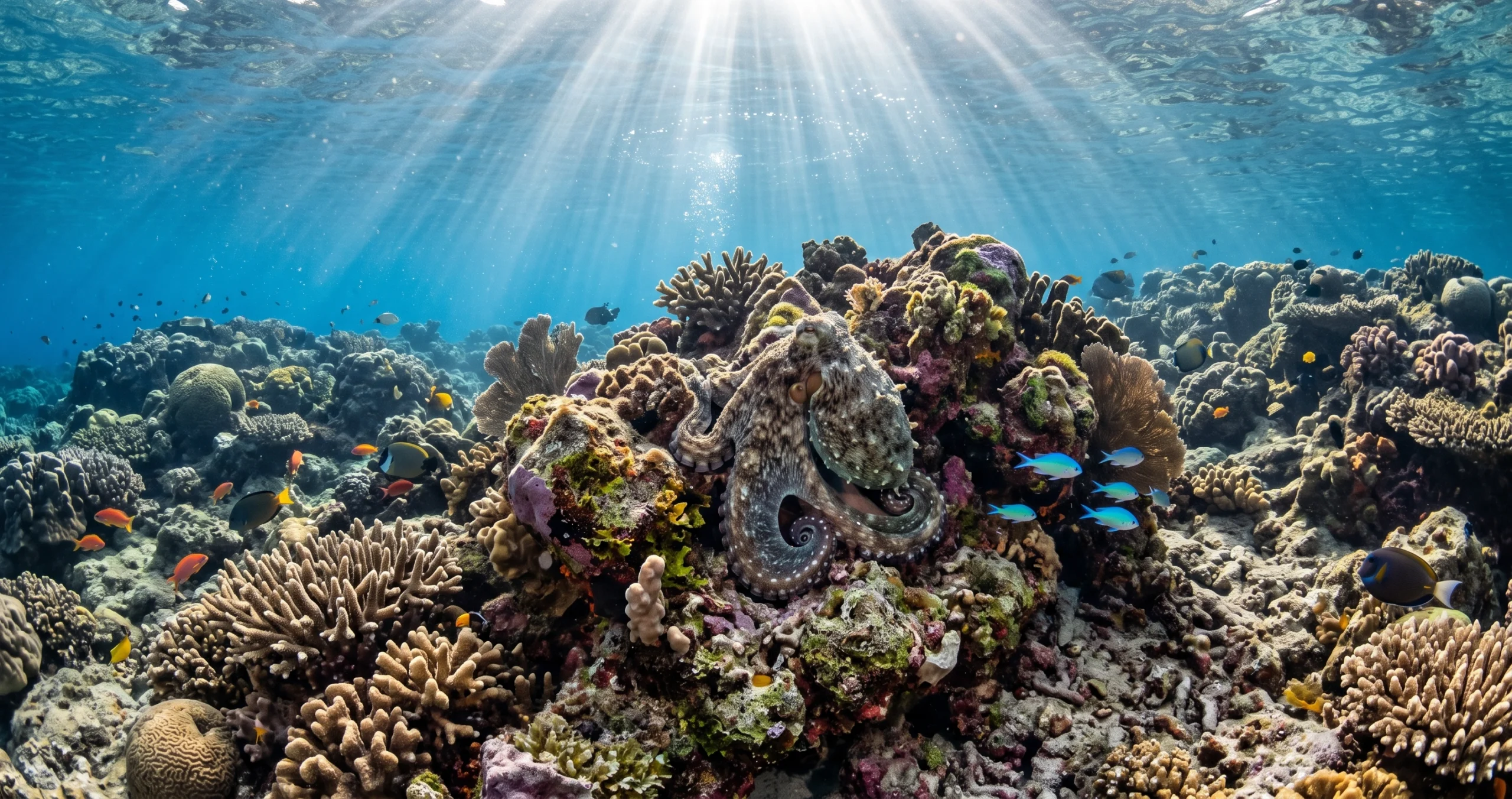
Imagine looking at the world without seeing colors—yet somehow blending perfectly into a bright coral reef, a bed of green seaweed, or a patch of red volcanic rock within seconds. It sounds impossible, but this is exactly what octopuses appear to do every day.
Octopuses are famous for their extraordinary camouflage. Videos of these intelligent animals disappearing into their surroundings have amazed scientists and nature lovers for decades. One moment an octopus is clearly visible; the next, it has seemingly vanished, matching not only the texture of the seafloor but also its color and brightness with astonishing accuracy.
The mystery becomes even more fascinating when you learn that most octopus species are believed to be colorblind. Unlike humans, who use three types of color-sensitive cone cells to perceive millions of colors, octopuses appear to possess only a single visual pigment. In theory, they should see the world largely in shades of brightness rather than distinct colors.
So how can an animal that cannot perceive colors consistently match colorful environments?
This question has puzzled marine biologists for decades and inspired some of the most exciting research in animal physiology. Scientists now know that the answer involves an incredible combination of specialized skin cells, advanced nervous system control, and possibly even the ability for an octopus’s skin to sense light directly.
The story of octopus camouflage colorblind adaptations reveals just how different evolution can be when solving the same survival problem.
Are Octopuses Really Colorblind?
Before exploring their camouflage, it’s important to understand what scientists mean when they say octopuses are colorblind.
Humans detect color using three types of cone cells in the retina that respond to red, green, and blue wavelengths of light. By comparing signals from these cones, our brains reconstruct the full spectrum of visible colors.
Most octopuses, however, possess only one type of visual pigment.
Without multiple cone types, they likely cannot distinguish colors the way humans do.
Instead, they excel at detecting:
- Contrast
- Brightness
- Edges
- Movement
- Polarized light
Their eyesight is highly effective for hunting prey and avoiding predators, even if their perception of color is limited.
Scientists continue studying whether some optical mechanisms in the octopus eye allow limited color discrimination under certain conditions, but the prevailing evidence still supports the idea that most octopuses are effectively colorblind.
The Secret Lies in Their Incredible Skin
The true magic of octopus camouflage happens not in the eyes—but in the skin.
Their skin contains several specialized layers that work together like an advanced biological display.
Chromatophores: Nature’s Tiny Color Pixels
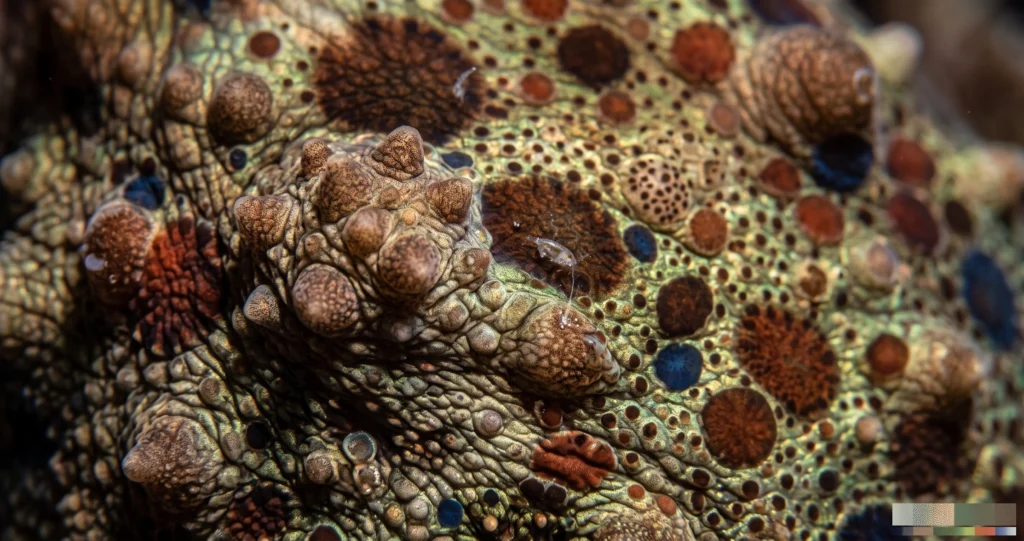
The outermost layer contains thousands of pigment sacs called chromatophores.
Each chromatophore is surrounded by tiny muscles controlled directly by the octopus’s nervous system.
When these muscles contract, the pigment sac expands.
When they relax, the pigment contracts.
Different chromatophores contain pigments such as:
- Yellow
- Orange
- Red
- Brown
- Black
By expanding or shrinking thousands of these pigment sacs simultaneously, an octopus can rapidly create complex patterns across its body in less than a second.
Think of chromatophores as living pixels controlled individually by the brain.
Iridophores: Creating Iridescent Colors
Beneath the chromatophores lies another remarkable layer called iridophores.
Unlike chromatophores, iridophores do not contain pigments.
Instead, they reflect light using microscopic crystalline structures.
These cells produce:
- Metallic blues
- Greens
- Silvers
- Gold reflections
- Iridescent effects
The exact color depends on how incoming light interacts with the microscopic layers.
This structural coloration is similar to what creates the shimmering colors seen in soap bubbles or butterfly wings.
Leucophores: Natural White Reflectors
The deepest reflective layer contains leucophores.
These cells scatter incoming light in many directions.
Instead of producing bright colors, leucophores act like adjustable white surfaces that reflect whatever ambient light is available.
They help octopuses match the brightness and overall appearance of their surroundings, making camouflage even more convincing.
Together, chromatophores, iridophores, and leucophores create one of the most sophisticated camouflage systems ever discovered.
The Leading Theory: Can Octopus Skin Sense Light?
One of the most exciting discoveries in recent years suggests that octopus skin itself may detect light.
Researchers have identified light-sensitive proteins called opsins within octopus skin.
Opsins are the same family of proteins that help eyes detect light.
This finding led scientists to propose the skin-photoreception theory.
How Skin Photoreception Might Work
According to this theory, different parts of an octopus’s skin may directly respond to light without relying entirely on information from the eyes.
This could allow the animal to:
- Fine-tune camouflage locally.
- Detect changes in brightness.
- Adjust patterns automatically.
- Improve camouflage even when parts of the body are outside the visual field.
Scientists are still investigating exactly how much information the skin can detect.
Current evidence suggests the skin likely responds primarily to brightness rather than full color.
This means skin photoreception probably complements—not replaces—the visual system.
The Brain Still Plays the Main Role
Although skin photoreception is exciting, the octopus brain remains central to camouflage.
Octopuses possess one of the largest nervous systems among invertebrates.
Much of this neural processing controls their skin directly.
Within fractions of a second, the brain coordinates millions of muscle movements across thousands of chromatophores while also controlling body posture and skin texture.
This extraordinary level of control explains why octopus camouflage appears almost instantaneous.
How Octopus Camouflage Differs From Chameleon Camouflage
Octopuses and chameleons are often compared because both can change appearance.
However, the underlying biology is very different.
Speed
Octopuses often change appearance in less than one second.
Chameleons usually change over several seconds or minutes.
Purpose
Octopuses primarily camouflage themselves to avoid predators or ambush prey.
Chameleons frequently change color for communication, courtship, stress, or temperature regulation as well as camouflage.
Mechanism
Octopuses rely on:
- Chromatophores
- Iridophores
- Leucophores
- Dynamic skin texture
- Flexible body posture
Chameleons mainly change color through specialized iridophore cells that alter how light is reflected, combined with pigment-containing cells.
Texture Changes
Perhaps the greatest advantage octopuses possess is their ability to change skin texture.
They can raise fleshy papillae that imitate:
- Coral
- Rocks
- Seaweed
- Sponges
Combined with color changes, this creates camouflage that fools both predators and prey.
Why Camouflage Is So Important
Octopuses lack protective shells.
Instead, survival depends on avoiding detection.
Excellent camouflage helps them:
- Escape sharks and large fish.
- Ambush crabs and shrimp.
- Hide during daylight.
- Protect themselves while resting.
- Reduce unnecessary energy spent fleeing predators.
For an octopus, remaining unseen is often the difference between life and death.
Where Divers and Tourists Can Ethically Observe This Behavior
Watching an octopus change appearance in the wild is unforgettable—but responsible wildlife viewing is essential.
Top Destinations
Some of the best locations include:
- Indonesia (Raja Ampat)
- Philippines (Anilao and Dumaguete)
- Australia’s Great Barrier Reef
- Hawaii
- The Mediterranean Sea
- The Red Sea
Healthy coral reefs and rocky coastal habitats often provide excellent opportunities.
Observe Without Disturbing
Never touch an octopus.
Handling causes stress and may disrupt natural behaviors.
Instead:
- Maintain a respectful distance.
- Move slowly underwater.
- Let the animal decide whether to remain visible.
- Use natural light whenever possible.
Avoid Flash Photography
Bright flashes may disturb sensitive marine animals.
Many underwater photographers prefer continuous lighting or natural sunlight whenever conditions allow.
Follow Local Guidelines
Marine protected areas often have specific rules regarding wildlife interactions.
Following these regulations helps preserve delicate ecosystems for future visitors.
Common Misconceptions
Several myths about octopus camouflage continue to circulate online.
Myth: Octopuses See Colors Like Humans
Current evidence indicates that most octopuses are effectively colorblind despite their remarkable camouflage abilities.
Myth: Skin Can Fully See Colors
Researchers have discovered light-sensitive proteins in octopus skin, but there is no evidence that the skin independently “sees” colors the way eyes do.
Skin photoreception remains an active area of research.
Myth: Octopuses Copy Exact Colors
Rather than perfectly reproducing every surrounding color, octopuses match combinations of brightness, contrast, texture, and reflected light that effectively fool observers.
Myth: Chameleons and Octopuses Use the Same Mechanism
Although both change appearance, the biological systems involved are fundamentally different.
Frequently Asked Questions
If octopuses are colorblind, how do they camouflage so well?
They rely on brightness, contrast, texture, sophisticated neural control, specialized skin cells, and possibly limited light detection by the skin itself.
What are chromatophores?
Chromatophores are tiny pigment-containing sacs controlled by muscles. Expanding or contracting them changes the visible color patterns on an octopus’s skin.
What do iridophores do?
Iridophores create shimmering structural colors by reflecting light rather than using pigments.
Can octopus skin really sense light?
Scientists have identified light-sensitive proteins in octopus skin, supporting the idea that skin may detect brightness and assist camouflage, although research is still ongoing.
Are octopuses smarter than chameleons?
Octopuses are generally considered among the most intelligent invertebrates, demonstrating advanced problem-solving, learning, memory, and behavioral flexibility. Chameleons excel in different evolutionary adaptations but are not known for the same level of cognitive complexity.
Conclusion
The idea that a colorblind animal can produce some of the most convincing camouflage on Earth seems almost impossible. Yet octopuses accomplish this feat every day through an extraordinary combination of specialized skin cells, rapid neural control, sophisticated body movements, and possibly even the ability for their skin to detect light.
Far from being a contradiction, octopus camouflage colorblind adaptations demonstrate how evolution often solves problems in unexpected ways. Instead of relying on human-like color vision, octopuses use brightness, texture, reflection, and intricate skin architecture to disappear into nearly any environment.
As scientists continue exploring skin photoreception and cephalopod neuroscience, each new discovery reveals how much remains to be learned about these remarkable animals. Their abilities challenge our assumptions about vision, intelligence, and perception while reminding us that nature often achieves extraordinary results through entirely different biological pathways.
Protecting marine ecosystems ensures that future generations can continue studying—and marveling at—one of the ocean’s greatest masters of disguise.
External Authoritative Sources
- Hanlon, R. T., & Messenger, J. B. Cephalopod Behaviour. Cambridge University Press. https://www.cambridge.org/core/books/cephalopod-behaviour/
- Marine Biological Laboratory – Research on cephalopod camouflage, vision, and skin photoreception: https://www.mbl.edu/
- Smithsonian Ocean – Educational resources on octopus biology and camouflage: https://ocean.si.edu/