
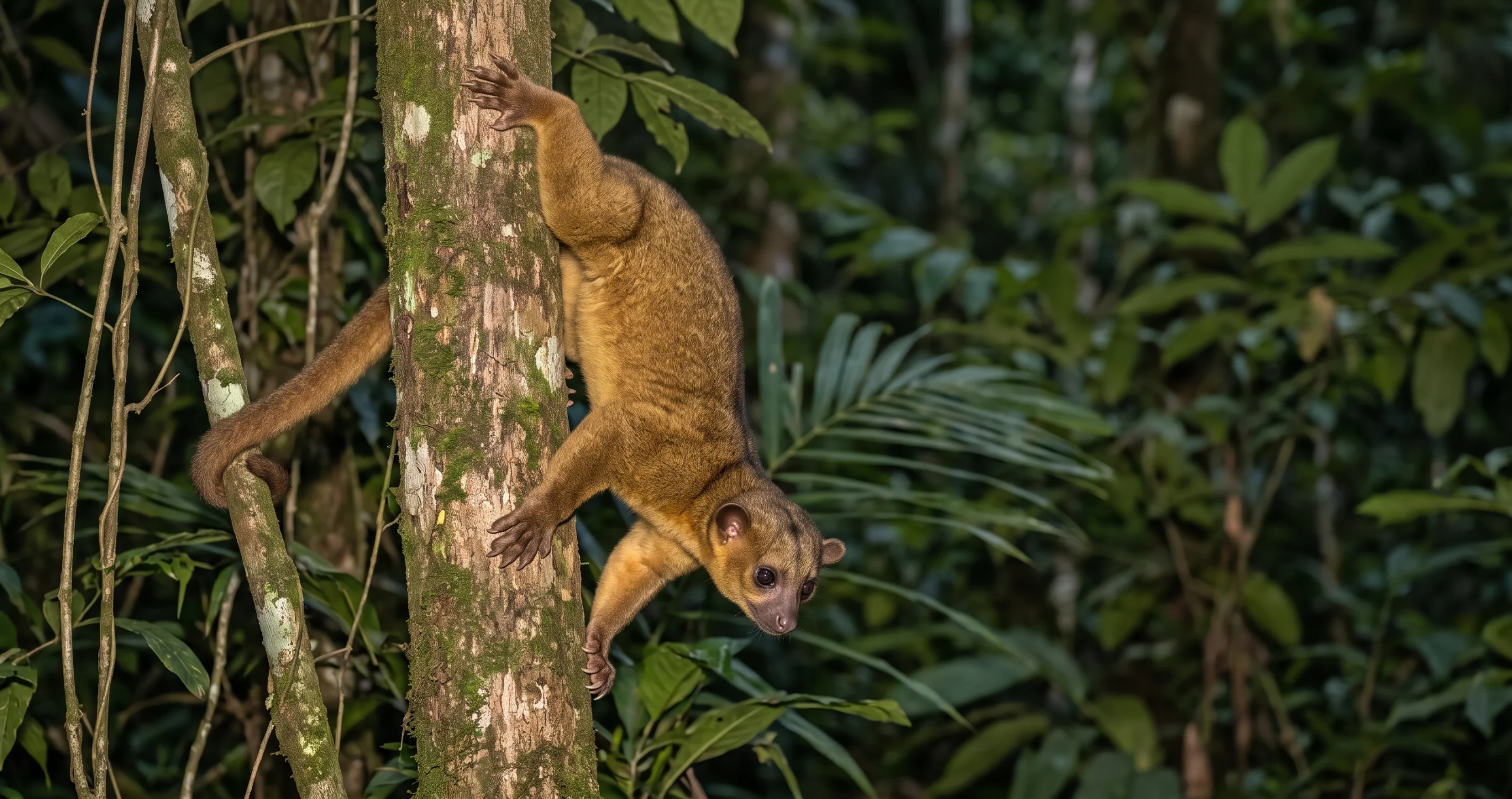
After sunset in a tropical American forest, a kinkajou may emerge from a tree hollow and begin moving through a world of trunks, vines and overlapping branches. Its movements can seem almost primate-like: it grips bark, reaches across gaps, hangs beneath branches and can descend a vertical trunk headfirst.
Much of this agility comes from the remarkable anatomy of kinkajou feet, together with curved claws, unusually mobile hind limbs, a flexible body and a long prehensile tail. Rather than relying on one extraordinary feature, the kinkajou uses several adaptations together to remain secure in the canopy.
Meet the Kinkajou
The kinkajou (Potos flavus) is a medium-sized arboreal mammal belonging to the family Procyonidae. This places it among the relatives of raccoons, coatis, ringtails and olingos within the order Carnivora. Smithsonian specimen records likewise classify Potos flavus as a procyonid carnivoran.
Its rounded head, forward-facing appearance, large eyes, grasping movements and life in trees sometimes lead people to assume that the kinkajou is a monkey or even a type of lemur. It is neither. Those similarities reflect features useful to an arboreal lifestyle rather than close evolutionary relationship. Animal Diversity Web notes that kinkajous were historically associated with primates in early taxonomy, but modern classification firmly places them among procyonids.
Kinkajous occur across a broad part of the Neotropics, from southern Mexico through Central America and into much of tropical South America. They inhabit several forest types, including humid evergreen forest, rainforest and some secondary forests.
They are predominantly nocturnal and highly arboreal. During daylight hours they generally rest in sheltered places such as tree hollows or dense vegetation, becoming active after dark to travel and forage in the canopy.
Kinkajou Feet Are Built for Life in Trees
A kinkajou does not have primate hands and feet. Its limbs retain the basic carnivoran arrangement, but they are specialized for climbing.
The digits are mobile and armed with curved claws. When a kinkajou moves over rough bark, those claws can engage irregularities in the surface, providing purchase while the limbs support and reposition the body. Animal Diversity Web describes kinkajous as having nimble, clawed digits and highly specialized hind feet associated with their arboreal locomotion.
The hind limbs are particularly interesting.
Popular descriptions often say that a kinkajou can simply “turn its feet backward.” That captures the visible result but oversimplifies what happens anatomically.
A detailed anatomical study published in the Journal of Mammalian Evolution found that kinkajous can plantarflex and invert the hindfoot through movements involving multiple joints. Together, these movements permit full hindfoot reversal approaching 180 degrees. The researchers identified both skeletal and muscular characteristics associated with this ability.
In other words, the foot is not behaving like an object attached to a single swiveling hinge. Coordinated mobility across the hindfoot and ankle region changes the orientation of the foot relative to the leg and climbing surface.
This distinction matters because it explains how kinkajous maintain useful claw orientation while moving in different directions on steep or vertical supports.
How a Kinkajou Descends Headfirst
Headfirst descent is one of the clearest demonstrations of kinkajou climbing anatomy. Recent behavioral observations have documented headfirst descent as part of the species’ locomotor repertoire.
Imagine a kinkajou positioned on a trunk with its head pointing toward the ground.
Reorienting the hind feet
Instead of leaving the hind feet in the same position used during an ordinary upward climb, the animal can alter their orientation through plantarflexion, inversion and movement across several joints.
Anatomical research confirms that kinkajous are capable of full hindfoot reversal of roughly 180 degrees.
Maintaining claw contact
As the body begins moving downward, the curved claws can continue engaging the bark. Reorienting the hind feet allows them to remain mechanically useful when the animal changes its direction of travel.
This is a verified anatomical capability. Exactly how forces are distributed among individual digits and muscles during every phase of wild headfirst descent has received less direct study, so detailed descriptions of load sharing should be treated as functional interpretation rather than precisely measured biomechanics.
Lowering the body under control
The kinkajou then coordinates its forelimbs and hind limbs as it progresses downward. Rather than releasing all four points of contact simultaneously, it can reposition its limbs while other contacts help stabilize the body.
Its hind-limb musculature is also specialized. Anatomical research has identified characteristics consistent with hindfoot reversal and suspension, including enlargement of the semimembranosus relative to comparison species.
The result is a climbing system that allows the animal to change vertical direction without first turning its entire body around.
For a mammal that spends much of its active life moving through trees, that ability provides considerable locomotor flexibility.
The Prehensile Tail Works Like an Extra Anchor
The kinkajou’s feet are only part of its climbing equipment. Equally distinctive is its long, genuinely prehensile tail.
“Prehensile” means capable of grasping. A kinkajou can curl its tail around a branch, creating another secure contact while climbing, feeding or changing position. Animal Diversity Web describes the tail as fully prehensile.
Functionally, the tail can behave somewhat like an additional limb, although it is not anatomically a true fifth limb.
When a kinkajou stretches toward fruit or flowers, the tail can remain wrapped around a branch while the limbs change position. During more complex movements, this extra anchor can stabilize the body and expand the range of positions from which the animal can forage.
Recent observations of kinkajou locomotion have recorded tail suspension, combined tail-and-hind-limb suspension and tail-assisted dropping movements, demonstrating that the tail participates actively in positional behavior rather than merely serving as a passive counterbalance.
Moving Through the Rainforest Canopy
A forest canopy is not a flat roadway. It is a three-dimensional network of branches that vary in diameter, orientation and stability.
Kinkajous therefore use several forms of locomotion.
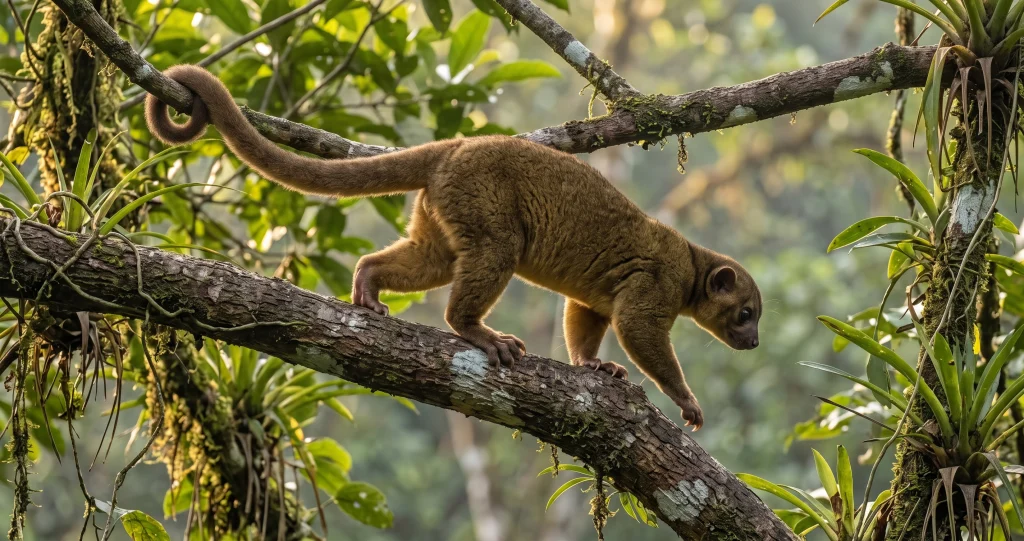
They climb vertical supports, walk along branches, cross between neighboring supports and adopt suspended postures while foraging. A 2024 study of kinkajou positional behavior documented climbing, bridging, leaping, suspension and headfirst descent among their movements.
Their spinal flexibility also contributes to this mobility. Animal Diversity Web reports exceptional flexibility that allows substantial rotation between the pelvis and the front of the body, helping kinkajous maneuver among branches.
The feet supply traction and gripping ability. The curved claws engage bark. Flexible limbs permit substantial repositioning. The body can twist as the animal changes orientation, while the prehensile tail supplies another potential anchor.
Together, these features allow the kinkajou to exploit a complicated arboreal environment.
Why Kinkajous Are Active at Night
Kinkajous are strongly nocturnal. Field studies have documented nighttime ranging and foraging, while zoo and natural-history sources likewise describe them as primarily active after sunset.
Large eyes are one conspicuous feature associated with their nocturnal lifestyle. Vision, smell, hearing and touch can all contribute to locating food and negotiating branches in low-light forest conditions.
Nighttime is also when kinkajous search for fruit, flowers and other foods. Radio-tracking research in French Guiana recorded nocturnal movements between feeding locations and found individuals using multiple canopy roosts.
It is safer scientifically to describe these observed relationships than to claim a single evolutionary reason why kinkajous became nocturnal. Activity patterns can reflect interacting ecological factors rather than one simple cause.
What Kinkajous Eat
Although kinkajous belong to the mammalian order Carnivora, fruit forms a major part of their diet.
Field observations have recorded them eating many species of fruit as well as flowers. They may also consume nectar and smaller amounts of animal material, including insects and, occasionally, eggs or small vertebrates.
Their climbing adaptations give them access to food distributed throughout tree crowns, including fruit on relatively small branches.
Kinkajous can also influence the plants whose fruits they consume.
In a field study in French Guiana, kinkajous fed on fruits from ten recorded plant species, with evidence of seed dispersal for at least seven. The researchers recorded seeds being transported away from feeding sites before defecation and described Potos flavus as an important seed-dispersal agent in that system.
More recent canopy-camera research has reinforced the importance of kinkajous as overlooked nocturnal frugivores and potential seed dispersers in Neotropical forests.
Kinkajous also consume nectar and visit flowers. Such visits can transfer pollen under some circumstances, so a pollination role has been proposed and observed for particular plant interactions. It should not, however, be generalized into a claim that kinkajous are major pollinators of all the flowers they visit.
Kinkajou Versus Other Tree-Climbing Mammals
Many mammals live in trees, but they do not all climb using the same anatomical system.
Monkeys generally rely heavily on grasping hands and feet, and some New World monkeys also possess prehensile tails. Their anatomy, however, comes from a primate evolutionary lineage very different from that of the kinkajou.
Sloths use another strategy. Their elongated, strongly curved claws and specialized limbs allow them to remain suspended beneath branches for long periods.
Some arboreal opossums combine grasping feet with a prehensile tail, but again their skeletal anatomy and evolutionary history differ from those of kinkajous.
Even among procyonids there is variation. The kinkajou is especially specialized for arboreal locomotion, with its prehensile tail, extreme body flexibility and capacity for full hindfoot reversal. Research indicates that partial hindfoot reversal occurs in other procyonids, while full reversal is much more restricted.
Similar climbing challenges can therefore be solved through different anatomical arrangements.
Life Above the Forest Floor
Living in trees provides access to resources that are widely distributed through the canopy.
Fruit may appear on one crown while flowers are available somewhere else. Suitable daytime refuges can occur inside tree cavities or dense vegetation. Reaching these resources means continually negotiating branches of different sizes and orientations.
The canopy also contains gaps. Some can be crossed along adjoining branches; others require stretching, bridging or leaping. Behavioral research has documented all of these kinds of positional behaviors in kinkajous.
Their anatomy gives them several ways to manage these challenges.
Claws provide purchase. Mobile hind feet permit dramatic changes in orientation. Flexible limbs and spine help reposition the body. The prehensile tail supplies additional stability when an ordinary four-footed stance is impractical.
Rather than attributing each feature to a single evolutionary purpose, it is more accurate to recognize that the combination is extremely effective for the locomotor demands of an arboreal mammal.
Threats and Conservation
The kinkajou is currently listed as Least Concern on the IUCN Red List, rather than being classified as globally threatened. Current conservation references continue to report that status.
Least Concern does not mean that populations face no pressure.
Forest loss and degradation can reduce suitable habitat and break continuous canopy into isolated patches. Kinkajous are closely associated with forested environments, making habitat condition and connectivity relevant to their long-term persistence.
Published zoological literature also identifies hunting and capture for the pet trade among pressures affecting kinkajous in parts of their range.
These threats can vary substantially between regions, so they should not be interpreted as evidence that the species is currently endangered throughout its entire distribution.
Kinkajou Facts and Common Misconceptions
A kinkajou is not a monkey. It belongs to Procyonidae, the carnivoran family containing raccoons, coatis and their relatives.
Its tail really is prehensile. The tail can wrap around branches and participate directly in suspension and stabilization.
Its feet do more than simply “flip backward.” Anatomical research describes plantarflexion and inversion occurring across multiple joints, collectively allowing hindfoot reversal of approximately 180 degrees.
Headfirst descent is a coordinated movement. Reoriented hind feet, curved claws, limb positioning and body control work together as the animal travels down a support.
There is no single secret behind kinkajou climbing. Feet, claws, hind-limb mobility, spinal flexibility and the prehensile tail form an integrated locomotor system.
Frequently Asked Questions
What is a kinkajou?
A kinkajou (Potos flavus) is a nocturnal, predominantly arboreal mammal of the family Procyonidae. It is related to raccoons and coatis rather than monkeys or lemurs.
Can kinkajous climb down trees headfirst?
Yes. Headfirst descent has been documented as part of kinkajou locomotor behavior. Their ability to substantially reverse the hind feet helps them maintain effective contact with a climbing surface while descending.
Can kinkajou feet rotate?
The hind feet can be reoriented by about 180 degrees, but saying they simply rotate at one ankle joint is misleading. Research indicates that plantarflexion, inversion and movement across multiple joints contribute to full hindfoot reversal.
What does the prehensile tail do?
The tail can grasp branches and help stabilize or suspend the animal while it climbs and forages. Observations include full tail suspension and combined tail-and-hind-limb suspension.
What do kinkajous eat?
Kinkajous are strongly frugivorous but also consume flowers and nectar, along with smaller amounts of insects and other animal foods. Their fruit consumption can make them effective seed dispersers.
Where do kinkajous live?
They occur in tropical forests from southern Mexico through Central America and across substantial portions of tropical South America. They are closely associated with forest habitats and spend much of their lives above ground.
A Climbing System Built Around Flexibility
Watching a kinkajou descend a trunk headfirst reveals how thoroughly its anatomy is suited to life in trees.
The remarkable kinkajou feet can change orientation through coordinated movement across the hindfoot and ankle region. Curved claws maintain purchase on bark, flexible hind limbs permit unusual climbing positions, and a highly mobile body allows the animal to maneuver around branches.
Above them all—sometimes literally—the prehensile tail provides another secure point of contact.
None of these features works entirely alone. Together, kinkajou feet, curved claws, flexible hind limbs, body mobility and the prehensile tail produce an exceptionally versatile arboreal mammal capable of climbing, hanging, bridging and descending headfirst through the complex architecture of a tropical forest.
Sources / Further Reading
- Animal Diversity Web, University of Michigan — Potos flavus species account.
- Marsh, S. F., Manfredi, K. & Smith, H. F. — “Myological and Osteological Correlates of Hindfoot Reversal in the Kinkajou (Potos flavus),” Journal of Mammalian Evolution, 2021.
- Mensah et al. — research on positional behavior and activity patterns of Potos flavus, Journal of Zoology, 2024.
- Julien-Laferrière — radio-tracking observations of kinkajou ranging and foraging in French Guiana, Journal of Tropical Ecology.
- Smithsonian National Museum of Natural History — Potos flavus collection and taxonomic records.
- IUCN Red List — Potos flavus, conservation category: Least Concern; status reflected in current conservation references.