
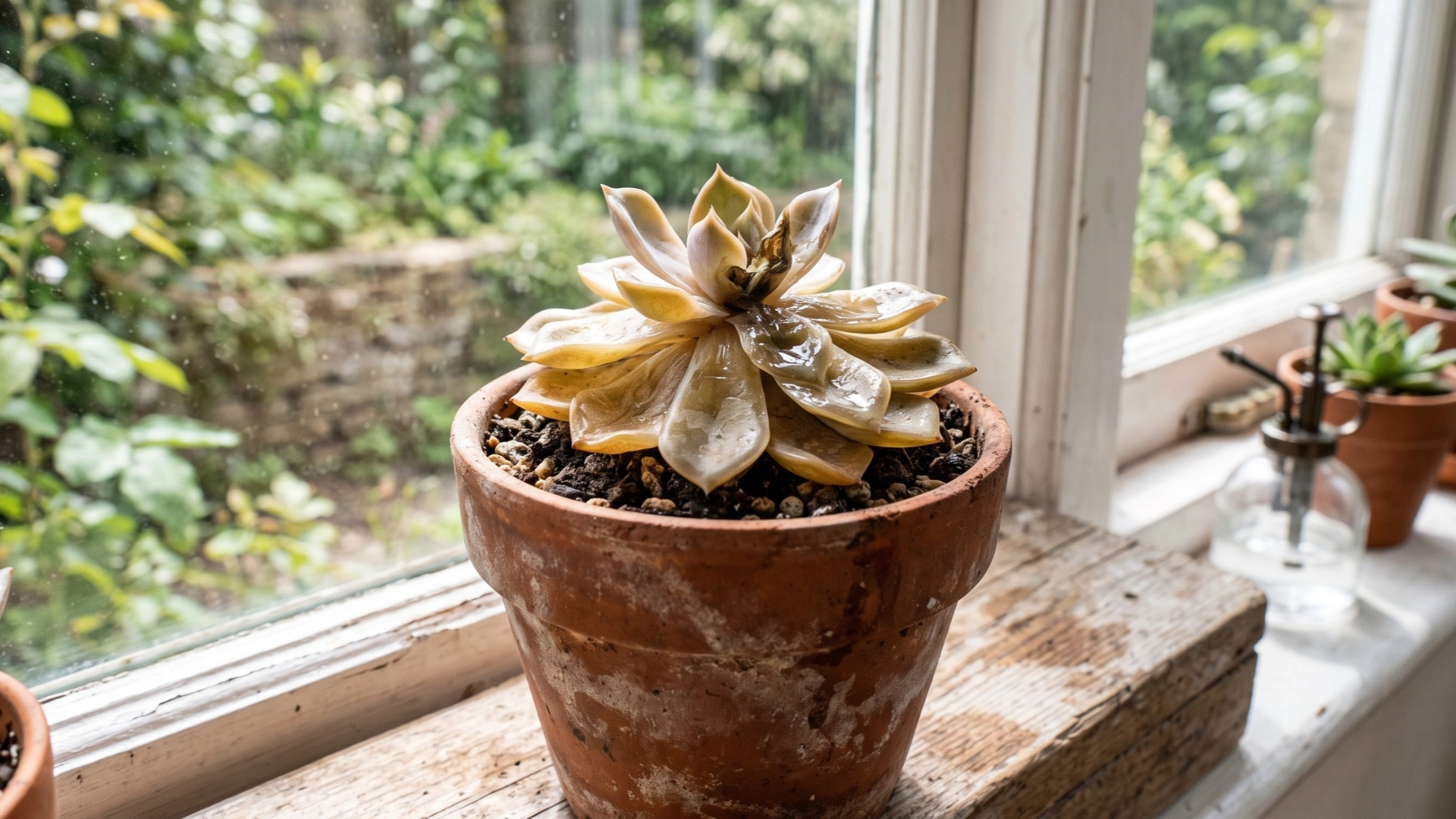
Succulents have a reputation for being easy houseplants, but there is one mistake that can quietly damage them before anything looks seriously wrong: too much water. The earliest signs of succulent overwatering can be subtle—a leaf that feels unusually soft, a slight change in color, or potting mix that stays damp much longer than expected.
Catching those changes early matters. Once prolonged moisture begins damaging roots and stems, recovery becomes much harder. Fortunately, a mildly overwatered succulent can often recover when its watering routine, soil, drainage, and growing conditions are corrected promptly.
This guide explains what succulent overwatering looks and feels like, how to distinguish it from underwatering, and what to do before the problem progresses to rot.
Table of Contents
- Why Succulents Are Vulnerable to Overwatering
- Early Signs of Succulent Overwatering
- Overwatering vs. Underwatering
- What Happens Below the Soil
- Soil and Drainage Setup
- How to Save a Mildly Overwatered Succulent
- Preventing the Problem From Returning
- Common Succulent Watering Myths
- Frequently Asked Questions
- Conclusion
Why Succulents Are Vulnerable to Overwatering
Succulents are defined by their ability to store water in fleshy leaves, stems, or other tissues. That adaptation allows them to survive periods when moisture is unavailable.
This means their roots generally don’t need to remain constantly moist. University of Minnesota Extension recommends allowing succulent potting soil to dry completely between waterings and notes that excess water trapped around the roots can quickly result in decay.
The problem isn’t simply that a succulent has received a large amount of water at once. In fact, thoroughly watering a healthy succulent can be appropriate.
The real danger is how long the root zone remains wet.
A plant growing in bright light, a porous container, and fast-draining soil may use and lose moisture relatively quickly. The same plant placed in low light in dense potting soil inside a container without drainage can remain wet for days longer.
That prolonged moisture creates conditions in which roots may become stressed and eventually rot.
Early Signs of Succulent Overwatering
Severe succulent overwatering is usually obvious. The plant may collapse, stems can become mushy, and leaves may fall with almost no resistance.
Earlier symptoms are easier to overlook.
1. Leaves Feel Too Soft
Healthy succulent leaves are generally firm because their tissues contain stored water.
One of the first tactile clues of excess moisture is a leaf that feels unusually soft, swollen, or almost squishy despite still appearing relatively normal.
This is different from the thin, flexible, wrinkled texture often associated with dehydration.
Gently touch a few mature leaves rather than repeatedly squeezing the plant. Compare leaves near the lower portion of the plant with healthy newer growth.
2. Leaves Look Unusually Translucent
Some overwatered succulent leaves develop a slightly translucent or water-soaked appearance.
Instead of looking naturally opaque and firm, portions of the leaf may seem glassy or unusually saturated with moisture.
This symptom isn’t universal, but when it appears together with wet soil and soft tissue, excess moisture should be suspected.
3. Yellowing Begins
Yellow leaves can have many causes, so color alone shouldn’t be used to diagnose a watering problem.
However, yellowing accompanied by soft leaves, damp soil, and a recent history of frequent watering is a stronger warning sign.
Iowa State University Extension lists yellowing leaves and soft or mushy leaves and stems among the characteristic symptoms of succulents growing in excessively wet conditions.
4. Lower Leaves Drop While Still Soft
Succulents naturally shed older leaves occasionally. Normally, an aging lower leaf gradually dries and shrivels as the plant reabsorbs resources from it.
Overwatered leaves may behave differently.
They can remain swollen, yellowish, or soft before detaching surprisingly easily.
A single fallen leaf isn’t necessarily alarming. Several plump or soft leaves dropping over a short period deserve attention.
5. The Soil Stays Wet for Too Long
Sometimes the earliest warning isn’t on the plant at all.
Check the potting medium.
If it remains noticeably damp long after watering, especially in an indoor container, the growing medium may be retaining more moisture than the roots can safely tolerate.
A wooden chopstick can provide a simple check. Insert it into the growing medium and remove it. If the portion that was buried appears darker or damp, moisture remains deeper in the pot. Iowa State Extension specifically describes this technique as a practical way to check whether watering is necessary.
!["Early signs of succulent overwatering in soft and translucent leaves."]](https://secretsofthegreengarden.com/wp-content/uploads/2026/09/manar-web-1024x576.webp)
Succulent Overwatering vs. Underwatering
This is where many succulent owners get into trouble.
An overwatered plant can eventually look wilted or shriveled because damaged roots are no longer functioning normally. Assuming every shriveled succulent needs more water can therefore make an existing moisture problem worse.
Look at several clues together.
Signs More Consistent With Overwatering
Overwatered leaves tend to be soft, swollen, yellowish, translucent, or mushy.
The growing medium is often still moist, and leaves may detach while they still contain plenty of water.
As the problem progresses, stems may soften and dark root tissue may develop.
Signs More Consistent With Underwatering
An underwatered succulent generally uses the water stored in its leaves.
As those reserves decline, leaves become thinner.
They may wrinkle, shrivel, flatten, or develop a dry appearance. Iowa State Extension notes that underwatered succulent leaves and stems commonly become wrinkled, while leaves may eventually brown and drop.
The soil should also be genuinely dry.
The distinction between soft and swollen versus thin and wrinkled is particularly useful, although species differ and no single symptom provides a perfect diagnosis.
What Happens Below the Soil
Roots need both moisture and oxygen.
When potting medium remains saturated for extended periods, air spaces within the soil fill with water. Oxygen availability around the roots decreases.
Roots experiencing prolonged stress can begin dying. Damaged tissues then become increasingly vulnerable to decay and microorganisms associated with root rot.
This creates a confusing situation above the soil.
The plant can have plenty of moisture surrounding its roots but still show symptoms resembling drought because its damaged root system can no longer absorb and transport water normally.
University of Maryland Extension recommends inspecting roots when root rot is suspected. Healthy roots are generally firm and lighter in color, while diseased roots tend to become dark and soft.
This is why automatically adding more water to a struggling succulent can sometimes accelerate its decline.
For more guidance on maintaining healthy indoor plants, explore the houseplant guides at Secrets of the Green Garden.
The Best Soil and Drainage Setup
Preventing succulent overwatering starts with the root environment.
Always Prioritize a Drainage Hole
A container should allow excess irrigation water to leave freely.
After watering, liquid should flow through the bottom rather than remaining trapped around the root system.
Never allow a drainage saucer, decorative sleeve, or cachepot to remain filled with water after watering.
Use a Fast-Draining Growing Medium
Ordinary indoor potting soil can remain moist too long for many succulents.
Iowa State University Extension recommends sharply draining media and suggests combining approximately one-third organic material with two-thirds mineral material, such as perlite, coarse sand, pumice, or fine gravel, for an indoor succulent mix.
The ideal mixture depends somewhat on the species, indoor climate, container material, and light conditions.
Whatever recipe you use, the objective is similar: water should penetrate the root ball but excess moisture should drain efficiently afterward.
Don’t Rely on Gravel at the Bottom
A widespread gardening myth says that placing rocks or gravel beneath the soil creates drainage.
It does not substitute for an actual drainage hole.
UC Master Gardeners specifically advises against adding a gravel layer to the bottom of succulent containers, noting that it can make drainage conditions worse rather than better.
If a decorative planter has no hole, keep the succulent in a smaller nursery pot with drainage and place that pot inside the decorative container.
Recovery Plan for a Mildly Overwatered Succulent
If the plant is still mostly firm and there is no obvious spreading stem rot, early intervention may be enough.
Step 1: Stop Watering
Don’t add more water simply because a few leaves look unhealthy.
Allow the growing medium to begin drying.
Empty any water remaining in the saucer or decorative outer pot immediately.
Step 2: Increase Appropriate Light and Airflow
Move the succulent to the bright conditions recommended for its species.
Good air circulation can also help the potting medium dry more efficiently. Iowa State Extension notes that moving air helps soils dry and reduces excessively humid conditions around succulents.
Avoid suddenly placing a plant accustomed to weak indoor light into intense direct sun. Abrupt exposure can cause sunburn and add another stress while the plant is recovering.
Step 3: Evaluate the Potting Mix
If the soil begins drying normally, you may not need to disturb the roots immediately.
If the medium remains saturated for an unusually long time, smells unpleasant, or is extremely dense, inspect the root system.
Gently remove the plant from its container.
Healthy roots should feel relatively firm. Dark, slimy, or mushy roots indicate that the problem has progressed beyond simple overwatering toward root decay.
Step 4: Repot When Necessary
If the existing soil is dense and moisture-retentive, repotting into fresh, fast-draining succulent medium can correct the underlying problem.
Use a clean container with an unobstructed drainage hole.
Avoid choosing a dramatically oversized pot. A large volume of unused soil can remain moist longer because relatively few roots are available to draw moisture from it.
Step 5: Resume Watering Based on Dryness
Don’t replace one rigid schedule with another.
Instead, check the growing medium.
Once it has dried appropriately and the plant appears stable, water thoroughly enough to moisten the root ball and allow excess water to escape through the drainage hole.
Then wait for the medium to dry again before repeating the process.
This wet-dry cycle is supported by horticultural extension guidance for succulent cultivation.
Preventing Succulent Overwatering From Returning
The most useful watering schedule isn’t actually a schedule.
Water demand changes with season, temperature, humidity, light intensity, container size, soil composition, species, and active growth.
A succulent beside a bright summer window may dry considerably faster than the same plant during a dark winter month.
Instead of deciding, for example, that every succulent gets water each Saturday, inspect the soil before watering.
Learn how quickly each container dries.
Terracotta pots tend to lose moisture faster than glazed ceramic or plastic containers because their walls are porous. Small or shallow pots can also dry faster than large containers.
Most importantly, remember that watering deeply and watering frequently are different things.
A succulent can receive a thorough soaking without being overwatered if excess water drains away and the root zone subsequently dries. Constantly adding small amounts of water that keep the soil damp can be more problematic.
Common Succulent Watering Myths
Myth: Succulents Only Need a Few Drops of Water
Succulents tolerate dry periods, but their roots still need access to water.
When irrigation is needed, watering thoroughly and allowing excess water to drain is generally preferable to repeatedly sprinkling tiny amounts onto the surface.
Myth: Mist Instead of Watering
Routine misting isn’t a substitute for properly watering the root system of most mature potted succulents.
The goal is a healthy wet-dry cycle throughout the root zone, not continuously dampening the surface.
Myth: A Layer of Rocks Fixes a Pot Without Drainage
It doesn’t.
A drainage hole provides an escape route for excess water. Gravel underneath soil does not perform the same function.
Myth: Succulents Should Be Watered Every Week
Some might need water around that frequently under particular conditions. Others may remain moist much longer.
Water according to the plant and growing conditions rather than the calendar.
Myth: Every Wrinkled Succulent Needs Immediate Water
Not necessarily.
Advanced root damage caused by excess moisture can leave a succulent unable to absorb enough water, producing symptoms that resemble drought.
Check the soil and roots before assuming that additional water is the solution.
Frequently Asked Questions
Can an overwatered succulent recover?
Yes, especially when the problem is detected early.
A plant with mostly healthy roots and firm stems may recover after excess watering stops and the growing medium is allowed to dry appropriately. Advanced rot is more difficult to reverse.
Should I repot an overwatered succulent immediately?
Not always.
If the plant is only mildly overwatered and the soil is beginning to dry normally, unnecessary root disturbance may add stress.
Repotting becomes more useful when the growing medium stays saturated, drainage is poor, the container lacks a drainage hole, or root rot is suspected.
How can I tell whether succulent roots are rotten?
Healthy roots are generally firm rather than mushy.
Roots affected by rot may become dark, soft, slimy, or fragile. A severely affected root system may also have an unpleasant odor.
Should I remove yellow succulent leaves?
Completely dead or detached leaves can be removed gently.
Don’t repeatedly pull at leaves that are still firmly attached. More important than cosmetic cleanup is correcting the moisture problem causing the yellowing.
How often should succulents be watered indoors?
There is no universal interval.
Light, temperature, humidity, soil composition, species, season, and container type all affect drying speed. Check the growing medium and water when it has dried sufficiently rather than relying exclusively on a calendar.
Does overwatering mean I used too much water at once?
Usually, the more important issue is excessive frequency or duration of wetness, not simply the volume applied during one watering.
A thorough watering followed by complete drainage and an appropriate drying period can be healthier than frequent small applications that keep the root zone continuously moist.
Can a succulent survive root rot?
Mild cases sometimes can.
If decay has spread extensively through the roots or stem, saving the original plant may no longer be possible. Healthy, unaffected leaves or stem sections can sometimes be propagated to preserve the plant.
Conclusion
The earliest signs of succulent overwatering are often subtle enough to miss: unusually soft leaves, slight yellowing, translucent tissue, premature leaf drop, and soil that remains damp longer than expected.
The best diagnosis comes from looking at the whole picture. Soft, swollen tissue combined with persistent soil moisture points toward excess water, while thin, wrinkled leaves combined with genuinely dry soil more strongly suggest dehydration.
Prevention is simpler than rescue. Use a container with drainage, choose fast-draining soil, provide suitable light and airflow, water thoroughly when necessary, and then allow the root zone to dry appropriately before watering again.
Most importantly, pay attention to the plant rather than the calendar. Once you learn how a healthy succulent’s leaves and soil normally feel, the earliest warning signs become much easier to recognize—and much easier to correct before serious root damage develops.
External Sources:
- University of Minnesota Extension — Cacti and Succulents
https://extension.umn.edu/garden-and-home/yard-and-garden/gardening-minnesota/cacti-and-succulents - Iowa State University Extension and Outreach — Common Problems and Issues of Succulents
https://yardandgarden.extension.iastate.edu/how-to/common-problems-and-issues-succulents - University of California Agriculture and Natural Resources — Succulents
https://ucanr.edu/site/uc-master-gardeners-santa-clara-county/succulents