
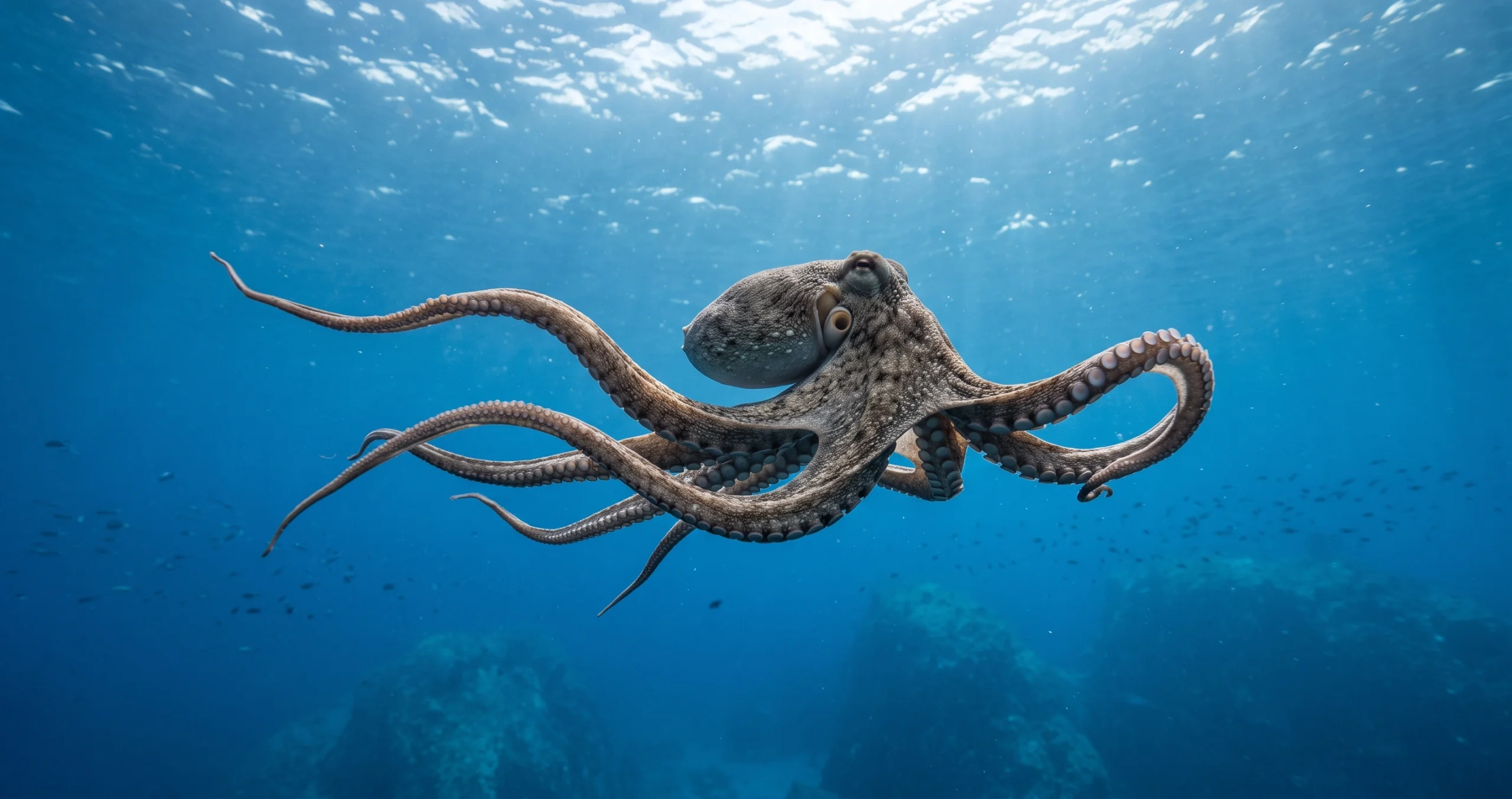
An octopus already looks like an animal designed by a very imaginative engineer: eight flexible arms, hundreds of suckers, remarkable camouflage, and a nervous system unlike our own. But some of its strangest features are hidden inside its body. The octopus three hearts blue blood combination is a real part of cephalopod biology, not an exaggeration.
An octopus has two hearts dedicated largely to moving blood through its gills and a third heart that sends oxygenated blood around the rest of its body. Its blood is blue because its oxygen-carrying molecule contains copper rather than the iron-based hemoglobin that gives human blood its familiar red color.
Even more surprisingly, the main systemic heart can temporarily stop pumping during powerful jet-propelled swimming. That unusual circulatory arrangement helps explain why many bottom-dwelling octopuses spend so much time crawling rather than swimming.
Table of Contents
- Why Octopuses Need Three Hearts
- How the Three-Heart Circulatory System Works
- Why Octopus Blood Is Blue
- Hemocyanin vs. Hemoglobin
- Why the Systemic Heart Stops During Swimming
- Why Crawling Works Better
- How Other Cephalopods Compare
- Common Myths About Octopus Hearts and Blood
- Frequently Asked Questions
- Conclusion
Octopus Three Hearts Blue Blood: The Basic Biology
Octopuses belong to the class Cephalopoda, a group of marine mollusks that also includes squid, cuttlefish, and nautiluses. Despite their very different appearances, these animals share several important anatomical features.
The Smithsonian describes the cephalopod circulatory system as having three hearts. Two are known as branchial hearts, while the larger central pump is called the systemic heart.
The distinction is important because these three hearts are not simply backup copies of one another. They perform different jobs within the same circulation system.
The Two Branchial Hearts
An octopus has two gills, and each is associated with a branchial heart.
Blood returning from the tissues has already delivered much of its oxygen. The branchial hearts help push this oxygen-depleted blood through the gills, where gas exchange takes place.
As seawater passes across the gills, oxygen moves into the blood while carbon dioxide is released.
The blood leaving the gills is now oxygenated and ready to be distributed throughout the animal.
The Systemic Heart
This is where the third heart takes over.
The systemic heart receives oxygenated blood from the gills and pumps it through the body, supplying the muscles, nervous system, digestive organs, and other tissues.
A simple way to visualize the system is:
Body → branchial hearts → gills → systemic heart → body
Rather than asking three identical hearts to do the same work, the octopus circulatory system divides the workload between specialized pumps.
![“octopus three hearts blue blood circulatory system showing branchial and systemic hearts.”]](https://secretsofthegreengarden.com/wp-content/uploads/2026/09/Gemini_Generated_Image_12xtr12xtr12xtr1-1024x541.webp)
Why Does an Octopus Have Blue Blood?
The color comes down to chemistry.
Humans and many other vertebrates transport oxygen primarily using hemoglobin. Hemoglobin contains iron, and oxygenated hemoglobin contributes to the red appearance of our blood.
Octopuses use a different respiratory pigment called hemocyanin.
Hemocyanin contains copper. When oxygen binds to this copper-containing molecule, the oxygenated blood takes on a blue coloration. Smithsonian Ocean notes that this copper-based oxygen-transport system is characteristic of cephalopods and explains their blue blood.
That means octopus blood isn’t blue because the animal lives underwater, because its skin changes color, or because blue pigment somehow enters the bloodstream.
The color is a direct consequence of the chemistry of its oxygen-carrying protein.
For a broader look at these extraordinary marine mollusks, the Smithsonian Ocean guide to cephalopods provides an excellent overview of their anatomy, evolution, and biology.
Hemocyanin vs. Hemoglobin
Hemocyanin and hemoglobin perform essentially the same critical job: transporting oxygen.
They accomplish it differently.
Hemoglobin contains iron and is packaged inside red blood cells in humans. Cephalopod hemocyanin contains copper and circulates dissolved in the blood.
These differences affect how oxygen is transported under different environmental conditions.
Cephalopods occur in environments ranging from shallow tropical reefs to extremely cold deep water. Smithsonian notes that research on Antarctic octopuses has shown adaptations in hemocyanin that support oxygen transport under challenging temperature and oxygen conditions.
It is therefore misleading to describe hemocyanin simply as an inferior version of hemoglobin. Evolution does not work toward one universal “best” respiratory pigment. Different oxygen-transport systems operate within different physiological and environmental constraints.
That chemistry is part of what makes the octopus three hearts blue blood system so fascinating: circulation, respiration, activity level, and habitat are interconnected.
The Heart That Can Stop During Swimming
Here the story becomes even stranger.
Many octopuses can move in two dramatically different ways. They can crawl across rocks and sediment using their arms and suckers, or they can rapidly propel themselves through the water.
Jet propulsion works by drawing water into the mantle cavity and then contracting the muscular mantle to force water through a funnel-like structure called the siphon.
The resulting jet pushes the octopus in the opposite direction.
It is an excellent escape mechanism.
But physiologically, it comes at a cost.
Classic physiological research on Octopus vulgaris found that during powerful jet propulsion, circulation from the systemic heart can be interrupted. Increased pressure associated with mantle contraction interferes with blood returning to the heart, producing temporary cardiac arrest during the jetting cycle.
This detail is sometimes simplified online into the phrase “an octopus’s heart stops whenever it swims.” The more precise explanation is that the systemic heart can temporarily stop pumping during jet-propelled swimming, particularly during forceful mantle contractions.
The branchial hearts and gills are part of a different section of the circulatory pathway.
Why Crawling Is More Energy-Efficient
An octopus capable of shooting through the water might seem better suited to swimming everywhere.
Instead, many bottom-dwelling species spend much of their lives creeping across the seafloor.
There is a physiological reason.
Jet propulsion requires strong contractions of the mantle and is energetically expensive. At the same time, those contractions can interrupt the output of the systemic heart.
Crawling avoids that combination.
An octopus can move across the substrate using coordinated arm movements without repeatedly producing the powerful mantle pressures associated with jet propulsion. Monterey Bay Aquarium describes species such as the two-spot octopus as spending much of their time on the seafloor, where they can slowly creep or quickly crawl, while jetting into open water when necessary.
In practical terms, crawling is the better everyday transportation method for many benthic octopuses.
Jet propulsion is extremely useful when speed suddenly matters—such as escaping a predator—but it is not necessarily the most economical way to travel continuously.
This distinction also helps explain a common misconception. Octopuses are not poor swimmers simply because they frequently crawl. They possess a highly effective jet-propulsion system; they simply use it selectively.
How Does This Compare With Other Cephalopods?
Octopuses aren’t alone in having this unusual cardiovascular architecture.
The three-heart arrangement and hemocyanin-based blood are characteristic features of cephalopods. Smithsonian describes cephalopods as having two branchial hearts that move oxygen-depleted blood through the gills and a systemic heart that distributes oxygenated blood through the body.
That includes familiar relatives such as squid and cuttlefish.
Yet cephalopods do not all live or move in the same way.
Squid are generally much more adapted to active swimming than many benthic octopuses. Cuttlefish combine swimming, fin movements, and jet propulsion, while nautiluses have their own specialized adaptations for life in the water column.
The vampire squid offers another fascinating example of how cephalopod physiology can become specialized. It lives in oxygen-poor deep water and has hemocyanin with exceptionally high oxygen affinity, alongside other adaptations that reduce its energy requirements.
The shared cardiovascular blueprint therefore does not mean every cephalopod uses its circulatory system in exactly the same way.
Common Myths About Octopus Hearts and Blue Blood
Myth 1: Each Heart Controls Different Arms
No.
The two branchial hearts are associated with circulation through the gills. The systemic heart supplies oxygenated blood to the body.
The eight arms are not divided among three separate cardiac territories.
Myth 2: Blue Blood Means Octopuses Don’t Use Oxygen
The opposite is true.
Hemocyanin is specifically involved in transporting oxygen. Its copper-containing structure produces the characteristic blue coloration when oxygenated.
Myth 3: An Octopus Has Three Hearts as Backups
The hearts aren’t simply spare organs waiting for another heart to fail.
They are specialized components of the same circulatory system. Removing one part would disrupt normal circulation.
Myth 4: All Three Hearts Stop When an Octopus Swims
The famous swimming fact concerns the systemic heart, not all three hearts simultaneously.
The simplified internet version often loses that important distinction.
Myth 5: Octopuses Cannot Swim Well
Octopuses can be remarkably fast when they need to be.
Jet propulsion can rapidly move an animal away from danger. Monterey Bay Aquarium describes the giant Pacific octopus as using jet propulsion alongside camouflage and its powerful arms while hunting and escaping threats.
The issue is not whether an octopus can swim. It is the energetic and circulatory cost of sustained jetting compared with crawling for many species.
An Evolutionary Solution Unlike Our Own
It is tempting to look at an octopus and compare every organ directly with its human equivalent.
That can be misleading.
Octopuses and vertebrates followed enormously different evolutionary paths. Their last common ancestors lived hundreds of millions of years ago, and natural selection produced very different solutions to many of the same biological problems.
Both humans and octopuses must transport oxygen.
Humans accomplish this with iron-containing hemoglobin, red blood, and a four-chambered heart.
Octopuses use copper-containing hemocyanin, blue blood, and three specialized hearts.
Neither arrangement needs to resemble the other to work.
This is one reason cephalopods are so valuable for understanding evolution: they demonstrate how radically different anatomical systems can solve similar fundamental challenges.
Readers interested in other unusual adaptations can also explore the wildlife and marine-life stories on Secrets of the Green Garden, including articles examining how animal anatomy and behavior are shaped by their environments.
Frequently Asked Questions
How many hearts does an octopus have?
An octopus has three hearts. Two branchial hearts pump blood through the gills, while the systemic heart distributes oxygenated blood throughout the body.
Why is octopus blood blue?
Octopus blood contains hemocyanin, a copper-containing oxygen-transport protein. When oxygen binds to hemocyanin, it produces a blue coloration.
Do octopuses really have blue blood?
Yes. This isn’t simply a nickname or visual illusion. Oxygenated cephalopod blood genuinely appears blue because of hemocyanin.
Which octopus heart stops during swimming?
The systemic heart can temporarily stop pumping during jet-propelled swimming. The high pressures generated by powerful mantle contractions can interfere with blood returning to the heart.
Does the heart remain stopped after the octopus finishes swimming?
No. The interruption is associated with jet propulsion. Normal systemic circulation resumes when the mechanical conditions causing the interruption end.
Why do octopuses crawl instead of swim?
For many bottom-dwelling octopuses, crawling is a more economical form of routine movement. Jet propulsion requires powerful muscular contractions and can interfere temporarily with systemic circulation, so it is particularly useful for rapid bursts rather than constant travel.
Do squid and cuttlefish have three hearts?
Yes. The three-heart circulatory arrangement is characteristic of cephalopods, including octopuses, squid, and cuttlefish.
Is hemocyanin found only in octopuses?
No. Hemocyanin occurs in other mollusks and in several groups of arthropods. Octopuses are simply one particularly famous example.
Are all three octopus hearts the same?
No. Two are branchial hearts associated with the gills. The third is the systemic heart responsible for distributing oxygenated blood through the body.
Conclusion
The octopus three hearts blue blood combination sounds almost fictional, yet it reflects a highly specialized circulatory system shaped by cephalopod evolution.
Two branchial hearts send oxygen-depleted blood through the gills. The systemic heart then distributes oxygenated blood around the body. Instead of iron-containing hemoglobin, octopuses rely on copper-containing hemocyanin, giving oxygenated blood its characteristic blue appearance.
The strangest part appears during locomotion. Powerful jet-propelled swimming can temporarily interrupt the systemic heart’s pumping, contributing to the high physiological cost of this type of movement. Crawling lets many bottom-dwelling octopuses travel without that same circulatory disruption.
Three hearts, blue blood, and an unusual relationship between circulation and movement are not isolated curiosities. Together, they show how profoundly different evolution’s solutions can be—and why octopuses remain some of the most extraordinary animals in the ocean.
External Sources:
- Smithsonian Ocean — Cephalopods: Octopuses, Squids, and Relatives
Smithsonian Ocean cephalopod guide
Useful for the three-heart circulatory system, hemocyanin, blue blood, and broader cephalopod biology. - NOAA Ocean Service — Octopus heart biology
NOAA Ocean Service octopus resource
Useful as a U.S. government source confirming the two gill hearts and systemic heart. - Monterey Bay Aquarium — Day Octopus
Monterey Bay Aquarium day octopus guide
Useful for independently confirming octopus anatomy, three hearts, behavior, habitat, and natural history.