
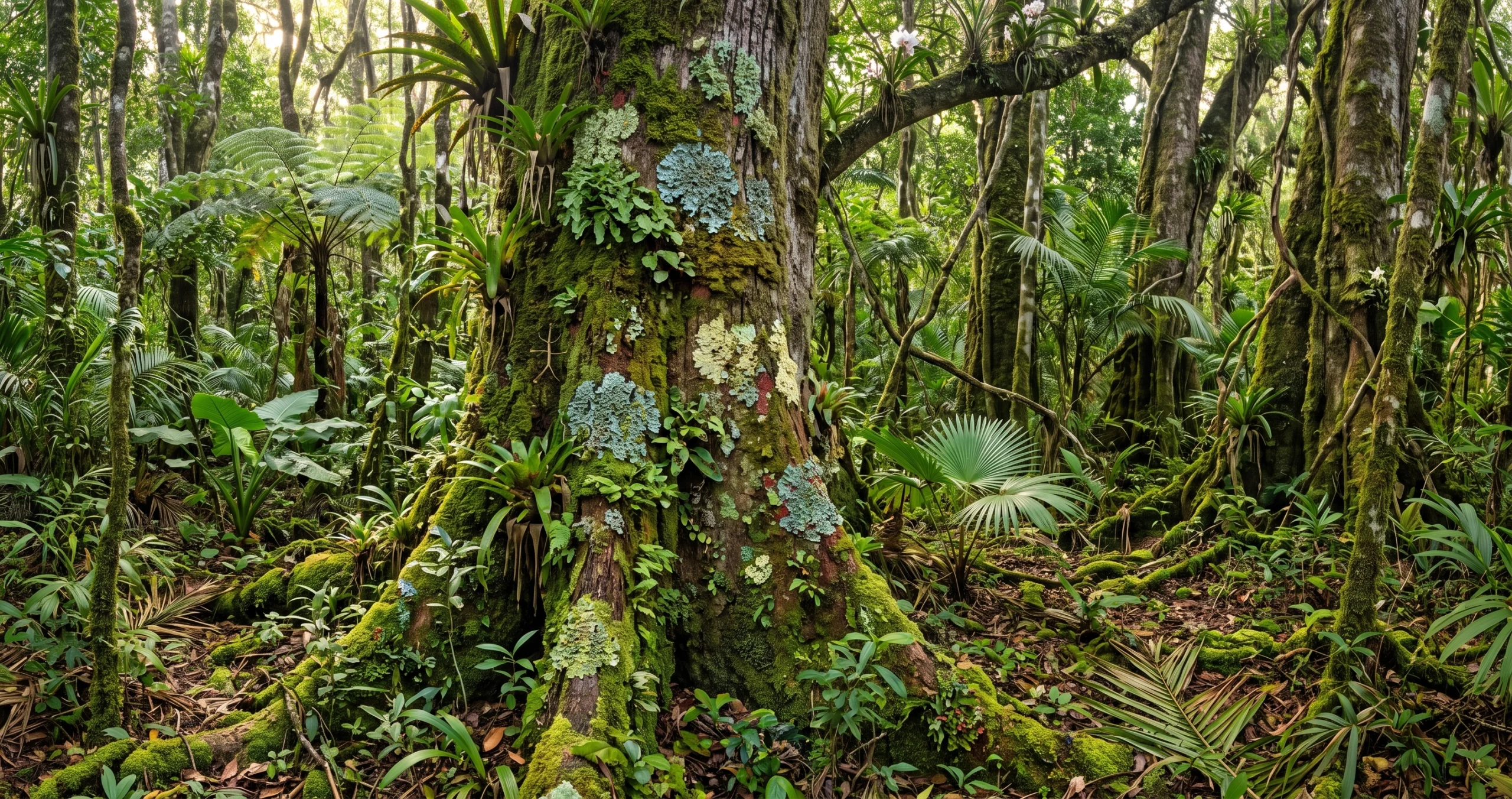
On a tree trunk in Madagascar, what looks like a patch of bark may suddenly open its eyes and move. The animal is a leaf-tailed gecko, and leaf-tailed gecko camouflage ranks among the most sophisticated forms of concealment found in vertebrates. These reptiles do more than match the colors of bark, moss, or dead leaves—their bodies can disrupt the very shadows and outlines that would otherwise reveal them.
Leaf-tailed geckos belong to the genus Uroplatus, a remarkable group found only in Madagascar and nearby islands. Different species imitate everything from rough tree bark to decaying leaves, combining coloration, flattened bodies, irregular skin fringes, specialized resting postures, and remarkably leaf-like tails.
Their camouflage is spectacular, but it is also tied to a fragile ecosystem. Madagascar’s continuing forest loss and habitat fragmentation threaten many highly localized reptiles, making the survival of these camouflage specialists dependent on conserving the forests they evolved to disappear into.
Table of Contents
- What Are Leaf-Tailed Geckos?
- How Leaf-Tailed Gecko Camouflage Works
- How Fringed Skin Helps Erase a Gecko’s Shadow
- More Than Color: The Complete Camouflage System
- Different Leaf-Tailed Geckos, Different Disguises
- How Their Camouflage Compares With Other Animals
- Madagascar: An Island Made for Specialization
- Deforestation and Conservation Threats
- Common Myths About Leaf-Tailed Geckos
- Frequently Asked Questions
- Conclusion
What Are Leaf-Tailed Geckos?
Leaf-tailed geckos belong to the genus Uroplatus. They are endemic to Madagascar and associated islands, meaning they occur naturally nowhere else on Earth.
The genus contains multiple species rather than one universal “leaf-tailed gecko.” Their sizes, habitats, colors, body shapes, and camouflage strategies differ considerably.
The satanic leaf-tailed gecko (Uroplatus phantasticus) is perhaps the most famous. Its flattened tail can resemble a dead leaf, sometimes complete with irregular edges that look remarkably like damage or decay.
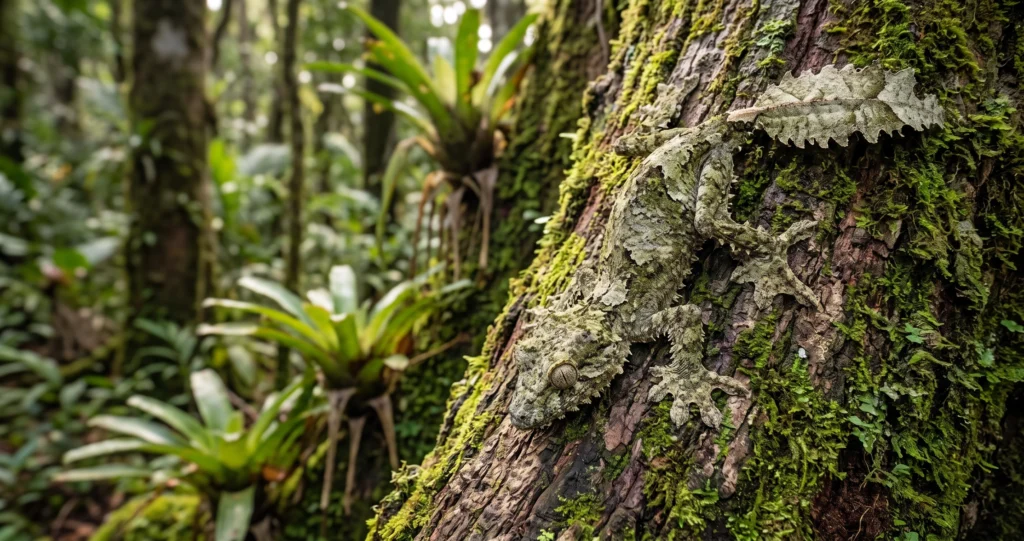
The mossy leaf-tailed gecko (Uroplatus sikorae) uses a different strategy. Its mottled skin resembles lichen-covered or mossy bark, allowing a resting animal to almost disappear against a tree trunk.
Other members of the genus resemble bark so effectively that even experienced observers can struggle to locate them.
Most are nocturnal. During daylight hours, remaining concealed is therefore enormously valuable because a motionless gecko resting on exposed bark could otherwise become an easy target for visually hunting predators.
National Geographic recently documented a mossy leaf-tailed gecko hiding against a rainforest tree in Madagascar’s Mantadia National Park, noting the importance of its camouflage in avoiding sharp-eyed predatory birds. (National Geographic)
How Leaf-Tailed Gecko Camouflage Works
Camouflage is often described simply as “matching the background.”
That is only part of leaf-tailed gecko camouflage.
Imagine placing an ordinary brown lizard against brown tree bark. Its color might blend reasonably well, but predators could still detect the recognizable outline of its body.
Edges matter enormously in visual detection.
A predator searching for prey can use contrasts between an animal’s body and its surroundings to distinguish a potential meal. Legs, tails, heads, and shadows can create recognizable boundaries even when coloration is similar.
Leaf-tailed geckos attack this problem on several levels.
Their bodies are dorsoventrally flattened, helping them remain close to the surfaces on which they rest. Their patterns imitate environmental textures, while irregular body margins interfere with the familiar outline of a lizard.
Some species take this strategy even further through specialized fringes of skin.
How Fringed Skin Helps Erase a Gecko’s Shadow
One of the most extraordinary features of some Uroplatus species is the dermal fringe running along portions of the body.
When the gecko presses itself against a tree trunk, these flattened flaps of skin spread over the bark.
That helps solve a subtle camouflage problem: shadows.
Without the fringe, even a well-camouflaged animal’s body could sit slightly above the tree surface. Light striking it from an angle would create a narrow shadow along its edge.
That shadow could betray the gecko’s location.
By spreading irregular skin margins against the substrate, the animal reduces the abrupt transition between body and bark. Its visible boundary becomes less distinct, and the hard shadow that might outline its silhouette is disrupted.
Calling this “erasing its shadow” is a useful description, although it should not be interpreted literally. The gecko does not somehow prevent itself from blocking light.
Instead, its flattened body and dermal fringes help minimize or break up the sharp shadows and contours that would make its shape easier to recognize.
This is why leaf-tailed gecko camouflage remains impressive even when photographs are examined closely. Evolution has modified not just the animal’s color but its physical silhouette.
More Than Color: The Complete Camouflage System
The dermal fringe works because it is part of a much larger collection of adaptations.
First comes coloration.
Depending on the species, leaf-tailed geckos display browns, grays, greens, creams, blacks, and other muted tones. Irregular patches can resemble bark, lichens, moss, dead vegetation, or shadows.
Pattern is equally important.
A perfectly uniform brown animal could still stand out against complicated bark. Mottled patterns create visual texture, breaking the body into patches that resemble the irregular surface beneath it.
Body posture adds another layer.
A resting gecko can flatten itself against bark and position its limbs close to the substrate. Some orient themselves vertically on tree trunks, further reducing obvious visual clues.
Even the eyes present a potential problem.
Bright reflections could reveal an otherwise invisible animal. National Geographic notes that mossy leaf-tailed geckos resting on trunks can face downward, helping reduce eye reflections that could alert predatory birds above. (National Geographic)
The tail completes the illusion.
Depending on the species, it may resemble a section of bark or a fallen leaf rather than a conventional lizard tail.
Together, these traits turn leaf-tailed gecko camouflage into an integrated system rather than a simple color match.
Different Leaf-Tailed Geckos, Different Disguises
Not every Uroplatus species is trying to resemble exactly the same thing.
The satanic leaf-tailed gecko is a specialist in dead-leaf masquerade. Its flattened body and tail help it disappear among forest vegetation, while the tail’s irregular margins can resemble a damaged leaf.
National Geographic describes Uroplatus phantasticus as the smallest member of the leaf-tailed gecko group and notes how effectively it blends into Madagascar’s forest environment. (National Geographic)
Mossy leaf-tailed geckos emphasize bark camouflage.
Their coloration can produce an extraordinary resemblance to tree surfaces covered in lichens and other irregular textures.
Other species have broad, flattened tails and cryptic patterns that make them difficult to distinguish from trunks and branches.
These differences matter because “camouflage” is not a single evolutionary solution.
Natural selection favors characteristics that work within a species’ particular habitat, resting behavior, predators, and prey.
Leaf-Tailed Gecko Camouflage Compared With Other Strategies in Nature
Nature has produced many ways to avoid being seen.
Stick insects provide one of the clearest examples of masquerade. Their elongated bodies resemble twigs so convincingly that predators may classify them as vegetation rather than prey.
Leaf insects take the same principle in another direction.
Their flattened bodies resemble leaves, sometimes including patterns reminiscent of veins or damaged plant tissue. National Geographic describes leaf and stick insects as camouflage specialists that imitate vegetation throughout much of their lives. (National Geographic)
Dead-leaf butterflies such as those in the genus Kallima provide another striking example. When their wings are closed, the underside can resemble a dried leaf rather than a brightly colored butterfly.
Cuttlefish use an entirely different system.
Instead of relying primarily on a fixed body shape, they can rapidly alter aspects of their appearance using specialized skin structures. This allows them to respond dynamically to different backgrounds.
Some cephalopods can alter not only color patterns but the apparent texture of their skin.
Chameleons are often treated as the ultimate camouflage animals, but their color changes have important roles in communication and physiological responses as well as concealment.
Some other geckos can change shade according to their surroundings. Research on Moorish geckos, for example, has investigated light-sensitive proteins in the skin that may contribute to background matching. (National Geographic)
Leaf-tailed geckos are different.
Their extraordinary disguise depends heavily on permanent anatomy—flattened bodies, irregular margins, leaf-like tails, skin patterns, and strategic posture.
For another example of remarkably sophisticated animal appearance, see our article on how birds-of-paradise use ultra-black feathers to win a mate.
Camouflage Helps Both Predator and Prey
Disappearing against bark offers at least two major advantages.
The obvious benefit is avoiding predators.
Birds and other visually oriented hunters may have difficulty recognizing the outline of a motionless gecko. The closer the resemblance to bark or vegetation, the greater the chance that a predator simply overlooks it.
But camouflage can also benefit a predator.
Leaf-tailed geckos themselves hunt small animals, particularly arthropods. Remaining inconspicuous can allow a gecko to wait near potential prey without advertising its presence.
National Geographic notes that the downward resting orientation observed in mossy leaf-tailed geckos may also position them to intercept insects climbing upward from the forest floor. (National Geographic)
The same disguise can therefore work in two directions: hiding the gecko from animals that want to eat it while concealing it from animals it wants to eat.
Madagascar: An Island Made for Specialization
Understanding leaf-tailed gecko camouflage requires understanding Madagascar.
Separated from other major landmasses for tens of millions of years, the island developed an extraordinary concentration of endemic plants and animals.
Isolation allowed evolutionary lineages to diversify in ways seen nowhere else.
Leaf-tailed geckos are part of that story.
Madagascar contains humid eastern rainforests, dry deciduous forests, montane habitats, spiny vegetation, and other ecosystems. Different Uroplatus species occupy particular portions of this environmental mosaic.
That specialization can produce spectacular adaptations.
Unfortunately, it can also create vulnerability.
An animal distributed across a huge continent may survive the destruction of one forest because populations exist elsewhere. A species restricted to a small section of Madagascar may have far fewer alternatives.
Some leaf-tailed geckos have particularly limited geographic ranges.
For these animals, protecting a relatively small forest can represent the difference between maintaining a viable population and losing critical habitat.
Deforestation and Conservation Threats
Madagascar’s biodiversity faces continuing pressure from habitat loss and degradation.
Forest can be cleared or altered for agriculture, fuelwood, charcoal production, logging, settlement, and other human activities. Habitat fragmentation can leave remaining forest populations isolated from one another.
For an animal whose survival strategy depends on a particular forest environment, losing that habitat is especially serious.
Leaf-tailed gecko camouflage evolved to match Madagascar’s vegetation.
A bark specialist cannot simply transfer its evolutionary adaptations to a radically altered landscape and expect the same protection.
Conservation status also differs among Uroplatus species, so it is misleading to describe every leaf-tailed gecko as equally endangered.
Some have broader distributions than others. Species with restricted ranges or dependence on threatened forests can face substantially greater risks.
Madagascar’s reptile diversity continues to reveal species that were previously unknown to science, while forest destruction can threaten wildlife before researchers have completely documented it. Reports on Madagascar’s biodiversity have repeatedly highlighted habitat loss as a major concern for its endemic reptiles. (National Geographic)
Wildlife trade is another issue requiring careful management.
The unusual appearance of leaf-tailed geckos has made them desirable in the exotic pet trade. Legal international trade in wildlife is regulated through systems such as CITES, while illegal collection can create additional pressure.
Protecting Uroplatus therefore requires more than admiring its camouflage.
It requires preserving functioning Malagasy forests.
Common Myths About Leaf-Tailed Geckos
Myth 1: Leaf-tailed geckos become completely invisible
Their camouflage can be extraordinarily effective, but they do not literally disappear.
Movement, an unsuitable background, lighting, or a predator viewing them from the right angle can reveal them.
Myth 2: They consciously change themselves into leaves
Their leaf-like characteristics are evolutionary adaptations.
A satanic leaf-tailed gecko does not decide to grow a leaf-shaped tail after selecting a hiding place.
Myth 3: Their skin creates no shadow
The famous shadow-disrupting effect is real in principle, but “erasing” the shadow is descriptive shorthand.
Flattened bodies and dermal fringes help disrupt hard edges and shadows rather than eliminating the physics of light.
Myth 4: All leaf-tailed geckos look like dead leaves
Different species use different forms of camouflage.
Some resemble leaves particularly closely, while others are extraordinary bark or lichen mimics.
Myth 5: Leaf-tailed geckos are dangerous
They are cryptic insect-eating reptiles rather than dangerous predators of humans.
Their extraordinary appearance is primarily associated with concealment, hunting, and predator avoidance.
Myth 6: Every leaf-tailed gecko is critically endangered
Conservation status varies among species.
The more accurate statement is that habitat loss represents an important threat to Madagascar’s endemic wildlife and that some Uroplatus species are considerably more vulnerable than others.
Frequently Asked Questions
Where do leaf-tailed geckos live?
Wild Uroplatus are native to Madagascar and nearby islands. Individual species occupy different forest habitats and geographic ranges.
Why do leaf-tailed geckos have fringed skin?
In species possessing pronounced dermal fringes, the flattened skin margins help break up the animal’s silhouette against bark. They can also reduce sharp edge shadows that might reveal the gecko.
Does leaf-tailed gecko camouflage really eliminate shadows?
Not literally. The fringes and flattened body disrupt the sharp boundaries and narrow shadows that would otherwise make the animal’s outline more obvious.
Are leaf-tailed geckos nocturnal?
Most are primarily nocturnal. Effective daytime camouflage allows them to remain concealed while resting before becoming active after dark.
What do leaf-tailed geckos eat?
They primarily prey on insects and other small invertebrates, although exact diets can differ among species and according to prey availability.
Can leaf-tailed geckos change color?
Their appearance can vary to some extent, but their camouflage should not be imagined as instantaneous chameleon-like transformation. Much of their disguise comes from anatomy, coloration, pattern, posture, and texture.
Why are leaf-tailed geckos threatened?
Threat levels vary among species, but habitat destruction and fragmentation are major concerns. Species with small geographic ranges can be particularly vulnerable when forests disappear.
Conclusion
The brilliance of leaf-tailed gecko camouflage is not any single feature.
Color helps. Pattern helps. A flattened body helps. A leaf-shaped tail helps. Remaining motionless helps.
But together, those characteristics create something much more convincing.
In species with pronounced dermal fringes, even the boundary between animal and tree becomes difficult to identify. Skin spreads against the bark, disrupting the silhouette and reducing the hard-edged shadows that could reveal a resting gecko.
It is an extraordinary demonstration of how natural selection works on details that humans might easily overlook.
The same evolutionary specialization also makes the geckos inseparable from Madagascar’s forests. Their disguise works because generations of animals evolved within particular habitats containing particular colors, textures, vegetation, predators, and prey.
Destroy the habitat and camouflage alone cannot save them.
Protecting leaf-tailed geckos ultimately means protecting the forests that make their remarkable disappearing act possible. Preserved against the bark of a living Madagascar tree, a motionless Uroplatus remains one of nature’s finest demonstrations that sometimes the most successful survival strategy is simply not to be noticed.
2 Internal Link Suggestions:
- Inside the World’s Largest Garter Snake Mating Gathering — a relevant internal link to another reptile-focused article examining an extraordinary biological adaptation and behavior.
- How Birds-of-Paradise Use Ultra-Black Feathers to Win a Mate — useful comparison showing another extreme visual adaptation produced by evolution.
3 External Dofollow Authoritative Sources:
- IUCN Red List of Threatened Species — authoritative conservation assessments for Uroplatus species and other Malagasy wildlife.
- National Geographic — Leaf-Tailed Gecko in Madagascar — natural-history observations of mossy leaf-tailed gecko camouflage in Mantadia National Park. (National Geographic)
- CITES Species Database — authoritative information on international wildlife-trade controls and listed species.