
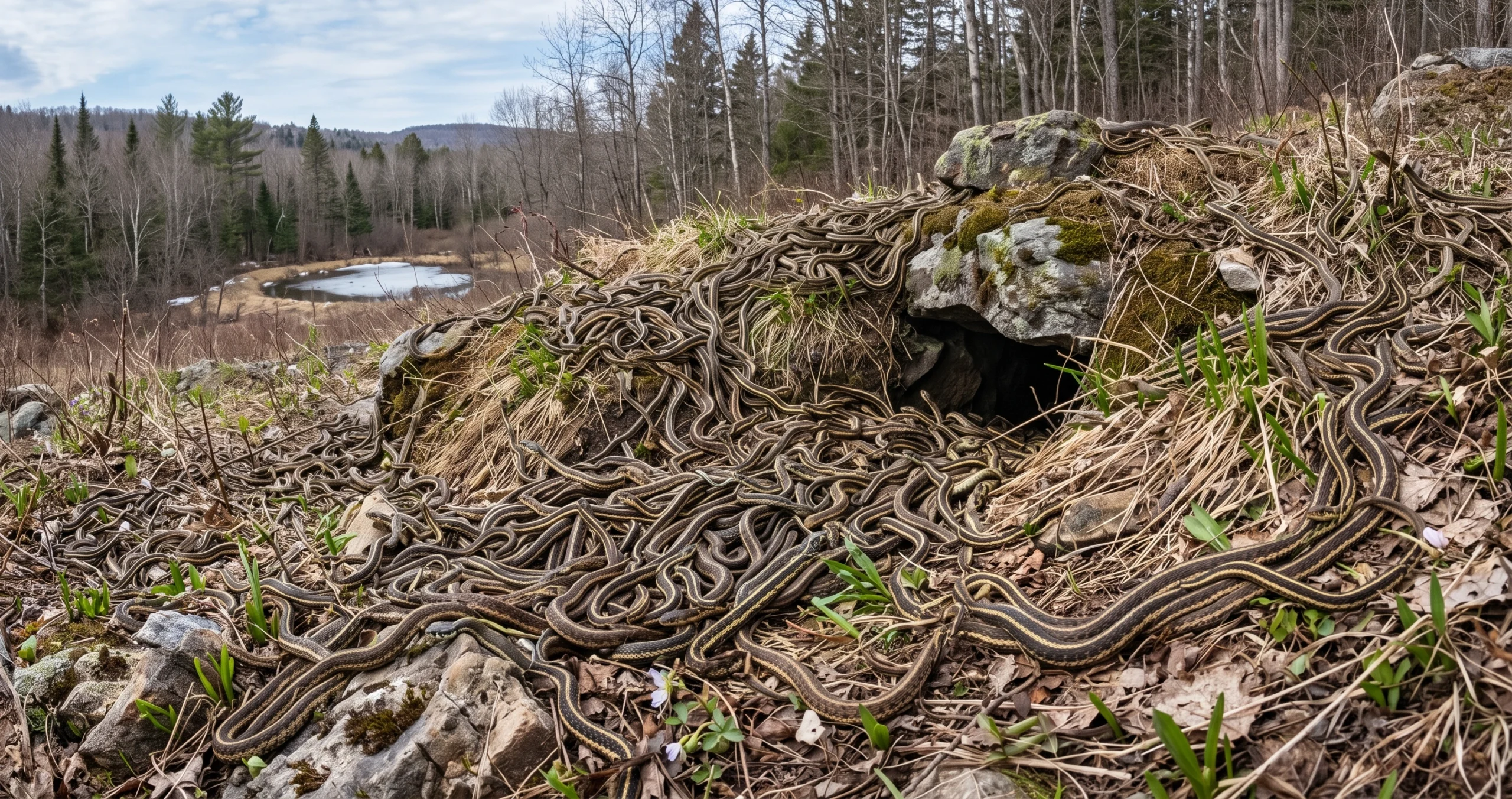
Every spring in Manitoba, Canada, the frozen ground releases one of the most extraordinary concentrations of reptiles on Earth. Tens of thousands of red-sided garter snakes emerge almost simultaneously from underground winter refuges, and the resulting garter snake mating balls can contain dozens—and sometimes up to around 100—males surrounding a single female. (Province of Manitoba)
The spectacle is most famously associated with the Narcisse Snake Dens, where unusual limestone geology has created exceptional overwintering habitat. Yet the gathering is more than a wildlife spectacle. It is a remarkable intersection of geology, chemical communication, extreme climate, migration, and reproductive competition.
Table of Contents
- What Happens at the Narcisse Snake Dens?
- Why So Many Garter Snakes Gather at Narcisse
- How Limestone Created the Perfect Winter Refuge
- How Garter Snake Mating Balls Form
- The Pheromone Chemistry Behind the Gathering
- What Happens After Mating?
- How Scientists Study the Narcisse Snakes
- Responsible Wildlife Tourism at Snake Dens
- Common Myths About Garter Snake Mating Balls
- Frequently Asked Questions
- Conclusion
What Happens at the Narcisse Snake Dens?
The Narcisse Snake Dens lie in Manitoba’s Interlake region, north of Winnipeg. The animals responsible for the spectacle are red-sided garter snakes, a form of the common garter snake (Thamnophis sirtalis parietalis).
According to the Province of Manitoba’s official Narcisse Snake Dens information, tens of thousands of snakes can emerge from their winter dens each spring. Four active dens are accessible along a roughly three-kilometer interpretive trail. (Province of Manitoba)
Timing depends heavily on weather.
The spring spectacle generally occurs from late April into May, with the intense mating period lasting roughly one to three weeks. Males usually appear first and gather around the entrances while waiting for females to emerge. (Province of Manitoba)
A female red-sided garter snake is substantially larger and thicker than a typical adult male.
When one emerges, waiting males rapidly converge upon her. Within moments, the female can disappear beneath a moving mass of intertwined bodies.
This is the famous mating ball.
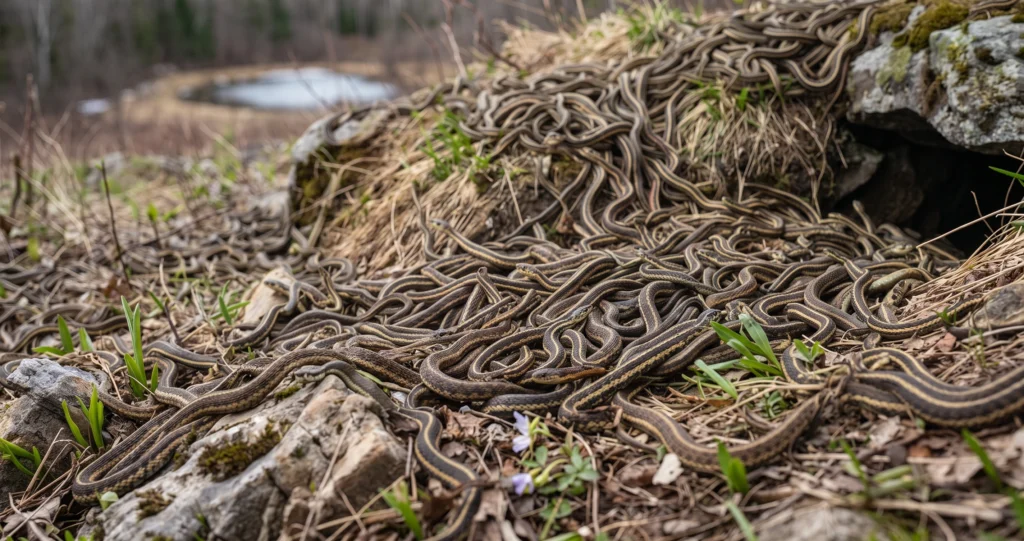
Why So Many Garter Snakes Gather at Narcisse
The gathering makes more sense when Manitoba’s climate is considered.
Snakes are ectothermic animals. They cannot maintain a high internal temperature independently of their surroundings in the way mammals and birds can.
That creates an obvious problem during a Manitoba winter.
Surface temperatures can remain far below freezing for extended periods. A snake attempting to overwinter in a shallow refuge could freeze and die.
The Narcisse region provides an unusual solution.
Beneath the landscape are natural underground passages extending deep enough for snakes to reach protected areas below the frost line. Instead of every animal finding an independent winter refuge, huge numbers can use suitable communal hibernacula.
Adults often return to established denning areas year after year. Manitoba’s wildlife authorities report that marking and recapture studies show most adults tend to use the same den, although some switch between dens. (Province of Manitoba)
The spring mating congregation is therefore partly a consequence of winter survival.
Thousands of snakes are already concentrated in a relatively small area when temperatures finally allow them to become active.
How Limestone Created the Perfect Winter Refuge
The geology beneath Narcisse is essential to the story.
The region contains limestone bedrock that has been modified by water over long periods. Groundwater can move through fractures and gradually dissolve portions of limestone, enlarging cracks and cavities.
Eventually, erosion and collapse create sinkholes, crevices, caverns, and underground networks.
At Narcisse, these geological formations became ideal snake hibernacula.
The Province of Manitoba explains that underground water eroded and collapsed limestone, creating networks of crevices and caverns extending toward the surface. These formations allow snakes to gather below the frost line and survive winter. (Province of Manitoba)
Suitable winter dens are therefore a limiting resource.
Food and water may exist across a much broader landscape, but only certain geological formations provide safe overwintering conditions for enormous numbers of snakes.
The result is an ecological bottleneck.
During summer, the population disperses across surrounding habitat. During autumn, snakes migrate back toward denning areas. Winter compresses them underground, and spring releases them almost simultaneously.
This concentration helps explain why garter snake mating balls reach such extraordinary proportions at Narcisse.
How Garter Snake Mating Balls Form
When spring warmth reaches the den, male red-sided garter snakes generally emerge before females.
Instead of immediately dispersing, many males remain around the den entrance.
They are waiting.
When a sexually receptive female emerges, males detect her and begin courtship. Multiple males surround her, rubbing their chins along her body and attempting to position themselves for mating.
As more males arrive, the group becomes a tangled, constantly shifting mass.
Research on red-sided garter snake group courtship has documented mating balls involving as many as about 100 males courting one female. Interestingly, males may court a female even more actively when other males are already courting her. (PubMed)
That produces a powerful positive-feedback effect.
One female attracts males. Their activity can intensify competition, and additional males join the aggregation.
Eventually, one male succeeds in mating.
Despite appearances, garter snake mating balls are not snakes fighting in the conventional sense. The males are primarily competing through courtship, positioning, endurance, and access to the female.
The Pheromone Chemistry Behind Garter Snake Mating Balls
The males do not simply identify females visually.
Chemical communication is fundamental to red-sided garter snake reproduction.
Female red-sided garter snakes produce sex-attractiveness pheromones in their skin lipids. Classic chemical research identified the signal as a mixture involving long-chain saturated and monounsaturated methyl ketones. (PubMed)
These molecules are not simply airborne perfumes detected from enormous distances.
They are relatively nonvolatile chemical signals. Snakes investigate chemical information using tongue-flicking, collecting molecules from surfaces and transferring chemical cues to the vomeronasal system.
The signal gives males remarkably useful information.
Experiments have demonstrated that male red-sided garter snakes can respond to female pheromone extracts and that variation in the chemical profile can even provide information associated with female body size. Males have shown stronger courtship responses toward chemical extracts from larger females. (PubMed)
The female’s chemical attractiveness is particularly important immediately after spring emergence.
Research has found that females emerge attractive and receptive, with their skin-based pheromone playing a central role in stimulating male courtship. After mating, females undergo changes that sharply reduce their attractiveness and receptivity. (PubMed)
In other words, the spectacular garter snake mating balls at Narcisse are driven largely by invisible chemistry.
An Even Stranger Pheromone Twist
Red-sided garter snakes have produced another fascinating discovery.
Researchers have identified some males that temporarily produce chemical signals resembling the female attractiveness pheromone. Other males consequently court them.
The phenomenon has historically been described in scientific literature as female mimicry.
A classic Nature study documented male snakes attracting mating aggregations because they emitted female-like chemical signals. (PubMed)
Later research continued investigating this unusual reproductive phenotype and its physiological basis. (PubMed)
These findings demonstrate just how heavily garter snake courtship depends upon chemical information.
To a human observer, sex differences may seem visually obvious when large females and smaller males are compared side by side. To a courting snake, however, chemistry can be the decisive signal.
What Happens After Mating?
The enormous spring aggregation is temporary.
Once mating activity declines, snakes begin dispersing from the dens toward their summer feeding areas.
The females do not lay eggs.
Garter snakes are live-bearing reptiles, and females retain developing embryos within their bodies before giving birth later in the season.
By summer, the dramatic concentrations seen at Narcisse have largely disappeared across the surrounding landscape.
Then autumn begins the cycle again.
Snakes move back toward traditional overwintering sites, gathering around the dens before cold weather drives them underground.
The Province of Manitoba notes that snakes begin returning in early September and can remain visible during warm autumn weather. (Province of Manitoba)
How Scientists Study the Narcisse Snakes
The enormous and predictable gathering makes Manitoba’s red-sided garter snakes unusually valuable for behavioral research.
Scientists can observe large numbers of individuals under natural conditions within a relatively concentrated area.
Researchers have conducted behavioral experiments involving pheromones, mate choice, courtship competition, physiology, dormancy, and seasonal reproduction.
For example, laboratory and field experiments using isolated skin chemicals helped scientists identify the chemical composition of the female attractiveness pheromone.
Other research has examined how winter dormancy affects that chemical signal.
One study found that female pheromone quantity and composition changed between autumn and spring, with important pheromone components increasing by emergence time. (PubMed)
Narcisse therefore offers much more than spectacular photographs.
The population has helped scientists understand how temperature, chemical communication, seasonal physiology, and reproductive behavior interact in reptiles.
For another remarkable example of animals using elaborate reproductive signals, read our article on how male bowerbirds build and decorate elaborate bowers to attract a mate.
Responsible Wildlife Tourism at Snake Dens
The Narcisse Snake Dens offer an unusual opportunity to observe wild snakes without needing to capture or disturb them.
Responsible viewing begins with using designated trails and observation platforms. Manitoba maintains viewing platforms beside the active dens specifically so visitors can watch the spectacle while reducing unnecessary disturbance. (Province of Manitoba)
Visitors should also watch where they step.
During peak emergence, snakes may move across trails and vegetation around viewing areas. Allowing them to travel naturally is preferable to surrounding, chasing, or repeatedly repositioning them for photographs.
Handling deserves particular caution.
Manitoba’s official guidance says visitors should handle snakes only in the presence of interpretive staff, who can demonstrate proper techniques. Females should be left alone during the spring mating season. (Province of Manitoba)
Never pull snakes from mating aggregations or den openings.
Visitors should also avoid feeding wildlife, removing snakes from the area, throwing objects into dens, or disturbing limestone openings.
Photography can be done without interfering with natural behavior. A telephoto lens or modest zoom makes it possible to capture impressive images while remaining on established viewing areas.
Finally, check official conditions before traveling.
Spring activity is highly weather-dependent, so the exact peak varies from year to year. Manitoba posts activity updates during viewing seasons. (Province of Manitoba)
Common Myths About Garter Snake Mating Balls
Myth 1: The snakes are fighting
The writhing mass can resemble combat, but the males are primarily courting and competing for access to a female.
A mating ball usually forms around one sexually attractive female.
Myth 2: Hundreds of snakes are mating simultaneously
Many males may participate in the aggregation, but they are competing for a mating opportunity.
Being part of a mating ball does not mean every male successfully mates.
Myth 3: The female is attracting males by making sounds
Chemical signals are central to the process.
Female skin contains a sex-attractiveness pheromone that males recognize during courtship. (PubMed)
Myth 4: Garter snakes are dangerously venomous
Red-sided garter snakes at Narcisse are not dangerous to visitors under ordinary viewing conditions. Manitoba describes the site’s garter snakes as harmless. (Province of Manitoba)
Wild animals should nevertheless be treated respectfully and left undisturbed.
Myth 5: The snakes live together at the dens all year
The huge aggregation is seasonal.
The dens are primarily crucial overwintering sites. Snakes disperse into summer habitat after the spring breeding period and return toward hibernacula in autumn.
Myth 6: Narcisse is crowded with snakes because food is abundant there
Food alone does not explain the concentration.
The critical resource is suitable winter shelter created by the area’s limestone geology. Underground cavities allow snakes to reach protected locations below the frost line. (Province of Manitoba)
Frequently Asked Questions
Where are the Narcisse Snake Dens?
They are located in Manitoba’s Interlake region near the community of Narcisse, Canada. The public site includes four active dens connected by an approximately three-kilometer interpretive trail. (Province of Manitoba)
When is the best time to see garter snake mating balls?
Late April through the first weeks of May is generally the main spring viewing period, but timing varies with weather. Checking Manitoba’s current snake activity updates before visiting is recommended. (Province of Manitoba)
How many males can surround one female?
Official Manitoba information says a mating ball can involve one female surrounded by up to approximately 100 males. (Province of Manitoba)
Why do garter snakes form mating balls?
Many males emerge before females and congregate near shared hibernacula. When a receptive female emerges, her chemical sex pheromone triggers intense courtship, causing numerous males to converge around her.
Why are there so many snakes at Narcisse?
The limestone geology provides underground crevices and caverns suitable for surviving Manitoba’s severe winters. Large numbers of snakes therefore concentrate in a relatively small number of suitable communal hibernacula.
Are the Narcisse garter snakes dangerous?
They are not considered dangerous to visitors. Observe them respectfully, remain on designated viewing areas, and follow instructions from site staff.
Do the snakes return to the same dens?
Many adults do. Mark-recapture studies cited by Manitoba indicate that most adults appear to return to the same den, although some individuals use alternate dens. (Province of Manitoba)
Conclusion
The enormous garter snake mating balls at Narcisse are spectacular, but their real story begins underground.
Manitoba’s limestone landscape created deep cracks, cavities, and sinkholes where red-sided garter snakes can escape lethal winter conditions. Because appropriate hibernacula are limited, enormous numbers of animals converge on the same locations.
Spring then brings thousands of snakes back to the surface within a narrow window.
Males emerge first. Females follow carrying powerful chemical information in their skin, and males respond almost immediately. A single female can suddenly become the center of an extraordinary moving aggregation.
The spectacle demonstrates how several seemingly unrelated biological processes can converge: geology determines winter habitat, climate synchronizes emergence, pheromones guide courtship, and intense reproductive competition creates the mating balls visitors see.
For wildlife watchers, Narcisse offers something equally valuable—an opportunity to observe an extraordinary natural phenomenon without needing to interfere with it.
Viewed responsibly, the gathering is more than a strange snake spectacle. It is a vivid demonstration of how animals adapt their entire annual cycle to climate, landscape, and one brief opportunity to reproduce.
2 Internal Link Suggestions:
- How Male Bowerbirds Build and Decorate Elaborate Bowers to Attract a Mate — relevant comparison showing how radically different animals use specialized signals and behaviors during mate selection.
- How Weaver Birds Engineer Complex Nests — And Why Females Reject So Many — another strong sexual-selection article examining reproductive competition and mate choice.
3 External Dofollow Authoritative Sources:
- Province of Manitoba — Narcisse Snake Dens official visitor and wildlife information — authoritative information on the dens, seasonal activity, limestone hibernacula, mating balls, and visitor guidance. (Province of Manitoba)
- PubMed — Sex Pheromones in Snakes — peer-reviewed Science research identifying the chemical components involved in red-sided garter snake sexual signaling. (PubMed)
- PubMed — Characterization and Behavioral Responses to Red-Sided Garter Snake Sex Pheromones — peer-reviewed research detailing pheromone chemistry and field behavioral responses. (PubMed)