
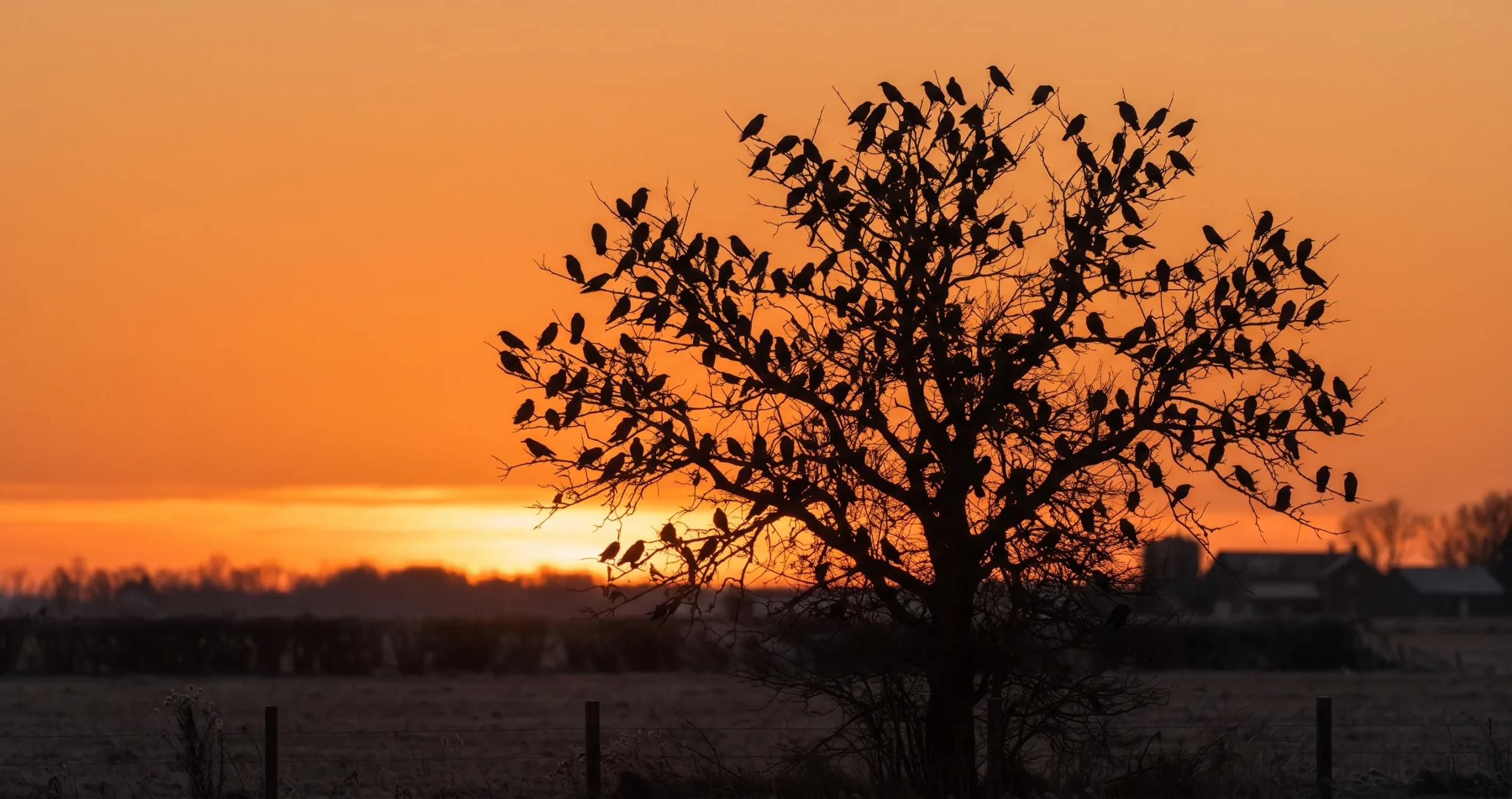
Just before sunset on a cold winter evening, the sky above an ordinary neighborhood may suddenly fill with hundreds of black birds. They circle rooftops, call from treetops, and move together toward a shared sleeping area. This remarkable gathering is known as a crow winter roost, one of the most fascinating seasonal behaviors of North American birds.
American Crows (Corvus brachyrhynchos) are intelligent, highly social birds that often gather in large groups outside the breeding season. While they may spend daylight hours scattered across fields, parks, and neighborhoods, many return to communal roosting sites as darkness approaches.
Scientists have proposed several explanations for this behavior, including protection from predators, social interactions, and access to information about food. Urban environments can also offer conditions that make certain roosting sites attractive.
Understanding these gatherings reveals how crows navigate winter, communicate with one another, and adapt to landscapes shared with people.
Table of Contents
- What Is a Crow Winter Roost?
- How Large Can Winter Crow Roosts Become?
- Why Do Crows Gather Together in Winter?
- Why Crow Roosts Often Form in Towns and Cities
- A Day in the Life of a Winter Crow
- Where to See Crow Winter Roosts
- How to Watch Crow Roosts Respectfully
- How to Manage a Crow Roost Near Your Home
- What Crow Intelligence Reveals About Roosting
- Common Misunderstandings About Winter Crow Roosts
- Frequently Asked Questions
What Is a Crow Winter Roost?
A crow winter roost is a communal nighttime gathering where crows settle together to rest during the colder months.
Unlike a breeding nest, a roost is not primarily a place for laying eggs or raising young. It is a shared sleeping location that birds use outside their daytime feeding activities.
American Crows may gather in deciduous trees, evergreen stands, or groups of trees near developed areas. Some roosts occupy relatively small spaces, while others spread across several blocks.
The birds often arrive gradually rather than flying directly to their final sleeping branches.
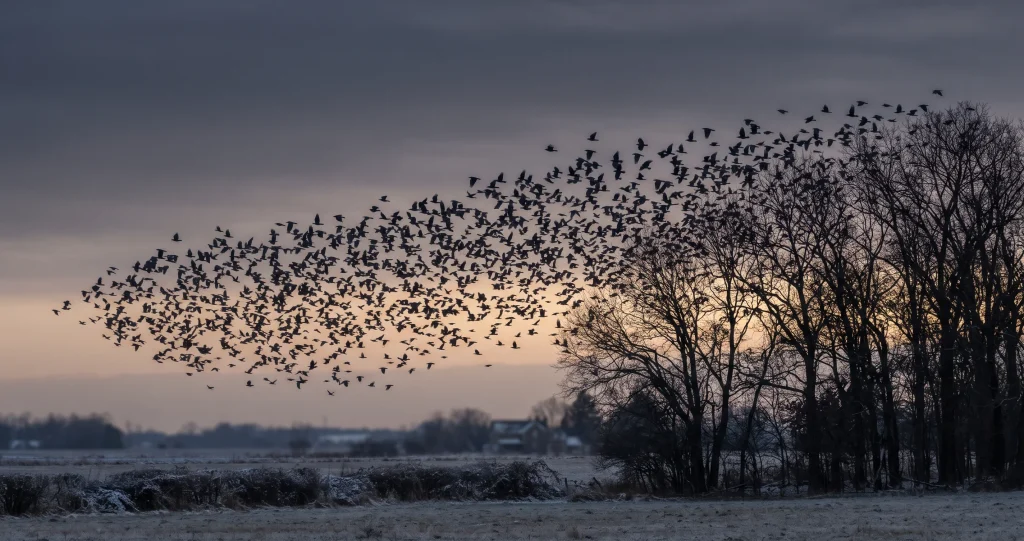
Large groups may first assemble at nearby staging areas, where they call, perch, and move between trees before settling into the main roost.
These gatherings can create an extraordinary evening spectacle, particularly when hundreds or thousands of birds arrive within a short period.
Are Winter Roosts Permanent?
Some communal roosts are used repeatedly during a winter season, and certain locations may attract crows across multiple years.
However, the exact roosting trees can change with weather, disturbance, habitat conditions, and other factors.
A location that hosts a large gathering one winter may support fewer birds the next.
Crows also do not necessarily use the same roost throughout the entire year.
Their social organization changes during the breeding season, when many adults spend more time defending territories and raising young.
How Large Can Winter Crow Roosts Become?
The size of a crow winter roost varies enormously.
Some gatherings contain only dozens of birds, while larger communal roosts can attract thousands.
Exceptionally large roosts have been reported with tens of thousands of crows, particularly in landscapes where birds converge from extensive surrounding areas.
These numbers should not be treated as typical for every town or region.
Roost size depends on local crow populations, food availability, weather, and the distribution of suitable sleeping habitat.
Why Counting Crows Is Difficult
Estimating a large roost is surprisingly challenging.
Birds may arrive from several directions, circle above the trees, leave temporarily, or move between staging areas.
Counting individual birds becomes nearly impossible once dense groups fill the sky.
Researchers and birdwatchers sometimes estimate numbers by counting birds passing through a defined area during a measured interval.
Even carefully produced estimates may contain uncertainty.
For casual observers, the experience of watching the gathering is often more meaningful than obtaining an exact count.
Why Do Crows Gather Together in Winter?
Scientists have investigated several possible benefits of communal roosting.
No single explanation necessarily accounts for every roost, and the importance of different benefits may vary among locations.
Protection From Predators
Safety is one of the leading explanations for communal nighttime roosting.
A crow sleeping alone may be more vulnerable to approaching predators than one surrounded by many alert birds.
Large groups can increase the likelihood that at least one bird detects a threat.
Crows may also benefit from the confusion created when many birds react together.
However, communal roosts do not eliminate predation risk. Owls and other predators can still hunt birds at or near sleeping sites.
Warmth and Shelter
Winter weather may influence where crows choose to sleep.
Dense trees, sheltered branches, and locations protected from strong winds can offer more favorable nighttime conditions than exposed perches.
Urban areas may also have slightly warmer nighttime temperatures than nearby rural landscapes.
Still, crows do not necessarily gain substantial warmth simply by standing close together.
Unlike animals that huddle in direct physical contact, roosting crows often occupy separate branches.
Shelter and microclimate may therefore be more important than direct body-to-body warming.
Information About Food
Another intriguing possibility is that communal gatherings help crows obtain information about feeding opportunities.
Birds arriving from different daytime locations may provide social cues about where food is available.
Researchers have explored this broader idea in communal-roosting birds, although the precise role of information exchange in American Crow winter roosts remains uncertain.
It would be misleading to assume that every crow deliberately communicates the location of a food source.
The more cautious explanation is that communal roosts may create opportunities for birds to observe and respond to one another.
Social Connections
Crows maintain complex social relationships.
Family members may remain associated for extended periods, and individuals can recognize familiar birds.
Large winter gatherings create opportunities for interactions beyond the immediate breeding territory.
These social benefits may contribute to roosting behavior, even when their exact importance is difficult to measure.
Why Crow Roosts Often Form in Towns and Cities
A large crow winter roost in the middle of a city can seem surprising.
Busy streets, traffic lights, buildings, and human activity appear very different from traditional woodland habitat.
Yet some urban environments provide a useful combination of sheltered trees, predictable nighttime conditions, and reduced exposure to certain predators.
Urban Trees Offer Roosting Space
Mature street trees, park trees, and ornamental evergreens can provide numerous branches for sleeping birds.
Groups of trees near buildings may also offer protection from wind.
Crows often use urban green spaces as part of a larger landscape that includes suburban neighborhoods, agricultural fields, and wooded areas.
Artificial Lighting May Matter
Streetlights and illuminated buildings can influence nighttime conditions.
Some researchers have suggested that lighting may help birds detect approaching threats or make certain roosting locations more attractive.
However, the relationship between artificial lighting and crow roost selection is complex.
It should not be assumed that bright lights are universally beneficial to crows or other wildlife.
Food Availability Around Cities
Crows are adaptable omnivores.
They eat insects, seeds, nuts, fruits, carrion, and various other foods depending on the season.
Urban and suburban landscapes can provide feeding opportunities, although birds may travel considerable distances from their nighttime roosts.
A city roost does not necessarily mean the birds spent the day feeding within the city itself.
A Day in the Life of a Winter Crow
The daily routine of a communal-roosting crow often follows a recognizable pattern.
Morning: Leaving the Roost
Around dawn, crows begin stirring and calling from their sleeping trees.
Groups gradually depart, sometimes creating streams of birds moving across the sky.
They disperse toward daytime feeding areas, which may include fields, lawns, wooded habitats, parks, and developed landscapes.
Not every bird follows exactly the same route.
Daytime: Feeding and Social Activity
During daylight, crows search for food and interact with other birds.
They may forage individually, in family groups, or in larger temporary gatherings.
Their flexible diet allows them to exploit different seasonal food sources.
In winter, natural foods such as nuts, seeds, and carrion can become particularly important.
Late Afternoon: Gathering Again
As sunset approaches, crows begin moving toward communal gathering areas.
They may stop in trees or open spaces before reaching the final roost.
These staging gatherings can be noisy and active, with birds arriving and departing repeatedly.
Eventually, many move toward their nighttime perches.
Night: Settling Into the Roost
After darkness falls, activity generally decreases.
Birds settle onto branches and remain relatively quiet, although occasional calls and movements continue.
The following morning, the process begins again.
This daily rhythm is one reason winter roosts are especially rewarding to observe around sunset.
Where to See Crow Winter Roosts
Finding a crow winter roost often begins with noticing repeated evening flight patterns.
In many parts of the United States, American Crows form communal roosts during fall and winter, particularly outside the breeding season.
The best viewing locations depend on local habitat and the movements of the birds.
City Parks and Mature Street Trees
Urban parks with large trees can provide suitable sleeping habitat.
Watch for increasing numbers of crows arriving from several directions shortly before sunset.
A few birds passing overhead do not necessarily indicate a nearby roost.
Repeated evening movements toward the same area provide a stronger clue.
College Campuses and Public Green Spaces
Campuses and other landscaped public spaces sometimes support winter crow gatherings.
Mature trees, open lawns, and surrounding buildings may create suitable conditions.
Observe from public paths and avoid entering restricted or private areas.
Suburban Woodlots
Not every communal roost is urban.
Crows also gather in wooded areas near residential neighborhoods, agricultural landscapes, and other suitable habitats.
Some roosts are easier to hear than to see because dense vegetation conceals the birds.
How to Locate an Active Roost
Begin watching roughly 30–60 minutes before sunset.
Look for groups of crows traveling consistently toward the same part of town or woodland.
Follow their movement only from safe, publicly accessible locations.
Local birdwatching groups may also know about established seasonal roosts.
Because locations can change, a previously reported roost should not be assumed active without recent observation.
How to Watch Crow Roosts Respectfully
A large winter gathering can be memorable without requiring close contact with the birds.
The most responsible approach is to observe from a comfortable distance.
Arrive Before Sunset
Getting into position early allows you to watch the gradual arrival of the birds.
Choose a public sidewalk, park path, or another location where observation is permitted.
Avoid blocking traffic, driveways, or pedestrian access.
Use Binoculars or a Zoom Lens
Binoculars help reveal the birds’ behavior without approaching their sleeping trees.
A camera with a moderate telephoto lens can capture flight patterns and silhouettes.
Avoid using flash photography directly into occupied roosting trees.
Avoid Disturbing the Birds
Do not throw objects, shout, use loud recordings, or deliberately flush crows from their perches.
Repeated disturbance can waste energy and disrupt nighttime resting behavior.
Keep pets under control and respect local rules.
For a broader introduction to crow identification and behavior, the Cornell Lab of Ornithology’s American Crow guide provides reliable species information.
Record Useful Observations
Birdwatchers can note the date, approximate number of birds, weather, arrival direction, and habitat characteristics.
These details can help document changes in roost use over time.
Photographs taken from a distance may also provide useful records without disturbing the gathering.
How to Manage a Crow Roost Near Your Home
A crow winter roost can create practical challenges when birds gather above sidewalks, parked cars, or residential properties.
Noise, droppings, and accumulated debris are common concerns.
However, humane management is preferable to harmful or indiscriminate control.
Start With Practical Adjustments
If birds roost directly above a parked vehicle, moving the vehicle may be the simplest solution.
For sidewalks and outdoor furniture, regular cleaning can reduce buildup.
Use gloves when handling droppings and avoid dry sweeping or pressure-spraying material that could become airborne.
Where possible, choose cleaning methods that minimize dust and splashing.
Avoid Feeding Large Gatherings
Deliberately providing food near a problematic roost can encourage birds to remain in an area.
Keep trash containers closed and avoid leaving accessible food waste outdoors.
This does not guarantee that the roost will move, but it reduces one potential attraction.
Seek Local Wildlife Guidance
If a large roost creates persistent problems, contact local wildlife authorities or a qualified wildlife-management professional.
Management options depend on the site, season, legal protections, and local regulations.
Some communities use coordinated, nonlethal deterrence programs, but results vary and birds may relocate rather than disappear.
Avoid attempting large-scale dispersal independently, especially when it could create hazards for birds, drivers, or neighbors.
Remember Their Seasonal Role
Many winter roosts change or diminish as the breeding season approaches.
A gathering that seems overwhelming in January may become much smaller later in spring.
Understanding this seasonal pattern can help homeowners decide whether temporary adjustments are sufficient.
What Crow Intelligence Reveals About Roosting
Crows are widely recognized for their flexible behavior and learning abilities.
They can solve certain problems, remember useful information, and respond differently to familiar and unfamiliar situations.
Research has also demonstrated that American Crows can recognize individual human faces associated with threatening experiences.
These abilities help explain why crows adapt successfully to changing environments.
Learning From Experience
Crows can remember locations where food is available and modify their behavior when circumstances change.
They also respond to the behavior of other crows.
Such abilities may influence how birds use communal gathering sites.
However, intelligence alone does not explain every aspect of roost formation.
Social Awareness
American Crows often maintain extended family relationships.
Young birds may remain near their parents and sometimes help with subsequent nesting attempts.
This social organization demonstrates that crow relationships can be more complex than simple temporary flocking.
Winter roosts bring together birds from different daytime areas, creating a larger social environment.
Scientists continue studying how individual relationships and group behavior influence these gatherings.
Common Misunderstandings About Winter Crow Roosts
One misconception is that large gatherings mean crows are preparing to migrate.
Some American Crow populations migrate, while others remain in the same general region throughout the year.
A winter roost can include resident birds, seasonal visitors, or both.
Another misunderstanding is that crows gather only because cities are warmer.
Temperature may influence roost selection, but predator avoidance, shelter, and social factors may also contribute.
Large roosts are sometimes interpreted as signs of unusual danger or an impending weather event.
There is no reliable basis for treating ordinary communal roosting as a prediction of severe weather or disaster.
Finally, a large gathering does not necessarily indicate an unusually high local breeding population.
Birds may converge from a broad surrounding area to use one shared sleeping location.
Frequently Asked Questions
Why do crows gather in large groups during winter?
Communal roosting may provide several benefits, including increased opportunities to detect predators, access to sheltered sleeping locations, and social interactions. Researchers continue investigating the relative importance of these factors.
How many crows can sleep in one winter roost?
Numbers range from small groups to thousands of birds. Exceptionally large roosts can contain tens of thousands, although such gatherings are not typical everywhere.
Do crows return to the same roost every night?
Many crows repeatedly use established communal roosting areas during winter. However, the exact trees and locations can change with weather, disturbance, and seasonal conditions.
Are winter crow roosts dangerous to people?
Crows generally do not pose a direct threat to people simply by roosting nearby. Large gatherings can create noise and sanitation concerns, particularly where droppings accumulate beneath occupied trees.
When is the best time to see a crow winter roost?
Late afternoon and the period around sunset are often ideal. Birds typically gather at staging locations before moving into their final sleeping trees as darkness approaches.
Conclusion
A crow winter roost transforms an ordinary evening into an extraordinary wildlife spectacle.
Hundreds or thousands of birds may converge on a shared sleeping area after spending the day searching for food across the surrounding landscape.
These gatherings reflect a combination of seasonal behavior, social relationships, and environmental conditions. Predator avoidance, shelter, and possible information-sharing benefits all remain important areas of scientific interest.
For birdwatchers, the best experience comes from observing quietly, respecting the birds’ space, and appreciating the remarkable coordination of their nightly arrival.
The next time streams of crows cross the winter sky at sunset, they may be heading toward one of nature’s most impressive communal gatherings.
External Sources
1. American Crow
Covers identification, habitat, food, social behavior, and communal roosting.
2. American Crow
Provides species information, natural history, habitat preferences, and social behavior.
National Audubon Society, Audubon — American Crow Field Guide