
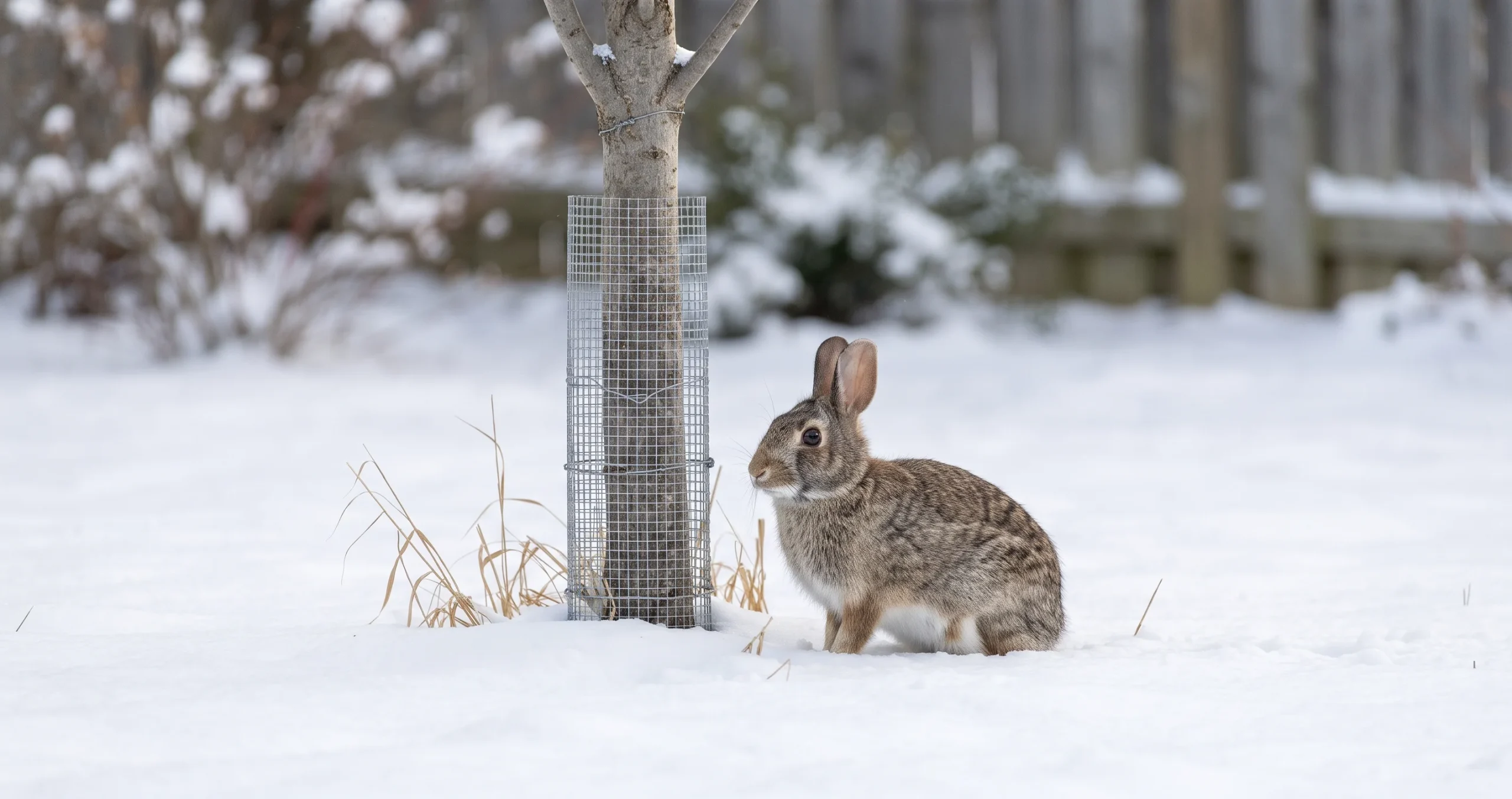
A young apple tree can look perfectly healthy in autumn, only to emerge from winter with its lower trunk stripped of bark. Rabbit damage to trees is a common cold-weather problem, especially in gardens where snow covers grasses and other food sources.
Rabbits do not gnaw bark simply to sharpen their teeth. During winter, bark, buds, and tender twigs become alternative foods when softer vegetation is scarce or buried beneath snow.
The damage can range from a few harmless-looking tooth marks to complete girdling, which may kill a young tree. Fortunately, simple physical barriers can prevent much of this damage.
This guide explains how to recognize rabbit feeding, protect vulnerable trees and shrubs, install effective trunk guards, and respond when bark has already been removed.
Table of Contents
- Why Rabbits Gnaw Tree Bark in Winter
- How to Identify Rabbit Damage to Trees
- Why Girdling Can Kill a Tree
- Trees and Shrubs Most Vulnerable to Rabbits
- How to Install Hardware Cloth Tree Guards
- Other Ways to Protect Trees From Rabbits
- When to Install and Remove Winter Protection
- What to Do if Rabbits Have Already Damaged a Tree
- Common Mistakes in Winter Tree Protection
- Creating a Rabbit-Aware Winter Garden
- Frequently Asked Questions
Why Rabbits Gnaw Tree Bark in Winter
Rabbits feed on a variety of grasses, herbaceous plants, buds, and tender shoots during warmer months. Their diet changes as temperatures fall and snow covers much of the vegetation.
When preferred foods become less accessible, rabbits may turn to woody plants. The bark and small twigs of young trees provide material they can reach during winter.
This behavior is particularly noticeable in landscapes with newly planted fruit trees, ornamental shrubs, and young saplings.
Snow Changes the Feeding Height
Snow creates an unexpected problem for gardeners.
A rabbit standing on deep, compacted snow can reach portions of a trunk that would normally be well above ground level.
As a result, damage may appear several feet above the soil after a snowy winter.
The height of feeding marks often reflects the snow surface at the time the rabbit was feeding, rather than its normal reach from bare ground.
This is why a short trunk guard may work during a mild winter but fail after heavy snowfall.
Why Young Trees Attract Rabbits
Young trees generally have thinner, more accessible bark than mature trees.
Their lower branches may also remain within easy reach of feeding rabbits.
Newly planted trees are especially vulnerable because they have limited stored reserves and smaller root systems.
A young tree that loses a large portion of its bark may struggle to recover even when its upper branches initially appear healthy.
How to Identify Rabbit Damage to Trees
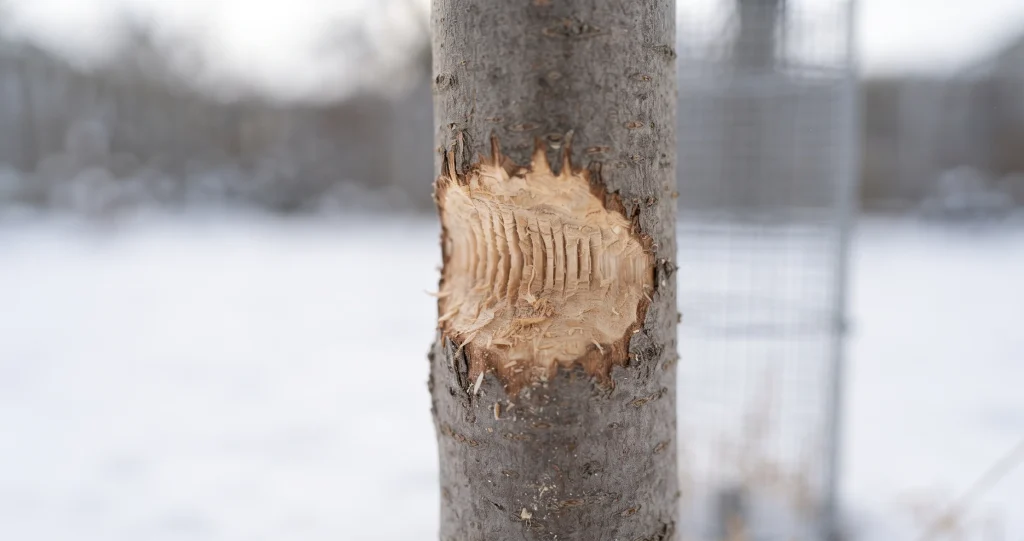
Correct identification matters because rabbits, voles, deer, and other animals can damage woody plants in different ways.
Rabbit feeding usually produces distinctive cuts on small stems and visible gnawing marks on bark.
Clean, Angled Cuts on Twigs
Rabbits have sharp incisors that can clip tender twigs with a relatively clean, angled cut.
A bitten stem may look as though someone used small pruning shears at an angle.
Deer browsing often leaves more ragged or torn ends because deer lack upper front incisors.
This difference is useful, although it should be considered alongside other evidence.
Tooth Marks on Trunks
When rabbits gnaw bark, they may leave closely spaced grooves or scraped areas.
The exposed wood can appear pale compared with the surrounding bark.
Damage often occurs on the lower trunk or near the winter snow line.
Look for repeated small tooth marks rather than assuming every missing patch of bark came from rabbits.
Other Clues Around the Tree
Rabbit tracks, small round droppings, and nearby clipped twigs can support the identification.
Voles also gnaw bark, but their damage is commonly concentrated near the ground or beneath snow cover, sometimes with narrower tooth marks.
If damage is unusually high, consider whether deep snow allowed rabbits to reach the affected area.
Why Girdling Can Kill a Tree
The most serious form of rabbit damage occurs when bark is removed around most or all of a trunk’s circumference.
This is called girdling.
Beneath the outer bark are living tissues involved in transporting sugars produced by the leaves to other parts of the tree.
When these tissues are destroyed around the entire trunk, the normal movement of sugars toward the roots is interrupted.
Partial Damage Versus Complete Girdling
A small patch of missing bark does not automatically mean the tree will die.
If enough healthy living tissue remains connected around the trunk, the tree may continue growing and gradually form wound tissue along the damaged edges.
Complete girdling is much more serious.
The tree may initially produce leaves using stored resources, even though its long-term survival is threatened.
This delayed response can make winter injury difficult to evaluate immediately.
Why Young Fruit Trees Are Especially Vulnerable
Young apple, pear, and other fruit trees often have relatively thin bark and limited trunk diameter.
A rabbit can remove a large proportion of their bark in a short feeding period.
Damage near the graft union is particularly concerning because the tree may lose the connection between the desired fruiting cultivar and its rootstock.
Prevention is far more reliable than attempting to repair severe girdling after it occurs.
Trees and Shrubs Most Vulnerable to Rabbits
Rabbits may feed on many woody plants, but some are especially attractive or vulnerable.
Fruit Trees
Young apple trees are frequent targets, particularly when winter food is scarce.
Crabapples, pears, cherries, and other fruit trees may also experience bark or twig damage.
Susceptibility varies with the species, cultivar, local rabbit population, and availability of alternative food.
Newly planted orchard trees should receive special attention during their first winters.
Ornamental Trees
Certain young ornamental trees can suffer similar damage.
Serviceberries, young maples, and other thin-barked species may be vulnerable under suitable conditions.
Even trees that are not normally preferred can be damaged during periods of food shortage.
Shrubs and Landscape Plants
Rabbits commonly browse tender shrub stems and buds.
Roses, burning bush, and some other ornamental shrubs may lose considerable growth during winter.
Low-growing branches are particularly accessible.
Unlike trunk girdling, the loss of aboveground shrub stems may sometimes be less serious if the plant can regenerate from healthy buds near its base.
However, repeated browsing can reduce flowering, distort growth, and weaken young plants.
How to Install Hardware Cloth Tree Guards
A properly installed hardware cloth guard is one of the most dependable ways to prevent rabbit damage to trees.
Hardware cloth is a rigid wire mesh sold in rolls or sheets. It can be shaped into a cylinder that surrounds the trunk without touching it.
Step 1: Choose Suitable Mesh
Use galvanized hardware cloth with openings of about 1/4 inch.
This small mesh size also helps exclude voles and other small rodents.
Larger openings may allow small animals to reach through or enter the guard.
Choose material sturdy enough to hold its shape through winter.
Avoid sharp exposed wire ends that could injure people, animals, or the tree.
Step 2: Measure the Height
For rabbit protection, guards commonly extend about 2–3 feet above the ground, but snowy locations may require considerably greater height.
The important measurement is the height above the expected snow surface.
A guard that becomes buried beneath a deep snowpack can leave the upper trunk exposed.
Where heavy snow is common, plan for local snow conditions rather than relying on a fixed minimum.
Step 3: Form a Protective Cylinder
Cut the hardware cloth to create a cylinder wider than the trunk.
Leave several inches of clearance between the bark and the wire.
This prevents rubbing and allows room for trunk growth.
Fasten the mesh edges securely so the cylinder maintains its shape.
The guard should stand upright without squeezing the trunk or pressing against the graft union.
Step 4: Secure the Base
Set the guard into the soil by roughly 1–2 inches where practical, or secure it tightly against the ground with suitable anchors.
The goal is to prevent rabbits and smaller rodents from slipping beneath the barrier.
Be careful not to damage major surface roots during installation.
If voles are also a concern, pay particular attention to gaps near the soil surface.
Step 5: Check the Guard Regularly
Inspect the guard after heavy snowfall, strong winds, and freeze-thaw cycles.
Make sure the mesh remains upright and that accumulated snow has not created an easy route over the top.
Remove trapped leaves or debris if they hold moisture against the trunk.
Adjust or replace the cylinder as the tree grows.
Other Ways to Protect Trees From Rabbits
Hardware cloth is highly effective, but other barriers may be useful depending on the planting area.
Spiral Plastic Tree Guards
Plastic spiral guards wrap around the trunk and can provide convenient protection for individual young trees.
They are relatively inexpensive and easy to install.
However, some designs trap moisture, restrict airflow, or become too tight as the trunk expands.
Inspect them regularly and remove or adjust them according to the manufacturer’s instructions and local recommendations.
In areas with deep snow, a short spiral guard may not provide sufficient protection.
Fencing Around Garden Beds
A wire fence can protect several young trees or shrubs at once.
Use mesh with openings small enough to exclude rabbits and install the fence high enough for expected snow conditions.
Secure the bottom to prevent animals from entering beneath it.
Fencing can be particularly practical for small orchards, nursery beds, and newly planted landscape areas.
Commercial Repellents
Some commercially available repellents are labeled for reducing rabbit browsing.
Their effectiveness varies with weather, application method, and animal feeding pressure.
Rain, snow, and new plant growth may reduce protection or require reapplication.
Always follow the product label, especially when treating edible fruit trees.
Repellents should generally be considered supplemental protection rather than a substitute for a properly installed physical barrier.
When to Install and Remove Winter Protection
Install protective barriers in late autumn before persistent snow cover and significant winter feeding begin.
Waiting until bark damage becomes visible may be too late for a young tree.
In regions with early snowfall, protection may need to be installed well before the beginning of December.
Winter Inspections
Check guards throughout the cold season.
Deep snow, drifting snow, and accumulated debris can change how effectively a barrier works.
Make sure rabbits cannot reach the trunk from a raised snow surface.
Also inspect for rubbing, trapped moisture, or damaged fasteners.
Spring Removal and Adjustment
Many rigid hardware cloth guards can remain in place beyond winter if they provide adequate clearance and are regularly inspected.
Temporary wraps and tight-fitting plastic guards may need removal or adjustment as temperatures rise.
The key is to avoid allowing any guard to constrict the expanding trunk.
Young trees may need protection for several winters until their bark becomes thicker and less vulnerable.
What to Do if Rabbits Have Already Damaged a Tree
Discovering missing bark in spring can be discouraging, but the appropriate response depends on how much of the trunk was injured.
Assess the Extent of Damage
Examine the damaged area carefully.
Determine whether the bark has been removed from one side or around the entire trunk.
Look for surviving strips of healthy bark connecting the tissue above and below the wound.
A partially damaged tree may recover if enough living tissue remains.
Avoid Common Wound Treatments
Do not automatically cover exposed wood with paint, tar, or homemade wound sealants.
These products generally do not restore damaged vascular tissue and may interfere with natural wound responses.
Avoid cutting away healthy bark in an attempt to make the injury look neat.
Protect the tree from further feeding and maintain appropriate watering during dry periods.
Consider Professional Repair for Valuable Trees
Bridge grafting is a specialized technique sometimes used to reconnect living tissues above and below a girdled section.
It involves grafting suitable shoots across the damaged area.
Success depends on timing, tree condition, species, and the extent of injury.
For a valuable fruit tree, consult an experienced arborist or fruit-tree specialist promptly.
Severely girdled young trees may be more practical to replace.
Common Mistakes in Winter Tree Protection
One common mistake is installing a guard that is too short.
A barrier that protects the trunk during autumn may become ineffective when snow accumulates.
Another problem is wrapping material tightly against the bark.
Tight guards can rub, trap moisture, or restrict growth.
Leaving gaps at the base may allow small rodents to reach the trunk.
Gardeners also sometimes rely entirely on repellents despite repeated browsing.
Finally, failing to inspect guards can allow a successful autumn installation to become ineffective by midwinter.
Regular checks are a small investment compared with replacing a damaged fruit tree.
Creating a Rabbit-Aware Winter Garden
Protecting trees does not require eliminating rabbits from the landscape.
Rabbits are part of many backyard ecosystems and provide food for predators such as hawks, owls, and foxes.
The goal is to protect vulnerable plants while recognizing that wildlife will continue using the surrounding habitat.
Choose durable barriers for valuable young trees, monitor browsing activity, and plan new plantings with winter conditions in mind.
Avoid placing attractive feeding materials immediately beside unprotected saplings.
For additional ideas about wildlife-friendly landscapes, explore the gardening and nature articles at Secrets of the Green Garden.
A thoughtful approach can protect your orchard without unnecessarily disturbing local wildlife.
Frequently Asked Questions
Can a tree survive rabbit bark damage?
Yes, if the injury is limited and enough living tissue remains intact around the trunk. Complete girdling is much more dangerous because it interrupts the transport of sugars to the roots.
How high should a rabbit tree guard be?
A guard often needs to extend roughly 2–3 feet above ground, but greater height may be necessary where snow accumulates. The top must remain above the snow surface rabbits can stand on.
Will rabbits eat bark from mature trees?
They can, especially during severe food shortages, but young trees with thinner bark are generally more vulnerable. Mature trees are not completely immune.
Does chicken wire stop rabbits?
Chicken wire may provide some protection if its openings are sufficiently small and it is installed securely. However, 1/4-inch hardware cloth is generally a better choice when protection against both rabbits and small rodents is needed.
Can rabbits damage trees during summer?
Yes. Rabbits may browse tender shoots, buds, and young plants throughout the growing season. Bark gnawing becomes particularly noticeable during winter when other food is less accessible.
Conclusion
Rabbit damage to trees can be one of the most frustrating surprises of winter gardening, especially when a young fruit tree loses bark after months of careful growth.
Fortunately, the most effective prevention methods are straightforward. Install sturdy hardware cloth guards before snow arrives, extend them above the expected snow level, secure the base, and inspect them throughout winter.
Recognizing angled twig cuts, tooth marks, and girdling early also helps gardeners respond appropriately.
With a little preparation, young trees can remain protected while rabbits continue playing their natural role in the winter landscape.
External Sources
1. Protecting Trees and Shrubs in Winter
Covers animal browsing, winter injury, trunk protection, and damage prevention.
University of Minnesota Extension
2. Horticulture and Home Pest News
Provides research-based guidance on protecting woody plants from rabbits, identifying winter browsing damage, and managing landscape injury.
Iowa State Horticulture Resources