
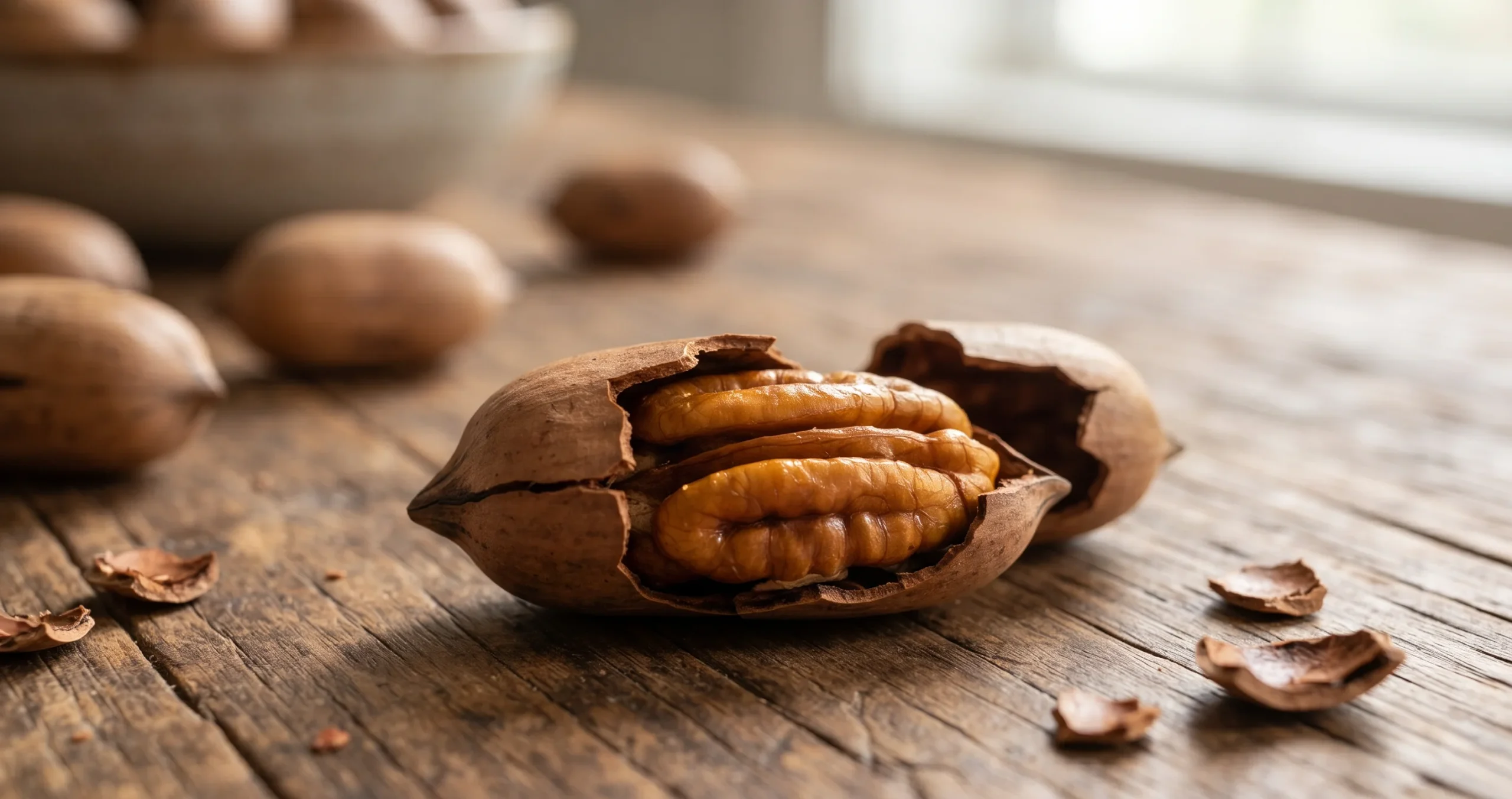
A pecan looks simple once it reaches your kitchen: a hard brown shell surrounding a rich, edible nut. But the pecan nut structure is more interesting than it first appears. Before harvest, each pecan develops inside a green outer husk, and beneath its woody shell sits a seed packed with stored energy for a future tree.
Understanding these layers explains why pecans split open on the tree, why some nuts contain poorly developed kernels, and why proper drying matters after harvest. It also helps gardeners recognize when pecans are mature and ready to collect.
The pecan tree (Carya illinoinensis) is a native North American hickory valued for its edible nuts, broad shade canopy, and role in wildlife habitats. Whether you grow one in your yard or simply enjoy pecans in the kitchen, there is a remarkable biological story inside every shell.
Table of Contents
- Understanding Pecan Nut Structure
- The Four Main Parts of a Pecan
- How Pecans Develop, Ripen, and Fall
- Where Pecan Trees Grow Naturally
- How Long Pecan Trees Take to Produce Nuts
- Why Pecan Trees Need Good Pollination
- Harvesting and Curing Pecans at Home
- How to Store Pecans Properly
- Wildlife That Eat Pecans
- Growing a Pecan Tree in Your Yard
- Frequently Asked Questions
Understanding Pecan Nut Structure
The pecan belongs to the walnut family, Juglandaceae, and is closely related to other hickories. Its edible portion is commonly called a nut, although botanically the entire fruit has a more complex structure than the familiar grocery-store shell suggests.
The pecan nut structure includes an outer husk, a hard shell, and an edible kernel. Within that kernel are two large seed leaves called cotyledons, which contain stored nutrients used during germination.
These layers serve different purposes. The husk protects the developing fruit, the shell surrounds the seed, and the kernel provides the energy a young pecan seedling needs before it can support itself through photosynthesis.
Recognizing these parts is useful for gardeners because their appearance changes as the growing season progresses.
The Four Main Parts of a Pecan
1. The Outer Husk: Nature’s Protective Covering
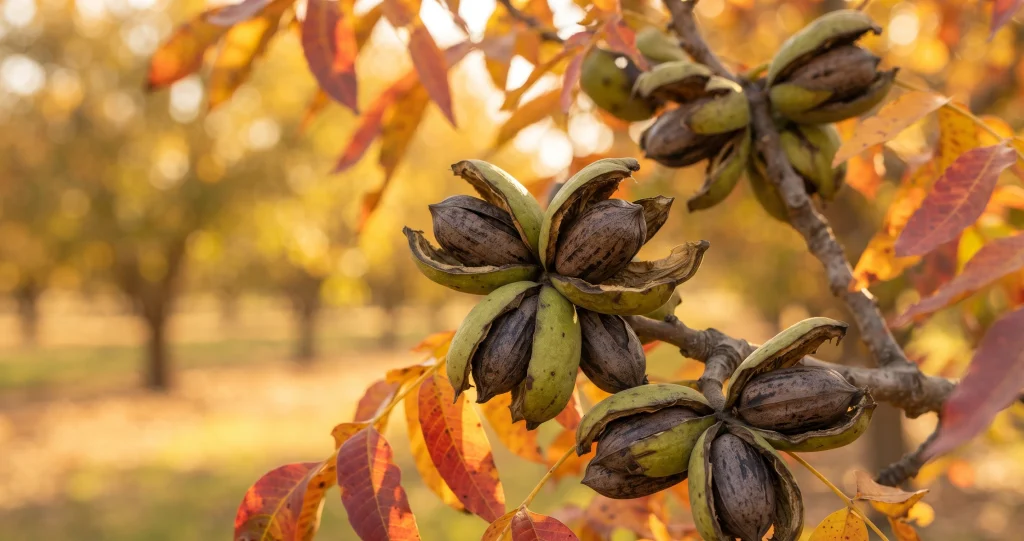
A developing pecan is enclosed in a thick green husk, sometimes called a shuck. This outer covering has four sections that become increasingly distinct as the fruit matures.
During summer, the husk surrounds the growing nut and helps protect it from environmental exposure. It gradually changes from green to brown as the fruit approaches maturity.
In autumn, the husk normally separates along four seams and opens, exposing the hard-shelled pecan inside. This splitting is one of the clearest signs that harvest season has arrived.
Unlike the edible kernel, the husk is not part of the food normally consumed. Gardeners often encounter discarded husks beneath mature trees after nuts have fallen.
2. The Hard Shell: Protection for the Seed
Beneath the husk is the familiar smooth, brown pecan shell. Its shape ranges from relatively short and rounded to long and narrow, depending on the variety.
The shell protects the developing seed from physical damage. Its thickness also varies among cultivars, influencing how easily a pecan can be cracked.
Some cultivated varieties are selected for relatively thin shells and a high proportion of edible kernel. However, a thinner shell does not automatically mean a tree will produce better nuts in every growing environment.
Shell shape alone is not a reliable way to identify a particular pecan cultivar.
3. The Kernel: The Edible Portion
Inside the shell lies the edible pecan kernel, with its characteristic golden-brown color, folded surface, and rich flavor.
The kernel contains oils, proteins, carbohydrates, and other nutrients. These substances make pecans valuable as food for people and as an energy source for wildlife.
Kernel quality depends on several factors, including pollination, moisture availability, tree health, and growing conditions during development.
A mature-looking shell can sometimes contain a small or poorly filled kernel. This happens because the shell and seed do not always develop successfully together.
4. The Cotyledons: Two Seed Leaves Inside
The two large, fleshy halves of a pecan kernel are called cotyledons. They are parts of the seed’s embryo and serve as storage organs.
When a viable pecan germinates, the young plant draws on nutrients stored in these cotyledons. The developing root and shoot then establish the seedling.
This is why the edible kernel is more than a food reserve for animals. Biologically, it is part of the next generation of pecan trees.
The small embryonic axis between the cotyledons contains the tissues that can develop into the seedling’s root and shoot.
How Pecans Develop, Ripen, and Fall
Pecan development begins with flowering in spring. After successful pollination and fertilization, the young fruit grows throughout the warmer months.
The husk enlarges around the developing nut, while the shell forms and hardens. Kernel filling becomes particularly important later in the season, when the seed accumulates stored nutrients.
Adequate moisture during this period helps support healthy nut development. Extended drought can contribute to poorly filled kernels and reduced harvest quality.
As autumn arrives, mature husks begin to dry and split. The nuts eventually loosen and fall naturally, although wind and weather can influence the timing.
Pecans that drop prematurely are not necessarily ripe. Insect damage, disease, drought, or other stresses may cause early fruit loss.
For a more reliable harvest, look for mature nuts released from opened husks rather than assuming every fallen pecan is ready.
Where Pecan Trees Grow Naturally
Pecans are native to parts of central and southern North America, particularly river valleys and bottomland forests associated with major drainage systems.
Their natural distribution includes areas around the Mississippi River basin and extends into portions of Mexico. These trees are especially associated with deep, fertile soils where moisture is available during the growing season.
Today, pecans are cultivated far beyond their original native range. Commercial orchards occur across several southern and southwestern states.
A pecan tree can become a large, long-lived shade tree. Its mature size makes it an important landscape feature but also means it requires considerably more space than most backyard fruit trees.
Pecans are deciduous, losing their leaves in autumn and entering a winter dormant period before growth resumes in spring.
How Long Pecan Trees Take to Produce Nuts
Growing pecans requires patience, especially when starting from seed.
Many grafted pecan trees begin producing some nuts after several years, often roughly four to eight years under favorable conditions. A substantial, dependable crop may take longer.
Seed-grown trees generally take longer to reach bearing age, and their eventual nut quality can differ from that of the parent tree.
Grafted trees are commonly preferred when predictable cultivar characteristics matter. Grafting preserves the selected variety rather than producing genetically variable seedlings.
Even mature trees do not necessarily produce equally heavy crops every year. Pecans commonly show alternate-bearing tendencies, with larger harvests followed by lighter ones.
Weather, nutrient availability, tree reserves, and crop load all influence this pattern.
Why Pecan Trees Need Good Pollination
Pecan trees produce separate male and female flowers on the same tree. Male flowers appear in hanging structures called catkins, while female flowers develop on shoots.
Pecans are primarily wind-pollinated. Pollen moves through the air rather than depending mainly on bees or other insects.
One challenge is that pollen release and female flower receptivity may occur at different times. This timing difference helps encourage cross-pollination.
Cultivars are commonly grouped according to whether they release pollen earlier or later relative to female flower receptivity.
Planting compatible cultivars with overlapping flowering periods generally improves the likelihood of successful pollination and good nut set.
A single pecan tree may occasionally produce nuts when suitable pollen is available nearby. However, planting one isolated tree is less reliable when consistent production is the goal.
Harvesting and Curing Pecans at Home
Recognizing Harvest Time
Harvest typically begins when mature husks split and nuts fall from the tree. Timing varies by cultivar, climate, and seasonal weather.
In many U.S. growing regions, pecan harvest occurs during autumn, often extending into early winter.
Collect fallen nuts regularly, particularly during wet weather. Prolonged contact with damp ground can encourage mold and reduce quality.
Remove remaining husk fragments and discard nuts that show obvious decay, insect holes, or severe damage.
Drying the Nuts
Freshly harvested pecans may contain more moisture than is desirable for storage. Proper drying helps reduce the risk of spoilage.
Spread sound, in-shell pecans in shallow layers in a clean, dry, well-ventilated location. Avoid piling them deeply where moisture can become trapped.
Drying time varies with initial moisture content, temperature, and airflow. The goal is a properly dried nut, not simply a shell that feels dry on the outside.
Commercial operations use moisture measurements and controlled drying conditions. Home gardeners should follow local extension recommendations suited to their harvest conditions.
Checking Kernel Quality
After drying, crack a sample of nuts and examine the kernels.
Healthy kernels should be well developed and free from visible mold, unusual discoloration, and unpleasant odors. A rancid smell or bitter, stale flavor indicates that the nuts should be discarded.
Poorly filled kernels can result from growing-season stress rather than a problem during storage.
Understanding pecan nut structure makes it easier to recognize whether a disappointing nut developed poorly on the tree or deteriorated after harvest.
How to Store Pecans Properly
Pecans contain substantial amounts of oil, which contributes to their flavor but also makes them vulnerable to rancidity.
Warm temperatures, oxygen, and extended storage can gradually reduce quality. Refrigeration or freezing is generally preferable to keeping pecans in a warm pantry for long periods.
Store shelled kernels in airtight, moisture-resistant containers. This helps limit exposure to air and prevents the nuts from absorbing odors from other foods.
In-shell pecans also benefit from cool, dry storage. For longer preservation, freezing is a practical option.
Pecans stored continuously frozen generally maintain quality much longer than those left at room temperature. Exact storage life depends on packaging, temperature stability, and the condition of the nuts before storage.
For kitchen use, thaw only the amount needed and keep the remaining supply sealed.
Wildlife That Eat Pecans
Pecan trees support more than human harvests. Their nuts provide concentrated food for several wildlife species.
Squirrels are among the most familiar pecan consumers. They can crack shells, carry nuts away, and sometimes bury them for later use.
Some buried nuts are never recovered. When conditions are suitable, these forgotten seeds may germinate and establish new trees.
Other animals, including certain rodents and birds such as crows and jays, may also eat pecans or exploit broken nuts.
Wildlife activity can be particularly noticeable during autumn, when nuts become available and animals prepare for colder weather.
Pecan trees also contribute shade, nesting opportunities, and habitat structure. Their ecological value extends beyond the nuts themselves.
Growing a Pecan Tree in Your Yard
Choose the Right Location
Pecan trees need abundant sunlight and enough room for their extensive canopy and root system.
They generally perform best in deep, well-drained soil with reliable moisture. Sites with prolonged waterlogging or severe soil compaction can limit healthy development.
Because mature trees become large, avoid planting them too close to buildings, overhead utility lines, or confined garden spaces.
Select a Suitable Variety
Choose cultivars recommended for your region rather than selecting solely by nut size.
Local disease pressure, winter temperatures, summer heat, and growing-season length all affect performance.
In humid regions, resistance to pecan scab is particularly important. This fungal disease can damage leaves and developing nuts, making locally adapted cultivars valuable.
Consult a regional extension service or reputable nursery for suitable varieties and compatible pollination partners.
Establish Young Trees Carefully
Plant during the appropriate dormant-season window for your climate. Keep the root system protected from drying during planting.
Water deeply as needed while the tree establishes, especially during dry periods. Apply organic mulch around the root zone while keeping it away from direct contact with the trunk.
Young trees benefit from protection against lawn equipment and animal damage.
Avoid expecting immediate harvests. Strong early growth, a healthy root system, and appropriate branch structure are more important than producing nuts during the first few years.
Frequently Asked Questions
Is a pecan a nut or a seed?
In everyday language, a pecan is a nut. Botanically, the edible kernel is a seed enclosed within a hard shell, and the entire fruit has additional protective tissues, including the outer husk.
Why are some pecans empty inside?
Poor pollination, incomplete kernel development, drought, insect damage, and other growing-season stresses can produce nuts with little edible material. A normal-looking shell does not guarantee a fully developed kernel.
Can I grow a pecan tree from a store-bought nut?
A fresh, viable, unroasted pecan may germinate under suitable conditions, often after appropriate cold, moist treatment. However, commercial nuts may have been dried or stored in ways that reduce viability, and seedlings will not necessarily reproduce the characteristics of the parent cultivar.
Conclusion
The next time you crack a pecan, consider the layers that made that edible kernel possible. The outer husk protects the developing fruit, the hard shell encloses the seed, and the cotyledons store nutrients for a potential new tree.
Understanding pecan nut structure also helps explain harvest timing, kernel quality, storage needs, and the importance of pollination.
For home gardeners, pecans offer a rewarding long-term project. With suitable growing conditions, compatible varieties, and patience, a mature tree can provide both a valuable food crop and habitat for wildlife.
External Sources
1. Flowering Habits of Pecan Trees
Explains flower development, the shuck, shell, and two cotyledons that form the kernel. New Mexico State University. Read NMSU Extension guide.
2. The Pecan Tree
Covers pecan development, pollination, fruit anatomy, and bearing age. University of Florida IFAS Extension. Read UF/IFAS guide
3. Managing Pecans in the Home Landscape
Provides practical recommendations for harvesting, drying, storing, and managing pecan trees. Oklahoma State University Extension. Read Oklahoma State guide.