
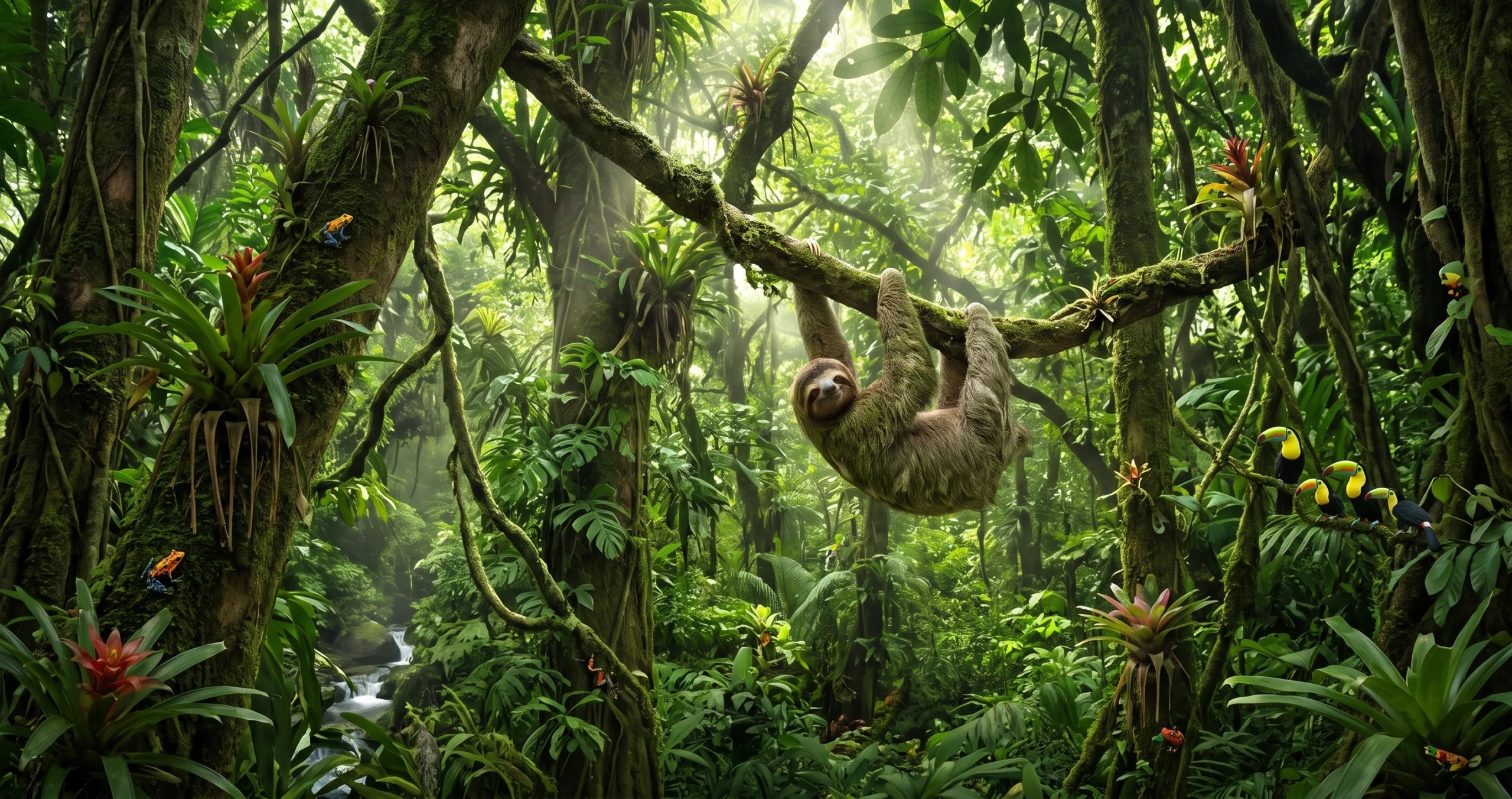
Sloths are often portrayed as the world’s laziest animals, spending most of their lives hanging upside down in tropical trees and moving at what seems like an impossibly slow pace. However, modern biology tells a very different story. Understanding why sloths are slow reveals one of evolution’s most efficient survival strategies. Rather than being lazy or incapable of moving quickly, sloths have evolved an energy-saving lifestyle perfectly matched to their diet, habitat, and predators.
Their slow movements, remarkably low metabolic rate, algae-covered fur, and unusual digestive system all work together to solve a difficult ecological challenge: surviving on one of the least nutritious diets in the rainforest. Scientists now view sloths as masters of energy conservation rather than examples of inactivity. Their lifestyle demonstrates how evolution often rewards efficiency instead of speed.
Table of Contents
- Meet the Sloth
- Why Sloths Are Slow: The Evolutionary Answer
- A Diet Built on Low-Calorie Leaves
- The Slowest Metabolism Among Mammals
- Digestion That Takes Weeks
- Algae and Camouflage: An Unexpected Partnership
- Moving Slowly to Avoid Predators
- Comparing Sloths to Other Energy-Saving Animals
- Why Scientists Study Sloth Physiology
- Common Myths About Sloths
- Frequently Asked Questions
- Conclusion
Meet the Sloth
Sloths are tree-dwelling mammals native to the tropical forests of Central and South America.
Today, six living species exist, divided into two major groups: two-toed sloths and three-toed sloths.
Although both groups share similar lifestyles, they evolved independently from different extinct ancestors.
Modern sloths spend nearly their entire lives suspended from branches.
Their long curved claws function like natural hooks, allowing them to hang with minimal muscular effort.
This upside-down lifestyle reduces energy expenditure while providing access to their preferred food source: leaves.
Why Sloths Are Slow: The Evolutionary Answer
Many people assume sloths move slowly because they are weak or unintelligent.
Neither assumption is true.
Their slow movement is an adaptation shaped by millions of years of natural selection.
Every aspect of sloth biology favors energy conservation.
Fast movement requires large amounts of energy.
Sloths simply cannot afford this because leaves provide relatively few calories compared with fruits, insects, or meat.
Instead of evolving faster digestive systems or more efficient hunting strategies, sloths evolved to reduce their energy requirements dramatically.
Their bodies consume far less energy than those of similarly sized mammals.
This allows them to survive on food that would be insufficient for many other animals.
A Diet Built on Low-Calorie Leaves
Leaves appear abundant in tropical forests, but they present significant nutritional challenges.
Most leaves contain:
- High amounts of cellulose
- Tough plant fibers
- Defensive chemicals
- Relatively little protein
- Low calorie content
Many animals avoid relying exclusively on mature leaves because extracting useful nutrients requires considerable time and specialized digestion.
Sloths have accepted this trade-off.
Rather than searching constantly for higher-quality food, they remain in areas where suitable leaves are plentiful and conserve energy instead.
This strategy minimizes travel while maximizing survival.
The Slowest Metabolism Among Mammals
One of the most important reasons why sloths are slow involves metabolism.
Metabolism refers to the chemical processes that convert food into usable energy.
Sloths possess one of the lowest metabolic rates among non-hibernating mammals.
Their body temperature fluctuates more than that of most mammals and often depends partly on surrounding environmental conditions.
A slower metabolism means:
- Reduced calorie requirements
- Lower oxygen consumption
- Less food needed each day
- Slower digestion
- Lower overall activity
Everything about sloth physiology supports long-term energy conservation.
Rather than generating excess heat and maintaining constant activity, sloths operate on an economical biological budget.
Digestion That Takes Weeks
Digesting leaves is difficult.
Sloths possess large, multi-chambered stomachs filled with microorganisms that break down tough plant material.
These microbial communities ferment leaves similarly to the digestive systems of cows and other herbivores.
However, the process occurs much more slowly.
Food may remain inside a sloth’s digestive tract for several weeks.
Some meals require nearly a month before complete digestion.
Although this seems inefficient, the strategy allows maximum extraction of nutrients from extremely poor-quality food.
The digestive system itself can account for a surprisingly large proportion of total body weight.
Conserving Every Possible Calorie
Because digestion requires so much time, sloths avoid wasting energy whenever possible.
They spend much of the day resting.
When they move, their motions are deliberate and controlled.
Even climbing requires surprisingly little effort because their specialized claws support body weight without continuous muscle contraction.
Unlike many mammals that actively grip branches, sloths effectively hang from them using skeletal anatomy and tendon arrangements.
This passive suspension conserves additional energy.
Algae and Camouflage: An Unexpected Partnership
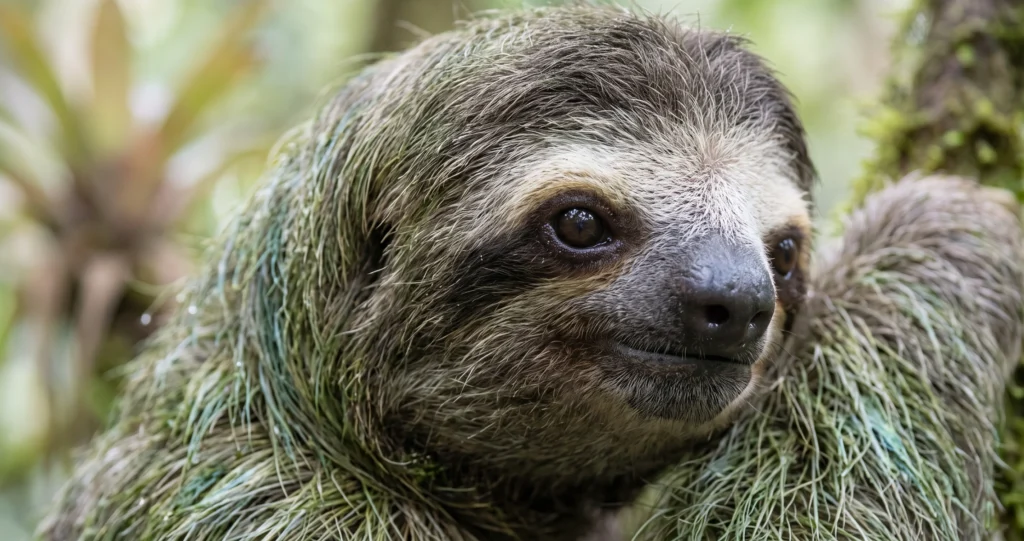
One of the most remarkable features of sloths is their unusual fur.
Each hair contains tiny grooves that trap moisture, particularly during rainy seasons.
These grooves create ideal conditions for algae growth.
Over time, the fur often develops a greenish tint.
Rather than harming the sloth, this algae may provide several ecological advantages.
The green coloration helps the animal blend into moss-covered tree branches and leafy canopies.
Researchers have also discovered complex miniature ecosystems living within sloth fur, including fungi, insects, and microorganisms.
Although scientists continue investigating these relationships, the algae clearly contribute to effective camouflage.
Moving Slowly to Avoid Predators
Most prey animals rely on speed to escape danger.
Sloths evolved a completely different strategy.
Many predators detect movement more readily than stationary objects.
Rapid motion immediately attracts attention.
By moving extremely slowly, sloths reduce the likelihood of being noticed in the first place.
This approach works especially well in dense forest canopies where irregular branches, leaves, moss, and filtered sunlight already disrupt visual outlines.
Combined with algae-covered fur, slow movement makes sloths surprisingly difficult to detect.
Natural predators such as harpy eagles and jaguars certainly find sloths, but remaining inconspicuous greatly reduces detection risk.
Weekly Trips to the Forest Floor
One of the greatest mysteries of sloth biology involves defecation.
Most sloths descend from trees only about once each week to urinate and defecate.
This behavior exposes them to predators and remains incompletely understood.
Several hypotheses have been proposed.
Some researchers suggest it helps fertilize preferred trees.
Others believe it relates to maintaining symbiotic organisms living in sloth fur.
The exact evolutionary explanation remains uncertain.
Regardless of the reason, these ground visits represent one of the riskiest parts of a sloth’s weekly routine.
Comparing Sloths to Other Energy-Saving Animals
Sloths are not the only animals that survive by conserving energy.
Nature contains many examples of low-energy lifestyles.
Koalas
Koalas also feed on nutrient-poor leaves and spend much of the day resting.
Like sloths, they rely on specialized digestion to extract nutrients.
Tortoises
Many tortoise species maintain relatively slow metabolisms that support long lifespans and survival during food shortages.
Tardigrades
Tardigrades survive extreme conditions by entering cryptobiosis, dramatically reducing metabolic activity until conditions improve.
Bears
Although bears are far larger and far more active, hibernation represents another strategy that temporarily lowers metabolism to conserve energy.
These examples demonstrate that slowing biological processes often provides significant survival advantages under challenging environmental conditions.
Why Scientists Study Sloth Physiology
Sloths provide valuable insights into metabolism, digestion, microbial symbiosis, and energy conservation.
Researchers investigate questions such as:
- How do sloths maintain muscle while moving so little?
- How do gut microbes efficiently digest leaves?
- How does fluctuating body temperature influence metabolism?
- What role do algae and microorganisms play in fur ecosystems?
Studying these systems improves our understanding of mammalian physiology and evolutionary adaptation.
It also highlights the importance of preserving tropical forests that support these specialized animals.
If you enjoy learning about remarkable survival adaptations, you may also enjoy our article about tardigrades and their extraordinary resistance to extreme environments at secretsofthegreengarden.com.
For reliable information about sloth conservation and biology, the Smithsonian’s National Zoo provides science-based educational resources:
https://nationalzoo.si.edu/
Common Myths About Sloths
Myth: Sloths are lazy.
False.
Their slow behavior represents an efficient adaptation to an extremely low-calorie diet.
Myth: Sloths can never move quickly.
False.
Although uncommon, sloths can move faster when escaping immediate danger.
Myth: The algae harms sloths.
Current evidence suggests algae contributes to camouflage and may provide ecological benefits rather than causing harm.
Myth: Sloths sleep all day.
Not entirely.
Wild sloths sleep considerably less than early captive observations suggested, often around 8–10 hours daily rather than nearly the entire day.
Myth: Slowness means poor intelligence.
False.
Movement speed does not directly reflect cognitive ability.
Sloths are highly specialized animals adapted to their ecological niche.
Frequently Asked Questions
Why are sloths so slow?
They conserve energy because their leaf-based diet provides relatively few calories.
What do sloths eat?
Most species feed primarily on leaves, although some occasionally consume fruits or flowers.
Why does algae grow on sloths?
Their specialized fur traps moisture, creating favorable conditions for algae growth.
How long does digestion take?
Digesting a meal may require several weeks because leaves are difficult to break down.
Are sloths endangered?
Some species face conservation challenges due to habitat loss, while others remain relatively stable. Conservation status varies among species.
Conclusion
Understanding why sloths are slow reveals one of nature’s most elegant examples of evolutionary efficiency. Rather than competing through speed or strength, sloths survive by minimizing energy expenditure, extracting maximum nutrition from low-quality leaves, and avoiding detection through slow movement and natural camouflage. Their specialized metabolism, remarkably slow digestion, and symbiotic relationship with algae all contribute to a lifestyle perfectly suited to tropical forest canopies.
Far from being lazy, sloths represent a sophisticated solution to a demanding ecological challenge. Their biology reminds us that evolution does not always reward the fastest or strongest species. Sometimes the greatest advantage comes from conserving energy, remaining unnoticed, and thriving where others cannot. As researchers continue studying these remarkable mammals, sloths remain powerful examples of how specialized adaptations can transform apparent limitations into extraordinary survival strategies.
2 Internal Link Suggestions:
- https://secretsofthegreengarden.com/tardigrades-the-microscopic-animal-that-can-survive-almost-anything/
- https://secretsofthegreengarden.com/why-beavers-are-natures-most-powerful-ecosystem-engineers/
3 External Dofollow Authoritative Sources with URLs:
- Smithsonian’s National Zoo – Sloths: https://nationalzoo.si.edu/
- Animal Diversity Web – Sloths: https://animaldiversity.org/accounts/Folivora/
- IUCN Red List – Sloth Species: https://www.iucnredlist.org/