
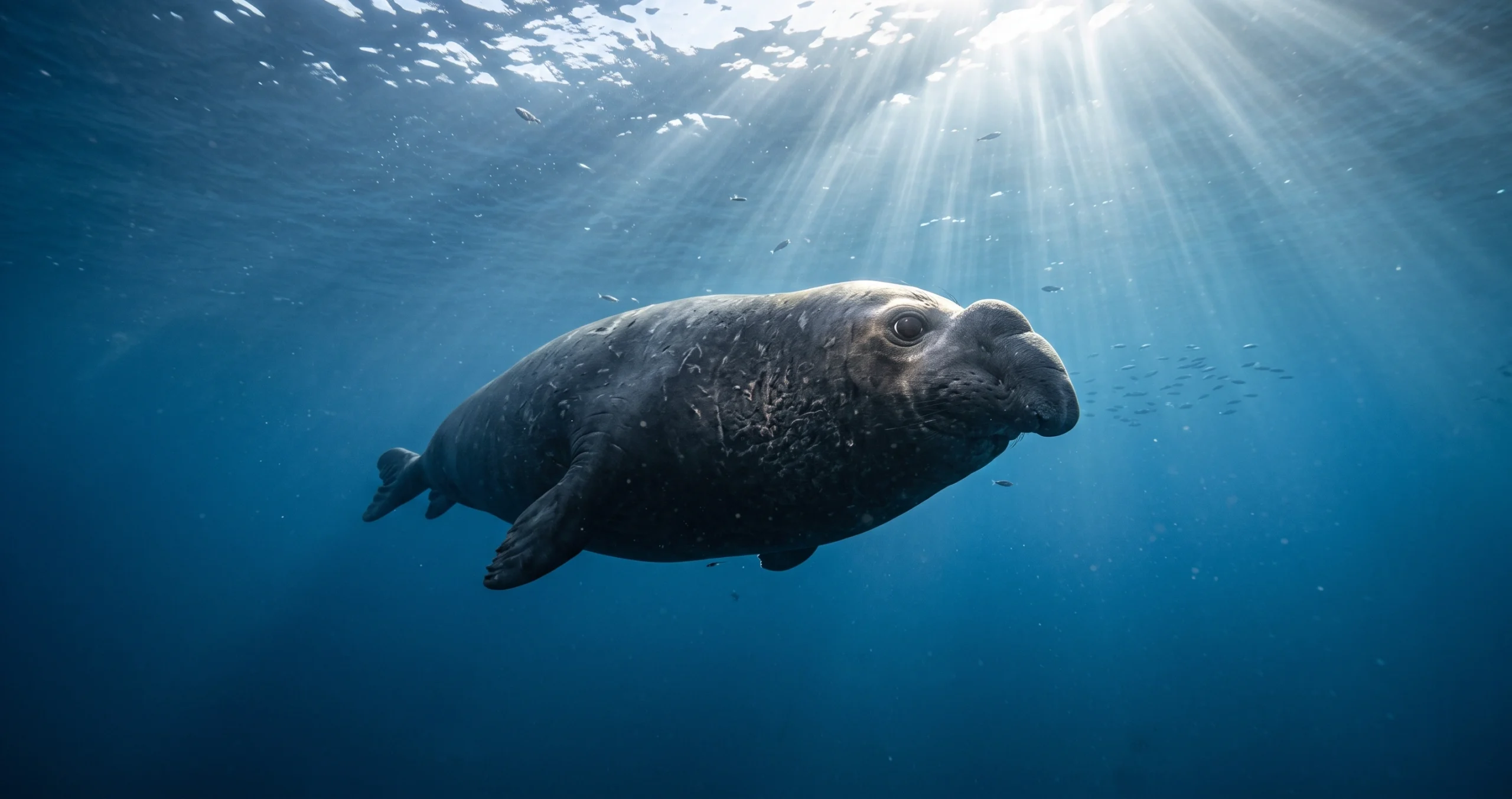
The ocean is full of remarkable survival strategies, but few are as surprising as the discovery that elephant seals regularly fall asleep while diving hundreds or even thousands of feet beneath the surface. In 2023, researchers published groundbreaking findings showing that elephant seal deep diving sleep occurs during short, deep descents far below the ocean surface. Rather than resting at the surface where predators are more common, these marine mammals drift into sleep while slowly sinking through the dark depths before waking and swimming back to breathe.
This discovery reshaped scientists’ understanding of marine mammal behavior. It revealed not only how elephant seals manage the competing demands of feeding, traveling, and resting but also how evolution has produced an elegant solution to the dangers of sleeping in the open ocean. Combined with extraordinary adaptations for storing oxygen and conserving energy, elephant seals demonstrate one of the most specialized sleep strategies known in the animal kingdom.
Table of Contents
- Meet the Elephant Seal
- The 2023 Discovery That Changed Marine Biology
- Elephant Seal Deep Diving Sleep Explained
- How Elephant Seals Dive So Deep
- Oxygen Storage: Fuel for Long Dives
- Bradycardia: Slowing the Heart to Save Oxygen
- Why Sleeping Deep Underwater Is Safer
- Comparing Elephant Seals to Other Diving Mammals
- How Researchers Studied Sleeping Seals
- Why This Discovery Matters
- Common Myths About Elephant Seal Sleep
- Frequently Asked Questions
- Conclusion
Meet the Elephant Seal
Elephant seals are among the largest seals on Earth.
Northern elephant seals (Mirounga angustirostris) inhabit the Pacific coast of North America, while southern elephant seals (Mirounga leonina) range across the Southern Ocean.
Adult males can exceed 4,000 kilograms (8,800 pounds), making them the largest members of the seal family.
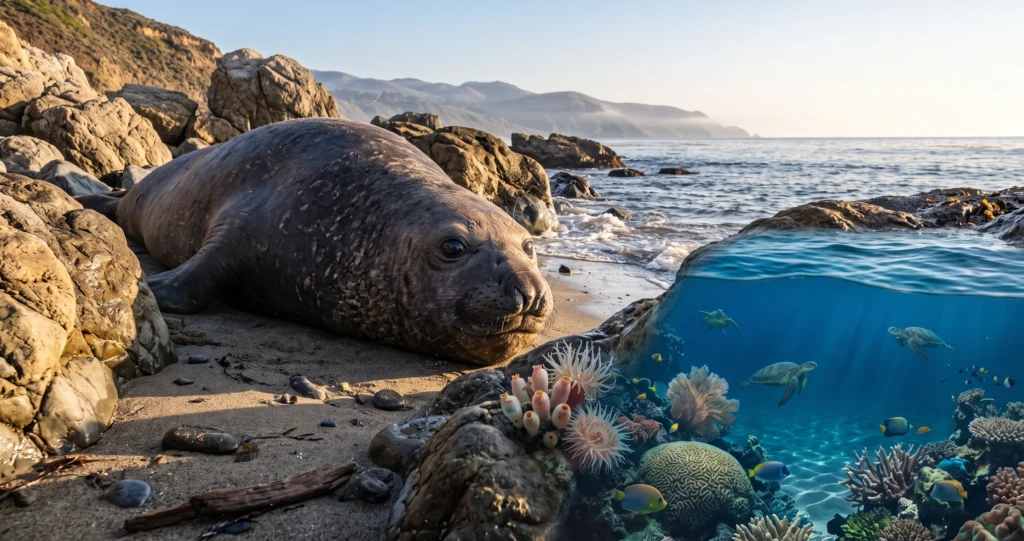
Despite their size, elephant seals spend surprisingly little time on land.
Outside breeding and molting seasons, they remain at sea for months at a time, traveling thousands of miles while performing nearly continuous deep dives.
These long ocean journeys raised an intriguing question for scientists.
When do elephant seals actually sleep?
The 2023 Discovery That Changed Marine Biology
For years, researchers suspected elephant seals somehow slept while at sea, but direct evidence was lacking.
In 2023, scientists from institutions including the University of California, Santa Cruz published a landmark study in Science using sophisticated biologging devices that recorded brain activity, heart rate, body movement, and dive behavior.
The findings revealed something extraordinary.
Rather than sleeping near the surface, elephant seals entered brief sleep episodes during very deep dives.
Many of these sleep dives occurred between approximately 300 and 600 meters (about 1,000–2,000 feet), although elephant seals are capable of diving well over 1,500 meters (nearly a mile) during foraging trips.
During sleep, the animals often drifted passively through the water before awakening and swimming back toward the surface to breathe.
These observations represented the first direct evidence of natural sleep occurring during deep ocean dives.
Elephant Seal Deep Diving Sleep Explained
The newly discovered sleep behavior follows a remarkably consistent pattern.
After spending much of the day actively hunting fish and squid, an elephant seal begins a specialized sleep dive.
It descends into deeper water, often well below the depths where many predators hunt.
Once the animal enters sleep, muscle tone decreases.
The seal gradually rotates into a slow spiraling posture sometimes called a “sleep spiral.”
Instead of actively swimming, it gently drifts downward through the water column.
These sleep episodes are relatively brief.
Individual bouts of sleep typically last only around 10 minutes before the seal awakens and begins swimming upward to replenish oxygen at the surface.
Across an entire day at sea, elephant seals accumulate surprisingly little sleep—often only about two hours.
Compared with many land mammals, this is an exceptionally small amount of daily rest.
How Elephant Seals Dive So Deep
Sleeping hundreds of meters below the surface would be impossible without extraordinary diving adaptations.
Elephant seals rank among the deepest-diving air-breathing mammals.
Some dives exceed 1,500 meters (nearly one mile), lasting well over an hour under favorable conditions.
Several specialized biological systems make these remarkable dives possible.
The animals efficiently store oxygen, reduce energy consumption, and carefully manage blood flow to essential organs.
Together, these adaptations allow elephant seals to remain underwater far longer than humans or most other mammals.
Oxygen Storage: Fuel for Long Dives
Unlike scuba divers, elephant seals carry all the oxygen they need before beginning a dive.
Their bodies maximize oxygen storage in several ways.
Large Blood Volume
Elephant seals possess unusually large blood volumes relative to body size.
More blood means more hemoglobin, the oxygen-carrying protein inside red blood cells.
High Hemoglobin Concentration
Their blood contains elevated concentrations of hemoglobin, allowing even greater oxygen transport.
Massive Myoglobin Stores
Their muscles contain exceptionally high levels of myoglobin.
This oxygen-binding protein stores oxygen directly within muscle tissue, providing fuel even when blood oxygen declines during prolonged dives.
Together, these adaptations create enormous internal oxygen reserves.
Bradycardia: Slowing the Heart to Save Oxygen
One of the most important physiological adaptations is bradycardia, an extreme slowing of the heart rate during dives.
While resting at the surface, elephant seals maintain relatively normal heart rates.
Once underwater, however, heart rate decreases dramatically.
This slower circulation reduces oxygen consumption while directing available oxygen toward organs that need it most, particularly the brain and heart.
Other tissues tolerate reduced blood flow until the animal returns to the surface.
This oxygen-conserving strategy greatly extends dive duration.
Additional Diving Adaptations
Elephant seals possess several other features that support extreme diving.
Flexible rib cages allow the lungs to collapse safely under immense pressure.
Collapsing lungs reduce nitrogen absorption, lowering the risk of decompression problems.
Their metabolism also slows during long dives, further conserving oxygen.
Together, these adaptations enable repeated deep dives throughout months-long ocean migrations.
Why Sleeping Deep Underwater Is Safer
One of the most important findings from the 2023 research concerns predator avoidance.
Sleeping at the ocean surface would expose elephant seals to significant danger.
Predators such as great white sharks and killer whales frequently hunt near the surface where visibility is greatest.
By sleeping hundreds of meters below, elephant seals spend their most vulnerable periods in comparatively safer environments.
Although the deep ocean contains other predators, many surface-hunting species rarely venture to these depths.
Evolution appears to have favored a strategy that separates sleep from the highest-risk portions of the water column.
This elegant solution allows elephant seals to balance rest with survival.
Comparing Elephant Seals to Other Diving Mammals
Many marine mammals dive deeply, but their sleep strategies differ considerably.
Dolphins
Dolphins remain conscious enough to surface regularly because they breathe voluntarily.
They exhibit unihemispheric sleep, allowing one half of the brain to rest while the other remains awake.
Whales
Some whales also rely on unihemispheric sleep while continuing to breathe at intervals.
Sea Otters
Sea otters typically sleep floating at the surface, often wrapping themselves in kelp to avoid drifting away.
Elephant Seals
Elephant seals represent a unique strategy.
Instead of sleeping near the surface or using prolonged unihemispheric sleep, they combine short sleep bouts with controlled deep dives far below predator-rich waters.
This strategy appears especially well suited to their long-distance oceanic lifestyle.
How Researchers Studied Sleeping Seals
The 2023 study became possible because of advances in biologging technology.
Researchers attached non-invasive recording devices that measured:
- Brain activity (EEG)
- Heart rate
- Body orientation
- Swimming movements
- Dive depth
- Acceleration
These instruments allowed scientists to distinguish true sleep from quiet wakefulness.
The recordings demonstrated that elephant seals entered both slow-wave sleep and rapid eye movement (REM) sleep while underwater.
During REM sleep, reduced muscle tone often contributed to the characteristic drifting spiral observed during sleep dives.
This represented one of the most detailed investigations of sleep ever conducted in a free-ranging marine mammal.
Why This Discovery Matters
The study extends beyond elephant seals themselves.
Understanding how marine mammals balance sleep with predator avoidance helps scientists explore broader questions about evolution, physiology, and animal behavior.
It also demonstrates how advanced biologging technologies are transforming wildlife research.
Future studies may reveal equally surprising sleep strategies in other ocean species.
Insights into oxygen management, metabolism, and cardiovascular regulation may also contribute to biomedical research involving hypoxia and human medicine.
For additional information about marine mammal research and conservation, the National Oceanic and Atmospheric Administration (NOAA) provides extensive educational resources:
https://www.fisheries.noaa.gov/
If you’re interested in extraordinary adaptations among marine animals, you may also enjoy our article on the cuttlefish hunting display and its remarkable camouflage strategies at secretsofthegreengarden.com.
Common Myths About Elephant Seal Sleep
Myth: Elephant seals sleep only on beaches.
False.
While they rest extensively on land during breeding and molting, they also sleep during deep dives while at sea.
Myth: They sleep for hours underwater.
False.
Individual underwater sleep bouts are typically brief, often lasting around 10 minutes.
Myth: They can breathe underwater while sleeping.
False.
Elephant seals remain air-breathing mammals and must return to the surface to inhale.
Myth: Every dive is a sleep dive.
False.
Most dives are dedicated to foraging. Sleep dives represent a specialized subset of their diving behavior.
Myth: Sleeping deep underwater eliminates all danger.
False.
Deep sleeping likely reduces predation risk from many surface predators, but it does not make elephant seals completely safe.
Frequently Asked Questions
How long do elephant seals sleep each day at sea?
Research suggests they average only about two hours of sleep per day while on long foraging trips.
How deep do elephant seals sleep?
Many sleep dives occur between roughly 300 and 600 meters, although the animals routinely dive much deeper while foraging.
Why don’t they sleep at the surface?
Surface waters expose them to predators such as killer whales and great white sharks.
What is bradycardia?
Bradycardia is a slowing of the heart rate that helps conserve oxygen during prolonged dives.
Why was the 2023 study important?
It provided the first direct measurements showing natural sleep occurring during deep dives in free-ranging elephant seals.
Conclusion
The discovery of elephant seal deep diving sleep represents one of the most remarkable advances in marine mammal research in recent years. By combining extraordinary oxygen storage, profound bradycardia, specialized cardiovascular adaptations, and carefully timed sleep dives, elephant seals have evolved an elegant solution to one of life’s most fundamental challenges: finding time to rest while remaining safe from predators.
Rather than sleeping where danger is greatest, these massive marine mammals descend into the quiet depths of the ocean, drift peacefully for a few minutes, and then awaken to continue their long migrations. Their behavior highlights the extraordinary diversity of survival strategies found in nature and reminds us that even familiar animals can still surprise scientists with entirely new discoveries. As biologging technology continues improving, elephant seals may prove to be only the beginning of a much deeper understanding of how life thrives beneath the waves.
2 Internal Link Suggestions:
- https://secretsofthegreengarden.com/the-cuttlefish-hypnosis-display-how-a-hunting-strategy-uses-skin-as-a-weapon/
- https://secretsofthegreengarden.com/tardigrades-the-microscopic-animal-that-can-survive-almost-anything/
3 External Dofollow Authoritative Sources with URLs:
- NOAA Fisheries – Elephant Seals: https://www.fisheries.noaa.gov/
- Science Journal: https://www.science.org/
- University of California, Santa Cruz – Marine Mammal Research: https://news.ucsc.edu/