
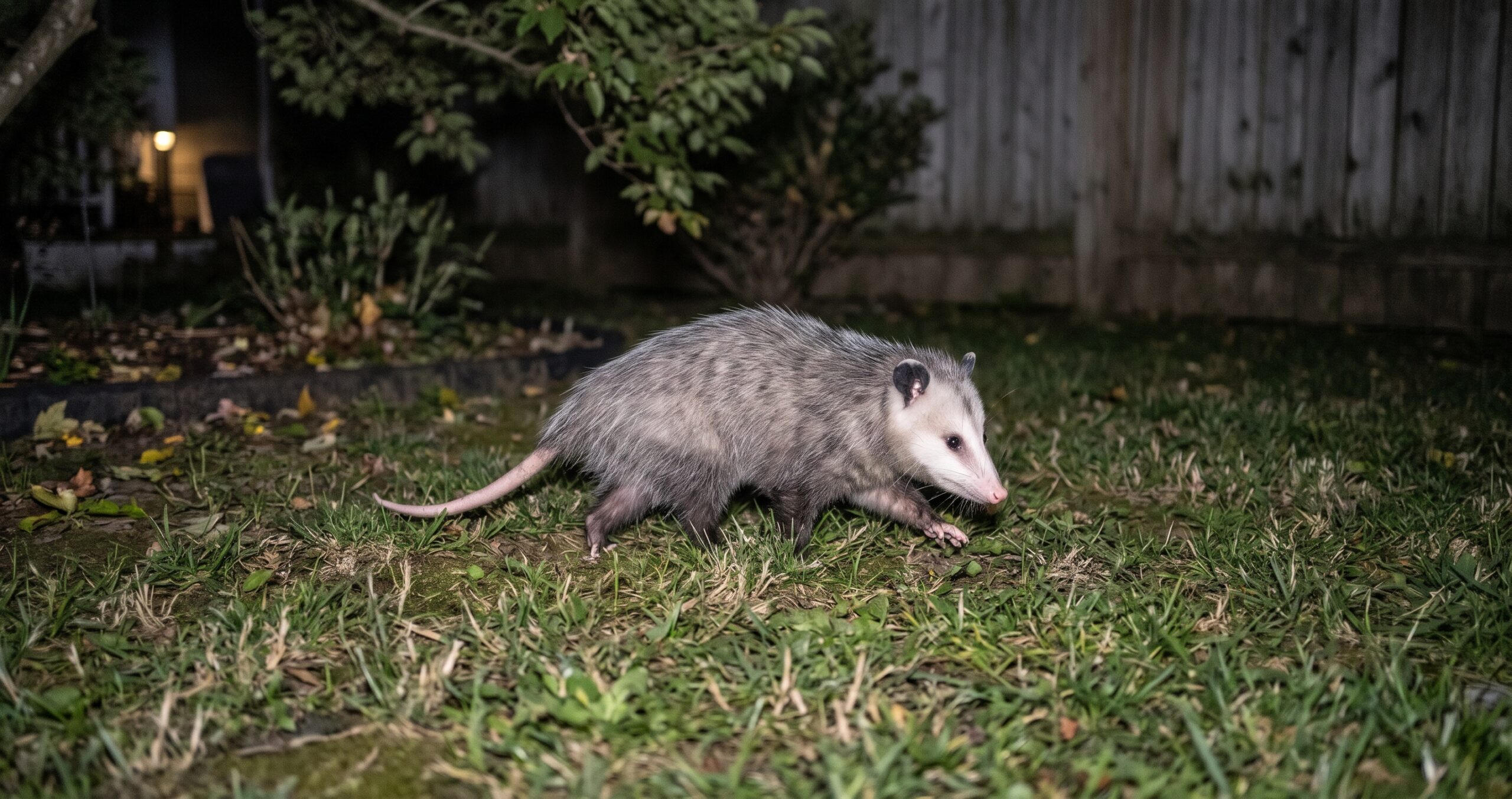
The Virginia opossum (Didelphis virginiana) is one of North America’s most misunderstood wild mammals. With its pointed face, grayish fur, long tail, and unusual defensive behavior, this adaptable animal often attracts curiosity and sometimes unnecessary fear. Yet many fascinating Virginia opossum facts reveal a remarkable creature with specialized reproductive biology and an important place in American ecosystems.
As the only marsupial native to the United States, the Virginia opossum raises its babies in a pouch, searches for a wide variety of foods, and uses surprising survival strategies when threatened.
Opossums can also provide ecological benefits in backyards by scavenging animal remains and consuming various invertebrates. However, popular claims about their ability to eliminate thousands of ticks are not supported by recent field-based research.
Understanding their actual behavior helps homeowners appreciate these animals while maintaining safe, respectful boundaries.
Table of Contents
- What Is a Virginia Opossum?
- Virginia Opossum Facts: Appearance and Special Adaptations
- Where Virginia Opossums Live in the United States
- Virginia Opossum Behavior and Daily Activities
- Why Opossums Play Dead
- How Opossums Reproduce and Raise Their Babies
- What Virginia Opossums Eat
- Backyard Benefits and Their Ecological Role
- The Truth About Opossums and Ticks
- Rabies and Other Disease Myths
- How to Coexist With Backyard Opossums
- What to Do When You Find a Baby Opossum
- Frequently Asked Questions
- Final Thoughts
What Is a Virginia Opossum?
The Virginia opossum belongs to the family Didelphidae, a group of marsupial mammals primarily associated with the Americas.
Unlike placental mammals, whose offspring undergo more extensive development before birth, marsupials give birth to extremely underdeveloped young that continue developing while nursing.
The Virginia opossum is the only marsupial species naturally established across the United States.
Although its common name refers to Virginia, this species occurs throughout much of the eastern and central United States, in parts of the West, and across a broader range extending into Canada, Mexico, and Central America.
Opossums have adapted remarkably well to environments influenced by people. They occupy forests, agricultural landscapes, suburban neighborhoods, parks, and even densely developed urban areas.
Their success comes partly from their flexible feeding habits and ability to use many different types of shelter.
Virginia Opossum Facts: Appearance and Special Adaptations
An adult Virginia opossum is approximately the size of a house cat, although its weight and body dimensions vary substantially.
Its coat usually appears grayish-white, with a pale face, dark eyes, rounded ears, and a long, mostly hairless tail.
The animal’s distinctive appearance reflects several useful adaptations.
A Tail That Helps With Climbing
The Virginia opossum has a prehensile tail that can curl around branches and other objects.
It uses this tail for balance and additional support while climbing, sometimes carrying nesting material with it.
However, adult opossums do not normally hang upside down from branches by their tails. Their bodies are too heavy for this to be a practical resting position.
Opposable Toes on the Hind Feet
One of the most interesting Virginia opossum facts involves its hind feet.
Each hind foot has an opposable, clawless inner toe called a hallux, which functions somewhat like a thumb.
This adaptation helps the animal grip branches and maintain stability while moving through vegetation.
An Impressive Number of Teeth
Virginia opossums possess 50 teeth, more than any other native North American land mammal.
These teeth allow them to process a remarkably diverse diet, including insects, fruits, small vertebrates, and animal remains.
When threatened, opossums may expose their teeth in a dramatic defensive display.
Despite this intimidating appearance, they generally prefer escaping confrontation.
Where Virginia Opossums Live in the United States
Virginia opossums occupy numerous habitats, including deciduous forests, wetlands, woodland edges, farmland, and suburban gardens.
They often favor areas providing food, protective vegetation, and access to water.
Rather than constructing elaborate burrow systems, opossums typically use existing shelters such as hollow logs, abandoned animal dens, cavities beneath structures, and brush piles.
Regional Differences
In the southeastern United States, relatively mild winters allow opossums to remain active throughout much of the year.
In northern states, including Minnesota and parts of the Great Lakes region, harsh winters present greater challenges.
Their relatively exposed ears, toes, and tails are vulnerable to frostbite during severe cold.
Virginia opossums do not truly hibernate, although they may remain sheltered during especially unfavorable weather.
Western populations include animals introduced beyond portions of their original native distribution.
The species’ range has also expanded northward over time, influenced by changing environmental conditions and human-modified landscapes.
Virginia Opossum Behavior and Daily Activities
Virginia opossums are primarily nocturnal, meaning they conduct most of their activities between dusk and dawn.
During daylight hours, they usually rest in concealed locations where predators and disturbances are less likely.
They are generally solitary animals, coming together primarily for breeding.
Searching for Food
Opossums spend much of their active time investigating the ground, fallen logs, vegetation, and other potential feeding areas.
Their strong sense of smell helps them locate food, including material hidden beneath leaves or debris.
They may follow familiar travel routes, but they do not necessarily defend rigid territories against every neighboring opossum.
Climbing and Exploring
Although commonly seen walking across lawns, opossums are capable climbers.
They use sharp claws, flexible feet, and their grasping tails to navigate trees, fences, and other structures.
However, they also spend considerable time foraging on the ground.
Their climbing ability helps them escape danger and exploit food sources unavailable to strictly terrestrial animals.
Are Opossums Aggressive?
Healthy Virginia opossums are usually cautious around humans.
When approached, they may freeze, retreat, hiss, or open their mouths to display their teeth.
These behaviors are primarily defensive and should not automatically be interpreted as aggression.
Like any wild mammal, an opossum can bite when cornered, restrained, or handled.
Why Opossums Play Dead
Among the most famous Virginia opossum facts is their unusual response to overwhelming danger.
The expression playing possum comes from a defensive behavior called thanatosis, or apparent death.
When escape and threat displays fail, an opossum may become largely unresponsive, lying motionless with its mouth open.
Its body can appear limp, and it may release unpleasant-smelling secretions.
This behavior may discourage predators that are less interested in prey appearing dead or unhealthy.
Is Playing Dead a Conscious Choice?
The behavior is not simply a deliberate theatrical performance.
It is generally described as an involuntary response to extreme fear or stress rather than something the animal consciously chooses on command.
Not every threatened opossum displays it.
According to the Smithsonian’s National Zoo and Conservation Biology Institute, apparent-death behavior is especially associated with young opossums, while adults may be more likely to hiss, display their teeth, or flee.
National Zoo
An opossum exhibiting this response should be left undisturbed rather than touched or moved unnecessarily.
How Opossums Reproduce and Raise Their Babies
Virginia opossum reproduction differs dramatically from that of most familiar North American mammals.
Their short pregnancy and extended period of development in the pouch are defining characteristics of marsupial biology.
An Extremely Short Pregnancy
Female Virginia opossums generally give birth after a gestation period of approximately 12–13 days.
At birth, their offspring are tiny, underdeveloped, and dependent on immediate access to the mother’s pouch.
These newborns are commonly called joeys.
A female may deliver more young than can successfully nurse, because the number of functional nipples is limited.
The Journey Into the Pouch
Immediately after birth, each newborn must crawl through the mother’s fur toward her abdominal pouch.
Although its body is extremely immature, its forelimbs are sufficiently developed to make this journey.
Once inside, a joey attaches to a nipple and continues growing while receiving nourishment from its mother.
Female Virginia opossums typically have 13 nipples, although anatomical variation occurs.
Not every newborn survives to become an independent juvenile.
Growing Inside the Pouch
The young remain closely attached to the mother during their earliest developmental stages.
Over approximately two months, they grow fur, develop their senses, and become increasingly capable of moving independently.
As they become larger, they begin leaving the pouch for short periods.
Eventually, the pouch can no longer accommodate the entire litter comfortably.
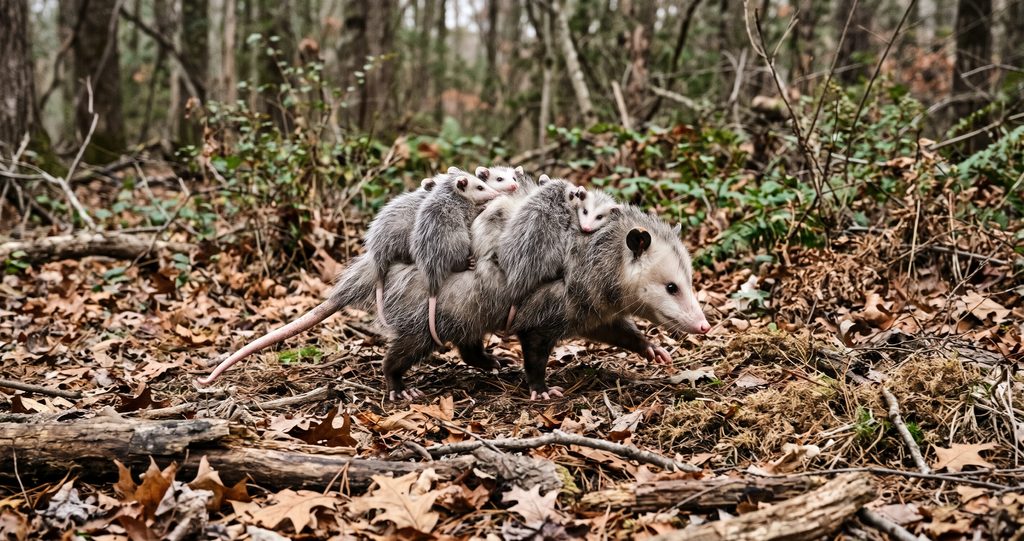
Babies Riding on Their Mother’s Back
One of the most recognizable wildlife scenes is a mother opossum walking with several young clinging to her back.
During this stage, the juveniles still depend on their mother while learning to move through their surroundings.
They gradually transition to independent feeding and exploration.
Most become independent at roughly three to four months of age, although timing varies.
How Many Litters Do Opossums Have?
Virginia opossums may produce one, two, or sometimes three litters annually, depending on latitude, climate, and individual circumstances.
Warmer southern regions generally provide longer reproductive seasons than northern areas.
Females can reach sexual maturity within their first year.
These reproductive characteristics help the species maintain populations despite significant mortality from predators, traffic, and environmental hazards.
Image placement — after this section
Suggested image: A realistic wildlife photograph showing a mother Virginia opossum walking through natural woodland vegetation with several juveniles riding on her back, clearly displaying their physical features and maternal behavior.
Alt text: Virginia opossum facts showing a mother carrying her babies on her back during early development.
What Virginia Opossums Eat
Virginia opossums are omnivores, meaning they consume both plant and animal material.
Their diet changes with seasonal availability, geographic location, and local habitat.
Rather than specializing in one food source, they take advantage of numerous opportunities.
Insects and Other Invertebrates
Opossums may consume beetles, grasshoppers, earthworms, and various other invertebrates.
These food sources provide protein and are especially accessible during warmer months.
However, opossums are generalist feeders rather than specialized insect-control animals.
Fruits and Plant Material
Wild berries, fallen fruits, seeds, and other plant materials can form important parts of their diet.
In suburban environments, opossums may investigate fallen fruit beneath ornamental or backyard fruit trees.
Their use of seasonal resources illustrates how adaptable their feeding behavior can be.
Small Animals and Carrion
Virginia opossums may eat small rodents, amphibians, reptiles, eggs, and occasionally birds.
They also scavenge carrion, meaning the remains of animals that have already died.
This scavenging behavior contributes to the breakdown and redistribution of organic material in ecosystems.
However, feeding on carrion does not mean an opossum can remove all animal remains or eliminate associated health risks.
Human Food Sources
Pet food, unsecured garbage, and accessible compost scraps can attract opossums into residential areas.
These artificial food sources may increase repeated wildlife visits and create unnecessary interactions with pets.
Providing food intentionally is generally discouraged because it can change normal foraging behavior.
Backyard Benefits and Their Ecological Role
Virginia opossums participate in several ecological processes, including scavenging, consumption of small animals and invertebrates, and interactions with fruit-bearing plants.
Their presence can indicate that a neighborhood provides shelter and usable food resources.
However, their ecological role should not be exaggerated into guarantees about garden pest control.
Consuming Some Garden Invertebrates
Opossums may eat various insects and other small invertebrates encountered while foraging.
This means they participate in natural food webs that include both garden pests and beneficial organisms.
There is insufficient evidence to promise that one opossum will noticeably reduce pest populations in a particular backyard.
Scavenging Organic Remains
As opportunistic scavengers, opossums consume some animal remains.
This contributes to nutrient cycling alongside insects, microorganisms, and other scavenging species.
Their role is ecological rather than a replacement for household sanitation or responsible disposal of dead animals.
Supporting a More Diverse Landscape
A yard containing native vegetation, shrubs, leaf litter, and varied habitats may support many different wildlife species.
Opossums are one possible participant in that broader ecosystem.
For practical planting ideas, see our guide to eight native shrubs that provide food and shelter for backyard birds.
Although that article focuses on birds, the broader principle of maintaining diverse, regionally appropriate vegetation also supports healthier habitat structure for other wildlife.
green garden
The Truth About Opossums and Ticks
One widely repeated claim states that opossums consume thousands of ticks every week.
This assertion has appeared in wildlife memes, gardening discussions, and public educational materials.
However, the scientific evidence is substantially weaker than those statements suggest.
Where the Claim Originated
Earlier laboratory research exposed captive opossums to blacklegged ticks and recorded how many ticks successfully fed.
Researchers inferred that many missing ticks had been consumed during grooming.
Those laboratory observations were later extrapolated into estimates involving thousands of ticks.
The estimates were not direct measurements of thousands of ticks being eaten in natural habitats.
What Later Research Found
A 2021 investigation by Cecilia Hennessy and Kaitlyn Hild examined the stomach contents of 32 Virginia opossums collected in central Illinois.
Researchers found no ticks or identifiable tick remains in those stomach samples.
Their review of previously published dietary studies also found no documented evidence of ticks forming a regular dietary component.
This does not prove that opossums never swallow individual ticks.
It does show that the popular claim of substantial, routine tick consumption lacks convincing field-based support.
ScienceDirect
Opossums should not be promoted as a reliable method of preventing ticks or Lyme disease.
Homeowners should continue using evidence-based tick prevention practices, including personal protection, vegetation management, and appropriate pet parasite control.
Rabies and Other Disease Myths
Another common belief is that Virginia opossums cannot contract rabies.
This is incorrect.
Opossums appear to be relatively resistant to rabies compared with many other mammals, and confirmed infections are uncommon.
However, resistance is not the same as complete immunity.
Can Opossums Carry Diseases?
Like other wild animals, opossums may carry parasites or microorganisms capable of affecting humans or domestic animals.
Potential concerns include certain fleas, ticks, intestinal parasites, and bacterial infections.
Risk depends on the organism, exposure route, and circumstances rather than simply the presence of an opossum nearby.
Avoid handling wildlife, touching feces with bare hands, or allowing pets to investigate injured or dead animals.
Does Hissing Mean an Opossum Has Rabies?
No. Hissing, drooling during a defensive display, and exposing teeth can occur in otherwise healthy opossums.
Likewise, seeing an opossum during daylight does not automatically mean it is sick.
Nevertheless, unusual neurological signs, severe disorientation, paralysis, or unexplained aggression warrant caution.
Anyone bitten or scratched by an opossum should wash the wound promptly and seek medical advice for assessment of infection risk, tetanus protection, and possible rabies exposure.
How to Coexist With Backyard Opossums
Most opossum encounters can be managed without trapping or harming the animal.
Simple changes around the property can reduce unwanted visits while allowing wildlife to move naturally through the neighborhood.
Secure Potential Food Sources
Keep garbage containers tightly closed and avoid leaving pet food outdoors overnight.
Clean up spilled birdseed and manage fallen fruit where repeated wildlife activity creates problems.
Avoid deliberately feeding opossums, since attracting them can also bring other wildlife into close contact with homes.
Protect Pets and Domestic Animals
Keep pets supervised outdoors, especially at night.
Small poultry and vulnerable domestic animals should remain in secure enclosures designed to exclude multiple potential predators.
Opossums are generally less confrontational than their threatening displays suggest, but close encounters can still result in injuries.
Prevent Entry Into Buildings
Inspect garages, sheds, crawl spaces, and other structures for accessible openings.
Before sealing an entrance, make certain no animal or dependent young remain inside.
If an opossum has established shelter beneath a building, consult a qualified wildlife professional for humane exclusion advice.
Wildlife handling and relocation regulations vary by state.
Reduce Road Hazards
Opossums frequently travel across roads during nighttime foraging.
Driving cautiously in areas with wildlife activity can reduce collisions.
Their slow movements and defensive freezing responses may make them particularly vulnerable to vehicles.
What to Do When You Find a Baby Opossum
Young opossums sometimes become separated from their mothers, especially following vehicle collisions.
However, not every small opossum found alone requires rescue.
Older juveniles may already be independent.
If a young opossum is visibly injured, unusually cold, weak, or exposed to a dog or cat attack, contact a licensed wildlife rehabilitator.
Very small juveniles found without their mother also require professional evaluation.
Do not attempt to feed cow’s milk, force water into the animal’s mouth, or raise it as a pet.
Appropriate care depends on its developmental stage and condition.
State wildlife agencies and licensed rehabilitators can advise whether intervention is necessary.
Frequently Asked Questions
Are Virginia opossums dangerous to humans?
They generally avoid confrontation and pose little danger when left undisturbed.
However, they are wild animals capable of biting if cornered or handled.
Do opossums eat thousands of ticks?
There is no convincing field-based evidence supporting the widely repeated claim that individual opossums routinely consume thousands of ticks.
Research examining wild opossum diets has challenged this assertion.
Why do baby opossums ride on their mother’s back?
Young opossums use their mother’s back for transportation after becoming too large to remain continuously inside her pouch.
They gradually become more independent as they develop.
Do opossums attack cats or dogs?
Opossums generally try to avoid confrontations with domestic pets.
Nevertheless, defensive biting is possible if an animal feels trapped or threatened.
Do Virginia opossums hibernate?
No. They remain capable of activity throughout winter, although harsh weather may keep them sheltered for extended periods.
How long do Virginia opossums live?
Wild Virginia opossums generally have relatively short lifespans, often around one to two years.
Individuals receiving veterinary care and protection from predators may survive longer.
Final Thoughts
Virginia opossums are remarkable North American mammals whose unusual biology deserves appreciation rather than fear.
Their marsupial reproduction, specialized climbing adaptations, flexible omnivorous diet, and distinctive defensive behavior make them an important part of regional wildlife diversity.
The most useful Virginia opossum facts also help correct misunderstandings about disease, aggression, and tick consumption.
Although opossums contribute to natural food webs and scavenging processes, they should not be described as guaranteed pest-control solutions.
Respecting their space, securing artificial food sources, and maintaining suitable habitat are practical ways to coexist with these fascinating animals.