
Hostas are among the most reliable shade-loving perennials in American gardens, valued for their attractive foliage, long lifespan, and relatively low maintenance. Understanding how to divide hostas allows gardeners to propagate established plants, manage crowded beds, and move healthy sections into new growing spaces without unnecessarily damaging their roots.
However, unlike some perennials that benefit from regular division, hostas can remain healthy and attractive for many years without being disturbed. Division is usually a choice rather than a requirement, and knowing when to leave a mature plant alone is just as important as knowing how to separate it.
With appropriate timing, careful root handling, and consistent watering, dividing hostas can be a straightforward way to expand a shade garden.
Table of Contents
- Understanding Why Hostas May Need Division
- Signs That Dividing Hostas Could Be Useful
- Best Time to Divide Hostas in Different U.S. Climates
- Understanding Hosta Roots, Crowns, and Growing Eyes
- Essential Tools and Preparation
- How to Divide Hostas Step by Step
- Different Methods for Separating Hosta Clumps
- How to Replant Hosta Divisions Correctly
- Watering and Aftercare
- Common Mistakes to Avoid
- Frequently Asked Questions
- Final Thoughts
Understanding Why Hostas May Need Division
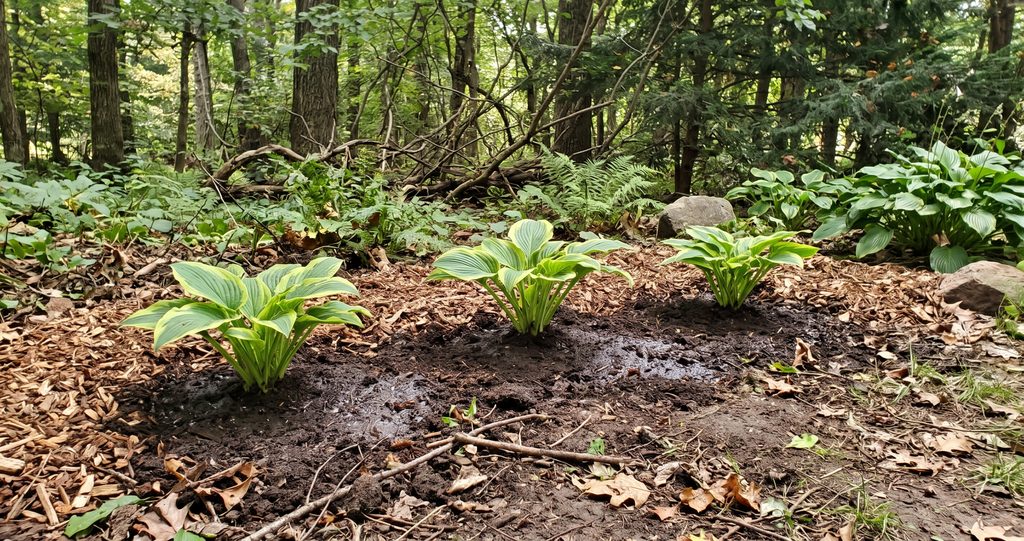
Hostas (Hosta spp.) are herbaceous perennials that develop expanding clumps of leaves from underground crowns. Depending on the cultivar, a mature plant may remain compact or gradually spread several feet across.
As hostas mature, additional growing points develop around the crown, allowing the clump to increase in size.
Unlike certain short-lived perennials, healthy hostas do not require division on a fixed schedule. The University of Minnesota Extension specifically explains that mature hostas do not need dividing to maintain plant health.
UMN Extension
Gardeners generally divide hostas for three practical reasons: producing additional plants, controlling the size of an established clump, or relocating sections to improve a landscape design.
Although division may relieve genuine crowding, it also disturbs the root system and temporarily reduces the plant’s ability to absorb water. Therefore, unnecessary division should be avoided.
Signs That Dividing Hostas Could Be Useful
The Plant Has Outgrown Its Space
A hosta may gradually extend over a walkway, crowd neighboring plants, or occupy more garden space than originally intended.
Dividing the clump can reduce its size while providing additional plants for other locations.
Neighboring Plants Are Becoming Crowded
Large hostas sometimes compete with nearby perennials for growing space, moisture, and nutrients.
Separating part of the clump may improve spacing, although moving neighboring plants is another possible solution.
You Want More Plants
Division is a form of vegetative propagation that produces new plants with the same cultivar characteristics as the parent plant.
This is particularly useful for propagating desirable foliage colors, leaf shapes, or growth habits that may not be reproduced reliably through seeds.
The Center Appears Thin or Unhealthy
Some aging perennial clumps develop sparse centers, but this is not automatically evidence that hostas need division.
Before cutting the plant apart, investigate drought stress, excessive sunlight, soil compaction, root damage, and disease.
A hosta growing vigorously with healthy foliage can usually remain undisturbed, even if it has occupied the same location for many years.
Best Time to Divide Hostas in Different U.S. Climates
Timing strongly influences transplanting stress and recovery.
Hostas tolerate division at several points during the growing season, but early spring is generally the easiest and most reliable period.
Early Spring: The Preferred Season
The ideal time to divide hostas is when pointed shoots, often called eyes or noses, begin emerging from the soil.
At this stage, the developing leaves are small, making the crown easier to inspect and reducing the likelihood of tearing mature foliage.
Spring division also gives plants much of the growing season to establish new roots before winter.
Late Summer and Early Fall
Dividing hostas in late summer or early fall is also possible, provided temperatures are moderate and sufficient time remains for root establishment.
Gardeners should avoid dividing immediately before the ground freezes.
Where winters are severe, plan fall divisions approximately six to eight weeks before the expected soil freeze when possible.
Regional Timing Across the United States
| Region | Generally favorable timing | Important consideration |
|---|---|---|
| Northeast | April–May; late August–early September | Allow adequate rooting time before winter |
| Upper Midwest | April–May; late August–early September | Avoid excessively late fall division |
| Mid-Atlantic | March–April; September | Avoid summer heat and dry soil |
| Southeast | February–April; September–October | Choose mild conditions and monitor moisture |
| Pacific Northwest | March–April; early fall | Avoid saturated soil and prolonged dry periods |
| Mountain West | April–May; late summer where feasible | Elevation and frost dates vary considerably |
| California and other mild-winter areas | During cool periods of active growth | Adapt timing to local heat, rainfall, and hosta dormancy |
These are approximate seasonal windows, not fixed planting dates. Local temperatures, elevation, soil conditions, and cultivar behavior matter more than the calendar.
For gardeners learning how to divide hostas, spring is usually the safest starting point.
Understanding Hosta Roots, Crowns, and Growing Eyes
Successful division begins with understanding which parts of the plant must remain together.
The Crown
The crown is the central growing structure where shoots and roots meet.
It contains the growing points responsible for producing new leaves and must remain attached to a functioning root system.
A piece consisting only of severed roots cannot be expected to develop into a healthy hosta.
The Growing Eyes
Hosta eyes are visible growing buds that emerge as pointed shoots during spring.
A practical division should generally contain at least two or three healthy eyes, although smaller pieces can sometimes survive under favorable conditions.
Larger divisions normally reestablish faster because they retain more stored resources and functioning roots.
The Root System
Hostas develop fleshy roots that store water and nutrients.
These roots help the plants survive temporary disturbances, but extensive cutting or drying can slow their recovery.
Keeping as many healthy roots attached as possible is more important than producing numerous small divisions.
Essential Tools and Preparation
Before beginning, assemble the following equipment:
- Sharp garden spade or digging fork
- Clean garden knife or sturdy soil knife
- Garden gloves
- Watering can or garden hose
- Bucket or tarp for temporary root protection
- Compost where soil improvement is appropriate
- Organic mulch for protecting the replanted soil
Clean cutting tools before use and disinfect them when moving between plants with suspected disease.
Choose a cloudy, mild day rather than working during hot, windy weather.
If the ground is dry, water the hosta the day before dividing it. Slightly moist soil is generally easier to dig than extremely dry or waterlogged soil.
Prepare the new planting areas in advance so exposed divisions can be replanted promptly.
Image placement — immediately before the step-by-step instructions
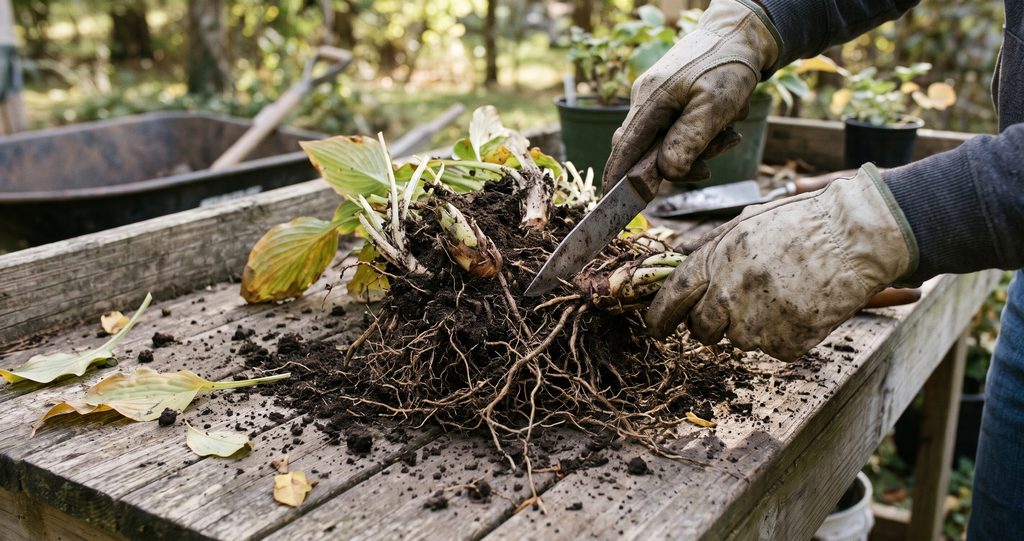
Suggested image: A realistic gardening photograph showing a hosta clump lifted from moist garden soil, with visible growing eyes, fleshy roots, and a clean garden spade.
Alt text: How to divide hostas safely by separating healthy crowns and roots before replanting.
How to Divide Hostas Step by Step
Step 1: Examine the Parent Plant
Inspect the hosta for healthy shoots, firm crown tissue, and signs of disease.
Plants with suspicious crown rot, extensive decay, or abnormal growth should not be propagated until the underlying problem has been identified.
Select a vigorous plant whose size or location justifies division.
Step 2: Dig Around the Clump
Insert a garden spade several inches beyond the visible crown.
Work around the plant, lifting carefully and preserving as much of the root system as practical.
Large, established hostas may have extensive roots and require considerable effort to remove.
Avoid pulling the plant upward by its leaves, which can damage the crown.
Step 3: Lift and Examine the Roots
Place the lifted clump on a tarp or shaded work surface.
Gently shake away loose soil or rinse away enough soil to reveal the natural arrangement of crowns and roots.
Examine the clump for suitable separation points and remove obviously dead or rotted material.
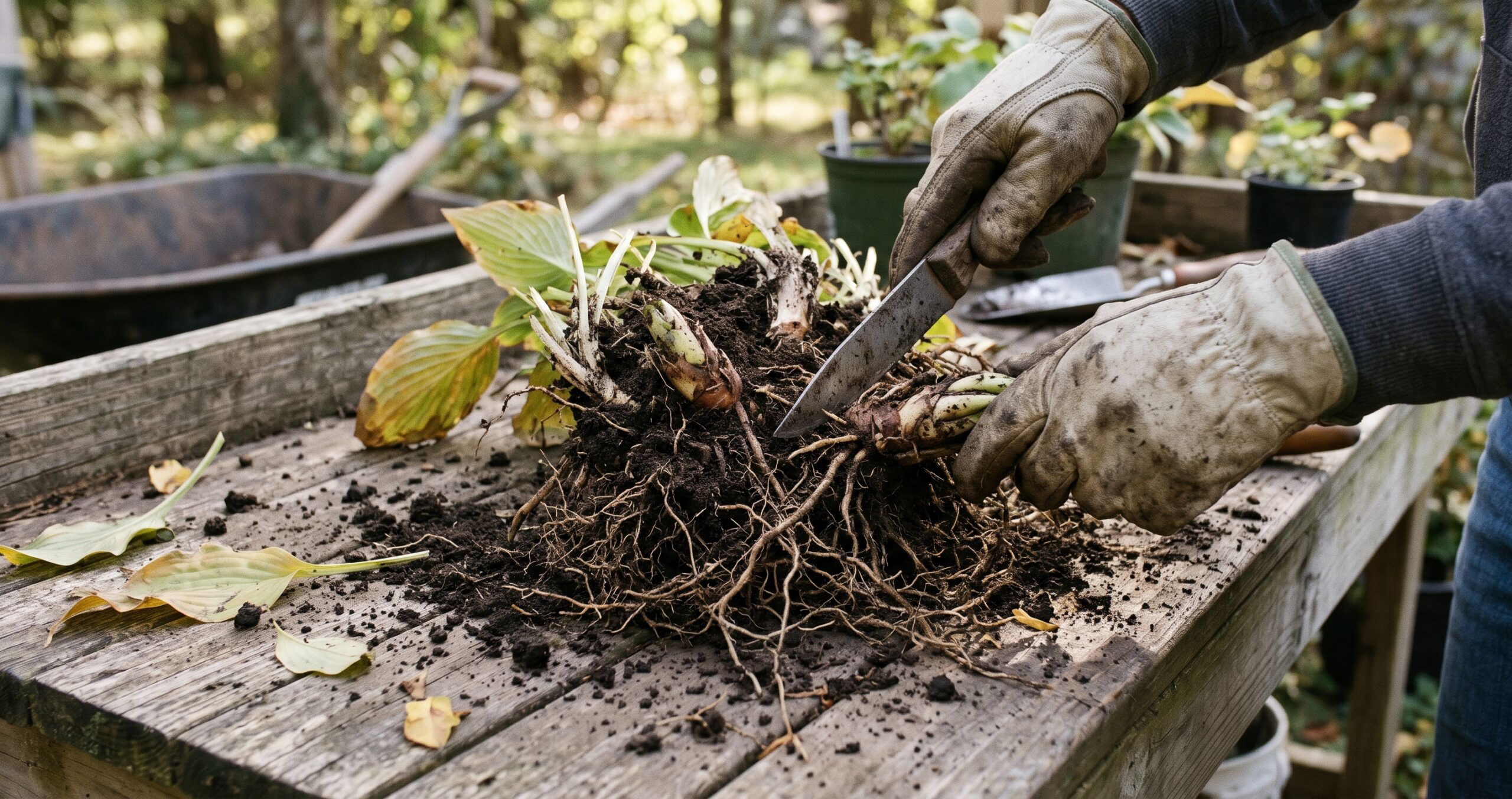
Step 4: Separate the Plant
Small hostas with loose root arrangements may separate naturally when gently pulled apart.
Dense clumps usually require a sharp knife or spade to divide the crown into manageable sections.
Make controlled cuts that preserve both growing eyes and healthy roots.
Avoid repeatedly cutting the same section into smaller pieces simply to increase the number of plants.
Step 5: Check Each Division
Inspect every section before planting.
Each should contain healthy crown tissue, viable growing points, and an adequate root system.
Sections with two or three substantial eyes are a useful starting point for most home gardeners.
Discard sections with extensively rotted crowns rather than introducing questionable material into another garden bed.
Different Methods for Separating Hosta Clumps
Gardeners can choose between several division techniques depending on the size and structure of the plant.
Hand Separation
Young hostas or naturally loose clumps may be divided by gently teasing their roots apart.
This method avoids unnecessary cutting but should not be forced when roots are tightly connected.
Knife Division
A sharp knife provides controlled separation when the individual crowns are visible.
It is particularly useful for medium-sized clumps and allows the gardener to preserve larger root sections.
Spade Division
Large, dense hostas may require a sturdy, sharpened spade.
Position the blade between healthy groups of growing eyes and make a decisive cut through the crown.
An alternative is to remove a wedge or outer portion of the clump while leaving the remaining plant in place.
This partial-division method may reduce disturbance to the parent plant, but it still requires careful cutting and adequate watering afterward.
How to Replant Hosta Divisions Correctly
Proper planting depth and soil conditions are important for healthy establishment.
Choose a Suitable Location
Most hostas perform best in partial shade or filtered sunlight, although light preferences vary among cultivars.
Some tolerate greater sun exposure when soil moisture is adequate, while others scorch under intense afternoon sunlight.
In hot Southern and Southwestern gardens, protection from strong afternoon sun is especially valuable.
Prepare the Soil
Hostas generally prefer fertile, moisture-retentive soil that also drains well.
In compacted or poor-quality soil, incorporate appropriate amounts of finished compost into a broad planting area rather than creating a sharply different pocket of amended soil.
For additional guidance on protecting soil moisture and structure, see How the Mulch You Choose Changes Your Soil Beneath the Surface.
Set the Correct Planting Depth
Dig a hole wide enough to accommodate the roots without severely bending or compressing them.
Position the crown at approximately the same soil level it occupied before division, with emerging growth tips at or just above the surface.
Avoid burying the crown deeply, as inappropriate planting depth can interfere with healthy growth.
Backfill gently, firm the soil enough to eliminate major air pockets, and water thoroughly.
Allow Room for Mature Growth
Hosta cultivars differ enormously in mature spread.
Small varieties may fit into compact borders, while large cultivars need substantially more space.
Check the expected mature dimensions of the specific cultivar rather than applying one spacing rule to every hosta.
Watering and Aftercare
The first several weeks after transplanting are important because divided roots must restore their ability to supply water to developing leaves.
Water Thoroughly After Planting
Immediately after replanting, water slowly so moisture reaches the entire root zone.
Continue checking soil moisture regularly, especially during warm or windy conditions.
Keep the root zone consistently moist but not saturated while new roots become established.
Apply Mulch Carefully
A modest layer of shredded leaves, fine bark, or another appropriate organic mulch can reduce evaporation and moderate soil temperatures.
Keep mulch away from the crown instead of piling it directly against emerging shoots.
Mulching can be particularly helpful for fall-planted divisions in regions experiencing repeated freezing and thawing.
Avoid Excessive Fertilization
Newly divided hostas do not automatically need strong fertilizer applications.
Adequate soil moisture and root establishment are more important immediately after transplanting.
If growth remains poor, consider soil testing before adding fertilizer.
Monitor Recovery
Temporary wilting or reduced foliage growth can occur after division, particularly when plants are moved with fully developed leaves.
Inspect soil moisture before assuming that wilting means the plant needs more water.
In some cases, saturated soil and root damage produce symptoms resembling drought stress.
Spring divisions may resume visible growth relatively quickly, while fall divisions may show their strongest recovery the following growing season.
Common Mistakes to Avoid
Understanding how to divide hostas also means recognizing practices that unnecessarily increase transplanting stress.
Dividing Healthy Plants Too Frequently
Hostas can become more impressive as their clumps mature.
Routine division every few years is not required, and repeatedly disturbing healthy plants can delay their development.
Cutting Divisions Too Small
Tiny sections with limited roots may survive but generally require more time to establish.
Retaining several healthy growing points and a substantial root system improves the likelihood of vigorous recovery.
Dividing During Extreme Heat
Hot weather increases water loss from leaves while disturbed roots have reduced water-absorbing capacity.
When possible, postpone division until cooler conditions return.
Planting Too Deeply
Burying the crown excessively can interfere with new shoot development and create unfavorable conditions around growing tissue.
Maintain the original planting depth.
Neglecting Watering
Divided hostas lack part of their former root system and are temporarily more vulnerable to moisture stress.
Check the soil frequently enough to prevent prolonged drying without creating waterlogged conditions.
Frequently Asked Questions
Can hostas be divided without digging up the entire plant?
Yes. A sharp spade can be used to remove a section from the outside of an established clump while leaving the remainder in place.
The removed section must contain healthy growing points and sufficient roots to survive independently.
How many eyes should each hosta division have?
Two or three healthy eyes with a substantial portion of the crown and roots are a practical recommendation for reliable establishment.
Very small divisions may survive, but recovery is often slower.
Can hostas be divided during summer?
Hostas can sometimes tolerate summer division, but high temperatures and full foliage increase transplanting stress.
Cooler weather and careful watering generally offer better conditions.
Do hostas need dividing every three to five years?
No. Healthy hostas can remain undivided for many years.
Divide them when propagation, relocation, or size management provides a clear reason to do so.
How long does it take divided hostas to grow?
Establishment depends on cultivar, division size, root condition, soil moisture, and climate.
Some divisions produce substantial foliage in their first growing season, while others require additional seasons to develop a mature appearance.
Final Thoughts
Learning how to divide hostas provides a practical way to expand a shade garden while preserving desirable varieties.
The most important principles are simple: divide only when there is a useful reason, choose favorable seasonal conditions, keep healthy crowns and roots together, maintain correct planting depth, and provide consistent moisture afterward.
Hostas are long-lived perennials, and many of the most attractive specimens are those allowed to mature without repeated disturbance.
For gardeners who decide division is worthwhile, careful preparation and thoughtful aftercare offer the best opportunity for healthy growth in the years ahead.