
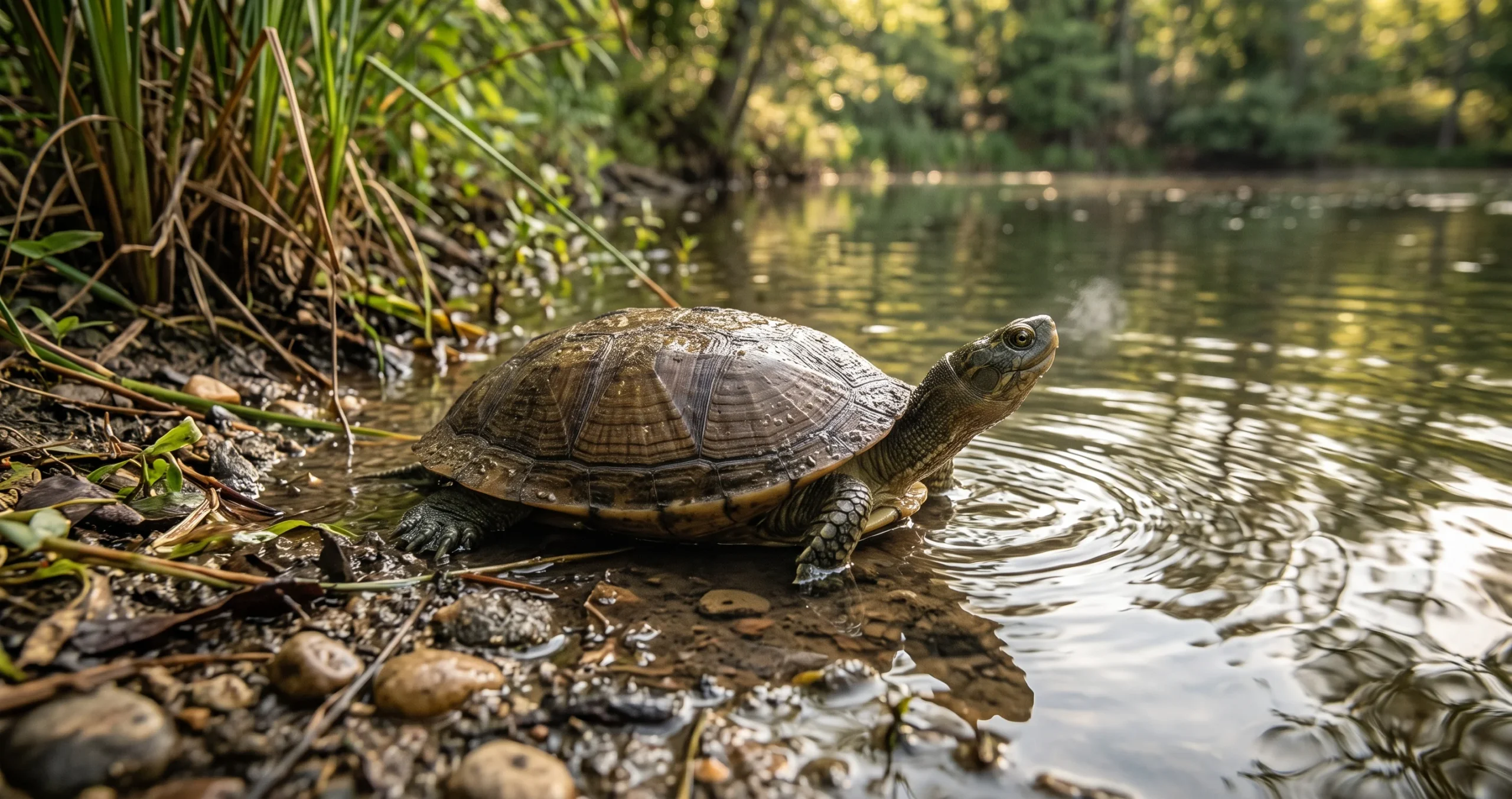
A turtle resting beneath the surface of a river or frozen pond may look completely cut off from the air. Yet some species possess remarkable ways of exchanging gases with the surrounding water. One of the strangest is commonly called turtle cloacal respiration—aquatic gas exchange through specialized tissues associated with the cloaca.
The popular phrase “breathing through the butt” is memorable, but it oversimplifies turtle physiology. Some turtles really do extract substantial amounts of dissolved oxygen through highly vascularized cloacal structures. Others, including painted turtles famous for spending winter beneath ice, rely on a combination of aquatic oxygen uptake, dramatically reduced metabolism, and an extraordinary ability to survive periods with almost no oxygen at all.
Understanding the distinction makes the real biology even more impressive.
Table of Contents
- What Is Turtle Cloacal Respiration?
- How Cloacal Respiration Actually Works
- Which Turtles Rely on It Most?
- The Painted Turtle Is a Special Case
- How Painted Turtles Survive Beneath Ice
- Normal Lung Breathing vs. Aquatic Respiration
- What Happens When the Water Runs Out of Oxygen?
- Why Cold Water Makes Winter Survival Possible
- Common Myths About Turtle Cloacal Respiration
- Why This Adaptation Matters Ecologically
- Frequently Asked Questions
- Conclusion
What Is Turtle Cloacal Respiration?
The cloaca is a chamber near the rear of a turtle’s body connected with the digestive, urinary, and reproductive systems. In many aquatic turtles, paired structures called cloacal bursae extend from this region.
In species specialized for aquatic respiration, these bursae contain thin, highly vascularized surfaces. Water can be moved into and out of the cloacal region, bringing dissolved oxygen close to blood vessels.
Oxygen then moves from the water across the respiratory surface and into the bloodstream. Carbon dioxide can move in the opposite direction.
That process is what people usually mean by turtle cloacal respiration.
It is not equivalent to a turtle taking a normal breath. No air is entering the lungs through the cloaca. Instead, gases dissolved in water diffuse across specialized tissue.
How Turtle Cloacal Respiration Actually Works
For aquatic respiration to work efficiently, three things are particularly useful: a large respiratory surface, a rich blood supply, and water containing enough dissolved oxygen.
Some Australian freshwater turtles have taken this adaptation remarkably far.
The Fitzroy River turtle (Rheodytes leukops), for example, possesses enlarged cloacal bursae lined with branching structures that increase the area available for gas exchange. Research has shown that the species adjusts cloacal ventilation in response to oxygen conditions in the surrounding water.
Water is repeatedly moved across these surfaces. Because the surrounding water contains dissolved oxygen, a concentration gradient allows oxygen to diffuse across the thin tissue and enter nearby blood vessels.
The bloodstream then transports that oxygen to tissues throughout the animal.
This ability allows certain turtles to remain underwater much longer than they could if they depended entirely on oxygen stored after their last breath at the surface.
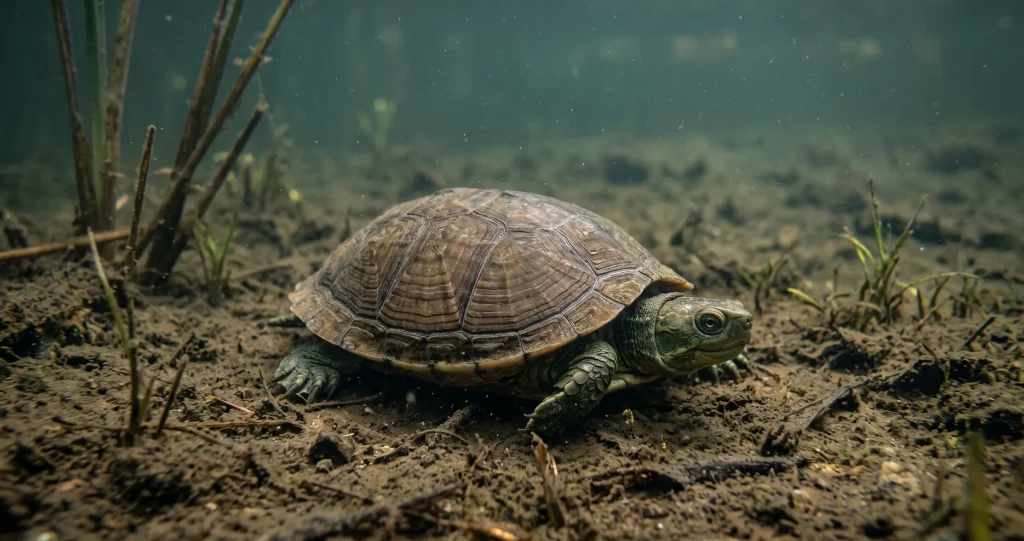
Which Turtles Rely on Cloacal Respiration Most?
Not every turtle uses turtle cloacal respiration to the same degree.
Some of the clearest specialists occur among Australian freshwater turtles. The Fitzroy River turtle is particularly well adapted, possessing two enlarged cloacal bursae lined with branching papillae. Australian government conservation information describes these structures as an important part of the species’ bimodal respiratory system.
The Mary River turtle (Elusor macrurus) is another well-known example. The Australian Museum notes that both Mary River and Fitzroy River turtles can obtain oxygen across cloacal surfaces.
The white-throated snapping turtle (Elseya albagula) also performs aquatic respiration. Experiments have demonstrated that smaller individuals can compensate for relatively smaller oxygen stores by extracting proportionally more oxygen from water through their cloacal bursae.
These species show what true specialization for cloacal aquatic respiration looks like.
The Painted Turtle Is a Special Case
Painted turtles (Chrysemys picta) are frequently included in online explanations of “butt breathing,” especially when discussing their extraordinary ability to overwinter beneath frozen ponds.
That description needs qualification.
Painted turtles certainly perform extrapulmonary aquatic gas exchange, meaning they can exchange gases without relying exclusively on their lungs. However, experimental research on western painted turtles found that blocking cloacal or buccopharyngeal exchange did not significantly reduce total aquatic oxygen uptake.
Blocking diffusion through the skin, by contrast, reduced oxygen uptake substantially. Researchers concluded that passive diffusion across the integument—the body covering—was the principal aquatic oxygen uptake pathway under those experimental conditions.
So painted turtles are excellent examples of extraordinary underwater winter survival, but they should not be presented as the textbook champions of turtle cloacal respiration.
Species such as the Fitzroy River turtle provide a clearer example.
How Painted Turtles Survive Beneath Ice
The painted turtle’s winter strategy is arguably even more remarkable than the simplified “cloacal breathing” story.
In northern climates, adult painted turtles can spend months submerged in cold water. Once a pond freezes over, reaching atmospheric air may become impossible.
Fortunately, cold dramatically lowers their metabolic demands.
When sufficiently oxygenated water is available, aquatic gas exchange can contribute oxygen while the turtle remains submerged. Studies of freshwater turtles show that aquatic respiration can satisfy much or even most of their oxygen requirements in cold, well-oxygenated water.
Painted turtles go one extraordinary step further.
They can survive when essentially no usable oxygen remains.
Research on painted turtles submerged at about 3°C has documented survival for extraordinarily long periods under anoxic conditions. Their survival depends not on secretly finding oxygen, but on tolerating its absence.
Normal Turtle Breathing vs. Aquatic Respiration
Under ordinary conditions, turtles are air-breathing reptiles.
They have lungs and normally surface to breathe atmospheric oxygen. Because a turtle’s ribs are incorporated into its shell, it cannot expand its rib cage the same way a mammal does. Specialized muscles help move the internal organs and ventilate the lungs instead.
Lung breathing delivers far more oxygen than passive aquatic gas exchange can provide for most turtle species, particularly when the animal is warm and active.
Aquatic respiration becomes especially useful when metabolic demand is low.
This helps explain why temperature matters so much.
A warm turtle swimming actively needs considerably more energy than a cold, nearly motionless turtle resting on the bottom of a winter pond. Aquatic gas exchange that would be inadequate during vigorous summer activity can become biologically meaningful when metabolism has been dramatically suppressed.
For specialized species such as the Fitzroy River turtle, turtle cloacal respiration can also support prolonged dives under warmer conditions, provided the surrounding water contains sufficient dissolved oxygen.
What Happens When the Water Runs Out of Oxygen?
Ice changes the underwater environment.
After a pond freezes, direct exchange between the atmosphere and water is greatly reduced. Aquatic plants and algae may continue photosynthesizing when enough light penetrates, but respiration and decomposition also consume oxygen.
Some ponds can therefore become severely oxygen depleted.
For most air-breathing vertebrates trapped underwater, that would quickly become fatal.
Painted turtles possess an exceptional physiological defense: profound metabolic depression.
Their cells sharply reduce both energy production and energy consumption. That allows the animals to stretch their stored fuel while greatly slowing the accumulation of harmful metabolic byproducts.
Without oxygen, turtles rely on anaerobic metabolism, which produces lactate.
Too much lactate would normally cause dangerous acidosis. Painted turtles counter this partly with another unusual resource—their own skeleton and shell.
Carbonate buffers associated with the shell and skeleton help neutralize accumulating acid, while lactate can also be sequestered into these mineralized tissues. These mechanisms contribute to the painted turtle’s ability to survive months of cold anoxia.
That is very different from breathing.
The turtle is surviving despite the lack of oxygen rather than extracting oxygen that is not there.
Why Cold Water Makes Winter Survival Possible
Temperature is central to the entire strategy.
Turtles are ectotherms, meaning their body temperature and metabolic rate are strongly influenced by environmental temperature.
As the water approaches winter temperatures, a painted turtle’s metabolism falls dramatically. Its tissues require much less energy, allowing limited oxygen—or stored chemical energy during anoxia—to last far longer.
Laboratory experiments illustrate just how extreme this adaptation can be.
Eastern painted turtles submerged at 3°C survived at least 150 days in oxygenated water in one experiment, while turtles in anoxic water survived for roughly four months.
Other work has demonstrated geographic differences as well. Painted turtle populations from colder northern regions can show greater tolerance of prolonged anoxia than populations from warmer southern regions, indicating adaptation to different winter environments.
This is therefore not simply a special respiratory organ. Winter survival involves the turtle’s entire physiology.
Common Myths About Turtle Cloacal Respiration
Myth 1: All turtles breathe through their butts
They do not.
Turtles are fundamentally lung-breathing reptiles. Aquatic gas exchange occurs to varying degrees among species, and highly developed turtle cloacal respiration is particularly characteristic of certain freshwater turtles.
Myth 2: Painted turtles survive winter entirely by cloacal respiration
This is misleading.
Painted turtles can perform aquatic gas exchange, but research on western painted turtles indicates that passive oxygen diffusion across the skin can be more important than cloacal exchange. Their winter survival also depends heavily on metabolic suppression and extraordinary anoxia tolerance.
Myth 3: Cloacal respiration works like underwater lungs
It does not.
The turtle is not filling its lungs with water. Dissolved oxygen crosses thin, vascularized tissues directly into the blood.
Myth 4: A turtle using aquatic respiration never needs air
Aquatic respiration can dramatically extend submergence, but the amount of oxygen available depends on species, temperature, activity level, and dissolved oxygen concentration.
Even specialized aquatic breathers still possess lungs and use atmospheric oxygen.
Myth 5: Turtles can extract oxygen from completely oxygen-free water
No respiratory surface can extract oxygen that is absent.
Painted turtles survive anoxic conditions because they can suppress metabolism, switch to anaerobic pathways, and tolerate the resulting chemical changes for astonishingly long periods.
Why This Adaptation Matters Ecologically
Aquatic respiration is more than a biological curiosity.
Remaining submerged can reduce the need for turtles to expose themselves at the surface. For some river turtles, that may decrease vulnerability to predators while allowing longer periods for resting or foraging underwater.
It also ties their survival to water quality.
A species adapted to extracting dissolved oxygen from flowing, oxygen-rich water may struggle if river conditions change. Dams, sediment, reduced flows, warming water, and declining dissolved oxygen can alter the environments on which specialized aquatic-breathing turtles depend. Australian conservation assessments specifically identify these environmental relationships for species such as the Fitzroy River turtle.
This connection between physiology and habitat is a recurring theme throughout wildlife biology. Readers interested in other unusual animal adaptations can explore more wildlife stories on Secrets of the Green Garden.
Frequently Asked Questions
What is turtle cloacal respiration?
Turtle cloacal respiration is a form of aquatic gas exchange in which dissolved oxygen passes from surrounding water across specialized, blood-rich tissues associated with the cloaca.
Some species have enlarged cloacal bursae that greatly increase the surface available for this exchange.
Do turtles actually breathe through their butts?
The phrase is catchy but anatomically imprecise.
Certain turtles pump water across vascularized cloacal structures and absorb dissolved oxygen from it. Their lungs are not connected to an underwater airway at the rear of the body.
Which turtle is especially good at cloacal respiration?
The Fitzroy River turtle of Australia is one of the best-known specialists.
Its enlarged cloacal bursae contain extensively developed respiratory surfaces, allowing substantial aquatic oxygen uptake.
Do painted turtles use turtle cloacal respiration during winter?
Painted turtles perform aquatic gas exchange, but cloacal respiration should not be portrayed as their primary winter respiratory mechanism.
Experimental work on western painted turtles found passive oxygen uptake through the skin to be the principal measured aquatic pathway under the study conditions.
How can a painted turtle survive under a frozen pond?
Cold temperatures drastically lower its metabolism.
If dissolved oxygen remains available, aquatic respiration can help. If oxygen disappears, painted turtles can suppress their metabolism further and tolerate prolonged anaerobic conditions, while their shell and skeleton help buffer accumulating acid.
Can turtles stay underwater all winter?
Some freshwater turtles can remain submerged for extraordinarily long winter periods, but their ability depends on species and environmental conditions.
Painted turtles are particularly well adapted to prolonged cold submergence and even extended anoxia.
Does cloacal respiration replace lungs?
No.
These turtles still have functional lungs and breathe atmospheric air. Aquatic respiration supplements lung breathing and allows longer periods underwater.
Conclusion
Turtle cloacal respiration is one of the most unusual respiratory adaptations among vertebrates, but the real biology is more nuanced than the famous phrase “breathing through the butt.”
Species such as the Fitzroy River turtle possess highly specialized cloacal bursae capable of extracting substantial dissolved oxygen from water. Other turtles use different aquatic surfaces to supplement their lungs.
Painted turtles demonstrate another remarkable strategy. Although they can absorb oxygen underwater, their famous ability to remain beneath frozen ponds also depends on extreme metabolic suppression, anaerobic survival, and the buffering capacity of their shell and skeleton.
A turtle beneath winter ice is therefore doing much more than finding an alternative way to breathe. Its entire body has shifted into a physiological state that allows an air-breathing reptile to endure conditions that would quickly overwhelm most vertebrates.
External Sources:
- PubMed — Avenues of extrapulmonary oxygen uptake in western painted turtles
PubMed study on western painted turtle aquatic oxygen uptake - PubMed — Hibernating without oxygen: physiological adaptations of the painted turtle
PubMed review of painted turtle anoxia adaptations - Australian Government — Fitzroy River Turtle conservation assessment
Australian Government information on Fitzroy River turtle respiration