
Table of Contents
- Introduction
- What Are Giant Tube Worms?
- The Discovery That Changed Biology Forever
- Tube Worm Chemosynthesis: Life Without Sunlight
- The Remarkable Partnership Between Tube Worms and Bacteria
- How Giant Tube Worms Obtain Oxygen and Hydrogen Sulfide
- Hydrothermal Vent Ecosystems: Oases on the Deep Seafloor
- Why Tube Worms Matter in the Search for Extraterrestrial Life
- Common Myths About Giant Tube Worms
- Frequently Asked Questions
- Conclusion
The extraordinary process of tube worm chemosynthesis challenges one of the oldest assumptions in biology—that nearly all life ultimately depends on sunlight. Giant tube worms thrive thousands of feet beneath the ocean’s surface in complete darkness, where no plant can grow and photosynthesis is impossible. Even more astonishing, adult tube worms survive without a mouth, stomach, or digestive tract, relying instead on a remarkable partnership with microscopic bacteria that manufacture food from chemicals released by hydrothermal vents.
This unique relationship has transformed our understanding of how ecosystems function and where life can exist. The discovery of giant tube worms in the late twentieth century revolutionized marine biology and inspired new ideas about the possibility of life beneath the icy surfaces of distant moons such as Europa and Enceladus.
Today, these unusual animals remain among the most fascinating examples of symbiosis and adaptation ever discovered, proving that life can flourish in places once thought completely uninhabitable.
If you enjoy exploring remarkable wildlife adaptations, you may also enjoy our article on How Basilisk Lizards Run Across the Surface of Water here on secretsofthegreengarden.com.
What Are Giant Tube Worms?
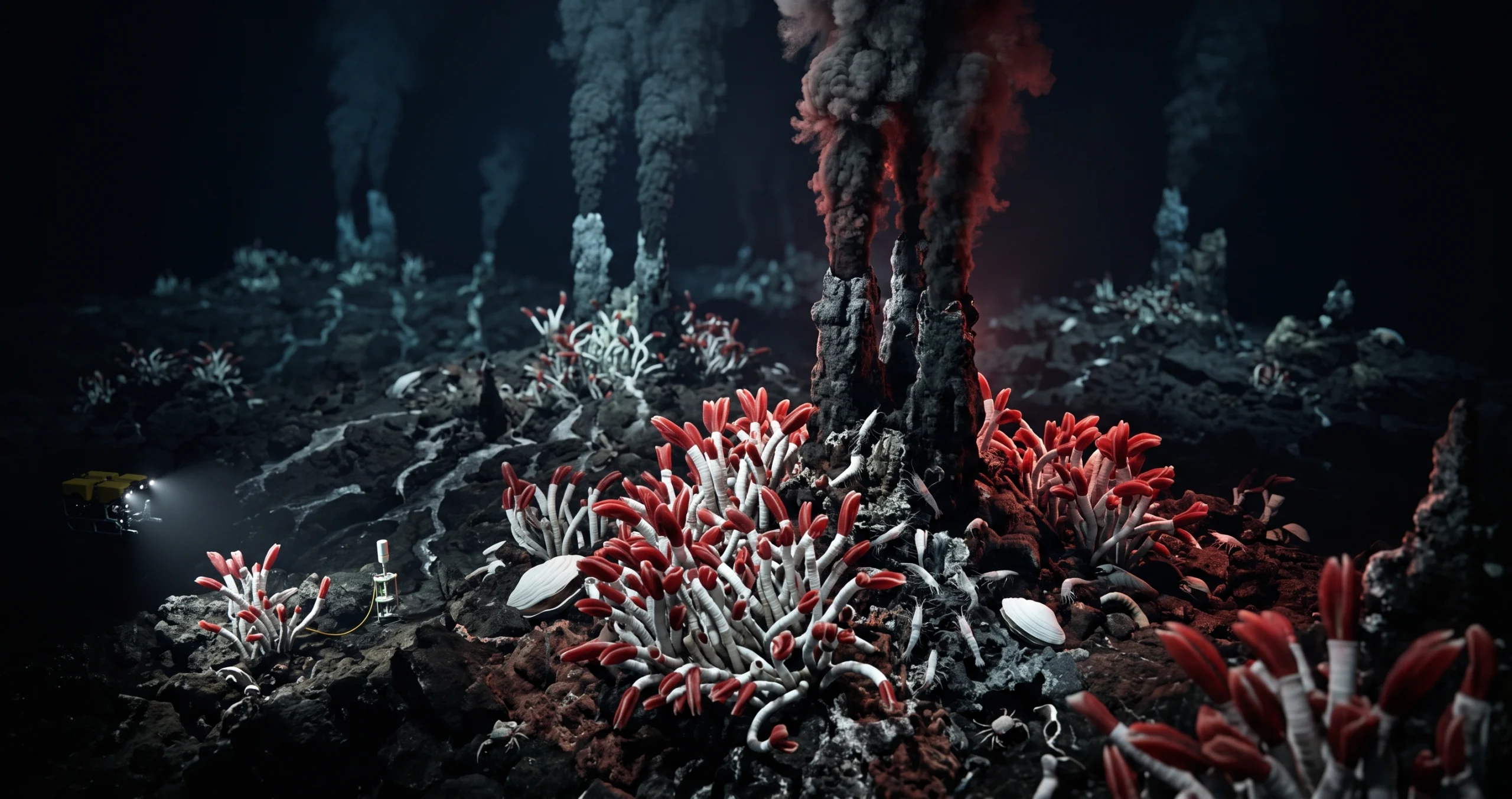
Giant tube worms (Riftia pachyptila) inhabit hydrothermal vent systems along the deep ocean floor, particularly in the eastern Pacific Ocean.
Some individuals exceed 8 feet (2.5 meters) in length while living inside protective white tubes anchored to rocky volcanic surfaces.
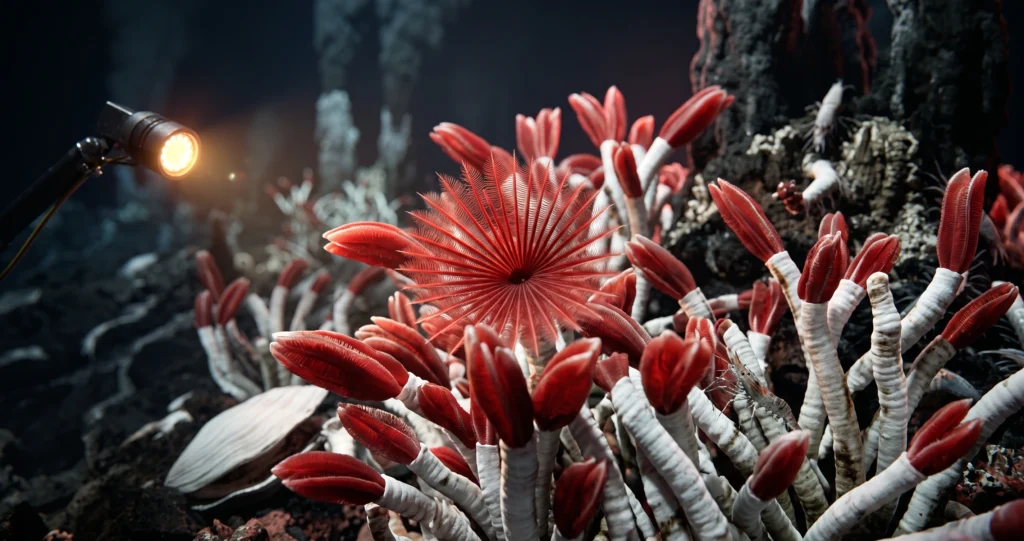
Only the bright red plume extends above the tube.
This striking plume functions much like external gills, collecting oxygen, carbon dioxide, and hydrogen sulfide from the surrounding seawater.
Unlike nearly every familiar animal, adult giant tube worms possess no mouth.
They also lack a stomach, intestines, and anus.
Instead of digesting food directly, they rely entirely on internal bacteria that manufacture nutrients through chemosynthesis.
This remarkable strategy allows them to thrive where virtually no sunlight ever reaches.
The Discovery That Changed Biology Forever
Before the late 1970s, scientists believed deep-sea ecosystems depended almost entirely on organic matter slowly sinking from the sunlit ocean above.
That assumption changed dramatically in 1977.
While exploring the Galápagos Rift aboard the research submersible Alvin, scientists discovered hydrothermal vents surrounded by thriving communities of giant tube worms, giant clams, crabs, shrimp, mussels, and many other previously unknown species.
The discovery astonished researchers.
Water emerging from the vents reached temperatures exceeding 650°F (340°C) before rapidly cooling as it mixed with surrounding seawater.
Despite these extreme conditions, life flourished.
The source of energy clearly was not sunlight.
Instead, it came from chemicals dissolved within the vent fluids.
This finding fundamentally changed biology textbooks.
For the first time, scientists had discovered large ecosystems powered primarily by chemosynthesis rather than photosynthesis.
Tube Worm Chemosynthesis: Life Without Sunlight
Tube Worm Chemosynthesis Powers an Entire Ecosystem
Chemosynthesis resembles photosynthesis in one important way.
Both processes produce organic food molecules that support life.
The difference lies in the energy source.
Plants capture sunlight.
Chemosynthetic bacteria obtain energy by oxidizing inorganic chemicals such as hydrogen sulfide.
Hydrothermal vents continuously release hydrogen sulfide, methane, and other reduced compounds from Earth’s interior.
Specialized bacteria use chemical reactions involving hydrogen sulfide and oxygen to generate energy.
That energy allows them to convert carbon dioxide into sugars and other organic molecules.
These bacteria effectively function as primary producers—the ecological equivalent of plants in sunlit environments.
Without them, giant tube worms and countless neighboring vent animals could not survive.
The Remarkable Partnership Between Tube Worms and Bacteria
Perhaps the most fascinating aspect of giant tube worms involves where these bacteria live.
Rather than coating the worm’s surface, billions of bacteria occupy a specialized internal organ called the trophosome.
The trophosome fills much of the worm’s body cavity.
It essentially replaces the digestive system.
The relationship benefits both partners.
The tube worm provides bacteria with a continuous supply of oxygen, carbon dioxide, and hydrogen sulfide gathered through its bright red plume.
The bacteria use these chemicals to manufacture carbohydrates, amino acids, and other nutrients.
In return, the worm receives nearly all of its food directly from its microscopic partners.
This mutualistic symbiosis represents one of the most efficient nutrient-sharing systems known in nature.
Without the bacteria, adult tube worms would starve.
Without the worm, the bacteria would lose access to the steady chemical supplies required for chemosynthesis.
How Giant Tube Worms Obtain Oxygen and Hydrogen Sulfide
Hydrogen sulfide presents a unique challenge.
For most animals, it is highly toxic because it interferes with cellular respiration.
Tube worms have evolved an extraordinary solution.
Their blood contains specialized forms of hemoglobin capable of transporting both oxygen and hydrogen sulfide simultaneously without allowing the chemicals to react with one another.
The bright red plume absorbs both substances from seawater.
The circulatory system then delivers them safely to the trophosome.
There, symbiotic bacteria perform chemosynthesis using the supplied chemicals.
This remarkable biochemical adaptation allows giant tube worms to survive in environments lethal to most other animals.
Researchers continue studying this unusual hemoglobin because of its unique oxygen-binding properties.
Hydrothermal Vent Ecosystems: Oases on the Deep Seafloor
Hydrothermal vents occur where seawater penetrates cracks in Earth’s crust.
The water becomes heated by underlying magma before returning to the seafloor carrying dissolved minerals and chemicals.
Upon contacting cold seawater, minerals precipitate rapidly, forming towering chimney-like structures known as black smokers or white smokers.
Around these vents develops one of Earth’s most productive ecosystems.
Giant tube worms often dominate newly formed vent communities.
Nearby live vent crabs, shrimp, snails, limpets, mussels, fish, octopuses, and countless microorganisms.
Many species possess their own symbiotic bacteria or unique physiological adaptations for vent life.
Because hydrothermal vents eventually become inactive, these ecosystems constantly change.
New vents form.
Old vents cool.
Animals disperse between them, colonizing fresh habitats whenever volcanic activity creates new chemical energy sources.
Why Tube Worms Matter in the Search for Extraterrestrial Life
The discovery of hydrothermal vent ecosystems dramatically expanded scientists’ ideas about where life might exist beyond Earth.
Before 1977, many researchers assumed sunlight was essential for sustaining complex ecosystems.
Tube worms proved otherwise.
Several moons within our solar system contain evidence of subsurface oceans.
Among the most promising are Jupiter’s moon Europa and Saturn’s moon Enceladus.
Both worlds likely possess liquid water beneath thick ice shells.
Enceladus even ejects water-rich plumes into space containing salts, organic molecules, and molecular hydrogen—ingredients that may support chemosynthetic life.
If hydrothermal activity exists on the seafloor of these hidden oceans, chemical energy sources similar to those supporting Earth’s vent communities could potentially sustain microbial ecosystems.
Although no extraterrestrial life has yet been discovered, hydrothermal vents now rank among the leading analogs for environments that future missions hope to investigate.
NASA continues studying ocean worlds partly because discoveries like giant tube worms demonstrated that life can thrive without sunlight.
Why Giant Tube Worms Changed Modern Biology
Beyond their unusual anatomy, giant tube worms reshaped several scientific disciplines.
Marine biologists gained entirely new perspectives on deep-sea ecology.
Microbiologists discovered remarkable symbiotic relationships.
Geologists recognized the biological importance of hydrothermal vent systems.
Astrobiologists expanded their search for habitable environments beyond planets receiving abundant sunlight.
Engineers designing deep-sea exploration equipment also benefited from increased interest in vent ecosystems.
Today, hydrothermal vents remain among the most intensively studied habitats on Earth.
Each expedition continues revealing new organisms and unexpected biological interactions.
Common Myths About Giant Tube Worms
Myth 1: Giant tube worms survive without food.
Reality:
They receive nutrients continuously from symbiotic bacteria performing chemosynthesis.
Myth 2: They absorb nutrients directly from seawater.
Reality:
The worms primarily deliver chemicals to internal bacteria, which manufacture food inside the trophosome.
Myth 3: Hydrothermal vents are too hot for life.
Reality:
Although vent fluids may exceed 650°F (340°C), animals inhabit cooler surrounding areas where temperatures remain suitable.
Myth 4: Giant tube worms are plants because they don’t eat.
Reality:
They are animals with specialized bacterial partners replacing a traditional digestive system.
Myth 5: Similar ecosystems require sunlight somewhere nearby.
Reality:
Hydrothermal vent ecosystems operate almost entirely on chemical energy rather than solar energy.
Frequently Asked Questions
What is tube worm chemosynthesis?
It is the process by which symbiotic bacteria living inside giant tube worms convert hydrogen sulfide, oxygen, and carbon dioxide into organic nutrients.
Why don’t giant tube worms have mouths?
Adult worms obtain nearly all nutrients from their bacterial symbionts, making a digestive tract unnecessary.
What is a hydrothermal vent?
A hydrothermal vent is an opening in the seafloor where heated, mineral-rich water emerges from Earth’s crust.
Why are tube worms important for space exploration?
They demonstrate that complex ecosystems can exist without sunlight, supporting the possibility of life inside subsurface oceans on icy moons.
Are hydrothermal vent ecosystems permanent?
No. Individual vents may become inactive over time while new vents form elsewhere through geological activity.
Conclusion
The remarkable phenomenon of tube worm chemosynthesis transformed our understanding of life itself. Giant tube worms survive without a mouth, stomach, or sunlight because they rely on an extraordinary partnership with chemosynthetic bacteria living inside their bodies. These microscopic organisms convert chemical energy from hydrothermal vents into nutrients, supporting one of Earth’s most unusual ecosystems.
Beyond revealing the incredible adaptability of life, giant tube worms continue influencing research in marine biology, microbiology, geology, and astrobiology. Their discovery demonstrated that sunlight is not the only path to sustaining complex ecosystems, opening exciting new possibilities in the search for life beyond Earth. As scientists continue exploring the deep ocean and distant ocean worlds, these remarkable animals remain powerful reminders that nature often thrives where we least expect it.
2 Internal Link Suggestions:
- https://secretsofthegreengarden.com/how-basilisk-lizards-run-across-the-surface-of-water/
- https://secretsofthegreengarden.com/sea-otters-keep-personal-tools-for-years-heres-how-and-why/
3 External Dofollow Authoritative Sources:
- Woods Hole Oceanographic Institution: https://www.whoi.edu/
- NASA – Ocean Worlds: https://science.nasa.gov/
- NOAA Ocean Exploration: https://oceanexplorer.noaa.gov/