
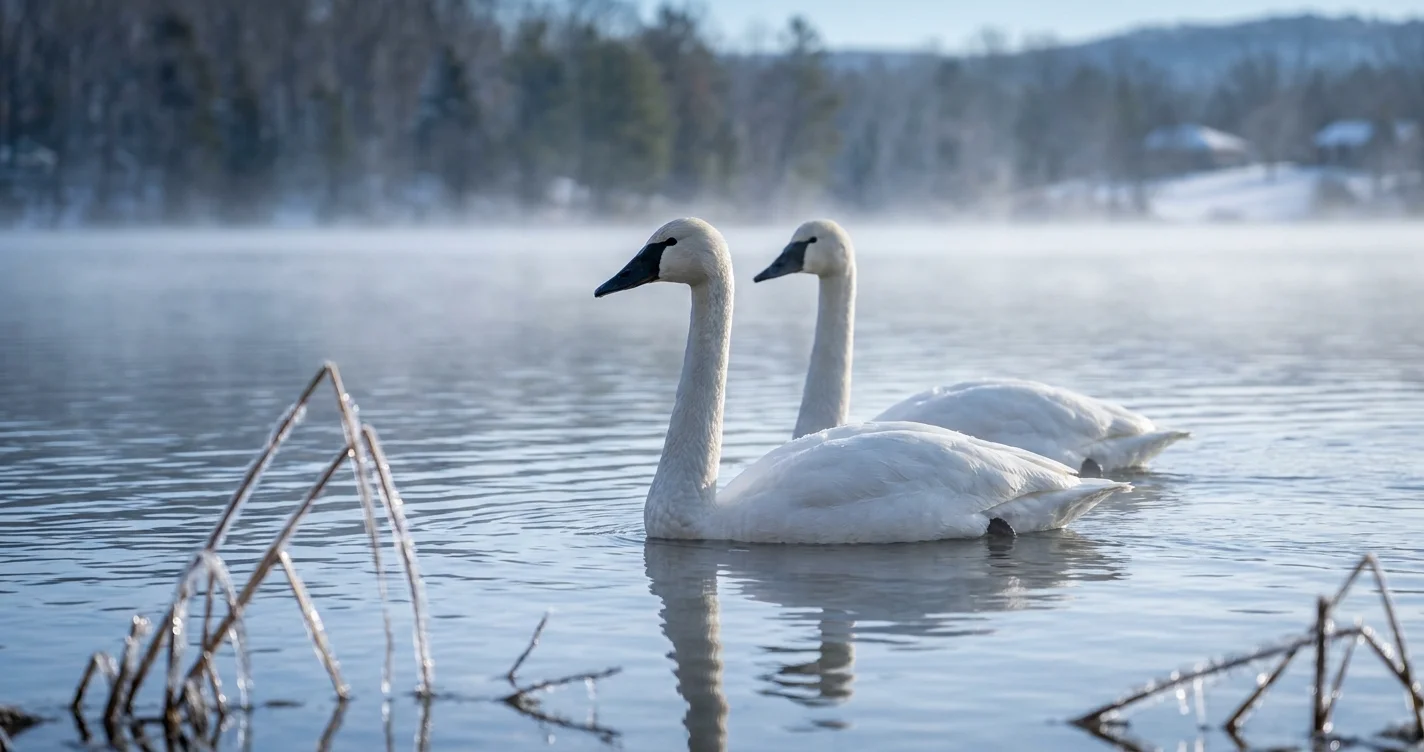
A vast white bird glides across a partially frozen lake, its reflection stretching across the dark water. Then it raises its long neck and releases a deep, resonant call that sounds almost like a brass instrument echoing across the landscape.
This is the trumpeter swan (Cygnus buccinator), North America’s heaviest native waterfowl species and one of its most impressive winter birds.
With an enormous wingspan, snow-white plumage, and a powerful black bill, the trumpeter swan can transform an ordinary winter wetland into an unforgettable wildlife scene.
But identifying one is not always straightforward. Tundra swans look remarkably similar, while introduced mute swans may occupy some of the same waterways.
Learning to recognize a trumpeter swan involves more than noticing its size. Its voice, bill shape, feeding behavior, and winter habitat all provide important clues.
The species also has a remarkable conservation history, having recovered in many areas after severe historical declines.
Table of Contents
- Meet the Trumpeter Swan: North America’s Giant Waterbird
- Trumpeter Swan Identification: The Science Behind Its Winter Appearance
- Trumpeter Swan vs. Tundra Swan vs. Mute Swan
- Where Trumpeter Swans Spend the Winter
- How Trumpeter Swans Survive Freezing Weather
- What Trumpeter Swans Eat in Winter
- Why Trumpeter Swans Nearly Disappeared
- How to Observe Trumpeter Swans Responsibly
- In Your Own Yard: Supporting Waterfowl Habitat
- Frequently Asked Questions
Meet the Trumpeter Swan: North America’s Giant Waterbird
The trumpeter swan belongs to the waterfowl family Anatidae, which also includes ducks and geese.
It is the largest native waterfowl species in North America by body mass and among the continent’s largest flying birds.
Adults have predominantly white feathers, long necks, broad wings, and black bills.
Their impressive proportions make them unmistakably swan-like, although separating them from other swan species requires careful observation.
How Large Is a Trumpeter Swan?
Adult trumpeter swans commonly measure approximately 4.5–5.5 feet in total length, although individuals vary.
Their wingspans can exceed 7 feet, giving them an extraordinary presence when flying overhead.
Males, called cobs, are generally larger than females, called pens.
Their size becomes particularly noticeable when they stand near smaller waterfowl.
However, apparent size can be misleading when birds are observed at different distances.
The Remarkable Trumpeting Call
The species takes its name from its powerful, resonant vocalizations.
Trumpeter swans produce deep, musical calls that can carry across open wetlands.
These sounds help birds communicate with mates and family members.
Pairs may call together, creating a distinctive chorus.
The voice is one of the most useful identification features, particularly when compared with the higher-pitched calls of tundra swans.
A Strong Family Connection
Trumpeter swans often form long-lasting pair bonds.
Breeding pairs defend nesting territories and raise their young together.
Their offspring, called cygnets, remain with their parents through their first winter in many cases.
A group of two white adults accompanied by grayish young birds can therefore represent a family traveling or feeding together.
Trumpeter Swan Identification: The Science Behind Its Winter Appearance
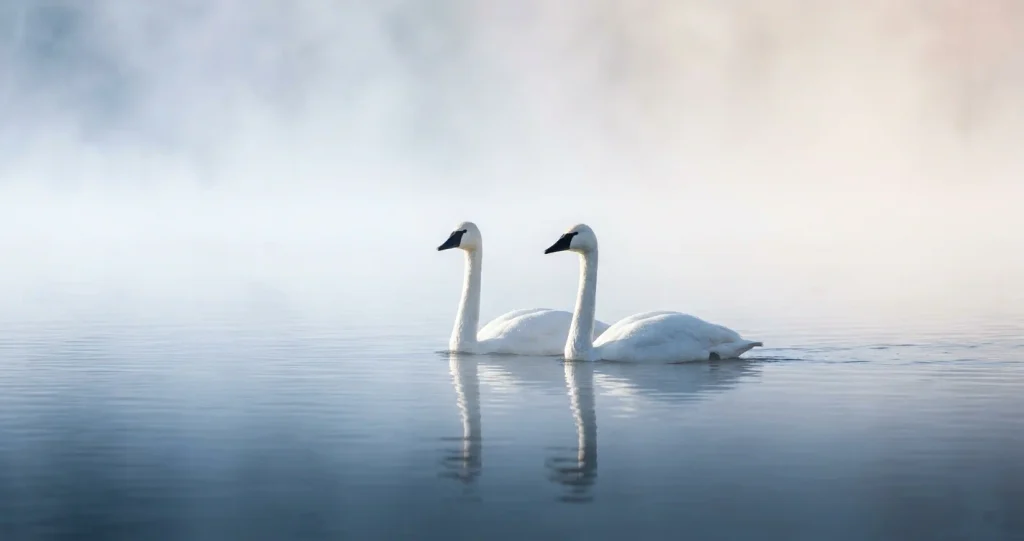
Trumpeter swans appear deceptively simple: white feathers, a long neck, and a dark bill.
Yet several anatomical and behavioral details make them distinctive.
Understanding these features can help birdwatchers identify them accurately during winter.
The Long, Straight Neck
Trumpeter swans have exceptionally long necks that often appear relatively straight when the birds are alert.
Their necks allow them to reach underwater vegetation while feeding.
When swimming, they may hold the neck upright or extend it forward.
Neck posture changes with behavior, so it should not be treated as a fixed identification characteristic.
The Broad Black Bill
Adult trumpeter swans typically have entirely black bills, sometimes with subtle reddish coloration near the mouth.
The bill is relatively large and often appears to merge smoothly with the dark facial skin.
Viewed from the side, the upper bill can show a fairly straight profile.
This differs from the orange bill and prominent basal knob of an adult mute swan.
The Eye and Bill Connection
One useful feature is the relationship between the eye and the dark facial area.
In trumpeter swans, the black bill and surrounding facial skin can create an almost continuous dark region extending toward the eye.
This can make the eye difficult to distinguish at a distance.
However, lighting, viewing angle, and individual variation can affect the appearance.
Why Young Swans Look Gray
Young trumpeter swans are not immediately pure white.
Cygnets typically have grayish plumage that gradually becomes whiter as they mature.
Their bills may also show pinkish coloration before becoming predominantly black.
During winter, families may contain adults and young birds with noticeably different plumage.
A gray swan beside white adults is therefore not necessarily a different species.
How Their Feathers Provide Insulation
Trumpeter swans have dense plumage that helps protect them from cold water and winter air.
Their feathers trap insulating air close to the body.
Preening helps maintain feather condition and water resistance.
Like other waterfowl, trumpeter swans also possess physiological adaptations that help reduce heat loss through their legs and feet.
These features allow them to remain active in cold environments, although severe weather and limited food can still create challenges.
Trumpeter Swan vs. Tundra Swan vs. Mute Swan
Distinguishing North American swans is one of the most rewarding winter bird identification challenges.
Three species are especially important to compare.
Trumpeter Swan
Trumpeter swans are exceptionally large, with long necks, broad black bills, and deep, resonant calls.
They often appear massive when compared directly with other swans.
Their bills generally lack the conspicuous yellow markings sometimes seen on tundra swans.
Tundra Swan
Tundra swans (Cygnus columbianus) are generally smaller and have shorter, more compact bills.
Some individuals show a small yellow spot near the base of the bill, close to the eye.
However, not every tundra swan displays a visible yellow mark.
Their calls are usually higher-pitched and more nasal than those of trumpeter swans.
Mute Swan
Mute swans (Cygnus olor) are introduced birds established in parts of North America.
Adults have orange bills with a prominent black knob near the base.
They frequently hold their necks in a curved, S-shaped posture.
Despite their name, mute swans are capable of making sounds, although their vocalizations differ from the powerful calls of trumpeter swans.
Quick Identification Comparison
| Feature | Trumpeter swan | Tundra swan | Mute swan |
|---|---|---|---|
| Adult bill | Black | Black, sometimes with yellow near eye | Orange with black knob |
| Relative size | Very large | Generally smaller | Very large |
| Typical voice | Deep, resonant | Higher-pitched, nasal | Usually quieter vocalizations |
| Neck appearance | Often long and relatively straight | Somewhat shorter | Frequently curved |
| North American status | Native | Native | Introduced |
No single feature is completely reliable in every situation.
The best identification combines bill structure, proportions, voice, location, and behavior.
Where Trumpeter Swans Spend the Winter
Trumpeter swans occur in several regions of North America, and their winter movements vary among populations.
Some migrate considerable distances, while others remain relatively close to breeding areas when suitable water and food are available.
The Pacific Northwest
Parts of the Pacific Northwest provide important wintering habitat.
Trumpeter swans may gather in wetlands, agricultural landscapes, and shallow lakes.
Their distribution depends on local conditions, including water availability and food resources.
The Rocky Mountain Region
Some populations winter in the northern Rocky Mountains and nearby valleys.
Areas with spring-fed or otherwise unfrozen water can provide access to aquatic vegetation during cold weather.
Wintering locations may become especially important when surrounding lakes freeze.
The Great Lakes and Midwest
Conservation and reintroduction programs have helped restore trumpeter swans to portions of the Great Lakes region and Midwest.
Today, they can be observed in suitable wetlands across several states where they were once absent or uncommon.
Local winter abundance varies considerably.
Why Open Water Matters
Trumpeter swans often depend on accessible water for feeding and resting.
When shallow lakes freeze, birds may move to rivers, spring-fed pools, or other locations that remain open.
However, the presence of open water does not automatically guarantee sufficient food.
Water depth, aquatic vegetation, disturbance, and surrounding habitat all influence winter suitability.
How Trumpeter Swans Survive Freezing Weather
Winter presents several challenges for large waterbirds. Lakes freeze, aquatic plants become harder to reach, and exposed wetlands offer little protection from strong winds.
Trumpeter swans survive through a combination of insulation, efficient circulation, flexible feeding behavior, and seasonal movement.
Feathers Create a Protective Layer
A swan’s dense feathers trap air close to its body, reducing heat loss.
The outer feathers help repel water, while underlying plumage provides insulation. Regular preening helps maintain feather condition.
During cold weather, swans may tuck their bills into their back feathers while resting, reducing exposure.
Their Feet Can Tolerate Cold Water
Waterfowl have specialized blood circulation in their legs that helps conserve body heat.
Warm blood flowing toward the feet passes close to cooler blood returning toward the body. Heat transfers between these vessels, reducing the amount lost to the surrounding water.
This process, known as countercurrent heat exchange, helps birds maintain their internal temperature while keeping their feet cooler than their bodies.
It does not make them immune to extreme conditions, but it is an important adaptation for life in cold wetlands.
Moving When Lakes Freeze
Trumpeter swans may remain in an area as long as accessible water and adequate food are available.
When ice expands and feeding becomes difficult, some birds relocate.
Rivers with moving water, springs, and protected wetlands can become valuable winter refuges.
The Cornell Lab of Ornithology identifies ice-free freshwater habitats and suitable aquatic vegetation as important features of wintering sites. All About Birds
What Trumpeter Swans Eat in Winter
Despite their enormous size, trumpeter swans are primarily plant eaters.
Their long necks allow them to reach vegetation beneath the water’s surface.
Aquatic Plants and Roots
Trumpeter swans consume leaves, stems, roots, and underground plant structures.
Their diet can include pondweeds, sedges, rushes, and other aquatic vegetation.
They may tip forward with their tails raised while reaching underwater, much like dabbling ducks.
Their powerful bills can also help loosen vegetation from soft sediment.
Feeding in Agricultural Fields
During winter, trumpeter swans sometimes forage in harvested fields.
They may eat leftover corn, barley, grasses, and other available plant material.
This behavior can be particularly noticeable when frozen wetlands limit access to aquatic foods. U.S. Fish & Wildlife Service
Why Feeding Wild Swans Is Discouraged
Although swans may approach people in places where they have become accustomed to human activity, feeding them is generally discouraged.
Human-provided food can alter natural behavior, encourage crowding, and increase conflicts.
Bread is particularly unsuitable because it provides poor nutritional balance compared with natural foods.
Observing swans as they feed naturally is the better approach.
Why Trumpeter Swans Nearly Disappeared
The modern presence of trumpeter swans across parts of North America represents an extraordinary conservation achievement.
However, their recovery followed a period of severe population decline.
Historical Hunting and Feather Collection
During earlier centuries, trumpeter swans were heavily hunted for meat, feathers, and skins.
Their large flight feathers were also valued for writing quills.
By the early twentieth century, breeding populations had disappeared from many areas of their historical range.
The species survived in scattered refuges, including remote northern habitats.
Protection and Restoration
Legal protections, habitat conservation, and carefully managed restoration programs helped trumpeter swans recover.
Reintroduction projects returned birds to portions of the Midwest and Great Lakes region.
Conservation organizations and wildlife agencies also worked to improve nesting habitat and reduce human disturbance.
Today, the species is considered a major North American conservation success, although recovery remains uneven across its former range. All About Birds
Threats That Still Matter
Despite their recovery, trumpeter swans continue to face environmental challenges.
Lead poisoning can occur when birds ingest spent ammunition or fishing tackle.
Collisions with power lines and other structures can cause injuries or deaths.
Wetland loss, habitat disturbance, and changes in water availability may also affect local populations.
Continued habitat protection remains important.
How to Observe Trumpeter Swans Responsibly
Watching trumpeter swans in winter can be unforgettable, especially when several birds gather on an open lake.
Responsible observation helps protect the birds while allowing natural behavior to continue.
Use Binoculars or a Spotting Scope
A spotting scope is particularly useful for examining bill shape and facial markings.
It allows detailed observation without approaching birds too closely.
Photographs can also help distinguish trumpeter swans from tundra swans.
Watch for Signs of Disturbance
Swans may become alert, stop feeding, or move away when people approach.
If birds repeatedly change their behavior in response to your presence, increase your distance.
Avoid separating family groups or forcing birds to take flight.
Observe From Established Viewing Areas
Wildlife refuges, public wetlands, and designated observation platforms often provide suitable opportunities.
Follow posted access restrictions and seasonal closures.
Never enter uncertain ice or dangerous shoreline areas to obtain a closer photograph.
Record Your Sightings
Documenting the date, location, number of birds, and identifying features can contribute to knowledge of seasonal distribution.
Platforms such as eBird allow birdwatchers to submit observations.
Accurate records are particularly useful in regions where trumpeter swans are expanding their range.
In Your Own Yard: Supporting Waterfowl Habitat
Most residential yards are too small to provide the extensive wetland habitat trumpeter swans need.
However, homeowners and gardeners can still contribute to healthier landscapes and waterways.
Reduce Fertilizer Runoff
Excess nutrients entering ponds and streams can contribute to water-quality problems.
Apply fertilizers according to soil needs and product instructions.
Avoid spreading them immediately before heavy rain.
Protect Native Shoreline Plants
Where property borders a pond, stream, or lake, maintaining native shoreline vegetation can help stabilize soil and reduce erosion.
Native plants also provide habitat for insects, amphibians, and other wildlife.
Choose species appropriate to local conditions and regulations.
Keep Waterways Free of Litter
Discarded fishing line, hooks, and other debris can injure birds and aquatic animals.
Proper disposal helps reduce these hazards.
Participating in organized shoreline cleanups can benefit local wetland habitats.
Support Wetland Conservation
Protecting wetlands is one of the most meaningful ways to support trumpeter swans and other waterbirds.
Local conservation organizations may offer volunteer opportunities involving habitat restoration, invasive plant removal, or wildlife monitoring.
Even people living far from swan habitats can support responsible water management and wetland protection.
Frequently Asked Questions
1. How can I tell a trumpeter swan from a tundra swan?
Trumpeter swans are generally larger and have longer, straighter black bills. Tundra swans may show a small yellow patch near the eye, although some lack this marking. Their voices are especially useful: trumpeter swans produce deeper, more resonant calls, while tundra swans sound higher-pitched. Combining several features provides the most reliable identification.
2. Where can I see trumpeter swans during winter?
Trumpeter swans winter in suitable areas of the Pacific Northwest, Rocky Mountains, Midwest, and Great Lakes region, among other locations. Look for open water, shallow wetlands, rivers, and nearby agricultural fields. Their presence varies by region and weather conditions.
3. Are trumpeter swans still endangered?
Trumpeter swans are no longer considered globally endangered, and many populations have recovered substantially. However, some regional populations remain more vulnerable than others. Wetland loss, lead poisoning, collisions, and disturbance continue to present conservation concerns.
Conclusion
Imagine standing beside a quiet lake as the first sunlight touches its frozen shoreline.
A magnificent white bird moves across the remaining open water. Its long neck rises, and a deep, musical call echoes through the cold air.
The trumpeter swan is more than North America’s largest native waterfowl. It is a living example of how conservation can help restore a species that once seemed close to disappearing.
Recognizing its black bill, impressive size, distinctive voice, and winter feeding behavior makes every sighting more meaningful.
Protecting wetlands, observing wildlife responsibly, and supporting habitat restoration can help ensure these remarkable birds remain part of North America’s winter landscapes.
And when that powerful call carries across a quiet lake, it reminds us that some of nature’s greatest conservation stories can still be heard.
External Sources
1. Cornell Lab of Ornithology — Trumpeter Swan Life History — Habitat, food, nesting behavior, migration, and conservation. All About Birds
2. The Trumpeter Swan Society — Swan Identification & Behavior — Detailed comparisons of trumpeter, tundra, and mute swans, including bill shapes and calls. Trumpeter Swan Society
3. National Audubon Society — Trumpeter Swan — Distribution, migration, feeding behavior, and conservation history. Audubon Field Guide