
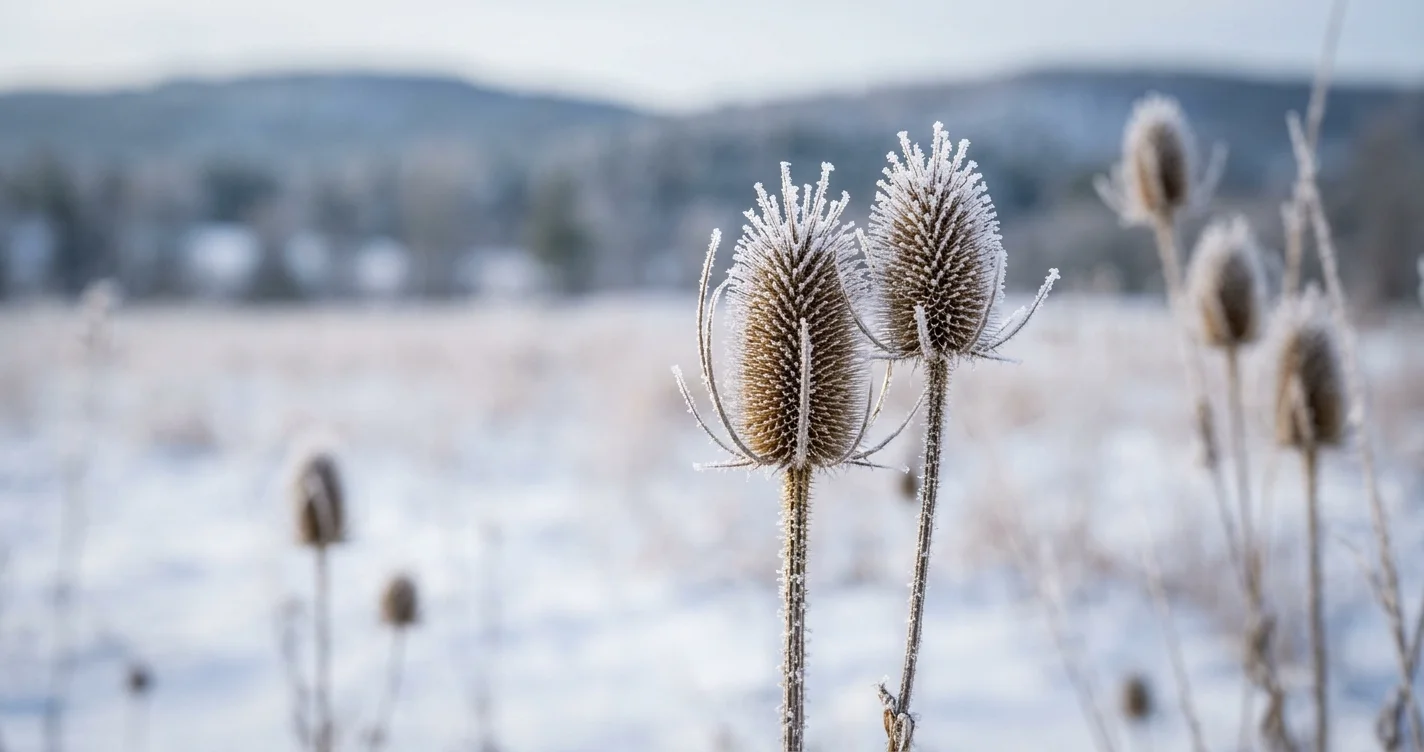
A tall, prickly plant stands above the snow, its oval seed heads resembling miniature sculptures covered in tiny hooks. Everything around it seems dormant, yet a small goldfinch lands on one of the dried stems and begins searching for seeds.
This is teasel, a plant that becomes particularly striking during fall and winter.
With its architectural seed heads, unusual flowering pattern, and ability to attract seed-eating birds, teasel can look like a valuable addition to a wildlife-friendly garden. But there is a surprising complication: several teasel species introduced to North America can spread aggressively and threaten native plant communities.
That creates an interesting dilemma for gardeners. A plant may offer food to birds while still causing ecological problems.
Understanding teasel’s life cycle, its relationship with wildlife, and its invasive potential reveals why this beautiful winter silhouette deserves a closer look before being welcomed into the garden.
Table of Contents
- What Is Teasel?
- Teasel: The Science Behind Its Unusual Life Cycle
- Why Teasel Seed Heads Stand Out in Winter
- Do Birds Eat Teasel Seeds?
- How Teasel Supports Insects and Other Wildlife
- Why Teasel Can Become Invasive
- How to Identify Teasel in the Garden
- Should You Grow Teasel for Wildlife?
- Managing Teasel Without Spreading Seeds
- In Your Own Yard: Better Ways to Support Winter Birds
- Frequently Asked Questions
What Is Teasel?
Teasel is the common name for several plants belonging to the genus Dipsacus, traditionally placed in the teasel family and now classified within Caprifoliaceae, the honeysuckle family.
These plants are native to parts of Europe, Asia, and northern Africa. Some species were introduced to North America, where they became established outside cultivation.
Common Teasel and Cutleaf Teasel
Two species are particularly important in the United States.
Common teasel (Dipsacus fullonum) has elongated, prickly flower heads surrounded by narrow bracts. Its leaves are generally undivided, with toothed or somewhat wavy edges.
Cutleaf teasel (Dipsacus laciniatus) has deeply divided leaves and pale flowers. It is also associated with invasive populations in parts of North America.
Both species can grow several feet tall and produce dense clusters of small flowers arranged around an oval or cylindrical head.
A Plant With an Unusual Appearance
Teasel is instantly recognizable once its distinctive features become familiar.
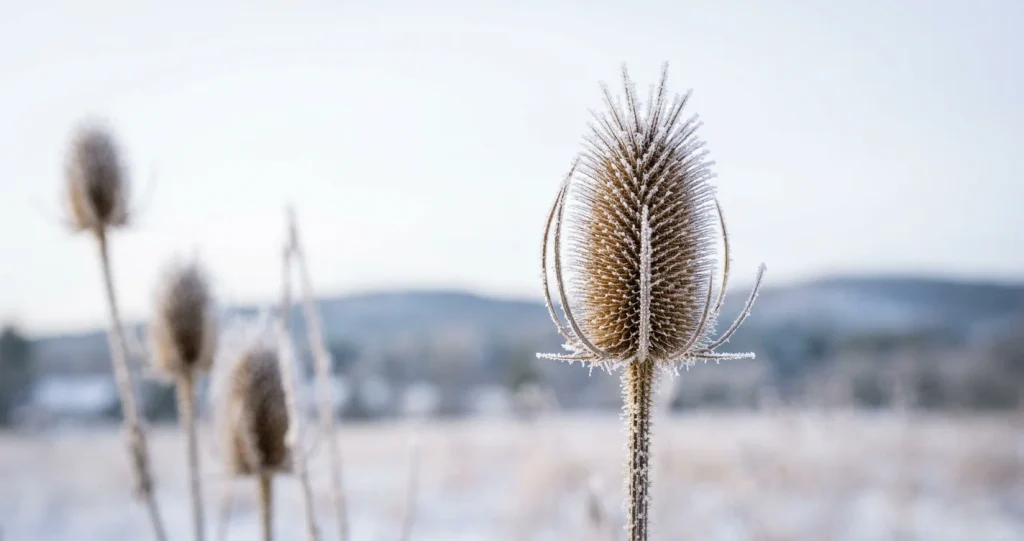
The stems are stiff and prickly, the leaves often form opposite pairs, and the flower heads resemble spiny eggs perched above the surrounding vegetation.
During summer, the heads may display rings of small purple or pale flowers.
By winter, the flowers have disappeared, leaving rigid brown structures filled with seeds.
These dried heads can remain upright long after surrounding herbaceous plants have collapsed.
Teasel: The Science Behind Its Unusual Life Cycle
Teasel’s success as a colonizing plant is closely connected to its life cycle.
Its ability to spend one season building energy reserves before producing a tall flowering stem helps explain both its dramatic appearance and its capacity to spread.
First Year: Building a Rosette
Teasel is generally biennial, although some plants may remain vegetative for longer before flowering.
During its first growing season, it typically forms a low rosette of leaves close to the ground.
These leaves capture sunlight and support the development of a substantial root system.
The plant stores resources that can later support rapid vertical growth and seed production.
At this stage, teasel may be overlooked because it lacks the familiar tall flowering stalk.
Second Year: A Dramatic Transformation
After sufficient development and appropriate seasonal cues, teasel produces an upright flowering stem.
This stem can rise well above neighboring grasses and wildflowers.
Branches develop near the upper portion of the plant, each potentially carrying a distinctive flower head.
The plant’s stored resources help support flowering and seed development.
After reproduction, the flowering plant usually dies, leaving its dried stalks standing.
Why Teasel Flowers in Rings
One of teasel’s strangest characteristics is its flowering sequence.
Rather than opening all flowers simultaneously, a flower head often begins blooming in a band around its middle.
Flowering then progresses toward both ends, sometimes creating two separate rings of blossoms.
This unusual pattern makes teasel easy to recognize during summer.
The precise sequence can vary with species, developmental conditions, and individual flower heads.
How Seeds Develop
After pollination, the flowers give way to fruits containing seeds.
A mature flower head can produce numerous seeds, although the number varies with growing conditions and plant size.
Seeds generally fall near the parent plant, but soil movement, mowing equipment, animals, water, and human activities may contribute to their dispersal.
Because new plants can establish in disturbed ground, a small population may gradually expand when seed production continues unchecked.
Why Teasel Seed Heads Stand Out in Winter
Winter reveals a different side of teasel.
Without leaves and flowers competing for attention, the plant’s geometry becomes particularly noticeable.
Natural Sculptures Above the Snow
Teasel’s stiff stems and compact heads often remain standing through portions of winter.
Frost can outline the spines, while snow may collect between the dried bracts.
Against a pale winter sky, the seed heads create dramatic silhouettes.
Their architectural appearance explains why dried teasel heads have historically been collected for decorative arrangements.
However, collecting or transporting seed-bearing heads can unintentionally spread invasive species.
Why the Heads Remain Upright
The mature stems become relatively rigid as their tissues dry.
This structure can allow them to persist after the plant dies.
Their survival depends on wind exposure, snow load, decay, and other environmental conditions.
Some stalks remain standing for months, while others break or collapse much sooner.
The Hidden Seeds Inside
A dried teasel head may appear empty from a distance.
In reality, mature heads can retain seeds that are available to wildlife or capable of germinating if dispersed.
This dual role is important.
The same seed supply that attracts birds may also allow teasel to establish additional plants.
Do Birds Eat Teasel Seeds?
Yes. Several seed-eating birds may use teasel as a food source, particularly during fall and winter.
Goldfinches are among the birds most frequently associated with its seed heads.
American Goldfinches and Teasel
American goldfinches have relatively small, pointed bills adapted for handling seeds.
They may perch on dried teasel heads and extract seeds from the surrounding structures.
Their feeding behavior can be fascinating to watch.
A goldfinch may balance on a slender stalk while carefully investigating the seed head.
However, teasel is not essential to goldfinch survival.
Goldfinches also consume seeds from many other plants, including native thistles, asters, and sunflowers.
Other Seed-Eating Birds
Depending on region and local conditions, other finches or small seed-eating birds may occasionally investigate teasel.
The frequency of these visits varies.
A teasel patch that attracts birds in one location may receive relatively little attention elsewhere.
Food availability, weather, habitat structure, and the presence of alternative seed sources all influence bird behavior.
Does Feeding Birds Make Teasel Beneficial?
This is where the ecological story becomes more complicated.
A nonnative plant can provide food to wildlife while simultaneously reducing habitat quality through competition with native vegetation.
Bird visits alone do not establish that a plant is environmentally beneficial.
For wildlife gardening, the broader effects on plant diversity, insects, soil, and surrounding habitats matter.
Native seed-producing plants can often provide food while supporting additional ecological relationships.
How Teasel Supports Insects and Other Wildlife
Teasel’s flowers can attract insects during the growing season.
Its nectar and pollen may be visited by bees, butterflies, hoverflies, and other flower-feeding insects.
Summer Flowers and Pollinators
The small flowers are grouped into dense heads that can offer accessible floral resources.
Different insect species may visit depending on location, flowering conditions, and nearby habitat.
However, the presence of pollinators does not mean teasel is preferable to native flowering plants.
Native species may support a broader range of specialized ecological relationships.
Wildlife Benefits Versus Habitat Costs
A dense stand of teasel may provide temporary cover or food for some animals.
At the same time, it can occupy space that would otherwise support native grasses, sedges, and wildflowers.
The ecological outcome depends on the plant community and the extent of teasel establishment.
This is why wildlife gardening requires more than simply counting the birds or insects visiting a particular plant.
Why Teasel Can Become Invasive
The greatest concern with teasel in North American gardens is its ability to establish dense populations outside cultivation.
Common teasel and cutleaf teasel are recognized as invasive plants in several states. They can invade grasslands, meadows, roadsides, and other open habitats. University of Minnesota Extension+1
Dense Growth Can Crowd Out Native Plants
When teasel establishes successfully, its large rosettes and tall flowering stems can occupy substantial space.
Over time, dense stands may reduce the abundance of neighboring vegetation, including native wildflowers and grasses.
This can change the structure of plant communities and reduce the diversity of resources available to wildlife.
Seed Production Makes Control Difficult
Teasel reproduces primarily through seeds.
Research summarized by the USDA Forest Service shows that seed production can be substantial, although it varies widely among plants and growing conditions.
Seeds often fall near the parent plant, allowing populations to become increasingly concentrated. Forest Service R&D
Some seeds can remain viable in soil for several years, making repeated monitoring important.
Disturbed Ground Encourages Establishment
Roadside margins, abandoned fields, construction areas, and disturbed garden beds may provide opportunities for teasel seedlings.
Once established, plants can expand into neighboring habitats.
Its invasive potential varies geographically, so gardeners should consult local extension services and state invasive-species guidance.
How to Identify Teasel in the Garden
Recognizing teasel before it produces seeds makes management easier.
Look for the First-Year Rosette
Young plants form a cluster of elongated, often wrinkled leaves close to the soil.
The leaves may have prickles, particularly along the underside of the central vein.
At this stage, teasel can resemble other broadleaf plants, so identification should be confirmed before removal.
Examine the Tall Flowering Stem
Mature plants have upright, ridged stems with sharp prickles.
The leaves occur in opposite pairs, and their bases may join around the stem to form a small cup capable of collecting rainwater.
Compare the Flower Heads
Common teasel usually produces lavender to pinkish-purple flowers and relatively long bracts surrounding its heads.
Cutleaf teasel generally has pale or white flowers, shorter surrounding bracts, and deeply lobed leaves.
These characteristics are useful for distinguishing the two species. Early Detection Species
Should You Grow Teasel for Wildlife?
For most North American wildlife gardens, intentionally planting invasive teasel species is difficult to justify.
Although birds may eat their seeds and insects may visit their flowers, these benefits can often be provided by regionally native alternatives.
Choose Plants That Support More Wildlife
Native sunflowers, asters, goldenrods, and appropriate native thistles can provide seeds, flowers, and habitat.
Many also support insects associated with local ecosystems.
The best choices depend on climate, soil, moisture, and regional native ranges.
Consider the Surrounding Landscape
A garden beside a prairie remnant, meadow, stream corridor, or conservation area deserves particular care.
Plants capable of spreading beyond property boundaries can affect habitats far from the original planting site.
Checking local invasive-plant lists before introducing unfamiliar species is a sensible precaution.
Managing Teasel Without Spreading Seeds
Management is most effective when plants are identified early and prevented from producing new seeds.
Remove Young Rosettes
Small rosettes can often be removed by digging, especially when the soil is moist.
Wear sturdy gloves to protect against prickles.
Removing the root crown is important because plants may regrow if enough living tissue remains.
Handle Flower Heads Carefully
Flowering and seed-bearing heads require special attention.
Cutting mature stalks without containing the heads can scatter seeds.
Extension guidance recommends bagging removed flower heads and disposing of them appropriately. Even cut heads may continue developing viable seeds if left on the ground. Illinois+1
Avoid transporting dried heads for decorations or scattering them in compost.
Monitor the Area for New Seedlings
Removing mature plants is only part of the process.
Seeds already present in the soil may germinate in subsequent seasons.
Inspect the site during spring and fall, when rosettes may be easier to recognize.
Repeated control over several years may be necessary. Minnesota Department of Agriculture
In Your Own Yard: Better Ways to Support Winter Birds
A wildlife-friendly winter garden can provide seed heads, shelter, and natural feeding opportunities without encouraging invasive teasel.
Leave Native Seed Heads Standing
Allow suitable native sunflowers, coneflowers, asters, and other seed-producing plants to remain standing through winter.
Their seeds may attract finches, sparrows, and other birds.
Dried stems can also provide overwintering habitat for certain insects.
Plant for Several Seasons
Combine spring-flowering shrubs, summer wildflowers, and fall-blooming perennials.
This creates a more continuous supply of flowers, insects, fruits, and seeds.
Choose plants native to your specific region whenever practical.
Keep a Small Natural Area
A garden does not need to look completely manicured to support wildlife.
Leaving some fallen leaves beneath shrubs and retaining suitable dead stems can create shelter for insects and other small organisms.
Maintain clear paths and remove vegetation that presents safety hazards.
Watch Winter Visitors
Observe which birds visit your garden’s seed heads.
American goldfinches may feed on several types of native plants, making them rewarding visitors to a winter wildlife garden.
A simple observation notebook can help reveal which plants attract wildlife across different seasons.
Frequently Asked Questions
1. Is teasel invasive everywhere in the United States?
Teasel’s legal status and ecological impact vary by state and region. Common teasel and cutleaf teasel are considered invasive in multiple areas, particularly where they spread into grasslands and other open habitats. Check local regulations and extension recommendations before planting or managing either species.
2. Do goldfinches really eat teasel seeds?
Yes. Goldfinches are among the birds known to consume teasel seeds. However, they also eat seeds from many other plants. Providing regionally native seed-producing flowers is generally a better long-term approach for supporting wildlife without encouraging invasive spread.
3. Should dried teasel heads be left standing through winter?
Where teasel is invasive, leaving mature seed heads standing can allow additional seeds to disperse. Removing and securely bagging the heads is usually the safer management choice. Native seed-producing plants can provide similar winter interest and bird food with fewer ecological concerns.
Conclusion
Picture that winter garden again.
A goldfinch balances on a prickly brown seed head while frost glitters across the surrounding stems.
It is a beautiful scene, and it reveals one of the most interesting contradictions in wildlife gardening.
Teasel can provide food for birds and flowers for visiting insects, yet its ability to spread and compete with native vegetation makes it a concern in many parts of North America.
The lesson is not that every plant visited by wildlife belongs in a garden.
Instead, thoughtful gardening considers how a plant interacts with the entire surrounding ecosystem.
By recognizing teasel, managing invasive populations, and choosing regionally native alternatives, gardeners can create winter landscapes that are both visually striking and ecologically responsible.
The next time you notice a sculptural seed head standing above the snow, admire its intricate design—but remember that the most wildlife-friendly garden is one that supports nature beyond its own boundaries.
External Sources
1. Common Teasel — Kew Grow Wild
Teasel leaves form small cups that collect rainwater and sometimes trap insects. Scientists have investigated whether the plant benefits nutritionally from these trapped insects, but the evidence remains mixed. Kew
2. Dipsacus fullonum — Oxford University Plants 400
Teasel flowers often open in two distinct bands, with one progressing upward and the other downward along the flower head. The same source documents goldfinches feeding on its winter seeds. herbaria.plants.ox.ac.uk