
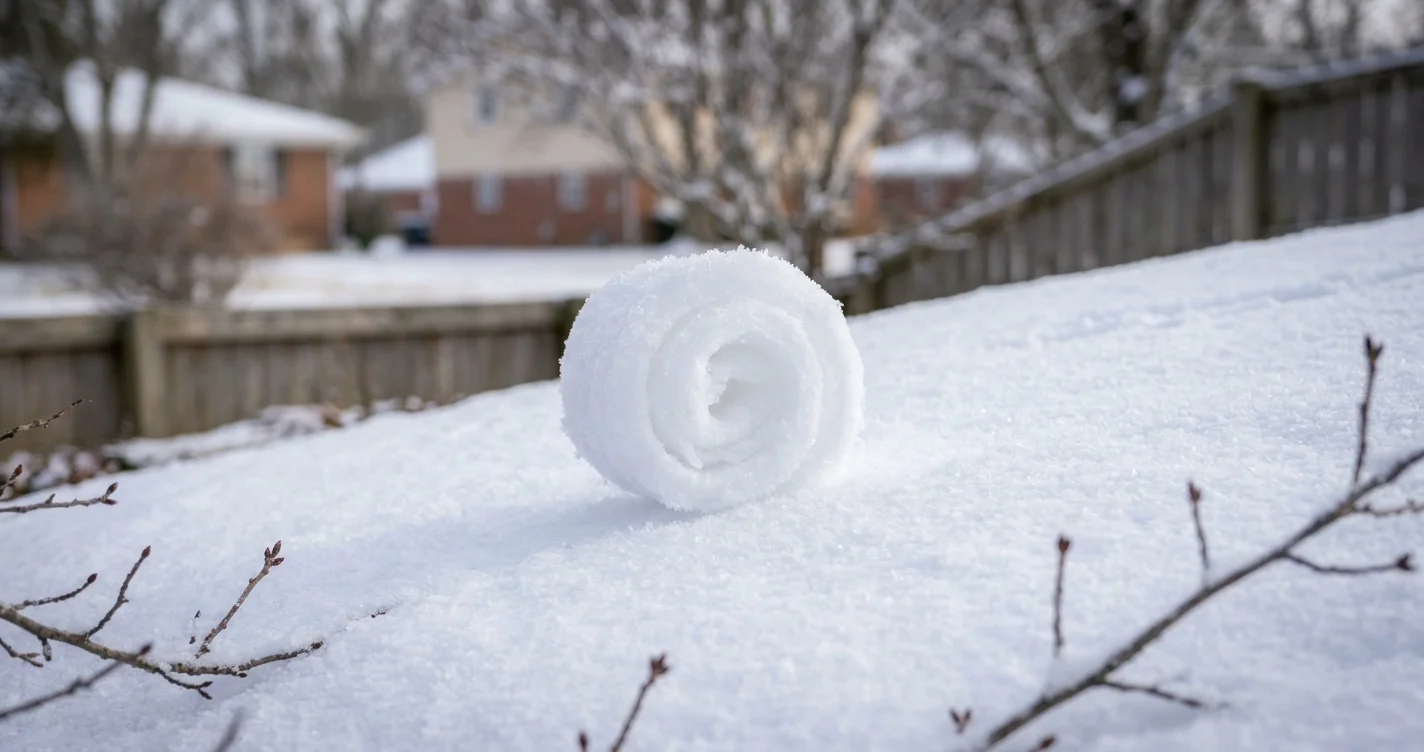
Imagine waking up after a winter storm and discovering dozens of perfectly rolled snow cylinders scattered across an empty field. Some resemble giant marshmallows, while others look like miniature hay bales with hollow centers. Even stranger, nobody has touched them.
These mysterious formations are called snow rollers, and they are among winter’s most unusual natural phenomena.
Unlike ordinary snowballs shaped by human hands, snow rollers form when wind, temperature, moisture, and snow conditions come together in just the right combination. Under favorable circumstances, the wind can lift and roll a thin layer of sticky snow across the ground, gradually creating remarkable cylindrical structures.
The process is surprisingly delicate. Too much moisture, too little wind, or the wrong type of snow can prevent these formations from developing.
What makes snow rollers particularly fascinating is that they reveal how seemingly ordinary winter weather can produce extraordinary shapes without any human involvement.
Table of Contents
- What Are Snow Rollers?
- Snow Rollers: The Science Behind Nature’s Rolling Snowballs
- Why Snow Rollers Sometimes Have Hollow Centers
- The Weather Conditions That Create Snow Rollers
- Where Snow Rollers Are Most Likely to Form
- How Snow Rollers Differ From Other Snow Formations
- Why Snow Rollers Are So Uncommon
- What Snow Rollers Reveal About Winter Weather
- In Your Own Yard: How to Recognize Snow Rollers
- Frequently Asked Questions
What Are Snow Rollers?
Snow rollers are naturally occurring snow formations created when wind or gravity causes a small piece of cohesive snow to roll across a snow-covered surface.
As the snow moves, additional layers may attach to the outside, gradually increasing its size.
The resulting formations often resemble cylinders, spirals, or loosely rolled carpets of snow.
Unlike a compact snowball, a snow roller may have a hollow center and a visible layered structure.
Natural Snowballs Without Human Hands
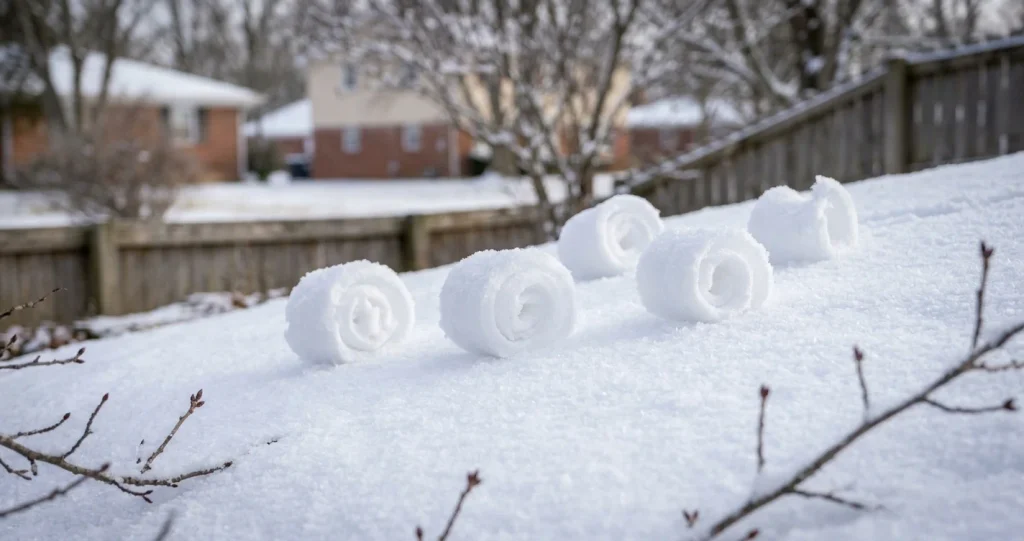
The most surprising feature of snow rollers is that they can appear in large numbers across an otherwise undisturbed landscape.
A field that looked completely ordinary the previous evening may contain dozens of rolled snow formations the next morning.
Some are small and fragile.
Others grow considerably larger when conditions allow them to travel farther across the surface.
Their final appearance depends on snow texture, wind strength, terrain, and the distance traveled.
Why They Often Look Like Miniature Hay Bales
Many snow rollers develop a cylindrical shape because a thin sheet of snow begins curling around itself.
As the formation moves, additional snow wraps around the outer surface.
This creates a structure similar to a rolled blanket or a small hay bale.
The layers may remain visible, especially when the snow is moist enough to stick together but not so wet that it collapses.
The result can look almost artificial.
Yet the entire process is driven by natural physical forces.
Snow Rollers: The Science Behind Nature’s Rolling Snowballs
Snow rollers form through a delicate interaction between snow cohesion, surface friction, wind force, and temperature.
Understanding these factors explains why the phenomenon occurs only under particular weather conditions.
Step 1: A Thin Layer of Sticky Snow Develops
The process often begins when a relatively thin layer of moist snow rests on a smoother underlying surface.
The fresh snow must have enough cohesion to hold together as it begins moving.
Snow cohesion describes the ability of snow crystals and particles to stick to one another.
Near the melting point, small amounts of liquid water can help create bonds between snow grains.
These bonds may allow snow to behave as a flexible sheet rather than breaking immediately into loose powder.
However, the amount of moisture matters.
Extremely dry snow may crumble instead of rolling, while excessively wet snow can become too heavy or compact to form a stable cylinder.
Step 2: The Underlying Surface Allows Movement
For a snow roller to form, the upper layer must be able to separate from the material beneath it.
This can happen when moist snow lies over a smoother, colder, or more resistant surface.
An icy crust or older compacted snow layer may provide relatively low resistance to movement.
The upper layer can then begin peeling away when sufficient force is applied.
If the snow is strongly bonded to the surface beneath it, the formation may remain stationary.
If the upper layer is too weak, it may break apart before a recognizable roll develops.
Step 3: Wind or Gravity Starts the Rolling Motion
Once a small section of snow begins curling, wind can push it across the surface.
On a slope, gravity may also initiate or sustain movement.
The force must be strong enough to overcome resistance but not so violent that the developing structure disintegrates.
This balance is important.
A gentle breeze may be insufficient to move the snow.
Very strong, turbulent winds may scatter loose material or break fragile formations.
The required wind conditions vary with snow density, surface texture, and the size of the developing roller.
Step 4: Additional Snow Wraps Around the Formation
As the initial curl moves, it may collect more snow from the surface.
Each rotation can add another layer to the growing cylinder.
The process resembles rolling up a thin carpet.
The outer diameter increases while the internal structure becomes more layered.
In favorable conditions, the roller continues growing until it becomes too heavy to move, encounters an obstacle, or reaches an area where the snow is less suitable.
Step 5: The Roller Stops and Remains in Place
Eventually, the forces pushing the snow roller can no longer overcome its weight and resistance.
The formation stops moving.
It may remain intact for some time if temperatures stay cold and the structure is sufficiently cohesive.
However, snow rollers are often fragile.
Changes in temperature, additional snowfall, wind, or direct sunlight can alter or destroy them.
This temporary nature helps explain why many people have never encountered one.
Why Snow Rollers Sometimes Have Hollow Centers
One of the most distinctive features of snow rollers is the opening that sometimes appears through the middle.
This hollow center gives certain formations the appearance of a snow doughnut or a loosely rolled tube.
The Original Snow Layer Creates the Opening
When a thin section of snow curls around itself, it may not form a solid core.
Instead, the first rotation can leave a small central opening.
As additional snow accumulates around the outside, the opening may remain visible.
The result is a layered cylinder with a hollow interior.
Why Some Centers Collapse
Not every snow roller retains its hollow center.
The inner layers may collapse under the weight of additional snow.
Temperature changes can also alter the structure.
As the snow becomes wetter, denser, or partially melted, the opening may shrink or disappear.
Other rollers begin with more compact centers and never develop an obvious hollow.
This variation is one reason snow rollers can appear in several different shapes.
The Difference Between a Snow Roller and a Snowball
A conventional snowball is usually compacted into a relatively dense, rounded mass.
Snow rollers often form through the wrapping of thin snow layers.
Their cylindrical shape and visible spiral structure reflect this different formation process.
However, natural snow formations do not always fit perfectly into separate categories.
Some wind-driven accumulations can appear rounded rather than cylindrical, depending on the conditions.
The Weather Conditions That Create Snow Rollers
Snow rollers require an unusually favorable combination of environmental conditions.
The exact requirements are not identical for every event, but several factors frequently appear together.
Temperatures Near Freezing
Snow that is slightly moist often has enough cohesion to hold together while rolling.
Temperatures near the freezing point can support these conditions.
However, snow properties also depend on previous weather, solar radiation, and the temperature of the underlying surface.
Air temperature alone does not determine whether snow rollers can form.
A Suitable Snow Surface
A thin layer of cohesive snow over a relatively smooth surface is often important.
The underlying layer may be icy, compacted, or otherwise resistant to bonding with the fresh snow.
This allows the upper material to peel away more easily.
A rough surface with exposed vegetation, debris, or irregular snow can interrupt the rolling process.
Steady Wind
Wind provides the horizontal force needed to move many snow rollers.
Open landscapes are particularly favorable because wind can travel across them with relatively few obstacles.
The wind must interact with snow that is both movable and cohesive.
There is no single wind speed that guarantees snow roller formation.
The necessary force depends on local conditions.
Open Terrain
Fields, frozen lakes, broad hillsides, and other exposed surfaces may provide suitable environments.
These locations can offer relatively smooth snow cover and unobstructed wind.
Sloping terrain can also support gravity-driven rolling.
However, snow rollers may occasionally form in other settings when the required conditions occur.
Where Snow Rollers Are Most Likely to Form
Snow rollers have been documented in several cold-weather regions.
They are not restricted to one country or climate zone.
Open Fields and Farmland
Large agricultural fields can provide relatively smooth, exposed surfaces during winter.
When covered with suitable snow, these areas may allow developing rollers to travel across considerable distances.
Their appearance can be especially striking because the surrounding landscape is often open and uniform.
Frozen Lakes and Snow-Covered Ice
Frozen lakes can provide smooth underlying surfaces.
When a cohesive layer of snow accumulates above ice or compacted snow, wind may move portions of the upper layer.
However, ice safety is a separate and serious concern.
Snow rollers should always be observed from safe ground rather than by walking onto uncertain lake ice.
Hillsides and Gentle Slopes
On sloping terrain, gravity can help initiate rolling.
A small section of snow may begin moving downhill and gather additional material.
These formations may resemble wind-driven snow rollers but rely more strongly on gravitational movement.
The final shape depends on slope angle, snow cohesion, and surface conditions.
Cold Regions of the United States
Snow rollers have occasionally been reported in parts of the northern and central United States.
Suitable conditions can occur in the Midwest, Great Lakes region, and other areas experiencing winter snow and fluctuating temperatures.
Their occurrence is highly dependent on individual weather events.
Even regions with frequent snowfall may go many winters without producing obvious snow rollers.
How Snow Rollers Differ From Other Snow Formations
Winter produces many unusual snow and ice structures.
Some may resemble snow rollers at first glance, but they form through different processes.
Snow Rollers Versus Snowdrifts
Snowdrifts develop when wind transports loose snow and deposits it in areas where airflow slows or changes.
They often form around fences, buildings, vegetation, and terrain features.
Snow rollers, by contrast, involve cohesive snow moving and wrapping into a distinct structure.
Snow Rollers Versus Snow Doughnuts
The term snow doughnut is sometimes used for hollow, rounded snow formations.
In many cases, these are simply snow rollers with particularly obvious central openings.
The terminology is descriptive rather than a strict scientific distinction.
Snow Rollers Versus Snowballs Formed on Slopes
Snowballs can grow as they move downhill, especially when sticky snow accumulates around a moving mass.
These formations may become rounded and compact.
Snow rollers often retain a more cylindrical or layered appearance.
The distinction depends on how the snow begins moving and how material accumulates.
Why Snow Rollers Are So Uncommon
Snowfall is widespread across many regions, yet snow rollers remain relatively unusual.
Their rarity comes from the number of conditions that must occur together.
The Snow Must Be Sticky but Movable
The snow needs enough cohesion to remain intact.
At the same time, it must separate from the underlying surface.
These requirements can be difficult to satisfy simultaneously.
Wind Must Provide the Right Force
Wind must be strong enough to initiate movement.
However, excessive turbulence or unsuitable snow conditions can prevent stable rolling.
Even when wind and snow appear favorable, rollers may not develop.
Conditions Can Change Quickly
A small temperature increase may make the snow too wet.
A drop in temperature may harden the surface.
Additional snowfall can bury developing formations.
Because these changes can occur over relatively short periods, the opportunity for snow rollers to form may be brief.
Many Formations Disappear Before Anyone Notices
Snow rollers can collapse, melt, or become buried.
Some form in remote fields or open areas where few people are present.
Consequently, the number of observed events may not represent every occasion when suitable conditions briefly occur.
What Snow Rollers Reveal About Winter Weather
Snow rollers are more than unusual photographic subjects.
They demonstrate how sensitive snow behavior is to environmental conditions.
Snow Is a Changing Material
Snow is not simply frozen water sitting motionless on the ground.
Its crystals, density, moisture content, and internal bonds change with temperature and weather.
These changes influence how snow settles, compacts, melts, and moves.
Snow rollers provide a visible example of these physical processes.
Small Differences Can Produce Dramatic Results
A minor change in moisture or surface temperature can affect whether snow sticks together or falls apart.
Similarly, differences in wind exposure can determine whether a developing roller moves or remains stationary.
The result is a striking example of how ordinary physical forces can create complex natural patterns.
Observations Can Support Weather Awareness
Photographs of snow rollers can provide useful descriptive information about local winter conditions.
However, the formations alone cannot establish exact temperatures, wind speeds, or snow properties.
Understanding the event requires considering surrounding weather observations and the characteristics of the snowpack.
In Your Own Yard: How to Recognize Snow Rollers
You do not need to travel to a remote mountain landscape to appreciate unusual winter snow formations.
Under favorable conditions, open yards, fields, and nearby parks may provide opportunities to observe them.
Look After a Suitable Snowfall
Pay attention to periods when fresh snow becomes slightly moist and winds remain active.
Snow rollers may be more likely when a cohesive upper layer rests on older compacted snow or ice.
Look across open, relatively smooth surfaces.
Search for Cylindrical Shapes
Natural snow rollers often resemble small rolled blankets or miniature hay bales.
Some have hollow centers.
Others appear as irregular cylinders with visible layers.
Their size and shape can vary considerably.
Look for Tracks in the Snow
A snow roller may leave a shallow trail behind it.
This track can reveal the direction of movement.
In some cases, several rollers may appear across the same area, with trails indicating a common wind direction.
However, tracks can become obscured by additional snowfall or drifting snow.
Photograph Without Disturbing Them
Snow rollers are often fragile.
Photographing them from a short distance helps preserve their structure.
Include a familiar object nearby for scale when possible, without placing anything on the formation itself.
Avoid walking onto frozen ponds, steep icy slopes, or hazardous terrain to obtain a photograph.
Try a Simple Snow Observation
A safe backyard activity is to compare different types of snow.
Observe whether fresh snow is powdery, sticky, compacted, or crusted.
Notice how these properties change as temperatures rise or fall.
This simple exercise can help explain why certain snow conditions allow rolling while others do not.
It also encourages closer observation of winter weather without requiring specialized equipment.
Frequently Asked Questions
1. Are snow rollers made entirely by wind?
Wind is responsible for many snow roller formations, but gravity can also play an important role, especially on slopes. The process requires snow that can separate from the underlying surface while remaining cohesive enough to roll. Local terrain and snow conditions determine which forces are most important.
2. Why do snow rollers sometimes look like hollow tubes?
Snow rollers may begin when a thin sheet of snow curls around itself, leaving an opening at the center. As additional snow wraps around the outside, the hollow structure can remain visible. Some centers eventually collapse, while other rollers form without obvious openings.
3. Can snow rollers form in a backyard?
Yes, snow rollers can occasionally form in yards or nearby open spaces when conditions are suitable. A relatively smooth surface, cohesive snow, and enough wind or slope-driven movement are important. However, the phenomenon is uncommon, and ordinary snowfall does not guarantee that rollers will appear.
Conclusion
Return to that quiet field after a winter storm.
Across the untouched snow lie dozens of strange cylinders, each appearing as though someone carefully rolled a small carpet of snow and left it behind.
Yet no human hands were involved.
Snow rollers are created through the interaction of moisture, temperature, surface conditions, wind, and sometimes gravity.
Their formation requires a delicate balance: snow must be sticky enough to hold together, loose enough to separate from the ground, and light enough to move.
When these conditions align, ordinary winter weather can produce extraordinary natural sculptures.
The formations may last only a short time before melting, collapsing, or disappearing beneath fresh snowfall.
But their temporary existence makes them even more remarkable.
The next time you look across a snow-covered field, pay attention to the smallest details.
Nature may have been quietly rolling its own snowballs while the world was asleep.
External Sources
Snow rollers sometimes resemble doughnuts because their weaker inner layers collapse and blow away. The same scientific resource describes other bizarre snow formations, including tall, pointed ice structures called penitentes. National Snow and Ice Data Center.
2. Rare Snow Rollers Make an Appearance in Illinois
In 2024, unusual snowballs appeared in several Illinois yards. Their trails across the snow helped reveal that they had formed naturally rather than being made by people. Illinois.