
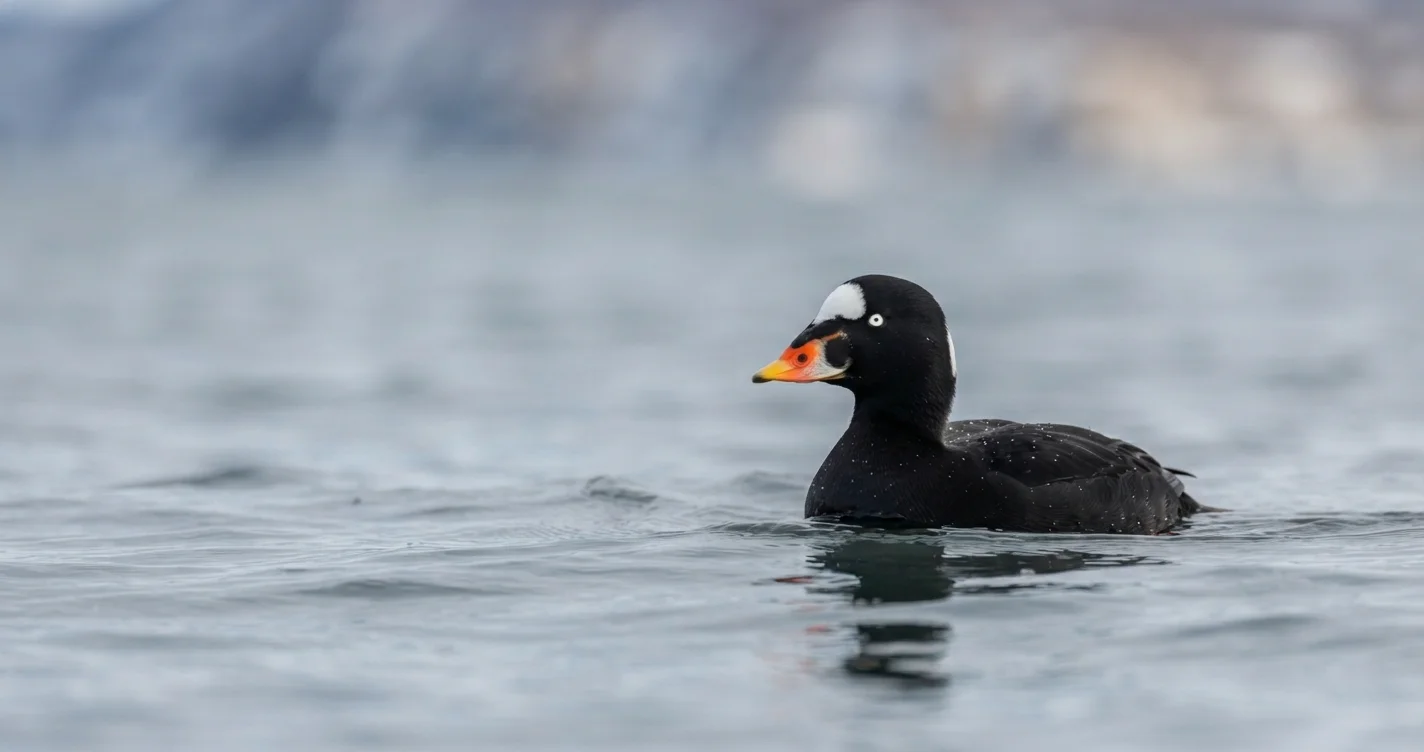
On a gray winter morning along the American coastline, a flock of dark ducks disappears beneath the waves. Moments later, the birds emerge, revealing flashes of white feathers and remarkably colorful orange bills that seem almost too bright for the surrounding winter landscape.
Among these fascinating birds is the surf scoter (Melanitta perspicillata), a North American sea duck with an extraordinary ability to navigate cold coastal waters.
While many people associate winter birdwatching with backyard feeders and woodland trails, coastal environments host an entirely different community of seasonal visitors.
Surf scoters spend much of the winter diving for shellfish, traveling in flocks, and riding ocean swells. Their distinctive appearance and underwater feeding techniques make them particularly rewarding birds to observe.
Table of Contents
- What Is a Surf Scoter?
- How to Identify Surf Scoters in Winter
- Where Surf Scoters Spend the Winter
- Surf Scoter Winter Survival: The Science Behind Deep Diving
- What Surf Scoters Eat During Winter
- Surf Scoters vs. Other Sea Ducks
- Why Surf Scoters Gather in Winter Flocks
- The Ecological Importance of Surf Scoters
- In Your Own Yard: Supporting Coastal Wildlife
- Frequently Asked Questions
What Is a Surf Scoter?
The surf scoter is a medium-sized sea duck belonging to the family Anatidae, which includes ducks, geese, and swans.
Native to North America, this species breeds primarily near freshwater lakes in northern Canada and Alaska before migrating toward coastal wintering grounds.
Its scientific name, Melanitta perspicillata, reflects its membership in a group of predominantly dark-colored diving ducks.
Unlike familiar mallards, surf scoters spend much of their nonbreeding season in marine environments.
A Duck With an Unusual Nickname
Male surf scoters are sometimes called skunk-headed ducks because of the contrasting white patches on their otherwise black heads.
However, their most striking feature is their enlarged, multicolored bill.
Shades of orange, white, yellow, and black combine to create an appearance unlike that of most North American waterfowl.
Size and Physical Characteristics
Adult surf scoters generally measure around 19–24 inches in length.
Their compact bodies, strong legs, and webbed feet are well suited to underwater movement.
Although they may appear somewhat heavy on the water, these ducks are capable swimmers and strong migratory fliers.
How to Identify Surf Scoters in Winter
Winter is an excellent time to observe surf scoters along suitable stretches of the Atlantic and Pacific coastlines.
Recognizing the differences between males, females, and immature birds can make identification considerably easier.
Identifying Adult Males
Adult male surf scoters have several distinctive features:
- Predominantly black plumage.
- A prominent orange and multicolored bill.
- A white patch on the forehead.
- A white patch on the back of the neck.
- Pale eyes that contrast with the dark feathers.
The combination of black plumage, white head markings, and a brightly colored bill makes mature males particularly recognizable.
Identifying Females
Female surf scoters have a more subdued appearance.
Their plumage is generally dark brown, with lighter patches near the base of the bill and behind the eyes.
They lack the male’s dramatically colored bill, making identification somewhat more challenging.
Pay attention to their relatively large bills, head shape, and facial markings.
Recognizing Immature Birds
Young surf scoters often resemble females, although their appearance changes as they mature.
Winter flocks frequently contain birds of different ages and sexes.
Observing the entire group rather than focusing on a single individual can help confirm the species.
Where Surf Scoters Spend the Winter
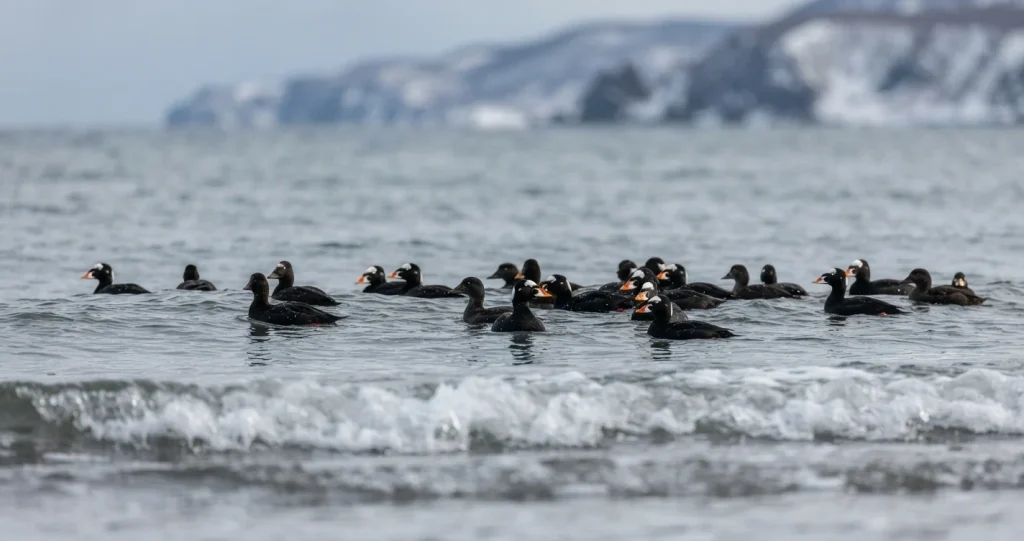
Surf scoters migrate from their northern breeding territories toward marine environments that provide accessible food during the colder months.
Their winter distribution includes extensive areas along both North American coastlines.
Atlantic Coast Wintering Grounds
Along the Atlantic Coast, surf scoters occur from Canadian maritime waters southward along the eastern United States, sometimes reaching Florida.
Protected bays, coastal inlets, and nearshore waters can provide productive winter habitat.
Chesapeake Bay and various coastal areas of New England are well-known locations for observing sea ducks.
Pacific Coast Wintering Grounds
On the Pacific Coast, surf scoters winter from Alaska southward to California and beyond into parts of Mexico.
Puget Sound, sheltered coastal bays, and productive estuaries can attract substantial gatherings.
Their presence often reflects the availability of suitable underwater food resources.
The Best Habitats for Observation
Look for surf scoters in sheltered coastal bays, sandy nearshore waters, estuaries, harbors, and areas containing abundant shellfish beds.
Although their name suggests a preference for breaking waves, they frequently occupy relatively sheltered water as well.
A pair of binoculars or a spotting scope can help reveal their distinctive markings when flocks remain offshore.
Surf Scoter Winter Survival: The Science Behind Deep Diving
Beneath the surface of a winter ocean lies a surprisingly productive ecosystem. Reaching it, however, requires specialized physical adaptations and considerable energy.
Powerful Feet for Underwater Movement
Unlike dabbling ducks, which typically feed near the water’s surface, surf scoters regularly submerge their entire bodies.
Their powerful webbed feet propel them underwater, while their partially extended wings may assist with movement and control.
This diving technique allows them to reach marine organisms living along the ocean floor.
Diving to Remarkable Depths
The Washington Department of Fish and Wildlife reports that wintering surf scoters can feed at depths of up to 66 feet.
At these depths, they search for shellfish and other marine invertebrates hidden from view at the surface. Washington Department of Fish & Wildlife
However, diving requires energy, and shallower feeding areas may offer advantages when food is abundant.
Staying Warm in Cold Seawater
Surf scoters possess several adaptations shared by other diving waterfowl.
Dense plumage and insulating down help limit heat loss, while natural feather maintenance helps preserve the protective qualities of their outer feathers.
A specialized arrangement of blood vessels in birds’ legs also allows heat to be transferred between outgoing and returning blood, reducing heat loss through their feet.
These adaptations help sea ducks remain active in environments that would quickly chill many land animals.
Balancing Energy and Food Availability
Repeated diving, swimming against currents, and maintaining body temperature require considerable energy.
Productive shellfish beds are therefore particularly valuable during winter.
When feeding conditions deteriorate, surf scoters may move to alternative locations where prey is more accessible.
What Surf Scoters Eat During Winter
The surf scoter’s winter diet reveals an intimate connection with the ecosystems beneath coastal waters.
Mussels and Clams
Small bivalves, particularly mussels and clams, are important components of their diet.
Surf scoters can swallow suitably sized shellfish whole.
Their muscular gizzards help break down hard food materials, allowing them to obtain nourishment from prey protected by shells.
Marine Invertebrates
Their diet may also include marine snails, small crabs, aquatic worms, and other bottom-dwelling organisms.
This dietary flexibility allows the birds to exploit different food sources as environmental conditions change.
A Seasonal Feast of Herring Eggs
In certain Pacific coastal environments, spawning herring create an abundant seasonal food supply.
Surf scoters may shift their feeding activities toward these temporary concentrations of fish eggs as spring approaches. wdfw.wa.gov
This seasonal transition illustrates how closely sea duck behavior follows the natural rhythms of marine ecosystems.
Surf Scoters vs. Other Sea Ducks
Surf scoters frequently share winter habitats with other dark-colored diving ducks.
Knowing a few distinctive characteristics can help prevent identification mistakes.
Comparing North American Scoters
| Feature | Surf scoter | Black scoter | White-winged scoter |
|---|---|---|---|
| Male plumage | Black with white head patches | Predominantly black | Blackish with white markings |
| Male bill | Large and multicolored | Black with yellow-orange knob | Orange with dark basal swelling |
| White forehead patch | Present | Absent | Absent |
| White wing patches | Absent | Absent | Present |
| Female appearance | Brown with pale facial patches | Brown with pale cheeks | Brown with pale facial markings |
| Winter habitat | Coastal bays and nearshore waters | Coastal waters | Coastal waters and bays |
Watch for White Wing Feathers
White-winged scoters possess distinctive white wing patches that become particularly noticeable during flight.
Surf scoters have dark wings, making this a useful identification feature.
Examine the Bill Shape
Adult male black scoters have a prominent yellow-orange swelling near the base of an otherwise dark bill.
Male surf scoters possess a larger, more elaborate bill with contrasting colors and a distinctive sloping profile.
Female and immature birds require closer examination because their differences are less obvious. bsee.gov
Why Surf Scoters Gather in Winter Flocks
Large groups of sea ducks floating together are commonly known as rafts.
For surf scoters, these gatherings are a characteristic feature of winter life.
Finding Productive Feeding Areas
Shellfish populations are unevenly distributed across the ocean floor.
Large groups of feeding scoters often indicate that an underwater area contains suitable prey.
Watching where birds repeatedly dive can reveal the location of an otherwise invisible feeding ground.
Responding to Winter Storms
Strong winds and rough seas can alter the distribution of wintering flocks.
During storms, surf scoters sometimes gather in sheltered bays and inlets, making them easier to observe from protected coastal locations.
Courtship Begins Before Spring
One particularly surprising feature of surf scoter behavior is that courtship begins on the wintering grounds.
Males may raise their heads, dip their bills, shake their heads, or perform short display flights around females.
Several males may display toward the same female, creating a lively spectacle on an otherwise quiet stretch of water. All About Birds
The Ecological Importance of Surf Scoters
Surf scoters are part of a complex marine food web that connects coastal birds with underwater habitats.
Connections to Shellfish Populations
By consuming mollusks and other marine invertebrates, surf scoters participate in natural predator-prey relationships.
Their feeding activities demonstrate how underwater biodiversity supports wildlife above the surface.
Habitat Loss and Coastal Pollution
Coastal development, pollution, oil spills, and disturbance can affect the quality of wintering habitats.
Changes in shellfish abundance may also influence the availability of food.
Regional population declines have been documented in Puget Sound, highlighting the importance of protecting productive coastal environments.
Protecting Northern Breeding Grounds
The conservation of surf scoters also depends on freshwater habitats far from the ocean.
Northern wetlands and boreal lakes provide essential nesting and brood-rearing environments.
Protecting these landscapes helps maintain the ecological connections between inland breeding territories and coastal wintering grounds.
In Your Own Yard: Supporting Coastal Wildlife
Even if surf scoters never visit your backyard, your gardening practices and everyday habits can contribute to healthier aquatic ecosystems.
Reduce Garden Runoff
Excess fertilizer and pesticides can enter streams, rivers, and eventually coastal waters.
Use fertilizers only when necessary, maintain vegetated areas, and consider planting rain gardens to help manage stormwater.
Choose Responsible Coastal Landscaping
If you live near the coast, preserve suitable native shoreline vegetation wherever possible.
Natural buffers can help reduce erosion and limit the movement of sediment into nearby waters.
Plan a Winter Birdwatching Trip
Between November and March, visit accessible coastal parks, public waterfronts, sheltered bays, or permitted fishing piers.
Bring binoculars, warm clothing, a bird identification guide, and a spotting scope if available.
Scan the water slowly, paying particular attention to groups of dark ducks that repeatedly disappear beneath the surface.
Observe Feeding and Flight Patterns
Spend several minutes watching a single flock.
Notice how the birds dive, regroup, and move across the water.
When they take flight naturally, observe their wing coloration and flight formation.
Maintain a respectful distance and avoid disturbing feeding or resting birds, especially during cold weather when conserving energy is important.
Frequently Asked Questions
1. Are surf scoters rare in winter?
Surf scoters are relatively common in suitable wintering habitats along both North American coastlines. However, their abundance varies by location, and they are much less frequently encountered in inland areas.
2. Do all surf scoters have orange bills?
No. Adult males have the distinctive multicolored orange bills associated with the species. Females and immature birds generally have darker, less colorful bills and brownish plumage.
3. Can surf scoters live in freshwater?
Yes. Surf scoters breed primarily near northern freshwater lakes and wetlands. During winter, most occupy marine environments, although some individuals may occur on large freshwater bodies such as the Great Lakes.
Conclusion
The next time you visit a quiet coastline in winter, look beyond the gulls and breaking waves.
A distant flock of dark birds may reveal flashes of white feathers and brilliantly colored orange bills.
The surf scoter is a remarkable example of how wildlife adapts to seasonal changes, cold environments, and specialized food sources.
Its underwater feeding abilities, distinctive appearance, and winter gatherings offer a fascinating glimpse into the hidden life of coastal ecosystems.
Even on the grayest winter morning, nature can deliver an unexpected burst of color.
External Sources
1. Ducks That Dive 66 Feet Below the Surface
Wintering surf scoters can dive approximately 66 feet below the water’s surface to feed on mussels and clams, Washington Department of Fish and Wildlife. https://wdfw.wa.gov/species-habitats/species/melanitta-perspicillata?utm_source=chatgpt.com.
2. Winter Storms Can Make Surf Scoters Easier to Spot
Rough ocean conditions sometimes drive surf scoter flocks into sheltered bays and inlets, creating better opportunities for coastal birdwatchers. Cornell Lab of Ornithology, https://www.allaboutbirds.org/guide/surf_scoter/lifehistory?utm_source=chatgpt.com
3. The Orange-Billed Duck Known as Skunkhead
The male surf scoter’s contrasting black and white head markings earned it the unusual nickname of skunkhead coot. National Audubon Society. https://www.audubon.org/field-guide/bird/surf-scoter?utm_source=chatgpt.com