
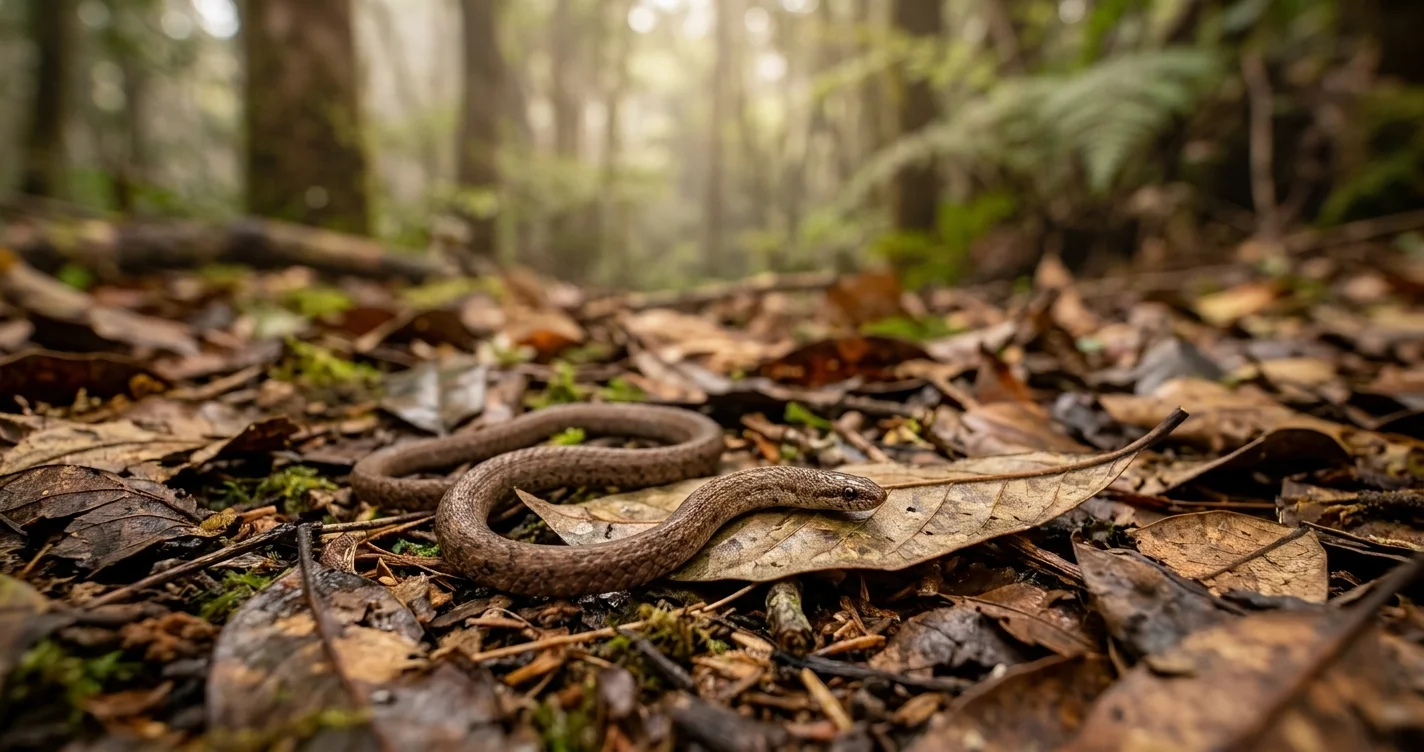
Imagine a tiny snake moving across the forest floor when danger suddenly appears. Instead of simply slithering away, it twists its body into a loop and begins tumbling across the ground.
It sounds like something from an animated movie, but this unusual behavior has been documented in a real snake.
The rolling snake is not a separate species. The name describes a remarkable escape behavior observed in the dwarf reedsnake, Pseudorabdion longiceps, a small Southeast Asian reptile.
Researchers have documented this snake using a form of locomotion called cartwheeling. By repeatedly rotating its body, the animal can move away from a perceived threat in a way that looks completely different from ordinary snake movement.
The discovery offers a fascinating reminder that even familiar-looking animals can have unexpected abilities.
From the snake’s flexible body to its secretive forest habitat, the dwarf reedsnake reveals how much remains to be learned about reptile behavior.
Table of Contents
- What Is a Dwarf Reedsnake?
- What Makes the Rolling Snake So Unusual?
- How Rolling Snakes Escape Predators
- Why Rolling Is Rare Among Snakes
- Where Dwarf Reedsnakes Live
- What Scientists Have Learned From the Discovery
- Are Dwarf Reedsnakes Dangerous to Humans?
- Why Unusual Animal Movement Matters
- In Your Own Yard: Helping Snakes and Other Reptiles
- Frequently Asked Questions
What Is a Dwarf Reedsnake?
The dwarf reedsnake, Pseudorabdion longiceps, is a small snake native to parts of Southeast Asia.
It belongs to the family Colubridae, a large and diverse group of snakes.
Unlike large, conspicuous snakes that are frequently photographed in open habitats, dwarf reedsnakes spend much of their time hidden among vegetation, soil debris, and leaf litter.
Their secretive habits make them difficult to observe in the wild.
A Small and Secretive Forest Snake
Dwarf reedsnakes are slender animals with smooth-looking bodies and relatively small heads.
Adults are generally only a few inches to roughly a foot long, although size varies among individuals.
Their narrow bodies help them move through small spaces beneath leaves and other forest-floor material.
They are not known for dramatic colors or elaborate defensive displays.
Instead, they rely heavily on concealment and movement through sheltered environments.
Their small size also means they may be vulnerable to larger animals.
This makes effective escape behavior particularly important.
Where Dwarf Reedsnakes Live
The species has been recorded in several parts of Southeast Asia, including areas of the Malay Peninsula and surrounding regions.
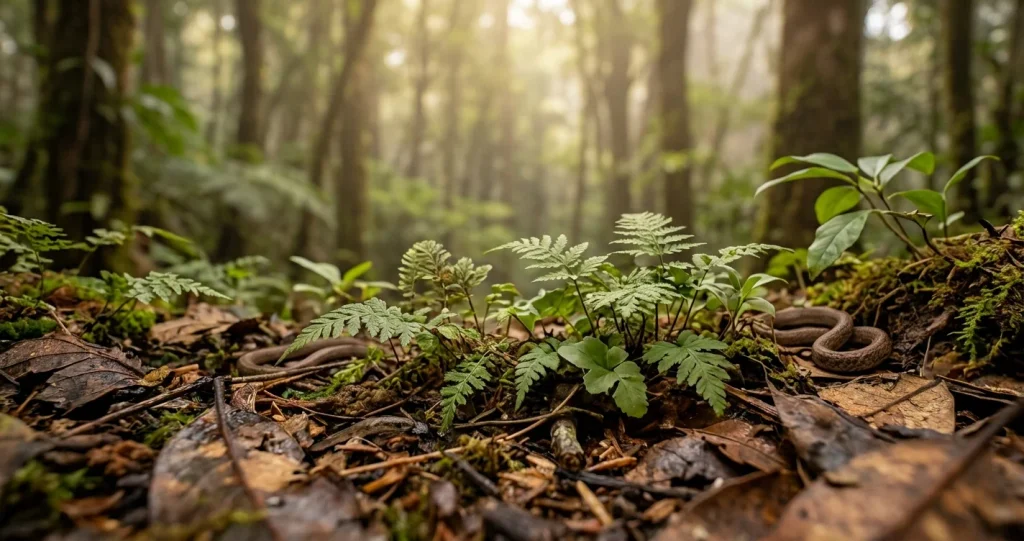
Its habitat includes forested environments where moist soil, fallen leaves, and natural ground cover provide shelter.
Dwarf reedsnakes are often associated with concealed spaces rather than exposed, sunny locations.
Because they are small and difficult to detect, researchers may encounter them less frequently than more visible snake species.
This can make unusual behaviors especially challenging to document.
What Makes the Rolling Snake So Unusual?
Most people picture snakes escaping danger by rapidly slithering away.
Dwarf reedsnakes can use more conventional snake movements, but researchers have also documented a striking alternative.
The animal bends its body into a loop and rotates forward.
This movement is commonly described as cartwheeling.
A Snake That Moves Like a Cartwheel
During cartwheeling, the snake’s body forms a curved loop.
Rather than maintaining continuous contact with the ground along its entire length, parts of the body lift and rotate.
The animal then completes successive rotations, producing a tumbling movement.
The behavior is visually surprising because snakes do not have limbs to push themselves into a conventional cartwheel.
Instead, the movement depends on coordinated bending and the flexibility of the snake’s body.
The result can resemble a small rolling wheel or hoop.
How Scientists Documented the Behavior
In 2023, researchers published a scientific report describing cartwheeling behavior in Pseudorabdion longiceps.
The report documented an observation in Malaysia and examined the movement as a potential escape response.
The researchers described how the snake formed a loop and propelled itself through successive rotations.
Their observations provided formal scientific documentation of a behavior that had received little attention in snake locomotion research.
Importantly, a documented observation does not establish how frequently every dwarf reedsnake uses this technique.
More research is needed to understand how widespread the behavior is across individuals and populations.
How Rolling Snakes Escape Predators
The dwarf reedsnake’s cartwheeling behavior is especially interesting because it appears to offer an alternative to ordinary slithering when the animal is disturbed.
The movement involves coordinated body bending, rotation, and forward displacement.
Scientists have described the behavior, but its precise mechanical advantages and effectiveness against natural predators require further study.
Step 1: The Snake Encounters a Threat
The documented cartwheeling behavior occurred when a dwarf reedsnake was disturbed.
In the wild, a small snake may face danger from birds, mammals, or larger reptiles.
Its first response may depend on the circumstances.
Concealment and conventional movement are likely important parts of its defensive behavior.
Cartwheeling represents an additional response rather than necessarily the snake’s preferred escape method in every situation.
Step 2: Its Body Forms a Loop
To begin the movement, the snake bends its body into a pronounced curve.
The head and tail move into positions that help create a loop-like shape.
This posture is essential to the cartwheeling motion.
Unlike a rigid wheel, however, the snake’s body remains flexible.
Its muscles must coordinate the movement while the animal changes its shape.
Step 3: The Body Rotates Forward
Once the loop forms, the snake moves into a rotation.
Sections of its body make contact with the ground as the loop turns.
The animal’s body bends and shifts during the movement, allowing the rotation to continue.
The snake does not roll like a perfectly circular object.
Its motion is more accurately described as a sequence of coordinated cartwheels.
Step 4: The Snake Continues Its Escape
The snake may perform multiple rotations in succession.
Each rotation can move it farther from the point where the behavior began.
In the published observation, the researchers documented repeated cartwheeling rather than a single accidental tumble.
This distinction is important.
The movement appeared coordinated, suggesting it was an active behavior rather than simply the result of losing balance.
Why Cartwheeling Might Be Useful
Cartwheeling could provide a way to move away from danger under certain conditions.
It may also create an unexpected visual effect that makes the snake’s movement harder for a predator to anticipate.
However, these possibilities should be treated as hypotheses rather than established facts.
The available observations do not demonstrate that cartwheeling consistently improves survival.
Researchers would need additional field observations or controlled studies to determine whether the behavior provides a measurable advantage over conventional escape movements.
The discovery is exciting precisely because it raises new questions about how snakes use their bodies.
Why Rolling Is Rare Among Snakes
Snakes are famous for their ability to move without legs.
Their bodies contain numerous vertebrae, flexible joints, and muscles that allow them to travel through a wide range of environments.
Despite this flexibility, cartwheeling is not a commonly documented form of snake locomotion.
The Usual Ways Snakes Move
Snakes use several major movement patterns.
Lateral undulation is the familiar side-to-side motion used by many snakes.
Concertina locomotion involves alternately anchoring and extending sections of the body, which can help snakes move through narrow spaces.
Rectilinear locomotion allows some snakes to move forward with relatively little visible side-to-side bending.
Sidewinding is a specialized movement used by certain snakes, particularly on loose or challenging surfaces.
Each method depends on interactions among muscles, body shape, and the environment.
Cartwheeling differs because the snake repeatedly rotates its body as a loop.
The Challenges of Rolling
A snake’s elongated body is highly flexible, but that does not automatically make rolling easy.
The animal must coordinate bending and rotation while maintaining enough control to move in a useful direction.
Surface conditions may also influence the behavior.
Loose leaves, uneven ground, obstacles, and slopes could affect how the body rotates.
The small size and slender shape of dwarf reedsnakes may contribute to their ability to perform the movement.
However, the precise relationship between anatomy and cartwheeling remains an area for further investigation.
Where Dwarf Reedsnakes Live
Understanding the dwarf reedsnake’s environment helps explain why its behavior has attracted scientific attention.
These animals are associated with tropical habitats where dense vegetation and ground cover create complex spaces for small reptiles.
Forest Floors and Leaf Litter
Leaf litter provides shelter for many small animals.
It can retain moisture, moderate temperature changes, and create spaces between decomposing leaves and twigs.
Small snakes may move through this material while searching for food or avoiding larger animals.
For a secretive species, the forest floor offers numerous places to hide.
Its irregular surfaces may also influence how different escape movements work.
Why Their Habitat Matters
Tropical forest floors support a rich community of insects, worms, amphibians, reptiles, and other organisms.
Small snakes form part of these interconnected food webs.
They may feed on invertebrates and other suitably sized prey, depending on species and local conditions.
They can also become prey themselves.
Habitat loss and disturbance can affect the sheltered environments used by small forest animals.
Protecting leaf litter, understory vegetation, and healthy forest ecosystems helps maintain habitat for many species that are rarely noticed.
What Scientists Have Learned From the Discovery
The 2023 report is valuable because it expands the documented range of snake movement.
Scientists have studied snake locomotion for many years, but unusual behaviors can remain overlooked when animals are small, secretive, or difficult to observe.
A New Addition to Documented Snake Locomotion
The observation showed that at least one dwarf reedsnake could perform repeated cartwheeling movements.
This adds to the diversity of locomotion patterns recorded among snakes.
It also illustrates why natural-history observations remain important.
A brief encounter with a little-known animal can reveal behavior that prompts new research.
What Remains Unknown
Several questions deserve further investigation.
Researchers do not yet have enough evidence to establish how commonly dwarf reedsnakes cartwheel in natural conditions.
It is also unclear whether the behavior is restricted to particular situations, individuals, or environmental conditions.
The energetic cost of cartwheeling has not been thoroughly established.
Neither has its effectiveness against different predators.
Future observations may clarify whether related species possess similar abilities.
For now, the most defensible conclusion is that cartwheeling is a documented but incompletely understood behavior.
Are Dwarf Reedsnakes Dangerous to Humans?
Dwarf reedsnakes are small, secretive snakes that generally avoid human contact.
They are not commonly regarded as a significant danger to people.
However, identifying unfamiliar snakes can be difficult, especially in regions with medically important venomous species.
Never assume that a snake is harmless based only on its size.
Why Handling Wild Snakes Is Unnecessary
Handling a wild snake can stress or injure the animal.
It can also create unnecessary risk for the person attempting to capture it.
The safest approach is to observe from a distance and allow the snake to move away.
In areas where venomous snakes occur, professional identification and local wildlife guidance are particularly important.
Why Unusual Animal Movement Matters
The rolling snake is more than an entertaining natural-history curiosity.
Its behavior demonstrates that animals can develop movement patterns that are difficult to predict from their appearance alone.
Evolution Produces Unexpected Solutions
Animals face different challenges depending on their habitats, predators, and physical characteristics.
Natural selection can favor behaviors and anatomical features that improve survival or reproduction.
However, a single observed behavior does not prove that it evolved specifically for one purpose.
Determining its evolutionary significance requires comparative evidence.
Cartwheeling may eventually provide useful insights into how elongated animals coordinate rapid movement.
Small Species Can Reveal Big Discoveries
Large animals often attract the most scientific and public attention.
Yet small, inconspicuous species can display equally remarkable adaptations.
A tiny snake hiding beneath tropical leaves may possess behaviors that remain undocumented for years.
The dwarf reedsnake is a reminder that biodiversity includes not only different species but also an enormous variety of behaviors.
In Your Own Yard: Helping Snakes and Other Reptiles
Dwarf reedsnakes are native to Southeast Asia, so homeowners in the United States should not expect to encounter this particular rolling snake in their gardens.
Nevertheless, many North American snakes also depend on suitable shelter and healthy local habitats.
A wildlife-friendly yard can provide valuable resources for native reptiles.
Provide Natural Shelter
Where appropriate, maintain areas with native vegetation, shrubs, and natural ground cover.
These features can create sheltered spaces for small wildlife.
Avoid placing brush piles or dense cover directly beside doors, children’s play areas, or heavily traveled paths.
In regions with venomous snakes, follow local wildlife recommendations when planning habitat features.
Reduce Unnecessary Chemical Use
Broad-spectrum pesticides can affect insects and other organisms that contribute to local food webs.
Using integrated pest management can help reduce unnecessary chemical applications.
Choose targeted methods when pest control is genuinely needed.
Healthy insect populations can support birds, reptiles, amphibians, and other wildlife.
Observe Snakes From a Safe Distance
If you notice a snake in your yard, avoid approaching or attempting to handle it.
Many snakes are simply passing through while searching for food, shelter, or suitable temperatures.
Give the animal space to leave.
If a snake is inside a building or poses an immediate concern, contact an appropriate local wildlife professional.
Keep Pets and Wildlife Apart
Dogs and cats may investigate or attack snakes.
This can injure wildlife and expose pets to bites.
Supervise pets in areas where snakes are known to occur.
In regions with venomous snakes, consult a veterinarian about appropriate precautions.
Respectful distance is usually the safest approach for people, pets, and wild reptiles.
Frequently Asked Questions
1. Do dwarf reedsnakes really roll like wheels?
Researchers have documented dwarf reedsnakes performing a movement called cartwheeling.
The snake bends its body into a loop and rotates repeatedly, producing forward movement.
It does not become a rigid, perfectly circular wheel.
2. Why do dwarf reedsnakes roll instead of slither?
Cartwheeling has been observed as a response to disturbance and is interpreted as a possible escape behavior.
It may help the snake move away from a threat under certain conditions.
However, researchers have not established exactly when the behavior is preferred or whether it consistently improves survival.
3. Are rolling snakes found in the United States?
The dwarf reedsnake, Pseudorabdion longiceps, is native to Southeast Asia, not the United States.
The documented cartwheeling behavior should not be assumed to occur in familiar North American snake species.
Other snakes have their own specialized ways of moving and escaping danger.
Conclusion
A tiny snake on a tropical forest floor might appear completely ordinary until it suddenly bends into a loop and tumbles away.
The dwarf reedsnake’s remarkable cartwheeling behavior challenges familiar assumptions about how snakes move.
Although scientists still have questions about its purpose and frequency, the observation demonstrates that animal locomotion is more diverse than we might imagine.
The rolling snake reminds us that some of nature’s most surprising discoveries are hidden in small, easily overlooked creatures.
And sometimes, escaping danger means doing something far more unexpected than simply slithering away.
Internal Sources
- Snake Tail Adaptations: 4 Incredible Survival Tricks: Connect rolling behavior with other unusual snake adaptations.
- How Snakes Shed Their Skin: The Fascinating Science of Ecdysis: Help readers discover more about snake biology and movement.
External Sources
- Quah et al. (2023) — Observations and Description of a Rare Escape Mechanism in a Snake: Provide the original scientific evidence documenting cartwheeling in Pseudorabdion longiceps. Read the study — Biotropica
- Natural History Museum (2023) — Snake That Cartwheels Away From Predators Described for the First Time: Explain the discovery, the snake’s forest habitat, and its unusual escape behavior in accessible language. Read the article
- Wiley (2023) — Can Some Snakes Do Cartwheels to Escape or Startle Predators ?Support the explanation of active cartwheeling, defensive behavior, and the importance of the discovery. Read the publisher’s announcement