
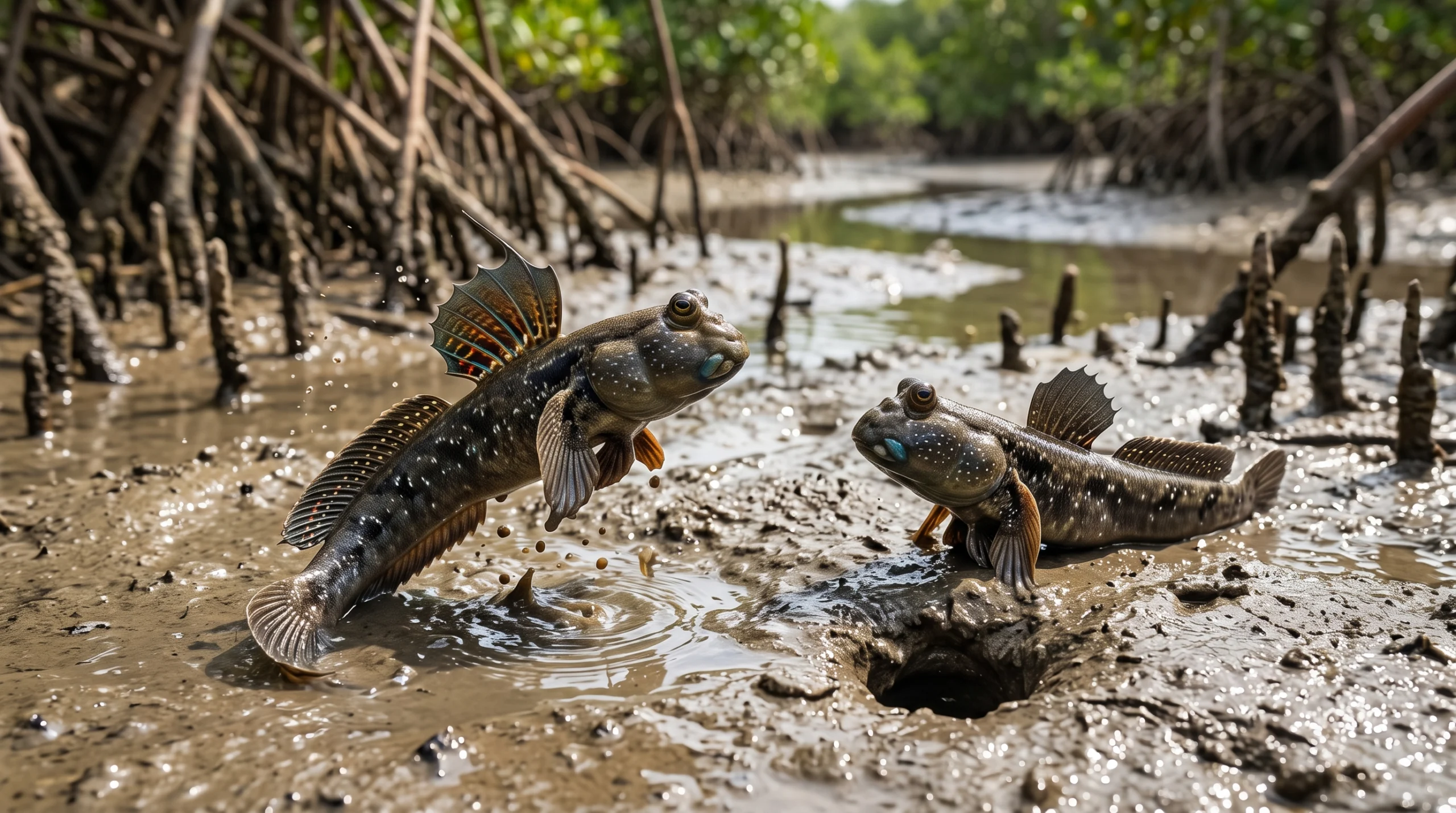
A fish resting on an exposed mudflat seems to be in the wrong place. Then it pushes itself forward on its fins, skips across the mud, raises a colorful dorsal fin at a rival, and disappears into a burrow.
Mudskippers make life outside water look almost ordinary.
These unusual animals are genuine fishes, not amphibians. Their ability to exploit exposed shorelines comes from a remarkable combination of mudskipper adaptations involving respiration, locomotion, vision, behavior, and burrow use.
They provide one of nature’s clearest examples of how an aquatic vertebrate can become highly successful at the constantly changing boundary between water and land—without ceasing to be a fish.
Yes, a Mudskipper Really Is a Fish
Despite their unusual behavior, mudskippers are fishes.
More specifically, they are highly amphibious gobies belonging to the oxudercine group. Multiple species are called mudskippers, so the name does not refer to one biologically identical animal.
Calling them amphibious fish means they can remain active outside water for substantial periods when environmental conditions are suitable.
It does not mean they are amphibians.
Mudskippers still possess fins and gills, and their evolutionary history belongs firmly within the fishes. What makes them exceptional is how extensively natural selection has modified ordinary fish systems for use in an amphibious lifestyle.
They do not need to become miniature frogs to survive on mud. Instead, they solve terrestrial problems with specialized versions of fish anatomy and physiology.
Life Where the Ocean Regularly Disappears
Mudskippers are closely associated with intertidal environments, particularly mudflats, estuaries, mangroves, tidal creeks, and similar coastal habitats across tropical and subtropical regions of Africa, Asia, and the Indo-Pacific.
These environments are defined by change.
At high tide, areas of mud can be submerged. As the tide retreats, enormous surfaces become exposed to air. Hours later, water returns.
For an animal living there, conditions can change dramatically within a single day.
Water depth changes. Exposed sediment can become hot. Salinity can fluctuate as seawater mixes with freshwater or evaporates. Pools and burrows may contain relatively little oxygen.
A strictly aquatic animal may retreat with the falling tide.
Mudskippers have another option: remain active on the exposed shore.
That ability gives them access to feeding areas, territories, and other resources during periods when much of the mudflat is no longer underwater.
How Does a Fish Move Across Land?
The answer starts with fins—but describing those fins as legs would be incorrect.
Mudskippers have heavily involved pectoral fins that help support and propel the body across exposed surfaces. Their locomotion also involves movements of the body and tail, and the exact mechanics vary among species and behaviors.
A mudskipper moving slowly over mud can appear to plant its pectoral fins against the surface and pull or pivot the body forward.
When rapid movement is needed, the entire body can become involved.
Mudskippers are also famous for their ability to skip or leap. Powerful flexion of the body and tail can launch the fish forward or upward.
Different movement patterns serve different purposes. Slow progression may be appropriate while feeding, while faster skipping or jumping can help with escape, territorial interactions, or courtship displays.
The result looks remarkably terrestrial.
Anatomically, however, the animal is still working with fish equipment.
Why “Walking Fish” Is Useful but Imperfect
Calling a mudskipper a fish that walks on land immediately communicates what makes the animal unusual.
Scientifically, “walking” needs qualification.
Human walking and the terrestrial locomotion of most four-legged vertebrates depend on weight-bearing limbs with joints and skeletal structures very different from fish fins.
Mudskippers do not have miniature tetrapod legs hidden inside their pectoral fins.
Their terrestrial locomotion evolved from a fish body plan.
The pectoral fins can interact with the ground in ways that visually resemble steps, but the biomechanics should not be treated as identical to walking in a mammal, reptile, or amphibian.
This distinction makes mudskippers more interesting, not less. Evolution has produced a way of moving effectively over land without first converting a fish into a tetrapod.
How Can Mudskippers Breathe Out of Water?
Movement is only half the problem.
A fish active on land must also obtain oxygen.
Mudskippers solve this through several respiratory surfaces rather than relying on one simple substitute for lungs.
Cutaneous Respiration
Gas exchange can occur across the skin, a process known as cutaneous respiration.
For this to work efficiently, the respiratory surface must remain moist. Oxygen can dissolve in the thin layer of moisture before diffusing across appropriately supplied tissues.
Mudskippers therefore have a strong physiological reason to remain associated with humid environments.
Mouth and Throat
The lining of the mouth and pharyngeal region can also contribute to aerial respiration.
This is generally called buccopharyngeal respiration.
These vascularized surfaces provide another pathway for exchanging respiratory gases while the fish is outside water.
The Gills Still Matter
It is also incorrect to imagine that a mudskipper steps onto land and simply stops using its gills.
The gills remain part of its respiratory system.
Mudskippers possess structural and behavioral adaptations that help maintain gill function during emersion, particularly by preventing the respiratory surfaces from collapsing or drying excessively.
The relative importance of skin, buccopharyngeal surfaces, and gills varies among mudskipper species and environmental circumstances.
There is no scientifically useful universal percentage describing exactly how much oxygen every mudskipper obtains from each route.
Why Their Skin Must Stay Moist
Respiratory surfaces work poorly if they become dry.
That simple physical limitation explains much of mudskipper behavior.
The fish remains closely associated with wet mud, shallow pools, humid vegetation, and burrows. Contact with moist surfaces helps prevent excessive drying.
A mudflat may look exposed, but its microhabitats can be dramatically more humid than open terrestrial ground.
Mudskippers can move between those microhabitats as temperature, sunlight, tide, and humidity change.
This dependence on moisture also explains why saying that mudskippers can simply “live on land” is misleading.
They are amphibious specialists adapted to a wet interface between aquatic and terrestrial environments—not ordinary terrestrial animals that happen to look like fish.
What Happens to the Gills on Land?
Most fully aquatic fishes encounter a serious respiratory problem outside water.
Gill filaments designed to function while supported by water can collapse together, greatly reducing the surface available for gas exchange. Drying makes the situation worse.
Mudskippers have adaptations that help limit these problems.
Their gill structures differ in ways that can help preserve useful spacing and function during periods out of water, while moisture retained within the branchial chambers helps protect respiratory surfaces.
This does not mean mudskippers “seal their gills shut.”
Instead, gill respiration operates as one part of an integrated amphibious respiratory system.
The mudskipper has not abandoned the fish gill. Evolution has altered how the entire respiratory apparatus functions during repeated transitions between water and air.
The Burrow Is a Critical Part of Mudskipper Life
The exposed mudflat is only the visible half of mudskipper habitat.
Below it lies another essential environment.
Many mudskippers construct burrows in soft sediment. Depending on species and context, these burrows can provide shelter from predators, extreme surface temperatures, tidal conditions, and unfavorable environmental changes.
Burrows can also play important reproductive roles.
Some species use specialized burrow chambers during breeding. Research has revealed sophisticated behavioral mechanisms associated with maintaining suitable conditions inside burrows, including species-specific examples of transporting air into underground chambers.
Such findings should not be generalized to every mudskipper, but they demonstrate that the burrow is much more than a simple hole in the mud.
It can function as a controlled refuge in an environment that changes repeatedly over short periods.
Territorial Life on the Mudflat
A receding tide can reveal what looks like a peaceful muddy landscape.
For a mudskipper, it may be divided into valuable territories.
Individuals can defend areas associated with burrows, feeding opportunities, or reproduction. Much of this competition is highly visual.
Mudskippers may raise their dorsal fins, change body posture, approach rivals, chase them, or perform conspicuous movements.
Those raised dorsal fins can be especially striking, sometimes displaying colors and patterns that remain hidden when the fin is folded.
Communication matters because territorial disputes do not always need to become prolonged physical fights.
Visual displays can provide information during an encounter and influence how individuals respond to each other.
As with other mudskipper behavior, however, territorial systems vary among species.
Why Mudskippers Leap
The name “mudskipper” itself points toward another conspicuous ability.
These fish can launch themselves from the substrate.
But not every jump means the same thing.
A leap can provide rapid locomotion across difficult sediment. It may help an animal escape danger. In social contexts, jumping can occur during territorial or courtship behavior.
Some species perform conspicuous aerial movements as part of breeding displays.
The mechanics involve rapid movements of the body and tail, converting muscular force into propulsion.
Treating every leap as an aggressive attack would therefore be as misleading as assuming every bird flight has the same purpose.
Context matters.
Can Mudskippers Really Climb?
Some mudskippers can negotiate surprisingly steep or complex surfaces.
Individuals may move over rocks, mangrove roots, vegetation, and inclined substrates using combinations of fin contact, friction, adhesion, and body movement.
This has produced dramatic descriptions of “tree-climbing fish.”
Those descriptions require context.
Moving along a low mangrove root is not the same as routinely climbing high into a tree canopy. Climbing ability also varies among species.
Still, the capacity to move over irregular surfaces demonstrates how versatile the mudskipper body can be.
Pectoral fins originally evolved in an aquatic evolutionary context, yet in these fishes they contribute to an impressive repertoire of terrestrial movements.
Those Strange Eyes Are Another Adaptation
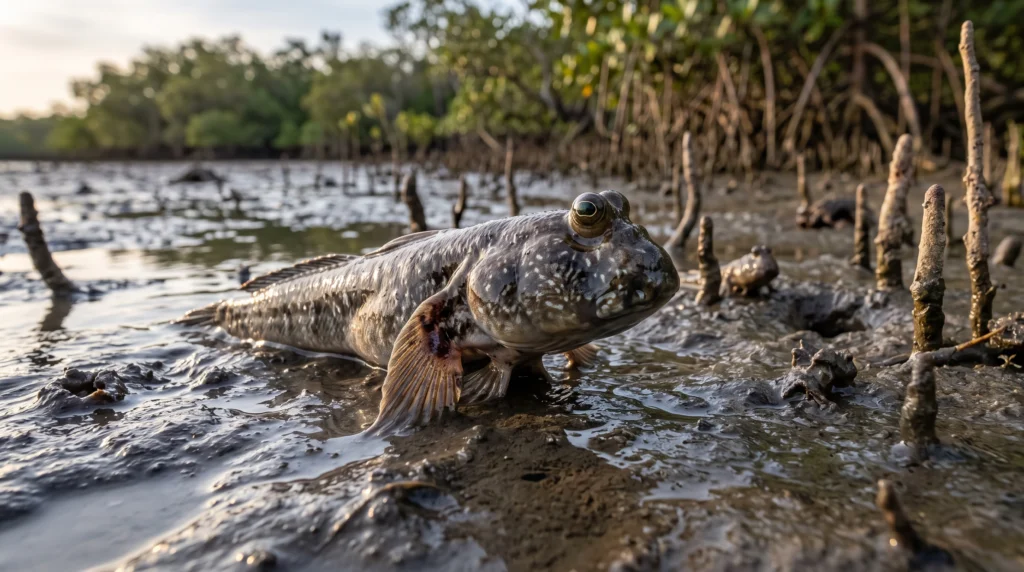
Mudskipper eyes are difficult to miss.
They sit prominently on top of the head, giving the fish a distinctive appearance and providing an excellent vantage point while much of the body remains close to mud or shallow water.
The elevated position helps a mudskipper monitor its surroundings.
That can be useful for finding prey, detecting predators, watching rivals, and navigating an environment where important events occur both near the substrate and above it.
Mudskipper visual systems have also attracted scientific interest because the animals regularly use their eyes in both aquatic and aerial conditions.
Seeing effectively through water and seeing through air impose different optical challenges.
Mudskippers therefore provide another example of an organ system operating across two very different physical environments.
Their vision should not, however, be described as functioning identically in water and air.
What Do Mudskippers Eat?
There is no single diet that applies perfectly to every mudskipper species.
Many consume small animals available in intertidal habitats.
Potential prey includes insects, small crustaceans, worms, and other invertebrates. Some species also consume algae, diatoms, or other plant-associated material and can differ considerably in how they obtain food.
Feeding on exposed mud creates its own challenges.
Aquatic fishes commonly rely on suction feeding, which works because water transmits the pressure changes created by rapid mouth movements. Capturing and manipulating prey in air requires different mechanics.
Research into mudskipper feeding has therefore become another valuable area for studying how fish systems can be modified for amphibious use.
Ecologically, mudskippers connect several parts of intertidal food webs. They consume organisms from mudflat communities while also serving as prey for larger fishes, birds, reptiles, and other predators.
Mudskippers and the Evolution of Life on Land
Mudskippers naturally invite an evolutionary comparison.
Here is a fish using fins on land, exchanging gases in air, and moving through an amphibious environment.
It can seem like a living reenactment of the ancient transition that eventually produced tetrapods.
That interpretation goes too far.
Modern mudskippers are not the ancestors of amphibians, reptiles, birds, mammals, or humans.
They are modern ray-finned fishes with their own evolutionary history. Their amphibious adaptations evolved within their lineage long after the ancient evolutionary events associated with the origin of tetrapods.
What makes them scientifically valuable is comparison.
Mudskippers allow researchers to investigate problems that any vertebrate moving between aquatic and terrestrial environments must confront: supporting and propelling the body, exchanging respiratory gases, feeding, maintaining water balance, sensing the environment, and communicating.
Their solutions are not necessarily the same solutions ancient tetrapod ancestors used.
They demonstrate that evolution can solve similar environmental challenges in different ways.
Different Mudskippers, Different Solutions
“Mudskipper” is a convenient ecological name covering multiple species.
Those species differ.
They vary in body size, geographic distribution, habitat preference, diet, degree of terrestrial activity, locomotor behavior, territorial systems, and respiratory physiology.
Some spend more time actively foraging on exposed mud. Others remain more closely associated with water.
Climbing ability, courtship displays, burrow construction, and feeding strategies can also differ.
This diversity is important whenever we encounter an extraordinary claim about mudskippers.
A behavior demonstrated experimentally in one species should not automatically become a universal fact about every member of the group.
The broader pattern is impressive enough: multiple related fishes have evolved different combinations of adaptations for exploiting intertidal environments.
Common Misconceptions About Mudskippers
“Mudskippers are amphibians.”
No. They are fishes—specifically highly amphibious gobies.
“Their fins have evolved into true legs.”
No. Pectoral fins play an important role in terrestrial locomotion, but they remain fins and are anatomically distinct from tetrapod limbs.
“Mudskippers breathe only through their skin.”
Incorrect. Cutaneous respiration is important, but gas exchange can also involve the mouth and throat surfaces and the gills.
“They can stay away from water indefinitely.”
No. Their amphibious lifestyle remains strongly dependent on moisture, humidity, physiological condition, species, and environmental circumstances.
“All mudskippers climb trees.”
Some species negotiate roots, rocks, vegetation, and inclined surfaces. This does not mean every mudskipper routinely climbs high into trees.
“Every leap is a territorial attack.”
Jumping can serve several functions, including locomotion, escape, territorial behavior, and courtship.
“Their gills stop functioning on land.”
Their gills remain part of the respiratory system, supported by adaptations that help them function during emersion.
“Mudskippers are living ancestors of terrestrial vertebrates.”
No. They are modern fishes, not surviving ancestors of tetrapods.
Frequently Asked Questions
Are mudskippers really fish?
Yes. Mudskippers are amphibious gobies. Their ability to spend substantial periods outside water does not make them amphibians.
How do mudskippers breathe on land?
They use several respiratory surfaces. Gas exchange can occur through moist skin and vascularized surfaces of the mouth and throat, while their adapted gill system also remains relevant during emersion.
How do mudskippers walk without legs?
They use their pectoral fins together with body and tail movements to propel themselves across exposed surfaces. Calling this “walking” is convenient, but the biomechanics differ from tetrapod walking.
Can mudskippers climb trees?
Some species can move over mangrove roots and other inclined or irregular surfaces. Claims that all mudskippers routinely climb high into trees exaggerate the behavior.
Why do mudskippers jump?
Depending on species and context, jumping can help with rapid movement, predator escape, territorial displays, or courtship.
How long can a mudskipper stay out of water?
There is no useful universal duration. The answer varies with species, temperature, humidity, access to moisture, physiological state, and other environmental conditions. Mudskippers can spend substantial periods emersed, but they remain dependent on conditions that keep critical respiratory surfaces moist.
Conclusion
Mudskippers demonstrate how dramatically a fish can adapt without ceasing to be a fish.
Their pectoral fins contribute to movement across exposed sediment. Their skin, buccopharyngeal surfaces, and specialized gill system support aerial respiration. Elevated eyes help them monitor an environment extending above the waterline, while burrows provide critical refuges from the rapidly changing conditions of intertidal habitats.
Add territorial displays, jumping, climbing ability in some species, specialized feeding behavior, and responses to the tidal cycle, and the result is one of the most impressive amphibious lifestyles among modern fishes.
The most fascinating thing about mudskipper adaptations is not that these animals have somehow become amphibians.
It is that natural selection has produced a completely different solution: a genuine fish exceptionally well equipped to live where water and land continually trade places.
Internal-Linking Opportunities
- Link “amphibious animals” to an article explaining other vertebrates that regularly move between aquatic and terrestrial habitats.
- Link “mangrove ecosystems” to an article about mangrove wildlife and adaptations to changing tides.
- Link “unusual fish adaptations” to related content about fishes surviving low oxygen, extreme salinity, or temporary drought.
- Link “evolution of vertebrate locomotion” to an article explaining how different vertebrate groups evolved distinct solutions for movement.
Authoritative External Sources
- Michel, K. B., Heiss, E., Aerts, P. & Van Wassenbergh, S. — research on terrestrial feeding mechanics in mudskippers, Proceedings of the Royal Society B.
- Sayer, M. D. J. — research and reviews on adaptations of amphibious fishes and their terrestrial lifestyles.
- Graham, J. B. — scientific work on air-breathing fishes and vertebrate transitions between aquatic and aerial respiration.
- Ishimatsu, A. and colleagues — research on mudskipper burrows, air deposition, respiration, and reproduction.
- Peer-reviewed research in Journal of Experimental Biology on amphibious fish locomotion, physiology, and respiratory adaptations.