
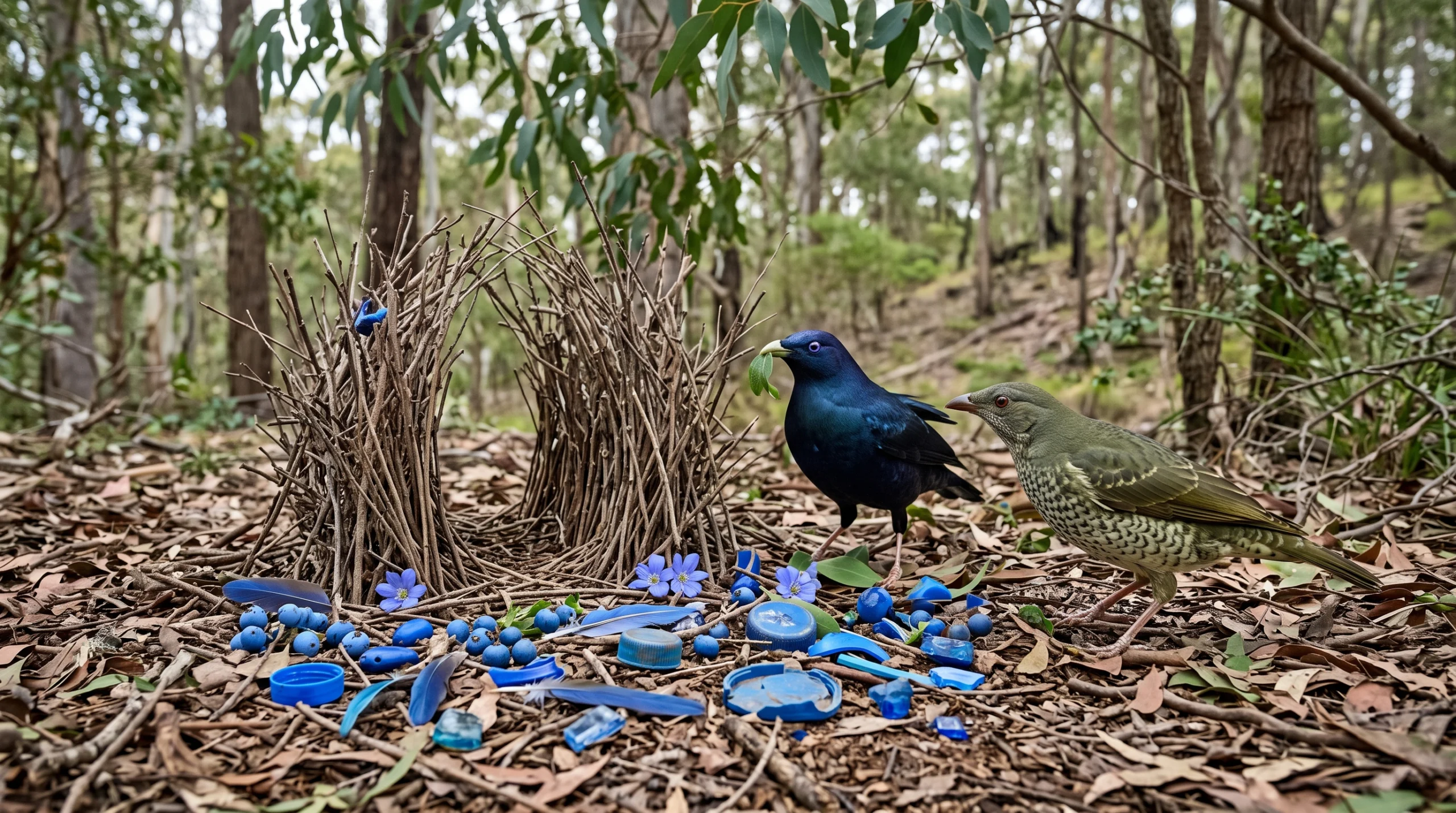
On the forest floor in eastern Australia, a male satin bowerbird may spend hours maintaining a structure made from carefully positioned sticks. Around it, he places selected objects—blue feathers, flowers, berries, shells, and, near human settlements, discarded pieces of blue plastic.
At first glance, the structure looks as though it must be an unusual bird nest.
It isn’t.
The bower is a courtship stage. No eggs need to be laid there, and it is not where the male and female establish a home together. Instead, the structure, its decorations, and the male’s performance form an elaborate bowerbird courtship system shaped by sexual selection.
The satin bowerbird (Ptilonorhynchus violaceus) offers one of the best-studied examples. Its famous preference for blue decorations is remarkable, but the real story involves far more than color. Architecture, object collection, maintenance, vocalizations, movement, female mate sampling, and competition among males all contribute to the display.
The Bird That Builds a Courtship Stage
Male satin bowerbirds create an unusual scene on the ground beneath Australia’s wetter forests and woodlands.
The species occurs along much of eastern and southeastern Australia. Adult males eventually develop glossy blue-black plumage, while females and younger males have predominantly greenish plumage.
During courtship, a male establishes and maintains a display site centered on a bower.
The structure itself is only one part of the attraction. Decorations are placed around it, and when a female arrives, the male performs a ritualized behavioral display involving movements, calls, and often a decoration held in his bill.
The result is closer to a stage than a shelter.
And understanding that difference is essential to understanding bowerbird biology.
First, a Bower Is Not a Nest
A bower is a courtship structure.
A nest is a reproductive structure used for eggs and young.
Those two definitions should never be confused.
In satin bowerbirds, the male constructs and maintains the bower as part of his mating display. Females visit male display sites and can inspect both the physical display and the male’s performance.
If mating occurs, the female does not turn the bower into a nursery.
She leaves the male’s display area and later constructs an actual nest elsewhere, typically in a tree or shrub. In this species, the female performs the nesting duties and raises the offspring without the male turning his bower into a family home.
So when photographs show a male surrounded by an extraordinary collection of objects, those objects are not decorating his chicks’ future bedroom.
They are components of courtship.
How a Satin Bowerbird Builds Its Bower
The satin bowerbird constructs what ornithologists describe as an avenue bower.
The male places sticks upright to form two roughly parallel walls. Between them is a narrow passage or avenue.
This structure is built on the ground and functions as the physical center of the courtship arena. The male can display from outside the avenue while a visiting female occupies or approaches it.
Australian Museum accounts describe males as maintaining their bowers meticulously rather than constructing them once and simply abandoning them.
Maintenance matters because the bower is part of a dynamic display.
Sticks can be adjusted. Decorations can disappear. New objects can be collected. Rivals may interfere. Weather and ordinary disturbance can alter the site.
Experimental research has even shown that when decorations were removed from male satin bowerbirds, males responded by changing other components of display investment, including increased bower construction behavior.
The structure is therefore something the male actively manages.
Then Come the Decorations
Once we move beyond the sticks, bowerbird behavior becomes even more visually striking.
Male satin bowerbirds collect objects and position them around the bower and its display area.
In relatively natural surroundings, decorations can include materials such as feathers, flowers, fruits, and shells. In places where people live nearby, the available selection can expand dramatically to include manufactured objects.
The birds are not simply gathering whatever happens to be nearby.
Object characteristics—including color—matter.
And for the satin bowerbird, one color has become especially famous.
Why Satin Bowerbirds Collect Blue Objects
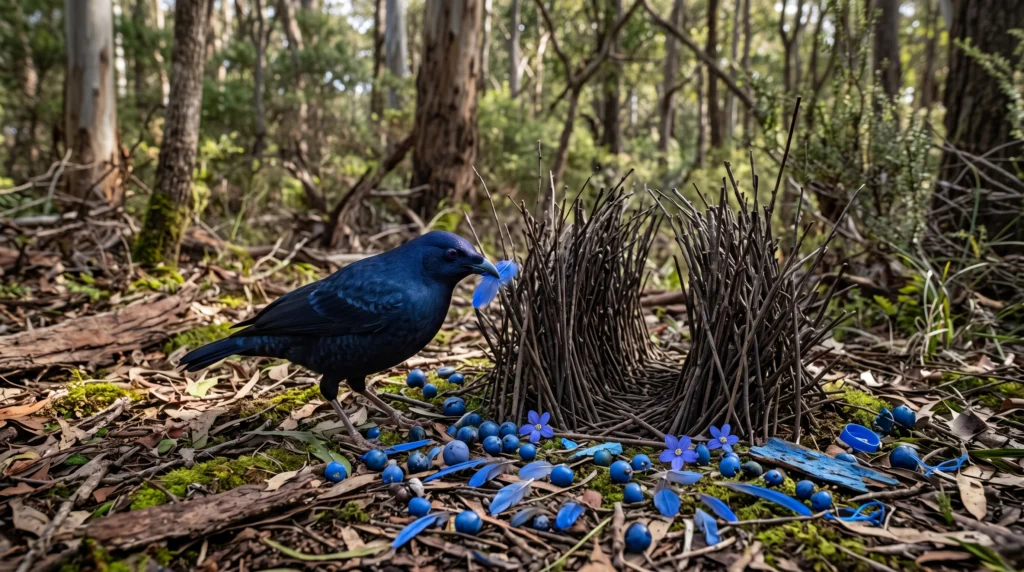
Blue objects are strongly associated with satin bowerbird bowers.
A male may gather blue feathers and flowers, but in human-modified environments he can also collect blue plastic, bottle tops, straws, clothespins, and other discarded objects.
This preference is real, but the common explanation that “female bowerbirds simply love blue” is too simplistic.
Courtship in satin bowerbirds involves multiple interacting signals. Scientific studies have found relationships between physical aspects of male displays and female courtship behavior, while other work shows that female preferences and mate-searching strategies can vary.
Blue decorations should therefore be understood as one component of a larger visual and behavioral system rather than a magic mating button.
A beautiful pile of blue objects alone does not explain mate choice.
The structure, decorations, male behavior, previous experience, and interactions during courtship can all matter.
Natural Treasures and Human-Made Objects
Before bottle caps and plastic appeared in the Australian landscape, satin bowerbirds were already decorating their bowers.
Human garbage simply introduced new materials into an existing behavioral system.
Natural decorations documented around satin bowerbird bowers include blue feathers, flowers, fruits or berries, and shells. Human-modified landscapes can provide objects such as blue straws, plastic pieces, bottle tops, and clothespins.
This distinction is important because viral photographs can make plastic collecting look like the essence of bowerbird behavior.
It isn’t.
The underlying behavior is object selection and display. Manufactured materials have become additional available objects in environments influenced by humans.
Other bowerbird species may also prefer different colors and materials, so the satin bowerbird’s famous blue collection should not be generalized to the entire family.
Does the Male Carefully Arrange Everything?
The objects around a bower are not necessarily left exactly where they first land.
Males actively maintain their display areas, and experimental work demonstrates that they respond behaviorally when important display components are altered.
This active management is one reason bowerbirds have attracted intense interest from researchers studying animal signaling.
But there is an important scientific caution.
Research on some other bowerbird species has examined sophisticated visual geometry, including size gradients and forced-perspective effects. Those findings should not automatically be assigned to satin bowerbirds.
The bowerbird family contains multiple species with different architecture and display systems.
Evidence about the visual geometry of one species describes that species unless comparable evidence exists for another.
What we can confidently say about satin bowerbirds is already impressive: males construct, decorate, modify, and maintain a physical courtship arena.
The Female Arrives
The purpose of all that work becomes clearer when a female visits.
She is not merely inspecting a pile of blue objects.
She encounters a complex display composed of multiple signals.
There is the architecture of the bower itself.
There are the decorations.
There is the male’s appearance.
Then the male begins to perform.
Research following female satin bowerbirds shows that mate searching can be a complex process. Females may sample several males and can make repeated visits before mating. Experience can also affect how females search for potential mates.
That makes the popular image of a female arriving, spotting the prettiest blue collection, and instantly choosing its owner misleading.
Mate choice can involve multiple visits and multiple traits.
The Male Is Part of the Display
A magnificent bower without courtship behavior tells only half the story.
When a female arrives, a male satin bowerbird can perform exaggerated movements including strutting, bowing, wing movements, and other ritualized actions. His vocal repertoire includes buzzing, rattling, whistles, hissing, and mimicry. He may incorporate an object from his collection into the performance.
The bower provides a physical setting within which these behaviors take place.
Research has shown an especially interesting interaction between physical and behavioral components of the display.
Male satin bowerbirds can perform intense courtship behavior, but a successful male must avoid frightening a prospective mate. Experiments and observations suggest that males modulate their display in response to female behavior. Researchers have also found that attractive physical display traits can influence how females respond to intense behavioral displays.
In other words, architecture, decoration, and performance are not necessarily independent advertisements.
They can interact.
What Is the Female Actually Evaluating?
Scientists can record which males females visit, which traits males possess, how females behave during courtship, and which males eventually mate.
What scientists cannot do is simply translate those observations into human thoughts such as, “She thinks his collection is beautiful.”
Studies of satin bowerbirds instead point toward a multi-trait system.
Bower quality, decorations, behavioral performance, female age or experience, and the interaction among signals can influence mate-searching and courtship outcomes. One study found that females of different ages can emphasize different male display traits during different stages of mate choice.
Another found that attractive bower decorations can facilitate behavioral displays by reducing the likelihood that females are startled by intense male courtship.
This makes the bower far more interesting than a simple beauty contest.
It is part of a communication system containing multiple signals.
Sexual Selection Built This Extraordinary Behavior
Why would evolution produce a bird that spends so much effort constructing something that provides no nursery for its offspring?
The answer lies largely in sexual selection.
Natural selection favors traits that improve reproductive success, but those traits do not always have to help an animal find food, escape predators, or survive bad weather directly.
If certain traits improve mating success, they can become increasingly elaborate across generations.
In bowerbirds, male construction, decorations, and behavioral performances can function as sexually selected traits because females use aspects of these displays during mate choice.
There is no conscious evolutionary plan involved.
No ancestral bowerbird decided that future males should become better decorators.
Instead, differences in mating success across many generations can shape increasingly elaborate courtship traits.
Competition Can Be Fierce
An impressive display is valuable only while it remains intact.
Male bowerbirds do not operate in isolation. Neighboring males are competitors for mating opportunities.
In various bowerbird species, researchers have documented behaviors including stealing decorations, damaging rival displays, and interference between neighboring males.
For satin bowerbirds, the tendency to collect attractive objects also creates opportunities for decorations to change hands. Australian Museum accounts even describe some human-made blue objects around bowers as stolen items.
Such competition helps explain why maintenance is important.
A male cannot necessarily finish his bower and forget about it.
His courtship display exists within a social environment where other males are also maintaining displays and competing for female visits.
Not Every Bowerbird Builds the Same Bower
The satin bowerbird’s avenue is only one version of bower architecture.
Across the bowerbird family, males have evolved strikingly different display traditions.
Some construct avenue-type bowers. Others create structures centered around vertical supports, often described as maypole-type bowers, and decorate the surrounding display courts.
Differences can extend beyond architecture to decoration colors, object types, arrangement, and male courtship behavior.
Research on Vogelkop bowerbirds, for example, has documented substantial differences in bower and decoration traits even between populations, along with corresponding differences in female preferences.
This diversity provides a remarkable illustration of how sexual selection can produce very different display systems among related animals.
The blue-decorated satin bowerbird is famous, but it represents only one evolutionary solution.
Are Bowerbirds Artists?
It is easy to understand why people call them artists.
A male selects objects partly by visual properties, arranges them around a constructed structure, maintains the result, and then performs within that setting.
From a human perspective, it looks remarkably like installation art.
Scientifically, however, “art” is a difficult label.
Art is a human cultural concept loaded with assumptions about intention, symbolism, creativity, aesthetics, and self-expression. Observing sophisticated object selection does not demonstrate that a bird possesses those same concepts.
Calling bowerbirds artists can therefore be a useful metaphor, but it should not be presented as a scientific conclusion about their cognition.
We do not need the metaphor to make the behavior extraordinary.
The displays are already visually elaborate, carefully maintained, and behaviorally sophisticated.
What Happens After the Female Chooses a Mate?
This is where the difference between bowerbird nest vs. bower becomes unmistakable.
After successful courtship and mating, the bower does not become a family home.
In satin bowerbirds, the female leaves the male’s display area and constructs an actual nest elsewhere. Australian Museum and BirdLife Australia accounts describe the nest as a loose structure of sticks placed in a tree or bush.
She then performs the parental duties associated with nesting and raising the young.
Meanwhile, the male can continue maintaining his bower and courting other females.
The elaborate structure on the ground therefore exists primarily for mating.
It is courtship architecture—not nursery architecture.
Common Misconceptions About Bowerbirds
“A bower is the bird’s nest.”
False. A bower is a male courtship structure. The actual nest used for eggs and chicks is separate.
“Females lay eggs inside the decorated bower.”
Not in satin bowerbirds. The female builds her nest elsewhere after mating.
“Every bowerbird collects blue objects.”
No. Blue decorations are particularly associated with satin bowerbirds. Other species have different preferences and display systems.
“Every bowerbird builds the same structure.”
No. Bower architecture varies considerably among species.
“Blue objects alone determine whether a male mates.”
That oversimplifies a complex system involving physical and behavioral display traits, female sampling, and individual variation.
“Bowerbirds decorate because they consciously make art.”
There is no scientific basis for assuming they possess the human cultural concept of art.
“A male builds his bower once and then abandons it.”
Satin bowerbird males actively maintain their bowers and displays.
“All bowerbirds use visual illusions.”
Research concerning specific visual effects in particular species should not be generalized across the family.
Frequently Asked Questions
Why do bowerbirds build bowers?
Males of bower-building species use them as courtship display structures. Architecture, decorations, and male performance can contribute to signals evaluated during female mate choice.
Is a bowerbird bower a nest?
No. The bower is a courtship site, not the structure in which the female lays her eggs and raises chicks.
Why do satin bowerbirds collect blue things?
Male satin bowerbirds show a strong association with blue decorations, but blue objects function within a broader, multi-component courtship system. It is misleading to reduce female choice to a simple preference for blue.
Do bowerbirds steal objects from each other?
Decoration theft and interference among competing males have been documented in bowerbirds, although behaviors vary among species and circumstances.
Does the female help build the satin bowerbird’s bower?
The characteristic courtship bower is constructed and maintained by the male. The female separately builds the nest used for reproduction.
What happens after satin bowerbirds mate?
The female leaves the courtship site and builds an actual nest elsewhere, where she carries out the nesting and parental duties. The male can continue displaying to other females.
Conclusion
The satin bowerbird demonstrates that bird courtship can involve far more than colorful feathers or a simple song.
A male constructs an avenue of sticks, collects visually distinctive objects, maintains his display area, performs elaborate movements, produces varied vocalizations, and interacts dynamically with visiting females.
Meanwhile, females may visit and compare multiple males, respond to combinations of physical and behavioral signals, and alter their mate-searching behavior according to experience.
This complexity is what makes bowerbird courtship such a powerful example of sexual selection.
Yet the most important fact remains surprisingly simple: the spectacular structure is not a home.
The bower exists for courtship.
After mating, the female leaves it behind and builds the real nest somewhere else.
Internal-Linking Opportunities
- Link “sexual selection in birds” to an article explaining elaborate plumage, dances, songs, and other mating displays.
- Link “bird intelligence and object use” to related content about tool use, problem-solving, or object manipulation in birds.
- Link “Australian wildlife” to another article about unusual Australian bird behavior.
- Link “elaborate bird courtship displays” to an article about species such as birds-of-paradise, manakins, or sage-grouse.