
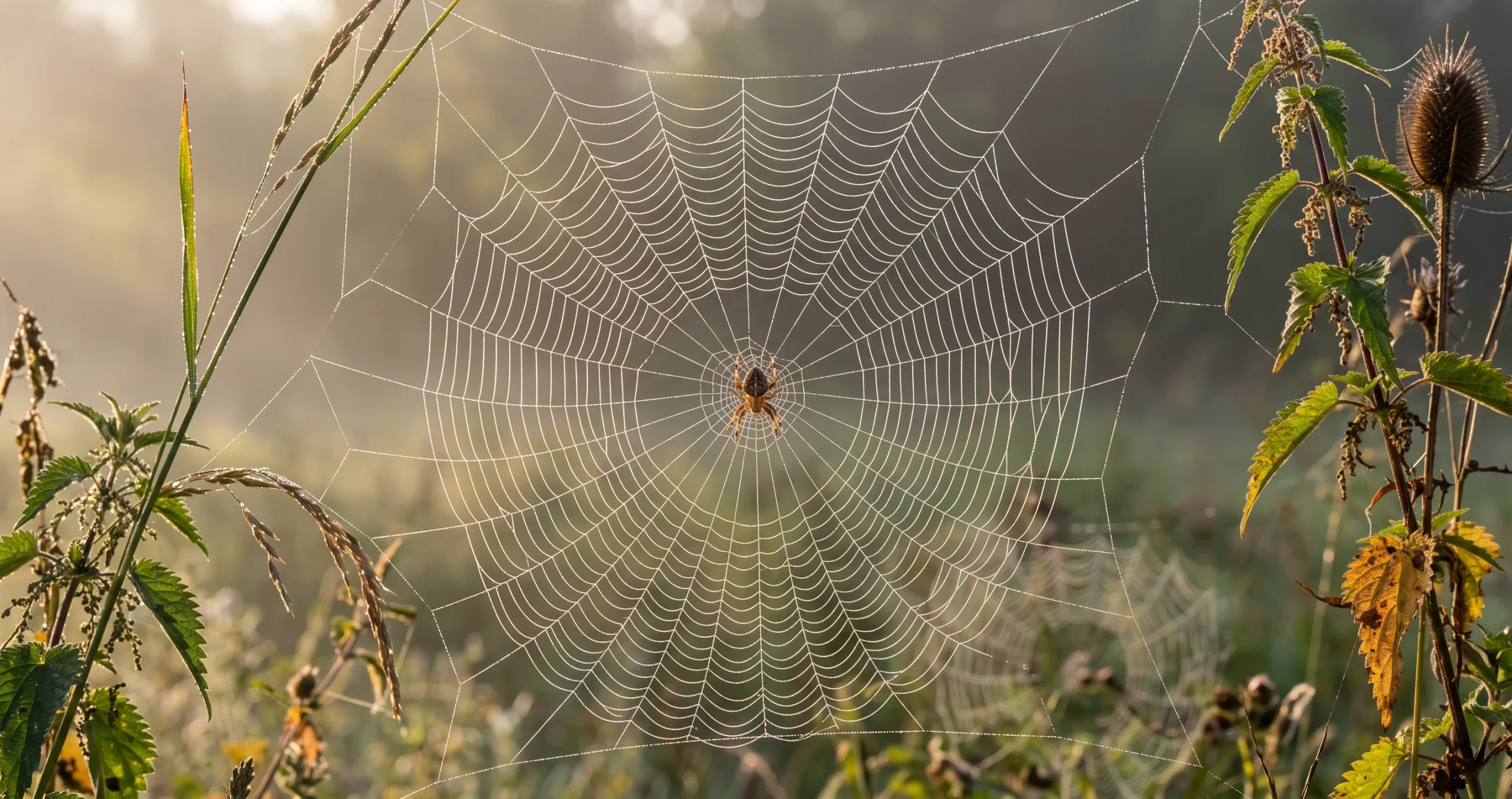
Identifying spider webs by their overall shape is one of the easiest ways to learn more about the spiders living around your home. Web architecture can often point you toward a spider family or general group, although the web alone usually cannot confirm an exact species.
This guide covers five recognizable web designs and explains what their shapes reveal about how spiders hunt.
Table of Contents
- Why Spiders Make Silk
- Identifying Spider Webs by Shape
- Orb Webs
- Funnel Webs
- Tangle or Cobwebs
- Sheet Webs
- Triangular Webs
- Other Spider Web Designs
- How to Identify a Spider Web Without Disturbing It
- Why a Web May Look Different From the Field Guide
- Spiders That Hunt Without Capture Webs
- A Simple Backyard Field Guide
Why Do Spiders Make Silk?
Spider silk is much more than material for catching insects. Spiders use different kinds of silk for safety lines, egg sacs, retreats, dispersal, courtship-related structures, prey restraint, and web construction.
The diversity is remarkable. Research on spider evolution has identified numerous web architectures, reflecting hundreds of millions of years of diversification in silk use and web-building behavior.
A prey-catching web effectively extends a spider’s ability to detect what is happening around it. When an insect contacts silk, vibrations can travel through the structure and alert the spider. Penn State Extension describes a web as an extension of the spider’s sensory network as well as a device for intercepting prey.
But not every spider depends on a capture web. Many species actively stalk or ambush prey instead.
Identifying Spider Webs by Shape
When identifying spider webs, begin with architecture rather than trying to find the spider immediately.
Look at the entire structure from several feet away. Is it circular and vertical? Is there a horizontal platform? Does the silk disappear into a funnel? Is the structure a seemingly chaotic three-dimensional network?
These large-scale differences are often more useful than individual silk threads.
1. Orb Webs: The Classic Wheel Shape
The orb web is probably the design most people picture when they hear the words “spider web.”
A typical orb resembles a wheel. Strong radial threads extend outward from a central region like bicycle spokes, while spiral threads cross those radii.
The Smithsonian describes typical orb webs as having radiating spokes together with a spiral capture structure. Some of those capture threads are sticky, while structural components can serve different mechanical roles.
Orb webs are commonly suspended between branches, tall plants, fences, porch structures, and other supports where flying insects are likely to cross.
Garden spiders and many other members of the orb-weaver family Araneidae construct variations of this architecture. A familiar North American example is the yellow garden spider, Argiope aurantia, whose large orb may include a conspicuous zigzag silk structure near its center.
Not every orb is perfectly circular. Wind, vegetation, available anchor points, and damage can distort its geometry.
2. Funnel Webs: A Sheet With a Hidden Retreat
A funnel web can look completely different.
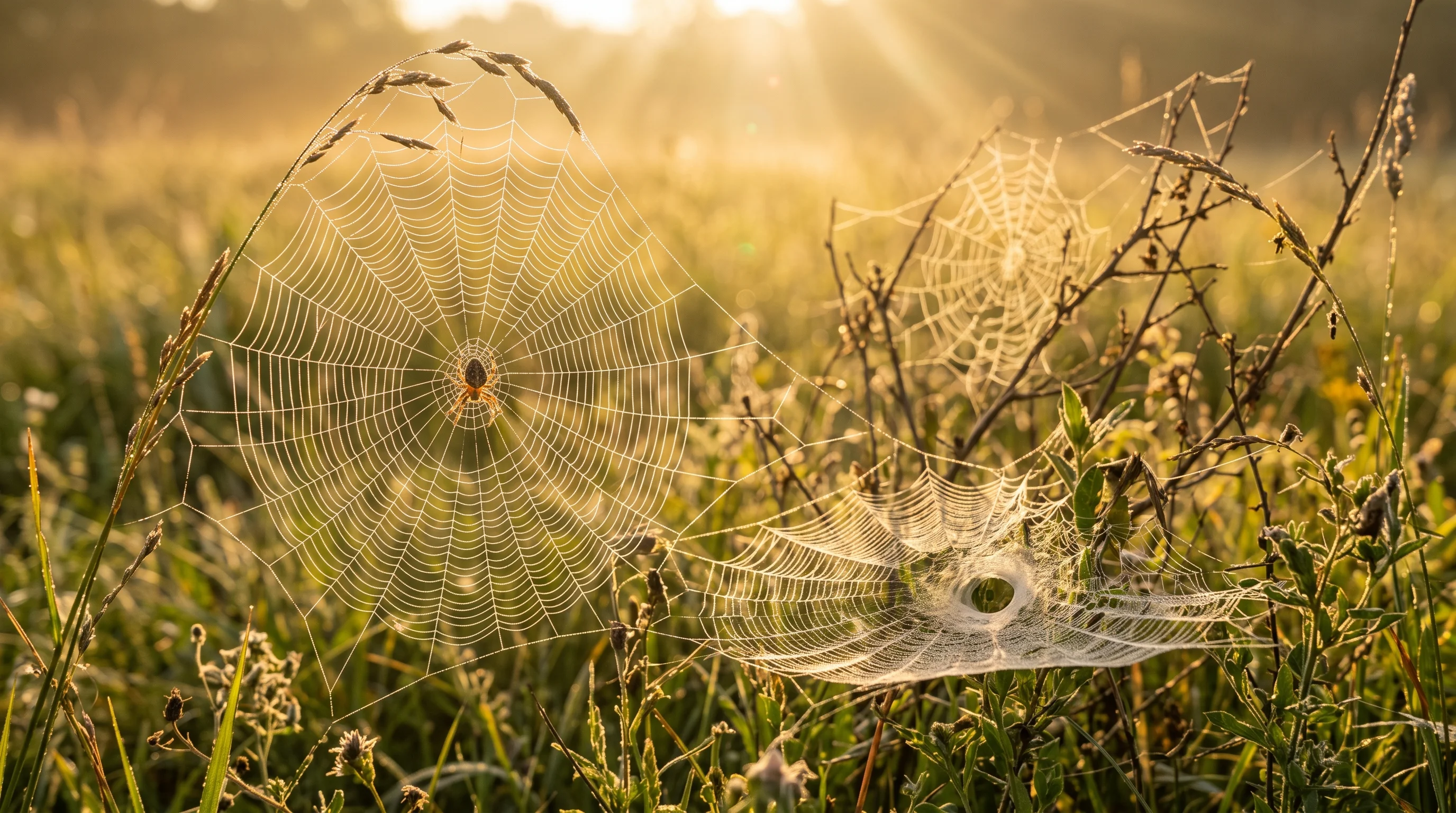
Instead of building a vertical wheel, many funnel weavers construct a broad, mostly horizontal sheet of silk. One portion narrows into a funnel or tunnel where the spider can shelter.
Grass spiders in the genus Agelenopsis provide a familiar backyard example. Their webs are often found across grass, weeds, ground covers, shrubs, brush piles, and similar low vegetation. Penn State Extension describes these webs as large, generally horizontal and sheetlike, with a funnel or tunnel positioned toward one side.
The spider frequently waits inside this retreat. When prey moves across the sheet, vibrations transmit information through the silk, allowing the spider to rush out.
The funnel is therefore not simply decorative. It functions as a protected retreat connected directly to the hunting platform.
One terminology caution is useful here: “funnel web” describes an architecture used by different spider groups. A funnel-shaped web in a North American lawn should not automatically be associated with the medically significant Australian spiders commonly called funnel-web spiders.
3. Tangle Webs or Cobwebs: Organized Chaos
A cobweb often looks messy compared with an orb.
There may be no obvious center, spiral, or symmetrical pattern. Threads extend in multiple directions, creating an irregular three-dimensional network.
These structures are often called tangle webs or cobwebs. Various members of the family Theridiidae, commonly known as comb-footed or cobweb spiders, construct webs in this general category.
Some tangle-web designs contain specialized sticky capture threads. An insect contacting one of these lines may become trapped, allowing the spider to respond through vibrations transmitted through the network.
The Smithsonian’s spider-web exhibits illustrate how some Steatoda webs use attachment lines with glue droplets near their bases. This shows why a structure that appears disorderly to human eyes can still be a highly functional prey-capture system.
Around homes and gardens, look for these irregular networks beneath ledges, between objects, around sheltered vegetation, and in other relatively protected spaces.
4. Sheet Webs: Silk Hammocks and Platforms
Sheet webs can resemble tiny hammocks suspended among plants.
The dominant feature is a relatively dense sheet of silk, often oriented horizontally or forming a shallow bowl. Additional threads may extend above the sheet.
Those upper strands can help interfere with the flight of small insects. Prey that encounters the surrounding silk may fall or move onto the denser platform, where the spider can attack.
Some sheet-web architectures are considerably more complicated than a simple flat surface. For example, the bowl-and-doily spider constructs a distinctive arrangement involving layered silk structures. The Smithsonian describes the spider waiting beneath its bowl-like component and responding to prey caught in the surrounding web.
When identifying spider webs of this type, concentrate on the dense platform rather than expecting every example to look identical.
5. Triangular Webs: A Reduced Orb With a Special Trick
One of the more unusual designs looks like somebody removed most of a circular orb.
Triangle spiders in the genus Hyptiotes construct triangular webs consisting of a small number of radiating lines connected by cross threads. The structure represents a highly modified form related to orb-web architecture.
Its operation is especially fascinating.
A triangle spider can hold tension in the web with its own body. When prey contacts the capture structure, releasing that tension can cause the web to move rapidly and help entangle the prey. Smithsonian educational material describes the triangle spider as effectively forming part of a spring-loaded system between the web’s tension and attachment threads.
A triangular web therefore should not be mistaken for an unfinished orb simply because part of the familiar wheel appears to be missing.
Other Web Structures You May Encounter
The five categories above provide a practical starting point, but spider architecture is far more diverse.
Some spiders produce bowl-shaped or dome-like webs. Others construct reduced webs containing surprisingly few capture lines. Bolas spiders take reduction even further, using specialized silk systems rather than building a conventional orb.
Scientists studying spider evolution recognize multiple major web categories and numerous variations within them. Architecture can also evolve substantially even among related spider lineages.
This diversity exists because web design involves tradeoffs involving habitat, silk properties, prey interception, predator avoidance, construction behavior, and evolutionary history. Three-dimensional architectures may even provide defensive benefits in addition to helping capture prey.
For a deeper scientific overview, the Smithsonian National Museum of Natural History’s Spider Strategies exhibit provides examples of dramatically different web designs and hunting strategies.
How to Identify a Spider Web Without Disturbing It
Identifying spider webs works best when you treat the web as a complete structure rather than focusing on a single thread.
Start by observing its overall silhouette and orientation. A vertical wheel suggests an orb, while a horizontal platform leading into a tunnel strongly suggests a funnel-type architecture.
Next, look at where the silk attaches. Branches, grass, building corners, low vegetation, and open spaces create different opportunities for web construction.
Search visually for a retreat. A spider hidden inside a silk tunnel, curled leaf, crack, or sheltered corner can provide another important clue.
Then examine the silk pattern. Look for radial spokes, spirals, dense sheets, irregular tangles, support threads, or a clearly reduced triangular structure.
Habitat matters too. The same garden can contain different spider communities at ground level, among flowers, beneath shrubs, and around buildings.
Finally, observe the spider itself if it is visible. Body shape, markings, posture, leg proportions, and position within the web can provide information that architecture alone cannot.
Avoid touching or breaking the web simply to make an identification. Photographs taken from several angles usually provide better information while leaving both the spider and its structure undisturbed.
Why Web Shape Can Be Misleading
A field guide shows ideal examples. Nature rarely does.
Rain can flatten sheets or destroy delicate capture threads. Strong wind may remove part of an orb, while falling leaves, struggling insects, animals, or human activity can tear large sections away.
Some spiders repair damaged structures, while others replace webs or major portions of them. Penn State notes, for example, that orb weavers may replace their webs frequently.
Timing matters as well. A spider partway through construction may leave a structure that looks nothing like the completed version.
Old and abandoned webs present another challenge. Dust, plant debris, moisture, and accumulated damage can turn a once-distinct architecture into an apparently random tangle.
For this reason, identifying spider webs should involve several clues rather than shape alone.
Web Shape Is a Clue, Not a Species ID
A common mistake is moving directly from “I found an orb web” to “I know which spider built it.”
Numerous spider species can construct broadly similar architectures. Even within one architectural category, details may vary with species, individual size, developmental stage, available space, and environmental conditions.
Web architecture is therefore best treated as a first filtering tool.
Finding a funnel web, for example, may narrow your search toward certain web-building groups. Confirming the exact builder may require seeing the spider itself and examining diagnostic physical characteristics.
That distinction makes identifying spider webs both more accurate and more interesting: the web provides evidence, not necessarily the final answer.
Spiders That Hunt Without Prey-Catching Webs
A garden with few obvious webs can still contain plenty of spiders.
Wolf spiders are primarily active hunters. They move across the ground and other surfaces searching for prey rather than waiting inside a large aerial capture web. University of Minnesota Extension specifically categorizes wolf spiders among hunting spiders that do not build prey-catching webs.
Jumping spiders also rely heavily on excellent vision, stalking, and rapid attacks instead of constructing traditional capture webs. They still produce silk for purposes such as safety lines and shelters.
This distinction is important. Producing silk and building a prey-catching web are not the same thing.
A Backyard Field Guide in Five Shapes
Identifying spider webs becomes much easier once you learn a few basic silhouettes.
An orb web resembles a wheel. A funnel web combines a sheet with a tunnel-like retreat. A tangle web forms an irregular three-dimensional network. A sheet web resembles a platform, hammock, or bowl. A triangle web reduces the familiar orb architecture to a specialized triangular capture structure.
These categories are starting points rather than rigid identification rules. Webs change with weather, damage, construction stage, habitat, and the particular spider building them.
The next time morning dew reveals silk across your garden, observe the architecture before looking for its builder. A web is not merely something a spider leaves behind—it is part of the animal’s hunting behavior, sensory environment, and evolutionary history.
Careful observation from a respectful distance can reveal much of that story without touching either the web or the spider.
Conclusion
Spider webs are more than delicate strands of silk—they are specialized structures shaped by different hunting strategies. Learning to recognize orb, funnel, tangle, sheet, and triangular webs can reveal useful clues about the spiders living around a garden or backyard.
Still, web shape is only a starting point. Weather, damage, rebuilding, and differences between species can change a web’s appearance, so exact identification often requires observing the spider as well.
External Sources: