
An apple picked in October can still taste crisp and refreshing long after the last autumn leaves have fallen. Yet another apple from the same tree might become soft, wrinkled, or rotten within weeks.
The difference often comes down to three surprisingly simple factors: temperature, fruit condition, and ethylene gas.
Understanding how to store apples properly can help home gardeners preserve their harvest, reduce food waste, and enjoy fresh fruit well into winter. Apples are naturally suited to storage, but they remain living tissues after picking. They continue breathing, releasing moisture, and gradually ripening.
With the right variety, careful sorting, and consistently cool conditions, some apples can remain usable for several months. Others are best eaten soon after harvest.
The secret is not a complicated preservation technique. It is learning how to slow the natural processes that cause apples to age.
Table Of Contents
- Why Some Apples Last for Months While Others Spoil Quickly
- How to Store Apples for Months: The Ideal Conditions
- Sorting Apples Before Storage
- The Science of Apple Storage: Respiration, Ethylene, and Ripening
- Which Apple Varieties Store Best?
- Storing Apples in the Refrigerator
- Can You Store Apples in a Basement, Garage, or Cellar?
- Should Apples Be Wrapped Individually?
- Common Apple Storage Mistakes
- In Your Own Yard: Preparing Homegrown Apples for Winter Storage
- Frequently Asked Questions
Why Some Apples Last for Months While Others Spoil Quickly
Not every apple has the same storage potential.
Some varieties are naturally suited to long-term keeping, while others lose their crisp texture relatively quickly.
Apple Variety Makes a Difference
Late-season apples often store better than many early-season varieties.
Cultivars such as Granny Smith, Fuji, and certain strains of Golden Delicious can maintain good quality for extended periods under suitable conditions.
Honeycrisp may also store well, but it can develop storage disorders under some temperature and handling conditions.
Early-ripening apples are frequently better enjoyed fresh or processed soon after picking.
Actual storage life depends on cultivar, maturity, growing conditions, and storage environment.
Harvest Maturity Matters
An apple harvested too early may lack its best flavor and texture.
One harvested too late may soften quickly or develop storage problems.
For home gardeners, useful signs of maturity include the background skin color, seed development, fruit firmness, and characteristic flavor.
However, these indicators differ among cultivars.
Apples intended for long storage should generally be harvested at the appropriate maturity for that variety rather than simply left on the tree as long as possible.
Healthy Fruit Stores Better
Bruises, cuts, insect damage, and broken skin can shorten storage life.
Damaged tissue provides opportunities for decay organisms to enter.
A firm, intact apple is usually a better candidate for storage than one with visible injury.
How to Store Apples for Months: The Ideal Conditions
The most important storage factors are low temperature, high relative humidity, and protection from freezing.
The Best Storage Temperature
For many apple varieties, temperatures near 30–32°F (-1 to 0°C) can slow ripening and preserve quality.
However, household storage is usually safer and more practical at approximately 32–40°F (0–4°C), depending on the variety and refrigerator conditions.
Apples contain dissolved sugars that allow their flesh to tolerate temperatures slightly below the freezing point of pure water.
Nevertheless, freezing damage can occur if temperatures fall too low.
For home storage, maintaining a stable temperature just above 32°F is a sensible goal.
Why Consistent Temperature Matters
Frequent temperature changes can accelerate deterioration and encourage condensation.
Warm conditions increase respiration and ripening.
Sudden cooling after exposure to warmer air may cause moisture to collect on fruit surfaces.
A consistently cool environment is generally preferable to one that repeatedly warms and cools.
The Importance of Humidity
Apples lose water gradually after harvest.
When the surrounding air is too dry, they may become wrinkled and less crisp.
High relative humidity, often around 90–95%, helps limit moisture loss during storage.
Commercial facilities carefully control humidity, but home gardeners can use simpler methods.
A perforated plastic bag or suitable produce drawer can help maintain a humid microenvironment without completely sealing off airflow.
Why Air Circulation Still Matters
High humidity should not mean trapping apples in stagnant, dripping-wet conditions.
Condensation and prolonged surface moisture can encourage decay.
Small ventilation openings allow some gas exchange and help reduce excess moisture accumulation.
The goal is humid air around dry, healthy fruit, not water collecting on the apples.
Sorting Apples Before Storage
One of the most effective ways to improve storage success is to inspect every apple before putting it away.
Separate Perfect Fruit From Damaged Fruit
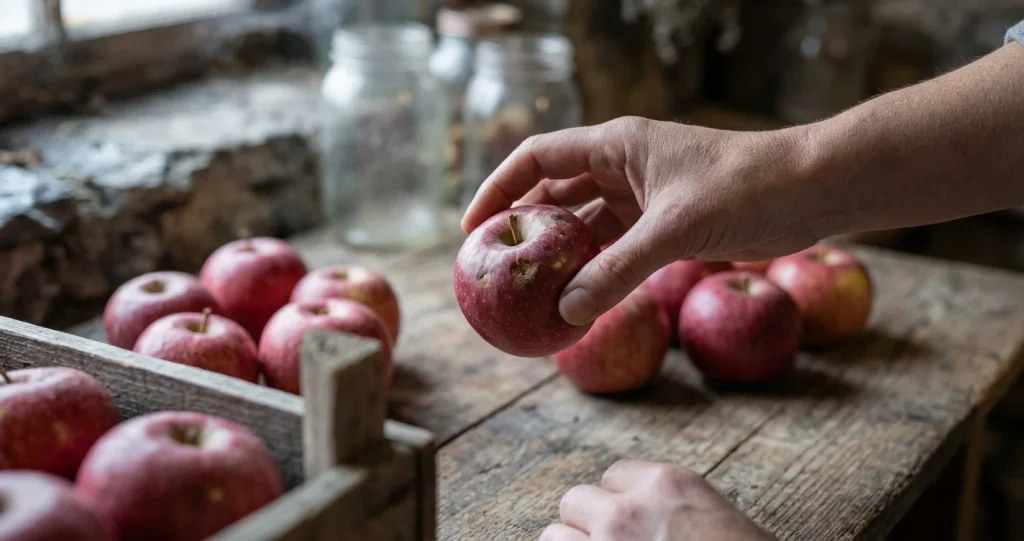
Choose apples that are firm and free from obvious damage.
Look for bruises, punctures, cracks, insect injuries, and soft spots.
Even a small damaged area can become a starting point for decay.
Use Bruised Apples First
A bruised apple does not always need to be discarded.
If the fruit is otherwise sound, it may be suitable for prompt use after trimming away the damaged portion.
Use these apples for cooking, baking, or applesauce rather than long-term storage.
Discard fruit showing mold, extensive rot, or other signs of spoilage.
Keep Different Varieties Separate
Apple cultivars vary in ripening speed and storage life.
Storing varieties separately makes it easier to monitor their condition and use shorter-keeping apples first.
Label containers with the variety and harvest date when known.
Handle Fruit Gently
Avoid dropping apples into buckets or stacking them roughly.
Bruises may not become obvious immediately.
Use shallow containers or carefully arranged layers to reduce pressure damage.
Inspect Stored Apples Regularly
Check stored fruit periodically.
Remove apples that begin softening, leaking, or developing decay.
One deteriorating apple can create unfavorable conditions for nearby fruit, especially when moisture and fungal growth are present.
The Science of Apple Storage: Respiration, Ethylene, and Ripening
Apples do not stop living when they are harvested.
Their cells continue carrying out metabolic processes that affect flavor, texture, and storage life.
Understanding these processes explains why refrigeration works so well.
Apples Continue to Respire
Respiration is the process through which living cells use stored carbohydrates to release energy.
After harvest, apples continue consuming oxygen and releasing carbon dioxide.
This process gradually uses the fruit’s stored resources.
Higher temperatures generally increase respiration rates, accelerating quality loss.
Cool storage slows these reactions and helps preserve firmness.
What Is Ethylene?
Ethylene is a naturally occurring plant hormone produced as a gas.
It plays an important role in the ripening of many fruits, including apples.
Apples are classified as climacteric fruits, meaning they undergo a characteristic increase in respiration and ethylene production during ripening.
Ethylene helps coordinate changes in texture, aroma, and other ripening characteristics.
How Ethylene Affects Stored Apples
As apples ripen, ethylene can stimulate further ripening processes.
In a warm, enclosed environment, ethylene may accumulate and contribute to faster softening.
Cooling reduces ethylene production and slows many of the fruit’s responses to it.
This is one reason apples generally keep much longer in refrigeration than on a kitchen counter.
Why Apples Can Affect Other Produce
Ethylene released by apples can influence nearby ethylene-sensitive fruits and vegetables.
Some leafy greens may yellow or deteriorate faster when exposed to elevated ethylene concentrations.
Certain vegetables can also develop undesirable changes in flavor, color, or texture.
The effect depends on ethylene concentration, exposure time, temperature, and the sensitivity of the neighboring produce.
Can You Completely Stop Ethylene Production?
Not with ordinary home storage.
Commercial facilities may use specialized technologies to manage ripening, but these are generally unnecessary for household apple storage.
For most home gardeners, the practical strategy is simple: keep apples cool, avoid unnecessary warming, and separate them from sensitive produce.
Why Cold Storage Is Not the Same as Freezing
Refrigeration slows metabolic activity while keeping the apple’s tissues largely intact.
Freezing forms ice crystals that can damage cells.
After thawing, a frozen apple may become soft and watery.
Frozen apples can still be useful for cooking, but they will not retain the texture of properly refrigerated fresh apples.
Which Apple Varieties Store Best?
Choosing suitable varieties can make a substantial difference.
| Apple variety | General storage characteristics | Best approach |
|---|---|---|
| Granny Smith | Often a good keeper | Cool, humid storage |
| Fuji | Frequently stores well | Refrigerate promptly |
| Golden Delicious | Can keep well under suitable conditions | Handle gently |
| Honeycrisp | Good potential, but sensitive to certain storage disorders | Follow cultivar-specific guidance |
| Gala | Moderate to good keeping potential | Refrigerate and monitor |
| McIntosh | Often softens sooner than firmer keeping varieties | Use earlier |
These are general tendencies, not guaranteed storage durations.
Harvest maturity, growing conditions, and temperature management can substantially change the results.
Storing Apples in the Refrigerator
For most households, the refrigerator is the simplest and most reliable storage option.
Use the Produce Drawer
Place apples in the refrigerator’s crisper drawer if space allows.
The drawer can help maintain a more humid environment than open shelves.
Avoid overcrowding.
Use Perforated Bags
A loosely closed or perforated food-safe plastic bag can reduce moisture loss.
Make sure some airflow remains possible.
If condensation collects heavily inside the bag, improve ventilation.
Keep Apples Away From Sensitive Vegetables
Where practical, separate apples from leafy greens and other ethylene-sensitive produce.
A dedicated produce drawer or separate storage compartment can help.
Avoid Washing Before Storage
Unless there is a specific reason to wash the fruit immediately, store apples dry.
Wash them under running water before eating or preparing them.
Excess surface moisture during storage can encourage deterioration.
Monitor Refrigerator Temperature
Use a refrigerator thermometer if needed.
Aim for a stable, food-safe temperature, generally at or below 40°F (4°C), without allowing the apples to freeze.
Can You Store Apples in a Basement, Garage, or Cellar?
Traditional apple storage often relied on naturally cool spaces.
These locations can still work, but conditions must be monitored carefully.
Root Cellars
A suitable root cellar can provide cool temperatures and relatively high humidity.
However, temperature and moisture levels vary between structures.
A thermometer and hygrometer can help determine whether conditions are appropriate.
Unheated Garages
Garages may become too warm during mild weather or too cold during freezing conditions.
They are only suitable when temperatures remain within a safe range.
Avoid storing apples where automotive chemicals, fuel, or other contaminants are present.
Basements
Some basements remain cool enough for short- or medium-term storage.
Others are too warm or dry for apples to keep well.
Do not assume that a basement is suitable simply because it feels cooler than the rest of the house.
Protect Apples From Rodents
Use clean, pest-resistant storage containers while maintaining appropriate ventilation.
Inspect the storage area for signs of mice or other pests.
Discard fruit that has been contaminated or gnawed.
Should Apples Be Wrapped Individually?
Some traditional storage methods involve wrapping apples separately in paper.
This can reduce direct contact between fruits and may limit the spread of surface moisture or decay.
When Wrapping May Help
Individual wrapping can be useful when storing small quantities in shallow boxes.
It also makes it easier to remove one damaged apple without disturbing the entire container.
Use Clean, Suitable Materials
Choose clean, dry, food-safe paper.
Avoid materials contaminated with inks, chemicals, or odors that could transfer to fruit.
Wrapping Cannot Replace Refrigeration
Paper does not prevent respiration or stop ethylene production.
Even individually wrapped apples need appropriate temperature and humidity.
Wrapping should be considered an optional handling technique rather than the main preservation method.
Common Apple Storage Mistakes
Several simple mistakes can shorten the life of an otherwise excellent harvest.
Leaving Apples on the Counter for Weeks
Room temperature encourages ripening and moisture loss.
Apples intended for long storage should generally be cooled promptly.
Storing Damaged Fruit With Healthy Apples
Bruised or rotting apples can deteriorate rapidly.
Separate them before storage and inspect the remaining fruit regularly.
Allowing Apples to Freeze
Temperatures below the fruit’s freezing tolerance can damage cells.
Avoid placing apples against freezing refrigerator walls or in unprotected outdoor storage.
Using Completely Airtight Containers
Apples continue exchanging gases after harvest.
Ordinary household containers should not be sealed in a way that traps excess moisture and creates unsuitable atmospheric conditions.
Ignoring Ethylene-Sensitive Produce
Keeping apples beside sensitive vegetables can accelerate undesirable changes in those vegetables.
Separate them when practical.
Forgetting to Check Stored Fruit
Even well-stored apples eventually deteriorate.
Regular inspections allow you to use fruit while it is still in good condition.
In Your Own Yard: Preparing Homegrown Apples for Winter Storage
If you grow apple trees, good storage begins before the fruit reaches the kitchen.
Harvest Carefully
Pick apples gently rather than pulling or shaking branches.
When possible, lift and twist the fruit so the stem separates naturally.
Avoid dropping apples into containers.
Collect Windfalls Separately
Apples that have fallen onto the ground may have bruises or contamination.
Do not mix them with carefully harvested storage fruit.
Sound windfalls may be suitable for prompt cooking or processing after appropriate inspection and cleaning.
Sort Immediately After Harvest
Create separate groups for long-term storage, near-term eating, and cooking.
This prevents damaged fruit from being forgotten among the best apples.
Label Storage Containers
Record the cultivar and harvest date.
If you grow several apple varieties, this information helps you compare storage performance from year to year.
Keep a Simple Storage Journal
Note the storage location, approximate temperature, and dates when apples begin losing quality.
Over several seasons, these observations can reveal which varieties perform best in your conditions.
Compost Suitable Waste
Apple peels and other uncontaminated scraps can usually be composted.
Manage compost piles to discourage rodents and other unwanted animals.
Fruit affected by certain orchard diseases may require different disposal methods, depending on local guidance.
Support Wildlife Without Leaving Rotting Fruit Everywhere
Some wildlife consumes fallen apples, but large accumulations of rotting fruit can attract pests and contribute to orchard disease problems.
Remove excessive fallen fruit and manage it appropriately.
A healthy orchard benefits from thoughtful sanitation as well as wildlife-friendly habitat.
Frequently Asked Questions
1. How long can apples stay fresh in the refrigerator?
Some suitable apple varieties can remain in good condition for several months under consistently cool, humid storage.
Others may soften or deteriorate much sooner.
Storage life depends on variety, harvest maturity, fruit condition, and refrigerator conditions.
Check apples regularly rather than relying on a fixed expiration date.
2. Should apples be stored separately from other fruits and vegetables?
Separating apples from ethylene-sensitive produce is generally helpful.
Apples release ethylene gas, which can accelerate ripening or quality changes in certain neighboring foods.
The effect varies among produce types and storage conditions.
3. Is it better to store apples in plastic bags or open containers?
Perforated or loosely closed food-safe plastic bags can help maintain humidity and reduce shriveling.
Open containers provide more airflow but may allow faster moisture loss.
The best option depends on temperature, humidity, condensation, and how frequently the fruit is inspected.
Conclusion
That crisp apple enjoyed in the middle of winter may have been harvested months earlier.
Its freshness is not a mystery. It reflects the combined effects of careful harvesting, proper sorting, cool temperatures, suitable humidity, and slower ripening.
Learning how to store apples successfully means understanding that fruit continues living after harvest.
By selecting healthy apples, refrigerating them promptly, managing moisture, and keeping them away from ethylene-sensitive produce, home gardeners can preserve more of their harvest and reduce unnecessary waste.
Not every apple will last until spring, and no storage method can reverse damage that has already occurred.
But with a little attention, the final apples of autumn can remain a delicious reminder of the orchard long after winter arrives.
External Sources
1. Growing Apples in the Home Garden
Explains why refrigeration at approximately 33–38°F helps apples last longer, how humidity prevents shriveling, and why perforated bags are useful for home storage. UMN Extension
2. Cold Storage Conditions for Tree Fruits
Provides cultivar-specific storage guidance, including the greater sensitivity of Honeycrisp apples to chilling injury. It also explains how refrigeration, humidity, and clean storage conditions help preserve fruit quality. University of Maine Cooperative Extension