
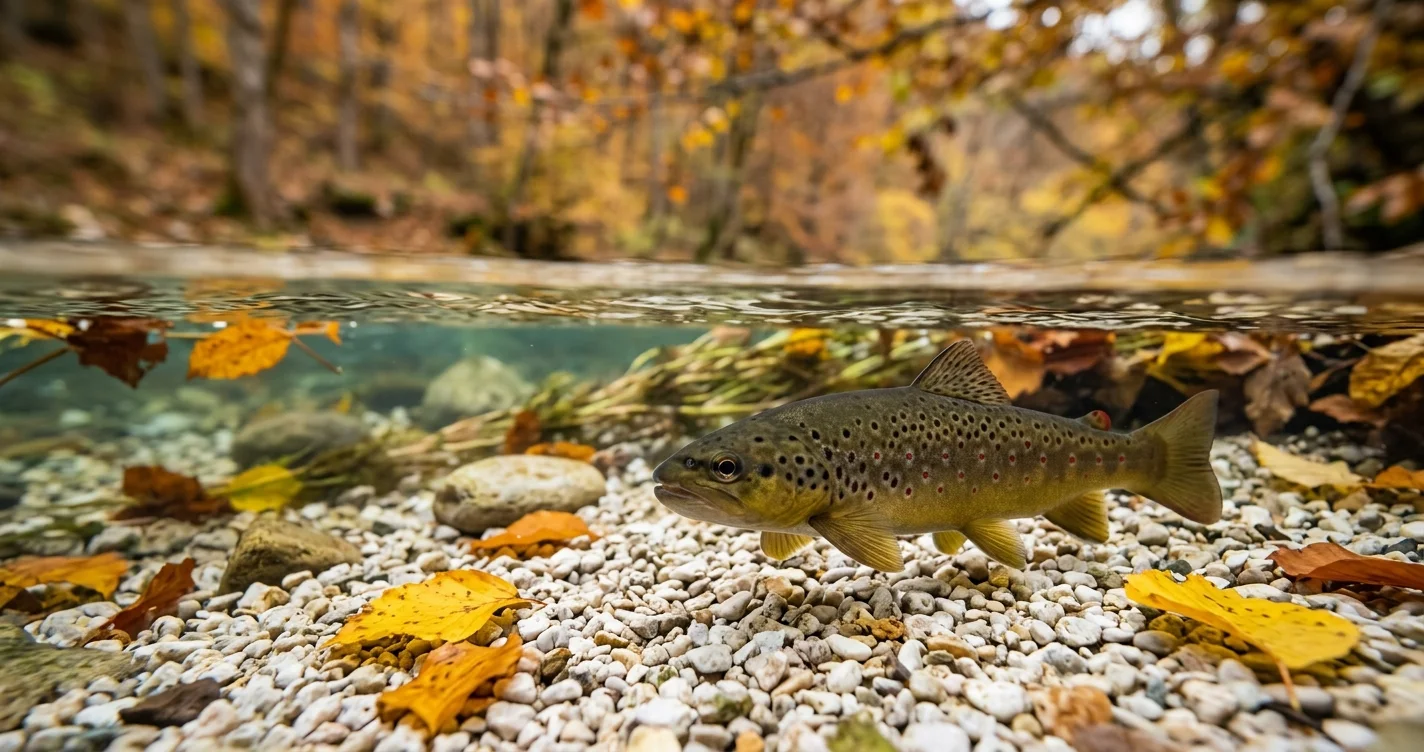
On a chilly autumn morning, a shallow stream may appear almost motionless. Then, beneath the clear water, a large trout turns sideways and beats its tail against the gravel. A pale cloud of sediment rises, revealing a patch of freshly disturbed stones.
This is one of the most remarkable moments in brown trout spawning, a seasonal process that helps sustain trout populations in cold freshwater habitats.
Brown trout (Salmo trutta) are famous for their spotted bodies, cautious behavior, and ability to thrive in suitable rivers and streams. But their reproductive behavior is equally fascinating.
Each autumn, mature trout may gather in gravel-bottomed areas where females prepare nests called redds. These underwater nests protect developing eggs while flowing water delivers the oxygen they need.
Understanding how brown trout build redds reveals an extraordinary relationship between fish behavior, streambed structure, water quality, and the changing seasons.
It also explains why a seemingly ordinary patch of gravel deserves special protection.
Table of contents
- What Is Brown Trout Spawning?
- What Is a Trout Redd?
- Brown Trout Spawning: How Females Build Redds
- Why Gravel and Water Flow Are Essential
- How Brown Trout Eggs Develop Beneath the Gravel
- Male Brown Trout During Spawning Season
- Brown Trout vs. Other Spawning Trout
- Why Brown Trout Spawning Matters to Stream Ecosystems
- Threats to Brown Trout Redds
- How to Observe Brown Trout Spawning Without Disturbing It
- In Your Own Yard: Protecting Healthy Streams
- Frequently Asked Questions
What Is Brown Trout Spawning?
Brown trout spawning is the reproductive process through which mature brown trout deposit and fertilize eggs in suitable freshwater habitats.
Unlike fish that attach eggs to aquatic vegetation or guard free-swimming young, brown trout generally bury their eggs within streambed gravel.
When Do Brown Trout Spawn?
In much of the Northern Hemisphere, brown trout spawn during autumn and sometimes into early winter.
The precise timing varies with latitude, water temperature, local conditions, and population characteristics.
In many North American streams, spawning activity occurs from October through December, although earlier or later activity is possible.
Why Autumn Matters
Autumn brings changes in water temperature, daylight, and stream conditions.
These seasonal cues influence reproductive development and spawning behavior.
Cooler water can also support the oxygen requirements of developing embryos, provided that the stream remains well oxygenated.
Where Brown Trout Spawn
Brown trout typically select gravel-bottomed areas with flowing water.
Suitable sites may occur in riffles, pool tails, or other stream sections where water moves through the gravel.
Not every shallow gravel patch provides appropriate conditions.
The size of the stones, current, oxygen supply, and amount of fine sediment all influence spawning suitability.
What Is a Trout Redd?
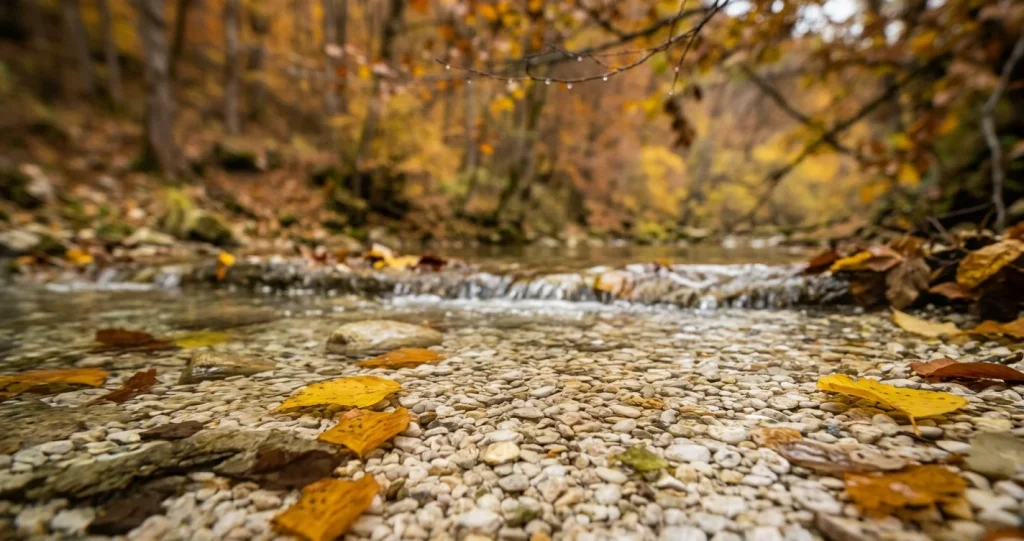
A redd is a nest excavated in streambed gravel by a spawning fish.
For brown trout, the female performs most of the excavation.
What Does a Redd Look Like?
A recently constructed redd often appears as a lighter patch of gravel surrounded by darker, undisturbed streambed material.
This difference occurs because digging exposes stones that have not been covered by the same surface films or sediment.
The redd may contain a shallow depression and a raised area of displaced gravel.
However, its appearance changes with water movement and time.
Why Trout Use Gravel
Gravel creates small spaces through which water can move.
These spaces help supply oxygen to buried eggs and carry away metabolic waste.
If the gravel becomes clogged with fine sediment, water exchange may decline.
Are All Gravel Patches Redds?
No.
Natural stream currents, other fish, and physical disturbances can create pale gravel patches.
Identifying a redd from appearance alone is not always reliable.
During spawning season, avoiding unnecessary disturbance of likely spawning areas is the safest approach.
Brown Trout Spawning: How Females Build Redds
The construction of a redd is one of the most important stages of brown trout reproduction.
Although the nest may look simple, its location and structure can influence the survival of developing eggs.
Step 1: Selecting a Suitable Location
A female brown trout searches for a section of streambed with appropriate gravel and water flow.
The ideal conditions depend on fish size, local stream characteristics, and available habitat.
She may inspect several locations before beginning excavation.
Step 2: Digging With the Tail
The female turns partly onto her side and beats her tail against the streambed.
This movement lifts and displaces gravel.
The current carries some loosened material downstream.
Repeated movements gradually form a depression in the gravel.
Step 3: Preparing the Egg Pocket
The female continues adjusting the excavation until it provides a suitable place for egg deposition.
The size and depth of the pocket vary.
Larger females may construct larger redds, although local conditions also influence nest dimensions.
Step 4: Courtship and Male Positioning
One or more males may approach the female.
Courtship can include close swimming, positioning alongside the female, and interactions between competing males.
The female ultimately releases eggs when spawning conditions and behavior align.
Step 5: Releasing Eggs and Milt
During spawning, the female releases eggs into the prepared pocket.
A male releases milt, the fluid containing sperm, near the eggs.
Fertilization occurs externally in the water.
Not every released egg is necessarily fertilized.
Step 6: Covering the Eggs
After an egg deposition event, the female may dig farther upstream.
Gravel displaced during this additional excavation moves downstream and covers the previously deposited eggs.
This helps protect them within the streambed.
A redd may contain multiple egg pockets created during successive spawning events.
Step 7: Leaving the Redd
Brown trout do not provide prolonged parental care after spawning.
Once the eggs are buried, their survival depends largely on stream conditions.
Water flow, oxygen availability, temperature, and protection from physical disturbance become especially important.
Why Gravel and Water Flow Are Essential
The relationship between gravel and moving water is central to successful brown trout reproduction.
Oxygen Reaches Eggs Through Gravel
Developing trout embryos require dissolved oxygen.
Water moving through the spaces between gravel particles can deliver oxygen to buried eggs.
This movement is often called interstitial or intragravel flow.
Fine Sediment Can Reduce Survival
Silt, sand, and other fine particles may accumulate between gravel stones.
Excessive sediment can reduce the spaces available for water movement.
This may limit oxygen delivery and make it harder for newly hatched fish to emerge.
The effects depend on sediment characteristics, water flow, and developmental stage.
Temperature Influences Development
Water temperature affects the rate at which trout embryos develop.
In colder conditions, development generally proceeds more slowly.
Warmer conditions may accelerate development within a suitable range, but excessive warmth can create physiological stress.
Stable Streambeds Matter
Floods can reshape streambeds and move gravel.
Some natural disturbance helps maintain river habitats, but severe scouring can damage redds.
Similarly, unusually low flows may expose spawning areas or reduce water movement through the gravel.
Healthy spawning habitat depends on a balance of natural stream processes.
How Brown Trout Eggs Develop Beneath the Gravel
Once fertilized and buried, trout eggs begin a period of development hidden from view.
The Embryonic Stage
The developing embryo uses nutrients stored in the egg.
Its growth depends on temperature, oxygen, and other environmental conditions.
The time required for hatching varies considerably among streams.
Hatching Into Alevins
Newly hatched trout are called alevins.
They possess a yolk sac that provides nourishment during their earliest development.
Alevins generally remain sheltered within the gravel while absorbing this reserve.
Emerging as Fry
After the yolk sac is largely absorbed, young trout begin emerging from the streambed.
At this stage, they must locate suitable feeding and shelter areas.
Small aquatic invertebrates become important food sources.
Why Early Survival Is Difficult
Young trout face predators, competition, changing water conditions, and limited food.
Only a portion of deposited eggs typically survive through the earliest life stages.
The proportion varies greatly among habitats and years.
Male Brown Trout During Spawning Season
Female trout construct the redds, but males also display distinctive reproductive behavior.
Brighter Colors and Physical Changes
During the spawning season, some male brown trout develop more pronounced coloration.
Mature males may also show a hooked lower jaw, known as a kype.
Its prominence varies among individuals.
Competition Between Males
Males may compete for access to spawning females.
Interactions can involve chasing, positioning, and displays of dominance.
Larger males sometimes gain advantages, but reproductive success is influenced by several factors.
Multiple Males May Participate
Although a dominant male may remain close to a female, other males can sometimes participate in spawning events.
This can contribute to variation in parentage within a redd.
Brown Trout vs. Other Spawning Trout
Several salmonid species use gravel nests, but their spawning seasons and behaviors differ.
| Species | Typical spawning season in much of North America | Nest behavior |
|---|---|---|
| Brown trout | Fall to early winter | Female excavates gravel redd |
| Brook trout | Fall | Female prepares gravel nest |
| Rainbow trout | Often spring | Female excavates gravel redd |
| Cutthroat trout | Often spring | Female excavates gravel redd |
These are general patterns.
Some populations spawn outside the typical periods, depending on geography and local environmental conditions.
Why Brown Trout Spawning Matters to Stream Ecosystems
Spawning is more than an individual reproductive event.
It connects fish populations to the physical and biological condition of freshwater habitats.
Trout Depend on Healthy Streambeds
Successful reproduction requires more than adult fish.
It also depends on gravel structure, suitable water temperatures, dissolved oxygen, and appropriate flow conditions.
A stream may support adult trout yet provide limited natural spawning habitat.
Redds Reveal Habitat Conditions
The presence of spawning activity can indicate that trout are using a particular section of stream.
However, seeing redds does not prove that egg survival is high or that the entire ecosystem is healthy.
Long-term monitoring is needed to understand reproductive success.
Brown Trout and Native Fish Communities
Brown trout are native to parts of Europe, western Asia, and North Africa.
They have been introduced widely elsewhere, including many watersheds in the United States.
In some North American streams, introduced brown trout compete with native trout or other aquatic species.
Their ecological role therefore depends on location.
Protecting stream health is important, but management should also consider native biodiversity and local conservation priorities.
Threats to Brown Trout Redds
A redd can be damaged even when the adult fish are no longer visible.
Walking Through Spawning Areas
Wading directly over redds can disturb gravel and potentially crush developing eggs.
The risk may continue after the spawning season while eggs and alevins remain beneath the streambed.
Excessive Sediment Runoff
Soil erosion from disturbed land, roads, or poorly managed streambanks can increase sediment entering waterways.
Fine particles may accumulate in spawning gravel.
Changes in Stream Flow
Water withdrawals, channel alterations, and some infrastructure projects can affect stream flow.
These changes may influence redd exposure, gravel movement, and oxygen delivery.
Loss of Streamside Vegetation
Riparian vegetation helps stabilize banks, filter some runoff, and provide shade.
Removing it can contribute to erosion and warmer water.
The consequences depend on local climate, stream size, and land use.
Climate-Related Changes
Changes in temperature, precipitation, and seasonal stream flow may affect trout reproduction.
Some populations may experience increased thermal stress or altered spawning conditions.
Impacts vary geographically and should not be assumed to be identical across all watersheds.
How to Observe Brown Trout Spawning Without Disturbing It
Autumn spawning activity can be fascinating to watch.
Responsible observation protects both the fish and their nests.
Watch From the Bank
The safest approach is to remain on the streambank.
Use polarized sunglasses or binoculars to observe fish behavior through the water.
Avoid entering shallow gravel areas where redds may be present.
Recognize Possible Spawning Habitat
Look for shallow gravel areas with moving water.
Freshly disturbed gravel may indicate spawning activity.
However, visual identification is imperfect.
When uncertain, avoid walking through the area.
Give Spawning Fish Space
Repeatedly approaching fish can interrupt courtship or nest construction.
Observe quietly and avoid casting shadows or making sudden movements directly over the fish.
Follow Local Fishing Regulations
Some states or watersheds have seasonal closures or special restrictions designed to protect spawning fish.
Regulations vary, so consult the appropriate state wildlife agency before fishing or wading.
In Your Own Yard: Protecting Healthy Streams
You do not need to own property beside a trout stream to help protect freshwater ecosystems.
Activities throughout a watershed can influence downstream water quality.
Reduce Soil Erosion
Keep bare soil covered with suitable vegetation or mulch.
Stabilize areas where runoff carries sediment toward drains, ditches, or waterways.
Plant Native Vegetation
Native plants can help reduce erosion and support local wildlife.
Where appropriate, maintain native vegetation along streambanks and drainage areas.
Choose species suited to local conditions.
Limit Fertilizer and Chemical Runoff
Apply lawn and garden products only when necessary and according to label instructions.
Avoid application before heavy rain.
Prevent excess nutrients and other pollutants from entering storm drains.
Manage Rainwater Thoughtfully
Rain gardens, vegetated drainage areas, and other suitable stormwater practices can help slow runoff.
Their effectiveness depends on soil, slope, drainage, and design.
Keep Streambanks Intact
Avoid unnecessary excavation, dumping, or removal of protective vegetation near waterways.
For larger projects, consult local conservation or watershed authorities.
Support Local Watershed Groups
Community organizations often organize stream cleanups, habitat restoration, and water-quality monitoring.
Participating in these activities can help protect freshwater habitats for many species.
Frequently Asked Questions
1. What time of year do brown trout spawn?
Brown trout generally spawn during autumn and early winter in much of the Northern Hemisphere.
In many North American streams, activity occurs from October through December.
However, timing varies with water temperature, latitude, and local conditions.
2. How can you recognize a brown trout redd?
A fresh redd may appear as a lighter patch of disturbed gravel, sometimes with a shallow depression and raised gravel nearby.
Its appearance varies, and other natural processes can create similar patterns.
Avoid walking through suspected spawning areas, especially during and after the spawning season.
3. How long do brown trout eggs remain in the gravel?
The duration depends strongly on water temperature and local conditions.
Eggs may take weeks or months to hatch, and newly hatched alevins remain within the gravel while absorbing their yolk sacs.
Because development continues well beyond the visible spawning event, redds can remain vulnerable through winter.
Conclusion
That pale patch of gravel in an autumn stream is not necessarily an ordinary disturbance.
It may be a carefully constructed nest containing the next generation of trout.
Brown trout spawning demonstrates how closely fish reproduction depends on flowing water, clean gravel, suitable temperatures, and stable freshwater habitats.
Female trout excavate redds with powerful tail movements, deposit eggs, and cover them beneath gravel where development continues out of sight.
For observers, the most important lesson is simple: appreciate the spectacle without disturbing the streambed.
By protecting water quality, reducing sediment runoff, and respecting spawning areas, communities can help maintain healthy waterways while supporting broader freshwater biodiversity.
The next time you notice a trout turning sideways above a shallow gravel bed, remember that a remarkable underwater process may be unfolding beneath the surface.
External Sources
1. Brown Trout — Michigan Department of Natural Resources
Explains autumn spawning, how females excavate gravel nests, external fertilization, and how eggs are covered with gravel. Michigan Governor’s Office.