
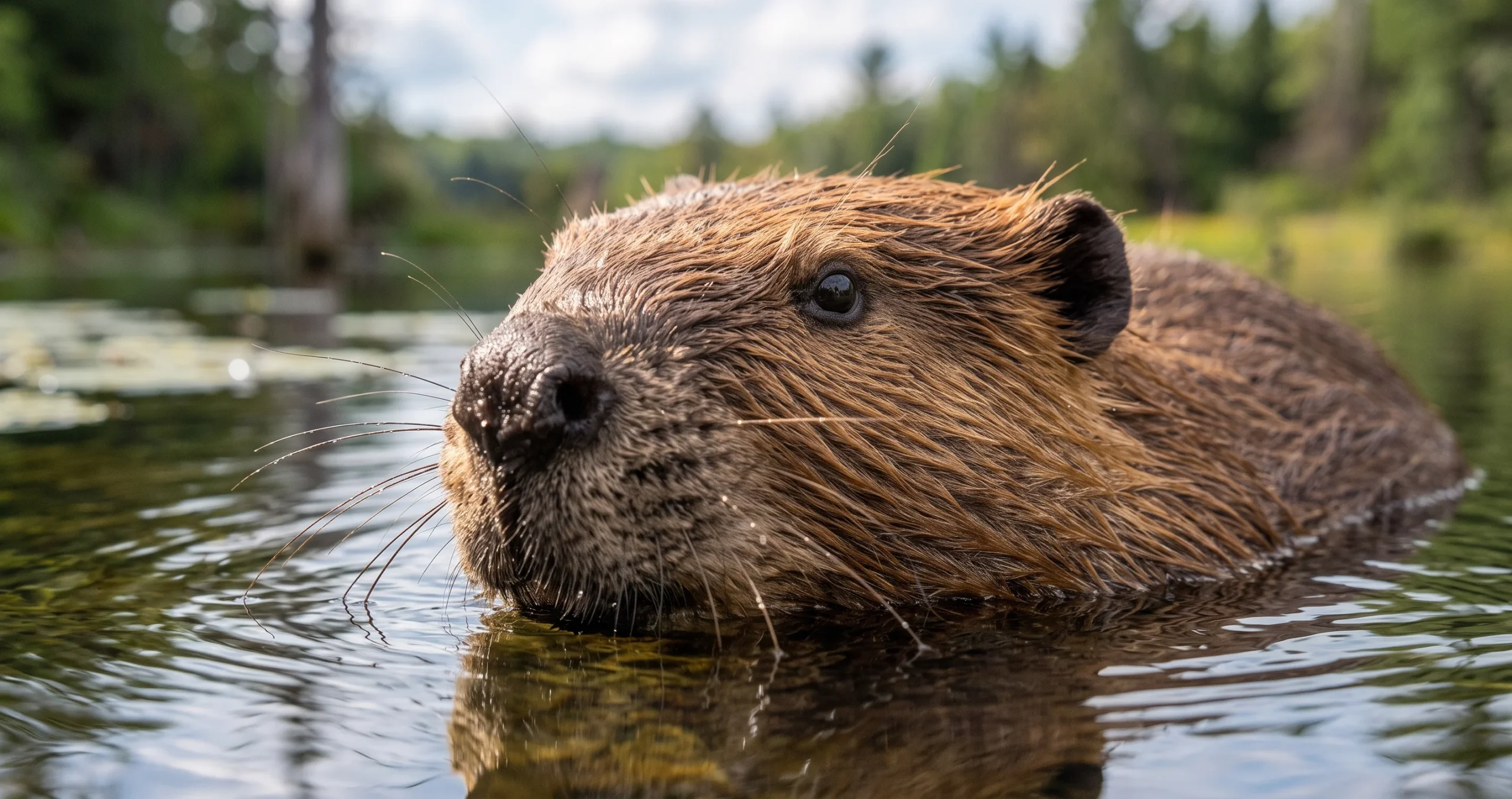
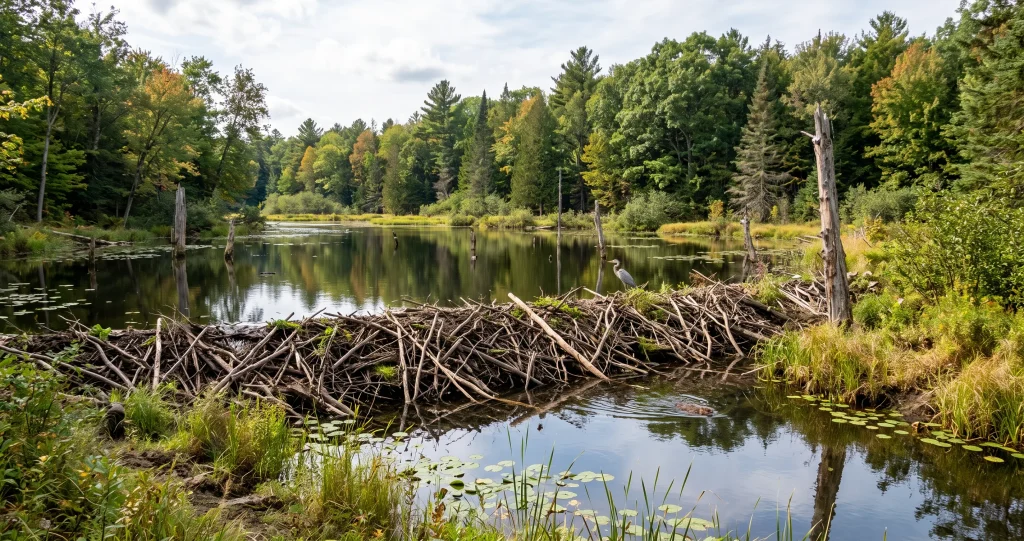
A beaver dam can look surprisingly simple: branches, mud, stones, leaves, and pieces of vegetation arranged across moving water. Yet that structure can alter the physical behavior of an entire stream corridor. This is why scientists often describe beavers ecosystem engineers—animals whose activities physically modify habitats in ways that affect many other species.
By slowing water, trapping sediment, raising local water levels, and creating ponds and wetlands, beavers can transform narrow streams into complex mosaics of open water, marsh, wet meadow, side channels, and riparian vegetation. Their influence can extend far beyond the pond immediately behind a dam.
Table of Contents
- Why Beavers Are Called Ecosystem Engineers
- How One Beaver Dam Changes a Stream
- Why Beavers Are Considered a Keystone Species
- Beaver Wetlands and Wildlife
- What Happens Underground
- Beaver Dams, Drought, and Water Storage
- Beavers and Fish Habitat
- Beaver-Powered Stream Restoration
- Beaver Reintroduction and Relocation
- From Overtrapping to Recovery
- Living With Beavers
- Common Beaver Myths
- Frequently Asked Questions
- Conclusion
Why Beavers Are Called Ecosystem Engineers
An ecosystem engineer is an organism that changes the physical environment in ways that create, remove, or modify habitat for other organisms.
Few North American mammals demonstrate the concept as visibly as the North American beaver, Castor canadensis.
Beavers cut woody vegetation, excavate channels, construct lodges, and, most famously, build dams. These behaviors are primarily about creating suitable habitat for the beavers themselves, especially deep and relatively safe water near food and shelter.
But the consequences extend to an entire ecological community.
A dam changes how quickly water travels downstream. It can change where sediment accumulates, where plants grow, how water interacts with the floodplain, and which animals can use the area.
That ability makes beavers ecosystem engineers on a landscape scale.
The U.S. Fish and Wildlife Service’s Beaver Restoration Guidebook describes how beaver activity can expand wetlands, reconnect floodplains, increase habitat complexity, and influence water tables and aquatic ecosystems.
How One Beaver Dam Changes a Stream
Imagine a relatively narrow stream carrying water downhill through a valley.
When beavers establish a dam, water begins backing up behind it. The faster-moving channel can become a slower, broader pond or wetland.
That slowing has several consequences.
Sediment that would otherwise remain suspended can settle. Water may spread sideways into low portions of the floodplain. Side channels can develop or become reconnected, and previously dry soils near the stream may remain wetter for longer periods.
The result is not simply “a pond.”
It can become a network of aquatic and semi-aquatic habitats.
Over time, beavers may construct additional dams upstream or downstream. A family can therefore help create a series of ponds, marshes, wet meadows, channels, and patches of woody vegetation.
The landscape becomes structurally more complicated.
And ecological complexity often creates opportunities for more species.
Beavers Ecosystem Engineers and Keystone Species
“Ecosystem engineer” and “keystone species” are related terms, but they do not mean exactly the same thing.
Calling beavers ecosystem engineers emphasizes their ability to physically transform habitat. Describing them as a keystone species emphasizes the disproportionately large ecological influence they can have relative to their abundance.
A handful of beavers may modify habitat used by far more organisms than the beavers themselves.
That influence is especially apparent in areas where dam-building converts relatively simple stream habitat into a mixture of shallow water, deeper pools, saturated soils, standing dead wood, emergent vegetation, and wetland edges.
Different species can exploit different pieces of this habitat.
The effect is a cascade: beavers change water movement, water changes vegetation and soils, and those changes influence insects, amphibians, birds, fish, mammals, and other organisms.
Beaver Wetlands Become Wildlife Neighborhoods
Wetlands are among the most biologically productive habitat types, and beaver activity can create or enlarge them.
Amphibians may gain shallow breeding habitat. Aquatic insects can colonize pond margins and vegetation. Waterfowl can use open water and marsh plants for feeding and shelter.
Dead or flooded trees can provide perches and cavities for birds. Dense vegetation around pond margins offers cover for small mammals and nesting habitat for some bird species.
Predators may arrive because prey becomes more abundant.
Even after a dam fails or beavers abandon a site, their ecological influence may continue.
A pond can gradually drain and develop into a wet meadow. Vegetation changes again, attracting a different community of organisms. Eventually, beavers may return and begin another cycle.
A beaver-modified landscape is therefore dynamic rather than permanently frozen in one condition.
What Happens Underground
Some of the most important changes created by beavers are less visible.
When a dam raises surface water locally, water can spread into surrounding soils and interact more extensively with groundwater. Under suitable conditions, this can raise the local water table and keep streamside soils moist farther from the original channel.
That moisture influences vegetation.
Willows, sedges, and other water-associated plants may expand where hydrological conditions are favorable. Those plants can stabilize banks, contribute organic matter, provide shade, and supply food and building material for beavers.
The relationship can become self-reinforcing.
Vegetation supports beavers, beavers modify water movement, and altered water conditions can support additional riparian vegetation.
This is one reason restoration ecologists have become increasingly interested in beaver-driven processes rather than treating every dam as an obstruction that should automatically be removed.
Beaver Dams, Drought, and Water Storage
One common claim is that beavers can “stop drought.”
That goes too far.
Beavers cannot create rainfall, reverse a regional drought, or guarantee permanent streamflow. Their effects also vary according to geology, valley shape, climate, vegetation, stream size, and the design and persistence of individual dams.
What they can sometimes do is change how water moves through a watershed.
By slowing runoff and spreading water across floodplains, beaver complexes may retain water locally for longer periods and increase wetland extent. The U.S. Fish and Wildlife Service notes that beaver restoration can produce higher water tables, expanded wetlands, floodplain reconnection, and other hydrological changes.
That can be valuable in drought-prone landscapes.
Instead of water moving rapidly through one incised channel, some of it may spend more time in ponds, soils, floodplain sediments, and connected wetland habitats.
But results are site-specific. Beaver restoration should not be presented as a universal substitute for broader watershed management.
Beavers Can Transform Fish Habitat
A beaver dam may look like an obvious obstacle to a fish, which has contributed to the widespread assumption that beavers are necessarily bad for migratory fish.
The real ecological picture is more complicated.
Beaver ponds can create slow-water habitat where juvenile fish feed, grow, shelter from high flows, and hide from predators. Pools, side channels, submerged vegetation, woody debris, and complex shorelines can substantially increase habitat diversity.
Research and restoration work in the Pacific Northwest have demonstrated these potential benefits for salmonids.
In Oregon’s Bridge Creek, for example, researchers used human-built structures to encourage beaver activity in a degraded stream. NOAA Fisheries reported increased habitat complexity and substantial improvements in juvenile steelhead survival relative to a control watershed.
More recently, NOAA reported strong responses by coho salmon in restored California streams where beaver dam analogues were used to help rebuild slow-water habitat. The results illustrate the potential of these techniques under appropriate local conditions, not a guarantee that every dam will produce the same response.
For another example of an animal whose anatomy dramatically shapes how it interacts with its environment, explore our article on how the nautilus shell controls buoyancy and depth.
Beaver-Powered Stream Restoration
Traditionally, restoring a damaged stream might involve heavy equipment, engineered structures, excavation, bank stabilization, vegetation planting, or channel reconstruction.
Those approaches are sometimes necessary.
But restoration practitioners have increasingly explored another strategy: restoring the natural processes that allow streams to develop complexity themselves.
Beavers can be part of that approach.
Some projects install beaver dam analogues, usually called BDAs. These are human-built structures designed to mimic some functions of natural beaver dams, such as slowing water and encouraging sediment deposition.
In certain projects, BDAs also provide starter structures that beavers later occupy, expand, and maintain.
NOAA has used or supported this approach in watersheds where managers are trying to improve habitat for threatened salmon and reconnect streams with their floodplains.
The attraction is easy to understand.
Instead of attempting to engineer every future channel, pond, and wetland feature directly, managers may be able to restore physical processes that allow water, sediment, vegetation, and sometimes beavers themselves to continue modifying the landscape.
Beaver Reintroduction and Relocation
Beaver restoration does not always mean releasing animals.
In some places, managers focus on protecting existing colonies. Elsewhere, they install BDAs and wait for nearby beavers to colonize suitable habitat naturally.
Another strategy is relocation.
Beavers causing serious conflicts in one location may sometimes be captured and moved to carefully evaluated restoration sites, where regulations and ecological conditions permit it.
The U.S. Fish and Wildlife Service describes projects in Washington that combine coexistence techniques, strategic relocation, and habitat restoration. Some programs attempt to relocate family groups rather than isolated animals and carefully evaluate potential release sites.
Relocation is not as simple as putting a beaver beside any degraded creek.
Suitable food, adequate water, stream gradient, valley width, predation risk, land ownership, infrastructure, permitting, and the likelihood that the animals will remain at the site all matter.
Successful beaver restoration therefore requires planning rather than simply adding beavers to a landscape.
From Overtrapping to Recovery
The modern enthusiasm for beaver restoration represents a striking reversal of history.
Beavers were once enormously abundant across much of North America. Their dense, water-resistant fur became one of the continent’s most valuable commodities during the fur-trade era.
Demand for pelts, particularly for felt hats, drove intensive trapping.
By the 1800s, beavers had disappeared or become rare across large portions of their former range. The Smithsonian notes that unregulated trapping caused beavers to all but disappear from much of their original range.
Their disappearance affected more than beaver populations.
Where beaver dams vanished, some wetlands and pond complexes were no longer maintained. Streams and riparian landscapes were simultaneously being altered by agriculture, grazing, logging, roads, settlement, and other land uses, making it difficult to separate the influence of beaver loss from other historical changes.
As trapping pressure declined and wildlife management changed, beavers began recovering in many areas.
Reintroductions also played a role.
At Acadia National Park, for example, beavers had disappeared locally before being deliberately reintroduced during the 20th century. The National Park Service describes the area’s history as one of reintroduction, relocation, recovery, and continuing coexistence management.
Today, beavers again occupy much of their North American range, although abundance varies widely by region.
Living With an Ecosystem Engineer Is Not Always Easy
Calling beavers ecosystem engineers does not mean every engineering project they undertake is convenient for humans.
A dam located deep within a protected wetland may provide valuable wildlife habitat.
The same behavior beside a road can flood a culvert.
Beavers may cut ornamental or valuable trees, inundate agricultural land, interfere with drainage systems, or create flooding near buildings and infrastructure.
Those conflicts are real.
Modern beaver management therefore increasingly includes coexistence tools such as protective fencing around important trees, culvert-protection systems, and specialized flow devices that regulate pond levels while allowing beavers to remain.
The U.S. Fish and Wildlife Service highlights several of these approaches and notes that relocation may be considered when coexistence methods are insufficient and suitable restoration sites are available.
Good management is not simply about choosing between “beavers everywhere” and “no beavers.”
It is about identifying where natural beaver activity can be beneficial, where conflicts can be mitigated, and where infrastructure or land-use constraints require active intervention.
Common Myths About Beavers
Myth: Beavers eat fish
Beavers are herbivores.
Their diet consists primarily of plant material, including bark, twigs, leaves, aquatic vegetation, and herbaceous plants. They do not build dams to catch fish.
Myth: Every beaver builds a dam
Not necessarily.
Beavers need secure aquatic habitat, but they do not always have to create it themselves. Beavers living along sufficiently deep lakes, rivers, or other water bodies may not need to construct a major dam.
Myth: Beaver dams permanently stop rivers
Beaver dams are generally permeable and dynamic structures.
Water can move through, around, and over them. Dams can also breach, wash out, be rebuilt, or be abandoned.
Myth: Beaver dams always prevent fish migration
Fish passage depends on the species, season, stream conditions, dam characteristics, and surrounding channels.
Studies have documented salmonids crossing beaver dams and dam analogues, while beaver ponds can provide important rearing habitat. That does not mean every dam is harmless in every fishery, but treating all beaver dams as permanent barriers is an oversimplification.
Myth: Beavers solve every watershed problem
Beavers can be powerful restoration partners, but they are not a universal solution.
Some landscapes lack appropriate vegetation or hydrology. Some streams are too steep or otherwise unsuitable, and some sites contain infrastructure that cannot tolerate increased water levels.
Effective restoration requires matching the technique to the landscape.
Frequently Asked Questions
Why are beavers called ecosystem engineers?
Beavers physically modify their environment through dam building, tree cutting, channel excavation, and other activities. These changes can alter water movement, sediment deposition, vegetation, wetland extent, and habitat availability for many other species.
Why are beavers considered a keystone species?
Their ecological effects can be disproportionately large compared with their numbers. A relatively small beaver population can create and maintain habitat used by numerous plants, insects, amphibians, fish, birds, and mammals.
Do beaver dams help wetlands form?
Yes, in suitable landscapes. Dams can slow water, raise local water levels, expand inundated areas, and reconnect streams with portions of their floodplains, creating or enlarging wetland habitat.
Can beavers help during drought?
Beaver complexes can sometimes retain and spread water through valleys and wetlands, potentially keeping local areas wetter for longer. However, they cannot eliminate drought, and the magnitude of the effect depends strongly on local conditions.
Are beaver dams good for salmon?
They can be. Beaver ponds and associated side channels may provide valuable feeding, shelter, and rearing habitat for juvenile salmonids, and restoration projects in the Pacific Northwest have documented important benefits. Effects vary by location and species.
What is a beaver dam analogue?
A beaver dam analogue, or BDA, is a human-built, low-tech structure designed to reproduce some functions of a natural beaver dam. It may slow water, trap sediment, reconnect floodplains, improve habitat, or encourage beavers to establish and maintain dams themselves.
Why did beavers nearly disappear from many areas?
Intensive trapping for the fur trade severely reduced North American beaver populations. By the 19th century, beavers had become rare or locally absent across substantial parts of their former range.
Are beavers protected today?
Regulations vary by jurisdiction. Beaver populations have recovered substantially in many regions, but their legal status, trapping seasons, relocation rules, and management requirements differ among states, provinces, and other authorities.
Conclusion
A beaver does not set out to restore a watershed.
It builds for its own survival.
Yet by cutting vegetation, constructing dams, digging channels, and maintaining ponds, beavers can change the movement of water and sediment across entire stream corridors.
Those physical changes can create wetlands, reconnect floodplains, alter vegetation, increase habitat complexity, and provide living space for organisms ranging from aquatic insects and amphibians to birds, mammals, and fish.
That is the remarkable ecological significance behind the phrase beavers ecosystem engineers.
Their history also offers an important lesson. North America once lost beavers from huge areas through intensive trapping. As populations recovered, scientists and restoration practitioners gained a clearer appreciation for how strongly these animals can influence streams and wetlands.
Today, some restoration programs are doing more than tolerating beavers. They are protecting existing colonies, using beaver dam analogues, encouraging natural recolonization, and, in selected situations, relocating animals to suitable habitat.
Beavers cannot repair every degraded stream, and their dams can create genuine conflicts with farms, roads, trees, and other infrastructure. But in the right landscape, one family of rodents can accomplish something extraordinary.
By building a dam for themselves, they can begin rebuilding an ecosystem for countless other species.
External Sources:
- U.S. Fish & Wildlife Service — The Beaver Restoration Guidebook
https://www.fws.gov/media/beaver-restoration-guidebook - Smithsonian’s National Zoo & Conservation Biology Institute — Beaver
https://nationalzoo.si.edu/animals/beaver