
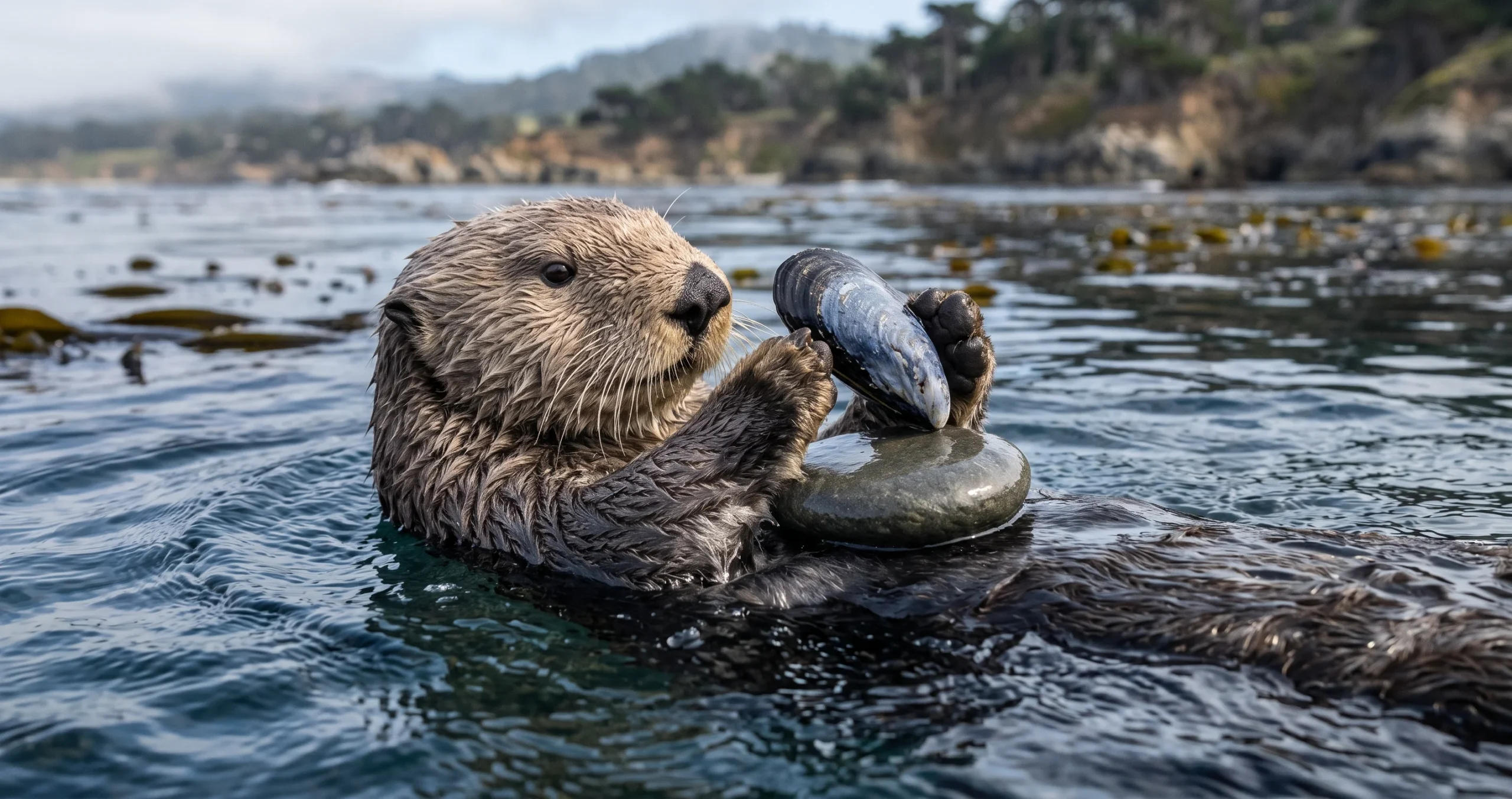
Floating on its back in a patch of coastal water, a sea otter may look relaxed. But when it places a clam or marine snail against a stone and strikes repeatedly, it is performing one of the clearest examples of habitual tool use among marine mammals.
Sea otter tool use allows these animals to overcome a basic mechanical problem: many nutritious prey species are protected by shells that are difficult to open with teeth and paws alone. Rocks, shells, fixed stones, and occasionally other hard objects can turn otherwise inaccessible food into a practical meal. Research also shows that tool use varies dramatically among individual otters and populations, revealing a surprisingly flexible approach to feeding.
Table of Contents
- What Counts as Tool Use in Sea Otters?
- How Sea Otters Find and Handle Hard-Shelled Prey
- How Rocks Become Hammers and Anvils
- Sea Otter Tool Use Varies Between Individuals
- Why Prey Specialization Matters
- Repeated Tool Use and Favorite Foraging Sites
- The Energetic Benefits of Using Tools
- How Tool Use Can Protect an Otter’s Teeth
- How Sea Otters Learn to Use Tools
- Is Sea Otter Tool Use Cultural?
- What Tool Use Reveals About Mammalian Cognition
- Why This Behavior Matters
- Frequently Asked Questions
- Conclusion
What Counts as Tool Use in Sea Otters?
Animal tool use generally involves manipulating an external object to accomplish a goal. For sea otters (Enhydra lutris), that goal is often gaining access to food.
A sea otter may use a loose stone underwater to help dislodge prey, bring a rock to the surface and use it while processing food, or strike prey against a fixed rock. Researchers have documented several forms of stone-assisted feeding.
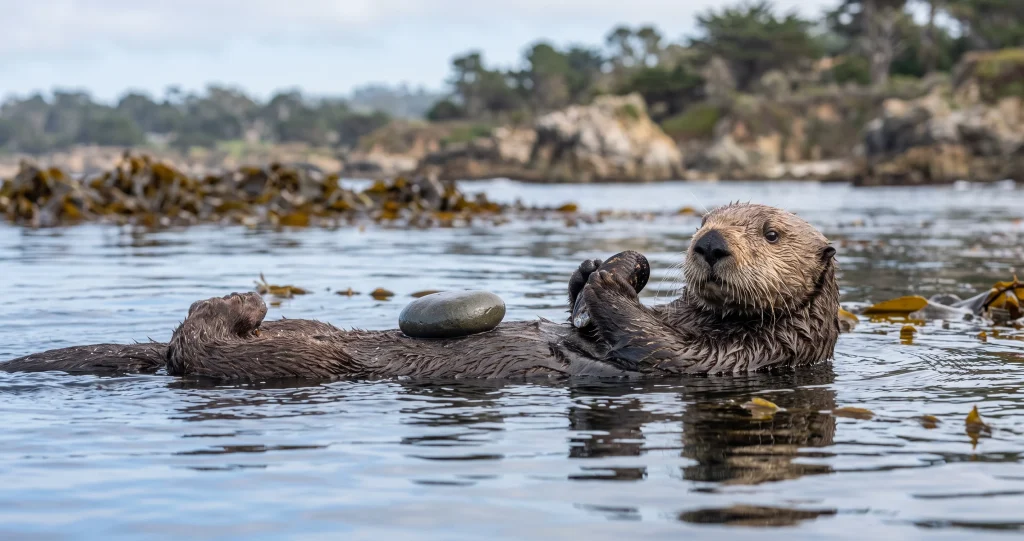
The familiar image of an otter floating on its back with a stone on its chest represents only one version of the behavior. Stones can function as anvils against which prey is struck, while hard prey or stones may also be manipulated in other ways depending on the feeding situation.
How Sea Otters Find and Handle Hard-Shelled Prey
Sea otters forage mainly on the seafloor, where they collect marine invertebrates such as sea urchins, crabs, clams, mussels, abalones, and marine snails.
Their forepaws are remarkably dexterous. Once an otter locates prey, it can grasp and manipulate the item before bringing it toward the surface for processing.
Some foods require little mechanical preparation. Soft-bodied prey can simply be eaten, while other species can be crushed or opened with the teeth.
Thick-shelled bivalves and marine snails present a greater challenge. Comparative research across sea otter populations found these hard-shelled prey were particularly likely to be associated with tool use, while soft-bodied animals such as worms and sea stars were much less likely to require tools.
How Rocks Become Hammers and Anvils
One of the best-known techniques begins after an otter surfaces with prey.
Floating on its back provides a relatively stable platform. The otter can manipulate the prey and a hard object with its forepaws, positioning the objects before delivering repeated strikes.
The rock effectively concentrates force onto the shell. Instead of depending entirely on bite force, the otter uses repeated impacts until the protective shell cracks or opens enough for the edible tissue to be removed.
Sea otters are not restricted to portable stones. Observations show that they may use shells and other hard objects, while fixed rocks can also serve as anvils. Researchers have even documented otters repeatedly pounding mussels against particular shoreline rocks.
This behavioral flexibility is important. The functional requirement is not necessarily a particular type of stone but access to an object or surface capable of helping solve the mechanical problem presented by the prey.
Sea Otter Tool Use Varies Between Individuals
Not every sea otter uses tools equally.
A major California study followed 211 tagged individuals from five study areas and found striking differences in tool-use frequency. In food-limited areas, individual rates ranged from essentially no tool use to tools being involved in as many as 98% of prey captures.
Population differences can be just as substantial.
Research covering eight populations from California to Alaska found tool use on less than 1% of successful foraging dives at Amchitka Island, Alaska, compared with approximately 16% in Monterey, California. Across the studied populations, the percentage of individuals observed using tools ranged from about 10% to 93%.
These differences demonstrate why it is misleading to describe tool use as something every sea otter performs in exactly the same way.
Local ecology matters.
Why Prey Specialization Matters
Sea otters living in the same region do not necessarily eat identical diets.
When highly preferred foods become limited, individuals may specialize on different available prey. One otter might consume more crabs, another more snails, while another relies heavily on bivalves.
That specialization strongly influences whether tools are useful.
The 2017 California study found that the prevalence of difficult-to-access prey in an individual’s diet was a major predictor of tool use. Individuals specializing in prey protected by tough shells naturally encountered more situations where an external object could provide a mechanical advantage.
Researchers examining populations across the sea otter’s range similarly concluded that prey morphology and the prevalence of different prey in local diets explained much of the observed population-level variation in tool-use frequency.
Tool use is therefore closely connected to ecological opportunity rather than simply being a fixed behavioral characteristic.
Repeated Tool Use and Favorite Foraging Sites
Some sea otter tool behavior leaves physical evidence behind.
At Bennett Slough in California, researchers documented wild sea otters repeatedly striking mussels against emergent rocks over approximately a decade. The activity produced recognizable wear patterns on the rocks and distinctive accumulations of broken shells.
These observations provide strong evidence for repeated use of particular anvil sites.
They have even created an unusual connection between animal behavior and archaeology. Because stone surfaces and broken shells can persist long after an individual feeding event, researchers have suggested that characteristic damage patterns might eventually help identify historical sea otter foraging sites.
Claims that every otter keeps a single personal “favorite rock” should be treated more cautiously. Sea otters certainly reuse tools or locations in some circumstances, but their behavior is diverse, and persistent ownership of one special stone should not be assumed for the species as a whole.
The Energetic Benefits of Sea Otter Tool Use
Sea otters live in cold marine environments and have exceptionally demanding energetic requirements. Efficient access to food is therefore critical.
A tool can expand the range of prey an otter can exploit.
A 2024 study in Science analyzed longitudinal observations of 196 radio-tagged southern sea otters. Researchers found that tool-using individuals, particularly females, could gain access to larger or harder-shelled prey. Tool use helped some animals process alternative foods that would be difficult to exploit through biting alone.
This becomes especially valuable when preferred prey are depleted.
Instead of abandoning a feeding area simply because easily processed foods have become scarce, an otter capable of effectively using tools may be able to switch toward mechanically challenging prey.
The behavior therefore functions as more than an impressive demonstration of dexterity. Under some ecological conditions, it can directly improve access to calories.
How Tool Use Can Protect an Otter’s Teeth
Opening shells with teeth has a cost.
Repeatedly biting, crushing, and prying hard prey can contribute to tooth wear and damage. Because sea otters depend on their teeth throughout their lives, severe dental deterioration can eventually interfere with feeding.
Tools can transfer some of the mechanical work away from the mouth.
The 2024 Science study found that the mechanical advantages associated with tool use translated into reduced tooth damage. The researchers also found that tool use could reduce trade-offs among prey accessibility, tooth condition, and energy intake.
The finding gives researchers a measurable biological benefit for a behavior that might otherwise simply be described as clever.
Read the USGS summary of the 2024 sea otter tool-use study
How Sea Otters Learn to Use Tools
How an otter develops effective tool-use behavior is more difficult to establish than simply observing the behavior itself.
Young sea otters spend substantial time with their mothers and have opportunities to observe maternal feeding techniques. Research reviews have reported correlations between mothers and offspring in prey preferences, foraging tactics, and methods of tool use.
That makes social learning a plausible contributor.
However, correlation between mother and offspring does not prove that every specific technique is copied through observation. Shared habitat, exposure to similar prey, individual practice, and other developmental factors can also influence behavior.
The safest conclusion is that learning clearly matters to the development of sophisticated foraging behavior, while the exact balance among observation, practice, inherited predispositions, and ecological experience remains an active research question.
Is Sea Otter Tool Use Cultural?
The word “culture” has a specific meaning in animal-behavior research. It generally requires evidence that behavioral traditions are maintained through social transmission rather than being explained entirely by genetics or similar environmental conditions.
There are intriguing reasons to investigate this possibility in sea otters.
Mother-offspring similarities provide opportunities for vertical social transmission, and individual feeding specializations can persist over time. Reviews of aquatic tool use have therefore discussed social transmission as a possible mechanism contributing to specialized behavior.
Genetic evidence also provides an interesting clue. A Smithsonian-led study found that frequent tool users in California were not simply members of one closely related genetic group, suggesting that genetic relatedness alone does not explain which individuals become frequent tool users.
None of this means that every regional difference in sea otter tool use should automatically be called a cultural tradition.
Ecology has a powerful demonstrated influence. Prey availability, shell characteristics, habitat, diet specialization, age, and sex can all contribute to observed variation.
For now, social learning and cultural transmission remain valuable hypotheses to investigate rather than universal explanations for sea otter tool use.
What Tool Use Reveals About Mammalian Cognition
Tool use does not automatically prove human-like reasoning.
What it does demonstrate is an animal’s ability to coordinate objects, movements, and environmental conditions toward a functional goal.
Sea otters must manipulate prey and tools with considerable precision. They can alter their processing behavior according to prey type, and some individuals repeatedly employ tool-assisted strategies when encountering mechanically challenging foods.
Such behavior reflects behavioral flexibility, motor control, and the capacity to learn effective relationships between actions and their consequences.
It also illustrates an important principle in cognitive ecology: intelligence is expressed in ways shaped by an animal’s environment.
For a primate, a useful tool might be a stick used to extract insects. For a crow, it might be a shaped twig. For a sea otter floating above a rocky seafloor, the critical object can be a stone capable of cracking a shell.
Readers interested in other remarkable wildlife adaptations can explore more animal behavior and ecology stories on Secrets of the Green Garden.
[Image placement suggestion 2: Educational sequence showing an otter collecting a shellfish, surfacing, positioning it against a stone, striking the shell, and eating the exposed prey.]
Alt text: “sea otter tool use sequence for opening shellfish with a stone”
Why This Behavior Matters
Sea otter tool use sits at the intersection of ecology, anatomy, behavior, and cognition.
The stones themselves are simple. The significance comes from how otters incorporate them into flexible feeding strategies.
Tools can expand access to food, allow exploitation of harder prey, and reduce damage to teeth. Individual differences also show how animals living in the same environment can solve similar nutritional challenges in different ways.
Studying these behaviors can therefore reveal not only what sea otters eat, but how ecological pressures shape behavioral innovation.
Frequently Asked Questions
Do all sea otters use rocks as tools?
No. Tool-use frequency differs substantially among individuals and populations. Diet, prey hardness, food availability, habitat, age, sex, and individual specialization can all contribute to this variation.
What foods do sea otters open with tools?
Hard-shelled prey such as marine snails and thick-shelled bivalves are particularly associated with tool use. Otters may also use tools in other feeding situations, including helping dislodge certain prey from substrates.
Do sea otters always use a rock on their stomach?
No. A rock positioned on the body while the otter floats is one technique. Otters can also strike prey against fixed rocks and use stones in other contexts.
Does every sea otter keep one favorite rock?
Evidence supports repeated use of tools and particular anvil locations in some circumstances, but the popular idea that every sea otter permanently owns and carries one special rock is an oversimplification.
Why don’t sea otters simply bite shells open?
They sometimes do. But especially hard or large prey may be mechanically difficult to process through biting alone. Tool use can provide access to such prey while also reducing tooth damage.
Do young sea otters learn tool use from their mothers?
Young otters have extensive opportunities to observe their mothers, and mother-offspring similarities in foraging behavior have been reported. Social learning is therefore plausible, but scientists should distinguish this evidence from stronger claims that all tool-use traditions are culturally transmitted.
Conclusion
Sea otters transform ordinary objects into effective feeding equipment. By manipulating rocks, shells, and hard surfaces, they can crack or open prey that would otherwise be difficult to exploit.
Research shows that sea otter tool use is far from uniform. Some individuals rarely use tools, while others incorporate them into a large proportion of their feeding attempts. Much of that variation can be linked to prey type, local food conditions, and individual dietary specialization.
The benefits are also increasingly measurable. Tool use can provide access to larger and harder prey while reducing dental damage, giving some otters an important advantage when easier foods become scarce.
What remains especially interesting is how these skills develop and persist. Observation, practice, ecological opportunity, and possibly social transmission may all contribute. Separating those influences will help researchers understand not only sea otters, but the broader evolution of tool use and flexible problem-solving in mammals.