
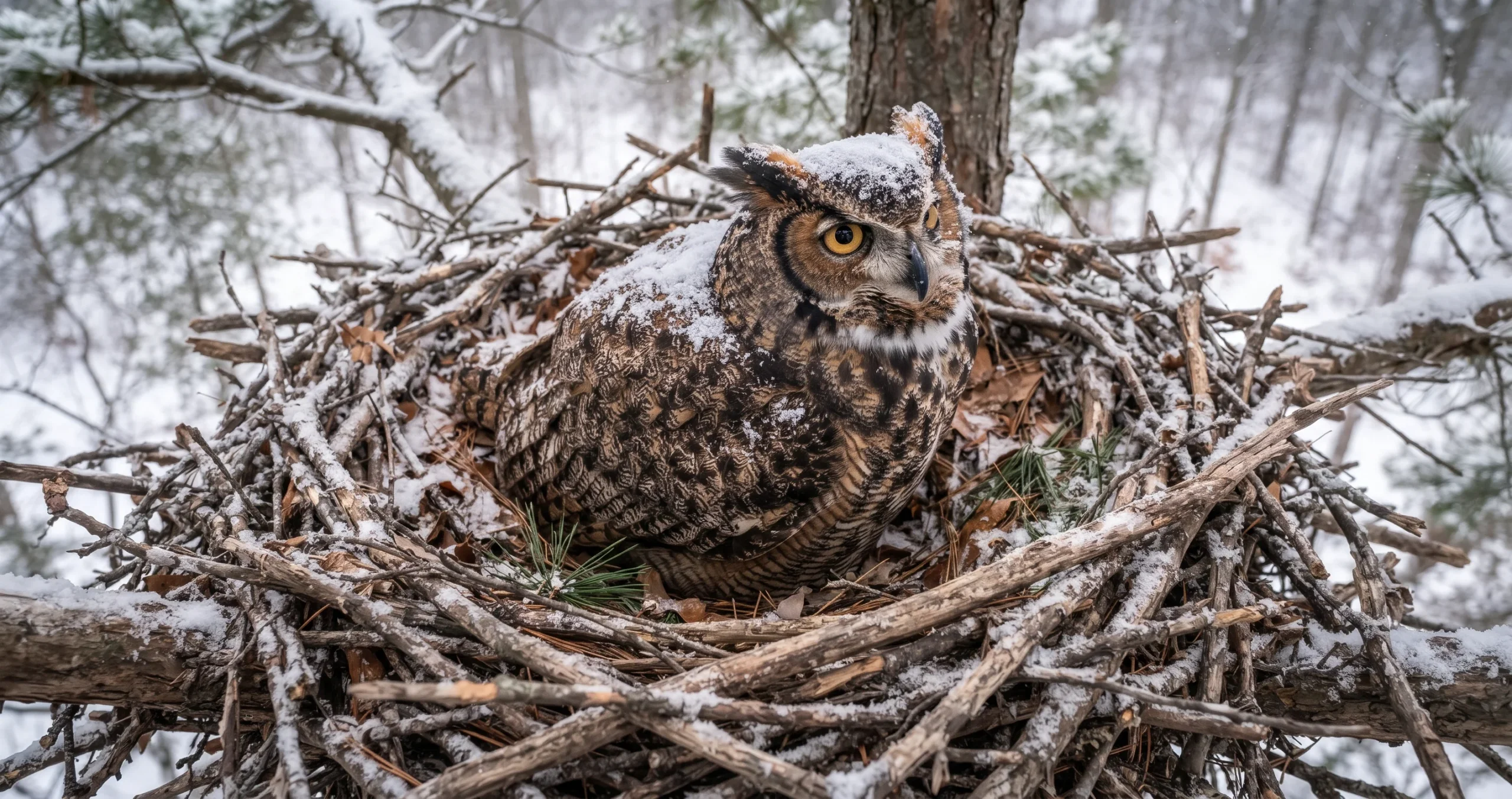
On a freezing January night, when most backyard birds are simply trying to stay warm, one of North America’s most powerful owls may already be preparing to raise a family. Great horned owl nesting begins surprisingly early, sometimes while snow still covers the ground and other birds have not even started their spring courtship.
The Great Horned Owl (Bubo virginianus) is a large, adaptable predator found across much of North America. Its deep, rhythmic hooting can echo through forests, farmland, suburban neighborhoods, and city parks during the colder months.
Unlike many songbirds that wait for warmer weather, Great Horned Owls often begin breeding in winter. Their early schedule allows their young to develop during spring, when hunting conditions and prey availability may become more favorable.
Understanding their courtship, nesting habits, parental roles, and owlet development offers a fascinating look at the seasonal lives of these remarkable birds.
Table of Contents
- Why Great Horned Owls Begin Nesting in Winter
- Great Horned Owl Nesting Season: When Courtship Begins
- Where Great Horned Owls Build Their Nests
- When Great Horned Owls Lay Their Eggs
- How Great Horned Owl Eggs Survive Cold Weather
- The Female and Male Owl’s Roles
- How Great Horned Owl Chicks Develop
- Why Early Nesting Gives Owlets an Advantage
- How to Spot a Great Horned Owl Nest
- How to Watch Owl Nests Without Disturbing Them
- Common Misunderstandings About Winter Owl Nesting
- Frequently Asked Questions
Why Great Horned Owls Begin Nesting in Winter
Most people associate bird nesting with spring, when trees begin producing leaves and insects become more abundant.
Great Horned Owls follow a different seasonal schedule.
In much of the United States, breeding activity begins during late fall or winter, with egg laying often occurring in January or February.
Some pairs begin earlier, while others nest later depending on latitude, climate, and local conditions.
This early schedule reflects the owl’s relatively long breeding cycle.
Raising Owlets Takes Time
Great Horned Owl chicks require substantial parental care.
After the eggs hatch, the young remain in or around the nest for several weeks before becoming capable of sustained flight.
Even after leaving the nest, juvenile owls continue depending on their parents for food and protection.
Beginning the breeding process early gives young owls time to develop their hunting abilities before their first winter.
The exact timing varies, but this extended period of dependence is an important part of the species’ life history.
Cold Weather Is Not Necessarily a Barrier
Great Horned Owls are well adapted to cold environments.
Their dense plumage provides insulation, while their feathered legs and feet help reduce exposure to winter conditions.
Adults also possess the hunting abilities needed to capture prey throughout much of the year.
These adaptations allow breeding to begin when temperatures remain low.
However, severe storms and food shortages can still affect nesting success.
Great Horned Owl Nesting Season: When Courtship Begins
The first signs of great horned owl nesting may be heard long before a nest becomes visible.
During late fall and early winter, pairs often communicate through deep hooting calls.
These vocalizations help maintain territories and strengthen pair relationships.
Listening for Courtship Calls
The familiar Great Horned Owl call consists of several low, resonant hoots.
Males and females both vocalize, although their voices differ.
Females are generally larger, but males usually produce lower-pitched calls.
A pair may exchange calls from separate trees, creating an alternating pattern that carries through the evening air.
This behavior is particularly noticeable around dusk and during the early nighttime hours.
Courtship and Pair Bonds
Great Horned Owls often maintain pair bonds across breeding seasons.
Courtship behavior may include calling, approaching one another, and displaying around potential nest sites.
Some pairs engage in mutual vocalizations or other close interactions.
These activities help coordinate breeding and reinforce territorial relationships.
However, hearing two owls calling does not prove that eggs have already been laid.
The birds may still be establishing or maintaining their territory.
Why Late Fall Is a Good Time to Listen
Deciduous trees lose their leaves during autumn, making large birds easier to see.
Cool, quiet evenings can also provide favorable listening conditions.
A repeated series of hoots from the same wooded area may indicate a resident pair.
Observing from a distance allows people to enjoy the calls without interfering with courtship.
Where Great Horned Owls Build Their Nests
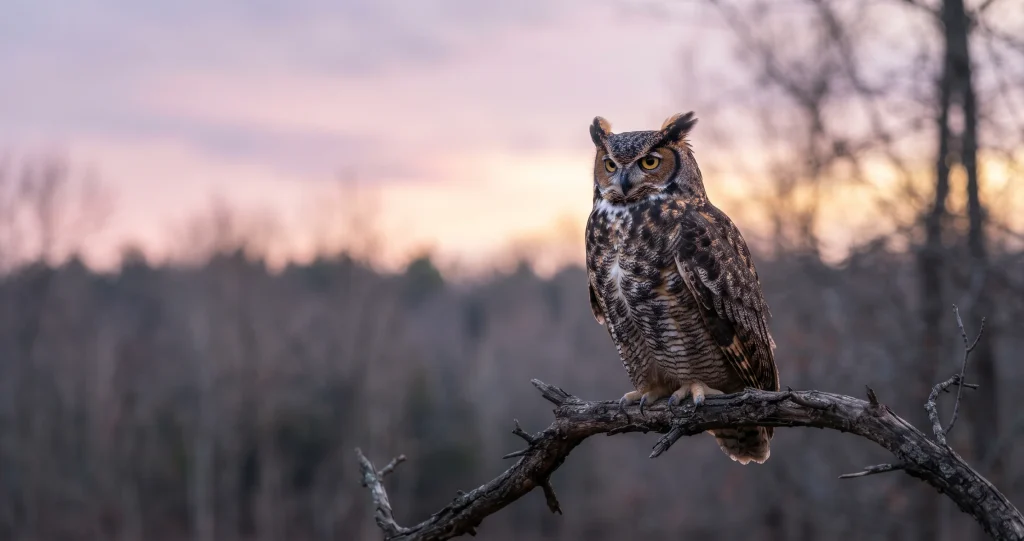
One of the most interesting facts about Great Horned Owls is that they generally do not construct elaborate stick nests of their own.
Instead, they frequently reuse structures built by other large birds.
This behavior saves the effort of gathering and arranging an entirely new nest.
Reusing Hawk Nests
Old nests built by Red-tailed Hawks and other large raptors are common nesting options.
These structures often sit high in mature trees and contain a substantial platform of sticks.
Great Horned Owls may occupy a suitable abandoned nest before its original builder returns for the next breeding season.
Because owls begin nesting early, they sometimes gain access to nests while other raptors are not yet breeding.
Crow and Heron Nests
Large crow nests may occasionally provide nesting platforms.
Old heron nests can also be used, particularly in areas where large trees and former heron colonies are available.
The suitability of a nest depends on its size, stability, location, and condition.
Not every abandoned nest is strong enough to support an adult owl and growing chicks.
Other Nesting Locations
Great Horned Owls are adaptable and may also use tree cavities, broken tree tops, cliff ledges, and occasionally human-made structures.
Some nest on the ground in locations where suitable elevated sites are unavailable.
Their flexibility helps explain their broad geographic distribution.
When Great Horned Owls Lay Their Eggs
Egg-laying dates vary considerably across North America.
In much of the United States, January and February are common months for laying eggs.
In some southern regions, nesting may begin earlier, while northern populations may start later.
Local climate, food availability, and individual pair behavior all influence timing.
How Many Eggs Are Laid?
Great Horned Owls commonly lay about two eggs.
Clutches may be smaller or larger, and the number varies among nesting attempts.
The eggs are generally white and rounded.
They are laid in the chosen nest without the elaborate soft lining used by many smaller birds.
Why Winter Eggs Are Surprising
A winter nest may be exposed to freezing temperatures, snow, and strong winds.
Yet the developing embryos require relatively stable warmth.
The female’s incubation behavior provides that warmth.
This makes uninterrupted parental attendance particularly important during cold weather.
How Great Horned Owl Eggs Survive Cold Weather
Incubation generally lasts about a month, commonly around 30–37 days.
During this period, the female spends much of her time sitting on the eggs.
Her body heat maintains the conditions needed for embryonic development.
The Female’s Incubation Role
Female Great Horned Owls perform most, if not essentially all, of the incubation.
They position themselves over the eggs and adjust their posture to maintain contact.
Their insulating feathers help reduce heat loss.
However, incubation is demanding because the female must remain attentive through cold nights and changing weather.
The Male Supplies Food
While the female incubates, the male typically hunts and brings prey to her.
This arrangement allows the female to remain at the nest for extended periods.
The male may deliver small mammals, birds, or other prey depending on local availability.
Food deliveries are especially important when severe weather makes hunting difficult.
What Happens During Snowstorms?
Great Horned Owls can continue incubating during winter storms.
The female may remain settled over the eggs while snow accumulates around the nest.
Nevertheless, storms can create serious challenges, particularly if the nest is exposed or food becomes difficult to obtain.
Not every nesting attempt succeeds.
Weather, prey abundance, nest stability, and disturbance can all affect outcomes.
The Female and Male Owl’s Roles
Great Horned Owl parents perform different but complementary tasks.
Their cooperation continues beyond incubation.
The Female Protects the Young
After hatching, the female spends considerable time brooding the chicks.
Young owlets cannot regulate their body temperature as effectively as adults during their earliest days.
The female shelters them with her body and helps protect them from exposure.
As the chicks grow and become better insulated, she can spend more time away from the nest.
The Male Hunts for the Family
The male remains an important food provider during the early nestling period.
He captures prey and delivers it to the female or nest area.
The female may tear food into smaller pieces for young chicks.
As the owlets develop, both parents contribute to feeding and protecting them.
Defense of the Nest
Great Horned Owls can defend their nests vigorously.
Adults may react aggressively to animals or people approaching too closely.
Their powerful talons make direct contact dangerous.
This is one reason nest observation should always take place from a considerable distance.
How Great Horned Owl Chicks Develop
Great Horned Owl chicks hatch covered in pale down.
Their eyes are initially closed, and they depend completely on their parents.
Over the following weeks, they become more alert, develop stronger muscles, and begin replacing their down with juvenile feathers.
The First Weeks
Young owlets spend much of their time resting, feeding, and growing.
Their parents provide food and protection.
As the chicks become larger, they may sit upright and begin exploring the edges of the nest.
Their appearance changes rapidly as facial features and developing feathers become more distinct.
Leaving the Nest Before Flying Well
Great Horned Owl young may leave the nest at roughly six to seven weeks of age, although timing varies.
At this stage, they may climb onto nearby branches or move around the nest tree.
These young birds are sometimes called branchers.
They are not necessarily capable of strong, sustained flight.
This behavior can surprise observers who assume a young owl outside the nest must have fallen.
Learning to Fly and Hunt
Flight ability develops gradually after the branching stage.
Young owls continue practicing movement and short flights while receiving food from their parents.
Even after they become capable of flying, they may remain dependent on adults for several months.
Learning to capture prey successfully takes time.
This extended development helps explain why the breeding season begins so early.
Why Early Nesting Gives Owlets an Advantage
The timing of great horned owl nesting is closely connected to the species’ long period of juvenile development.
By hatching in late winter or early spring, young owls have several months to grow and practice essential survival skills.
Preparing for Independence
A young owl must eventually locate prey, approach it quietly, capture it, and handle it successfully.
These skills require coordination and experience.
Beginning life early in the year provides time for practice before the next cold season.
However, the precise evolutionary advantages of early nesting are complex and cannot be attributed to one factor alone.
Access to Spring Food
As spring arrives, many prey species become more active.
Small mammals, birds, and other animals may become more available in some habitats.
This seasonal change can help support the increasing food demands of growing owlets.
Still, food availability varies widely by region and year.
Early nesting does not guarantee that prey will be abundant.
Reduced Competition for Nest Sites
Because Great Horned Owls often occupy existing nests before many other large birds begin breeding, early nesting may influence access to suitable structures.
However, nest availability is only one part of the species’ breeding ecology.
The owls’ timing also reflects their reproductive development and the lengthy period required to raise young.
How to Spot a Great Horned Owl Nest
Finding a Great Horned Owl nest can be rewarding, but it requires patience and careful observation.
The safest approach is to look for indirect signs rather than searching aggressively through occupied habitat.
Listen for Repeated Hooting
Deep hooting during late fall and winter may indicate a territorial pair.
Listen from public trails or other permitted locations.
Repeated calls from a wooded area can help identify a general territory.
However, calling locations do not always reveal the exact nest tree.
Look for Large Stick Nests
During winter, leafless deciduous trees make old hawk and crow nests easier to see.
Scan the upper branches of mature trees with binoculars.
A large owl sitting low in a stick nest may be incubating.
Do not approach simply to confirm whether eggs are present.
Watch for Adult Activity
An adult owl repeatedly visiting the same tree may indicate nesting activity.
Food deliveries can be another clue.
Observing these movements from a distance is preferable to approaching the nest.
Avoid following birds closely or forcing them to reveal the nest location.
Notice the Owl’s Silhouette
Great Horned Owls have large, rounded bodies and prominent feather tufts on their heads.
These tufts resemble horns but are not ears.
An incubating owl may be difficult to see because much of its body remains below the nest rim.
Sometimes only the head and feather tufts are visible above the sticks.
How to Watch Owl Nests Without Disturbing Them
Ethical observation is essential because nesting owls can be sensitive to repeated human activity.
A photograph is never worth causing a parent to abandon its normal behavior.
Keep a Generous Distance
Use binoculars or a telephoto lens to observe from a distance that does not change the birds’ behavior.
There is no single safe viewing distance for every nest.
Terrain, visibility, nesting stage, and the owls’ responses all matter.
If an adult becomes visibly agitated, repeatedly calls in alarm, or changes its behavior because of your presence, move farther away.
Avoid Flash and Artificial Lighting
Do not shine bright lights into an occupied nest.
Avoid flash photography, particularly at night.
Natural daylight and long-distance observation are safer choices.
Never Approach the Nest Tree
Climbing a nest tree or attempting to inspect eggs and chicks can create serious risks.
It may disturb the adults, expose young birds to weather, or cause defensive attacks.
Avoid drones near occupied nests unless a properly authorized research program specifically permits their use.
Protect Nest Locations
Sharing the exact location of an active nest can attract crowds.
Heavy visitation may disturb the birds or damage surrounding habitat.
Consider keeping sensitive locations private, especially when nests are easily accessible.
Common Misunderstandings About Winter Owl Nesting
One common misconception is that an owl sitting in a snowy tree must be struggling to survive.
Great Horned Owls are naturally adapted to winter conditions and can begin breeding during cold weather.
Another misunderstanding is that they build their own large stick nests.
Although they may modify existing structures slightly, they typically rely on nests built by other birds or use alternative nesting sites.
Some observers assume that an owlet outside its nest has been abandoned.
In reality, branching is a normal developmental stage.
A young owl perched near the nest may still be receiving regular parental care.
Finally, seeing a Great Horned Owl during daylight does not automatically mean the bird is sick.
Adults may be visible near nesting sites during the day, especially when guarding or attending young.
Frequently Asked Questions
Why do Great Horned Owls nest during winter?
Their early breeding schedule allows young owls time to develop before becoming independent. The species’ long period of parental care is an important factor, although nesting timing varies with climate and local conditions.
What month do Great Horned Owls lay eggs?
January and February are common egg-laying months across much of the United States. Some southern populations begin earlier, while northern birds may nest later.
Do Great Horned Owls build their own nests?
Usually not. They frequently reuse old hawk, crow, or heron nests. They may also use tree cavities, broken tree tops, cliffs, and other suitable sites.
How long do Great Horned Owl eggs take to hatch?
Incubation generally lasts around 30–37 days, or approximately one month. The female performs most of the incubation while the male provides food.
What should I do if I find a young owl on the ground?
Keep people and pets away and observe from a safe distance. Some young owls leave the nest before they can fly well, and their parents may still be caring for them. If the bird is visibly injured or in immediate danger, contact a licensed wildlife rehabilitator for guidance.
Is it safe to photograph an active owl nest?
Yes, when photography takes place from a distance that does not disturb the birds. Use a telephoto lens, avoid flash and drones, and leave immediately if the adults show signs of distress.
Conclusion
Great Horned Owls are among the earliest nesting birds in North America, beginning their breeding season while much of the landscape remains locked in winter.
Their deep courtship calls, preference for reused stick nests, attentive incubation, and extended parental care make their reproductive cycle especially fascinating.
Understanding great horned owl nesting helps explain why these powerful predators can raise young successfully during a season that seems unsuitable for most birds.
For wildlife enthusiasts, the best approach is to listen carefully, observe from a respectful distance, and allow these remarkable owls to complete their nesting cycle without interference.
Internal Sources
1. how suitable nesting structures can support certain owl species how an owl nest box can help control rodents naturally.
External Sources
1. Great Horned Owl
Species identification, habitat, nesting, breeding behavior, and natural history.
Cornell Lab — Great Horned Owl
2. Great Horned Owl
Information on courtship, nesting locations, eggs, incubation, and young owl development. Audubon — Great Horned Owl Field Guide
3. Bubo virginianus
University of Michigan educational species account covering reproduction, parental care, habitat, and behavior. Animal Diversity Web — Great Horned Owl