
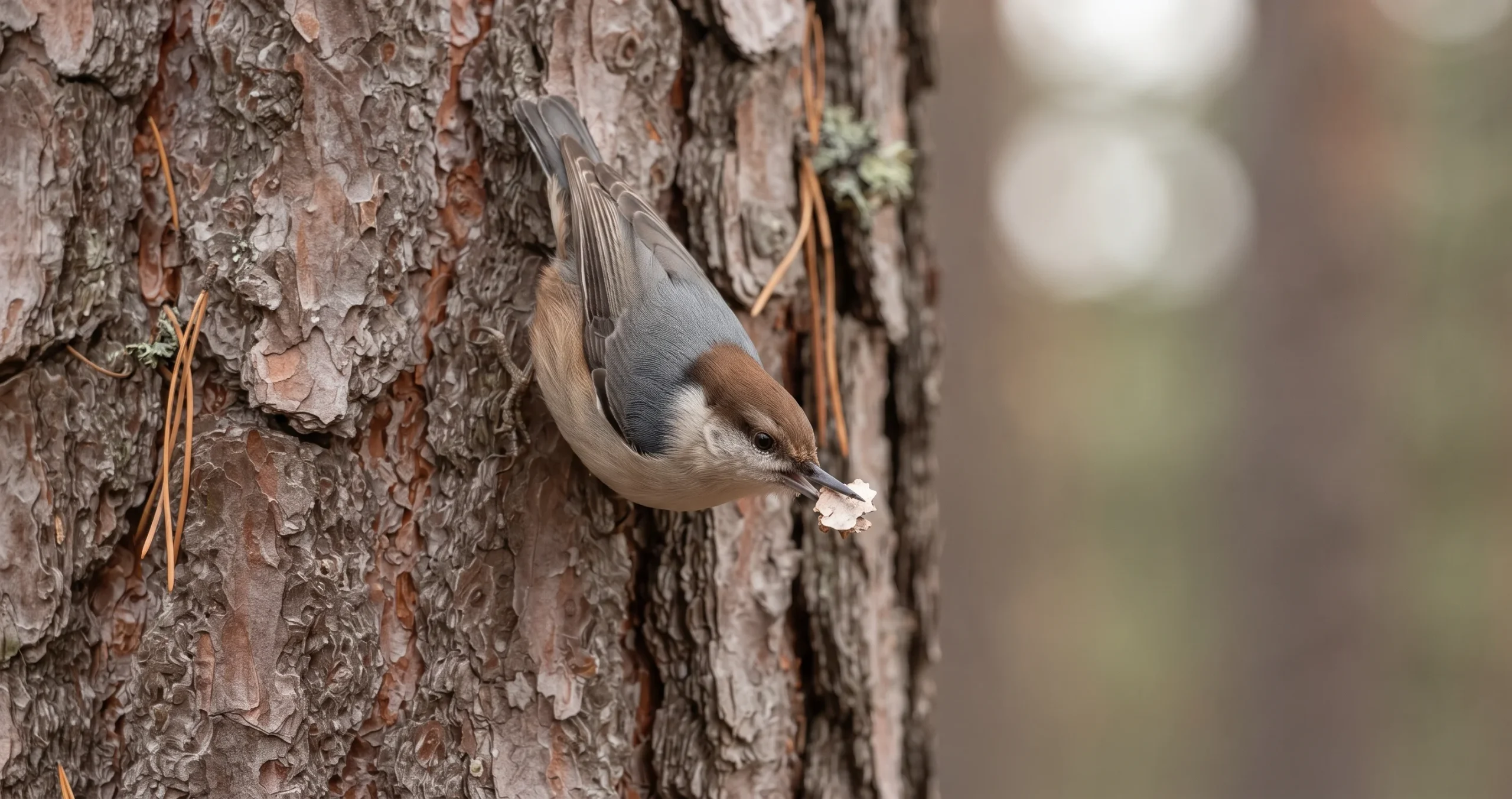
Imagine a tiny bird clinging to the rough trunk of a pine tree. It pauses, picks up a loose piece of bark, and uses that fragment to pry at another section of bark. Hidden beneath the surface may be an insect, a spider, or another small food item.
This remarkable behavior belongs to the brown-headed nuthatch, one of the most interesting little birds living in the pine forests of the southeastern United States. Although it measures only about four inches long, it has demonstrated a skill that many people associate mainly with primates and crows: using an object as a tool.
The brown-headed nuthatch is also an important part of southern pine ecosystems. It searches for insects among bark crevices, excavates nesting cavities in dead wood, and depends on habitats that have changed considerably through logging, development, and altered fire regimes.
Understanding this bird reveals how intelligence, specialized behavior, and forest conservation can come together in a surprisingly small package.
Table of Contents
- What Is the Brown-Headed Nuthatch?
- Where Brown-Headed Nuthatches Live
- How the Brown-Headed Nuthatch Uses a Bark Tool
- Why Tool Use in Birds Is So Remarkable
- How Brown-Headed Nuthatches Find Food
- Nesting in Dead Pine Snags
- Family Groups and Cooperative Breeding
- Habitat Threats and Conservation
- How to Attract Brown-Headed Nuthatches
- How to Help Protect This Species
- Frequently Asked Questions
What Is the Brown-Headed Nuthatch?
The brown-headed nuthatch (Sitta pusilla) is a small songbird native to the southeastern United States. It belongs to the family Sittidae, a group of birds known for climbing along tree trunks and branches while searching for food.
Unlike woodpeckers, which commonly use their tails for support when climbing, nuthatches can move headfirst down trunks with remarkable agility.
How to identify this tiny bird
Adult brown-headed nuthatches have a warm brown crown, a blue-gray back, and pale underparts.
A small white patch on the back of the head can be visible from certain angles.
Their bills are narrow and pointed, helping them probe bark crevices and handle small food items.
At approximately 3.5–4.5 inches long, they are among North America’s smallest nuthatches.
Their compact bodies and quick movements can make them difficult to follow as they move through pine branches.
A surprisingly distinctive voice
The bird’s call is often described as a series of high-pitched squeaks resembling a small rubber toy.
These sounds help individuals communicate while foraging or moving through the forest.
Learning the call can be more useful than searching visually for the bird.
In suitable habitat, a sequence of squeaky notes overhead may reveal a brown-headed nuthatch before it becomes visible.
A bird closely tied to pine trees
Although the species may visit neighboring habitats, it is especially associated with mature and open pine woodlands.
Its feeding and nesting behaviors are closely connected to pine bark, pine seeds, and dead or decaying wood.
This specialization makes habitat quality particularly important to its survival.
Where Brown-Headed Nuthatches Live
The species occurs across portions of the southeastern United States, including areas of the Atlantic Coastal Plain and Gulf Coast region.
Its distribution extends through suitable pine habitats from parts of the Carolinas southward into Florida and westward along the Gulf Coast.
Open pine forests
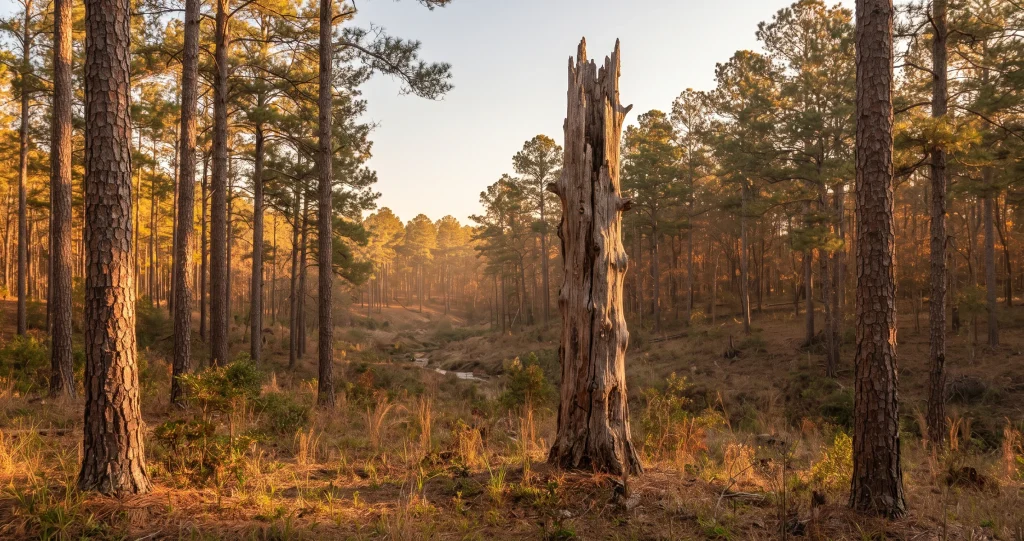
Brown-headed nuthatches are strongly associated with open pine stands, including longleaf pine ecosystems.
Historically, many southeastern pine landscapes were maintained by frequent, low-intensity fires.
These fires helped limit dense hardwood undergrowth while allowing fire-adapted pines and ground-layer vegetation to persist.
The resulting open woodland structure provides important conditions for a variety of specialized wildlife.
Why mature trees matter
Older pine stands often contain larger trees, more varied bark surfaces, and opportunities for deadwood to develop.
These features can provide feeding sites and nesting material.
The bird is not restricted exclusively to untouched old-growth forests, but suitable stand structure and available nesting sites are important.
Young, densely planted pine stands may offer fewer opportunities when deadwood and open conditions are absent.
A mostly resident species
Unlike long-distance migratory songbirds, brown-headed nuthatches generally remain within their regional range throughout the year.
They may travel locally in search of food or suitable habitat.
Because they are largely resident, the condition of southeastern pine forests matters across all seasons.
They cannot simply depend on distant breeding or wintering grounds to replace lost local habitat.
How the Brown-Headed Nuthatch Uses a Bark Tool
One of the species’ most extraordinary behaviors is its documented use of loose bark as a tool.
This is not merely a bird carrying nesting material or accidentally moving a fragment of wood.
In reported observations, individuals have deliberately manipulated bark pieces to help loosen other bark or reach material beneath it.
The bark-flake technique
A bird may pick up a small, detached piece of bark with its bill.
It then uses the fragment to probe, lift, or pry at another piece of bark.
This action can expose small organisms or concealed material that would otherwise be difficult to reach.
The bark fragment functions as an external implement, extending what the bird can accomplish with its bill alone.
Why this counts as tool use
Scientists use several definitions of animal tool use, but most involve manipulating an external object to achieve a specific result.
Using a detached bark fragment to pry another surface fits widely used descriptions of tool-assisted foraging.
However, not every brown-headed nuthatch has been observed performing this behavior.
It should be described as a documented capability of the species rather than something every individual does routinely.
Is the behavior learned?
The exact developmental mechanisms behind bark-tool use in this species are not fully established.
Observational reports demonstrate the behavior, but they do not prove how every bird acquires it.
Experience, individual experimentation, and opportunities provided by the environment may influence whether tool use occurs.
Scientists distinguish between documenting a behavior and demonstrating how it is learned or transmitted.
Why a tiny tool makes a difference
A loose bark fragment may seem insignificant, but it can help an animal interact with surfaces in ways its body alone might not allow.
The behavior illustrates how simple objects can become useful in the right ecological context.
It also challenges the assumption that sophisticated object manipulation is limited to large-brained mammals.
Why Tool Use in Birds Is So Remarkable
Birds have evolved a wide range of behaviors involving object manipulation.
Some use tools to obtain food, while others use objects during nest construction or courtship.
New Caledonian crows
New Caledonian crows are well known for making and using tools to extract insects and other prey from difficult-to-reach places.
They can manipulate sticks and plant materials into functional implements.
Research on these birds has helped scientists investigate problem-solving and tool manufacture.
Woodpecker finches
Woodpecker finches of the Galápagos Islands are another classic example.
They may use twigs or cactus spines to extract insect larvae from crevices.
Their behavior demonstrates how a bird can compensate for the absence of a woodpecker-like probing tongue.
Egyptian vultures
Egyptian vultures have been observed using stones to break open large eggs.
This is a different form of tool use because the object acts as an impact tool rather than a probe.
It illustrates how tool use can evolve in very different feeding contexts.
What makes the nuthatch unusual
The brown-headed nuthatch is particularly interesting because its tool is a simple fragment of the same material it is investigating.
The bark fragment is both readily available and suited to the task.
Its example reminds us that animal intelligence cannot be judged solely by body size or whether a species uses tools frequently.
How Brown-Headed Nuthatches Find Food
Most of the bird’s feeding activity involves ordinary probing and searching rather than tool use.
It moves rapidly over pine trunks, branches, and clusters of needles, inspecting surfaces for food.
Searching beneath bark
Small insects, spiders, and other arthropods can shelter in bark crevices.
The nuthatch uses its narrow bill to investigate these spaces.
It may remove loose bark or inspect cracks while moving along a trunk.
This behavior makes the bird part of the forest’s network of insect-eating wildlife.
Pine seeds and seasonal food
Brown-headed nuthatches also consume pine seeds.
Their diet changes with food availability and seasonal conditions.
Seeds can become particularly important when insect activity is reduced.
The species may store food items for later consumption, a behavior known as caching.
Moving headfirst down trees
Nuthatches are famous for descending trunks headfirst.
Their strong feet and claws help them maintain a secure grip while moving in different directions.
This movement pattern allows them to inspect bark surfaces from angles that other birds may use less frequently.
It is one reason nuthatches are so entertaining to watch.
Nesting in Dead Pine Snags
Dead trees are not simply waste material in a forest.
For brown-headed nuthatches, standing dead wood can provide essential nesting opportunities.
Excavating a nesting cavity
The species often excavates nest cavities in dead or decaying wood, including pine snags.
Its small bill is suited to working softer, deteriorated wood rather than drilling deeply into hard, healthy trunks.
Both members of a breeding pair may participate in cavity excavation.
The completed nest provides a sheltered location for eggs and developing chicks.
Why deadwood matters
Removing every dead tree from a woodland can reduce available nesting sites.
Many other animals also depend on standing deadwood, including woodpeckers, insects, and cavity-nesting birds.
In suitable locations, retaining safe snags supports habitat complexity.
However, dead trees near homes, roads, or heavily used paths can present falling hazards.
Safety assessments should always take priority in those situations.
Nest boxes as an alternative
Brown-headed nuthatches may use appropriately designed nest boxes in suitable pine habitat.
Boxes should have dimensions and entrance sizes appropriate for small cavity-nesting birds.
Placement, predator protection, and maintenance also affect their usefulness.
A nest box cannot fully replace a healthy pine woodland, but it can provide additional nesting opportunities where suitable natural cavities are limited.
Family Groups and Cooperative Breeding
Another unusual aspect of brown-headed nuthatch biology is cooperative breeding.
In some groups, additional birds assist a breeding pair with raising young.
Helpers at the nest
These helpers are often related to the breeding adults.
They may assist with feeding nestlings or other parental activities.
Cooperative breeding occurs in several bird species, but it is not universal among North American songbirds.
Its presence makes the brown-headed nuthatch especially interesting to behavioral ecologists.
Why cooperation may help
Additional helpers can increase the amount of food delivered to young under some circumstances.
They may also contribute to nest defense or other activities.
However, the benefits of cooperative breeding vary with environmental conditions and group composition.
Scientists continue to study how these social arrangements affect reproductive success.
Small birds with complex social lives
The combination of tool-assisted foraging and cooperative breeding shows that the species has more behavioral complexity than its size might suggest.
Its social interactions are an important part of its natural history.
Observing a family group moving through pine branches can reveal communication and coordinated activity that might otherwise go unnoticed.
Habitat Threats and Conservation
The brown-headed nuthatch depends on southeastern pine ecosystems that have undergone extensive changes.
Historical conversion of longleaf pine landscapes, development, altered forest management, and changes in fire frequency have affected habitat availability.
Loss of open pine woodland
Large areas of natural pine habitat have been converted to other land uses or replaced with different forest structures.
Some remaining stands are fragmented.
Fragmentation can isolate groups and reduce access to suitable feeding and nesting locations.
Because the species is generally resident, maintaining connected local habitat is particularly valuable.
Fire suppression changes habitat
In many southeastern pine ecosystems, periodic fire historically helped maintain open conditions.
When fire is excluded for long periods, dense hardwood vegetation can develop.
This can alter the habitat structure used by pine-specialist birds.
Conservation programs may use carefully planned prescribed burning to restore suitable conditions.
Such work should be conducted by trained professionals under appropriate regulations.
The importance of standing deadwood
Intensive removal of snags can reduce nesting opportunities.
Where safety permits, retaining dead pine stems can benefit cavity-nesting wildlife.
Forest managers may also create or maintain suitable nesting structures as part of broader habitat restoration.
Conservation requires habitat-scale action
Bird feeders and nest boxes can help locally, but they cannot replace extensive, functioning pine ecosystems.
Long-term conservation depends on protecting and restoring suitable woodland.
Land management that maintains appropriate pine structure, nesting resources, and ecological processes can support the species and many other native organisms.
How to Attract Brown-Headed Nuthatches
Gardeners and homeowners within the species’ natural range may be able to make their properties more suitable.
The most effective approach begins with habitat rather than feeders alone.
Preserve suitable pine trees
Mature native pines can provide food, cover, and foraging surfaces.
Where possible, retain healthy pine trees and avoid unnecessary removal.
If a property includes suitable woodland, maintaining a varied structure can support more wildlife than replacing it with extensive lawn.
Offer appropriate food
Brown-headed nuthatches may visit feeders offering sunflower seeds or suet.
Use fresh food and clean feeders regularly.
Feeder visits depend on local populations, habitat, and seasonal food availability.
Even a well-maintained feeder may not attract the species if suitable pine habitat is absent.
Provide safe nesting opportunities
In appropriate habitat, a species-specific nest box may be useful.
Follow established guidance for entrance dimensions, mounting height, and predator protection.
Monitor boxes responsibly without repeatedly disturbing nesting birds.
Remove old nesting material only when appropriate for the species and local conditions.
Reduce avoidable hazards
Keep domestic cats indoors or in secure outdoor enclosures.
Minimize pesticide use where practical and manage pests through targeted, evidence-based methods.
Prevent window collisions using effective external window treatments.
These measures can benefit many birds, not only brown-headed nuthatches.
How to Help Protect This Species
Supporting brown-headed nuthatches involves more than attracting individual birds to a backyard.
Healthy populations depend on functioning pine ecosystems across the southeastern landscape.
Support pine habitat restoration
Conservation organizations and land managers work to restore longleaf pine and other suitable open pine habitats.
These efforts may include native pine planting, prescribed fire, and management of competing vegetation.
Restoration benefits a broader community of plants and animals adapted to these environments.
Participate in bird monitoring
Community science programs can help document where birds occur and how their populations change.
Reporting observations through established platforms contributes information that researchers can analyze alongside other data.
Accurate identification and location details improve the usefulness of these records.
Share accurate wildlife information
The bark-tool behavior is fascinating enough without exaggeration.
Not every brown-headed nuthatch has been observed using a tool, and the behavior should not be presented as universal.
Explaining what scientists have actually documented helps readers appreciate the species while maintaining trust in wildlife education.
Frequently Asked Questions
Do brown-headed nuthatches really use tools?
Yes. Brown-headed nuthatches have been observed using detached bark fragments to help pry or lift other bark while foraging. However, this behavior is not necessarily performed by every individual and should not be described as their primary feeding method.
Where can you find brown-headed nuthatches?
They live primarily in suitable pine forests of the southeastern United States. Open pine woodlands with mature trees, foraging opportunities, and deadwood for nesting are especially important.
How can I attract brown-headed nuthatches to my yard?
Properties within their natural range may attract them by retaining native pines, providing suitable nest boxes, and offering clean feeders with appropriate foods. Habitat quality is more important than any single feeder or nesting structure.
Conclusion
The brown-headed nuthatch is a remarkable example of how complex animal behavior can appear in a very small bird.
Its documented use of bark fragments as tools reveals a specialized way of interacting with the forest environment, while its headfirst climbing, cavity nesting, and cooperative family groups add further layers to its natural history.
Yet this tiny bird’s future depends on something much larger: the survival of suitable southeastern pine woodlands.
Protecting mature pines, retaining safe deadwood, and supporting responsible habitat management can help preserve the places where these birds live.
For anyone exploring a southern pine forest, a series of squeaky calls overhead may be the first clue that one of North America’s most unusual little songbirds is nearby.
External Sources
1. Brown-headed Nuthatch Life History
Cornell directly documents the bird’s use of bark fragments to pry away loose bark, along with its preference for mature, open pine forests and nesting in dead wood. Cornell Lab of Ornithology
2. Brown-headed Nuthatch Field Guide
Audubon describes bark-tool use, insect foraging, nest excavation, and the additional helpers sometimes involved in raising chicks. National Audubon Society.
3. The Use of Tools by Brown-Headed Nuthatches (1968)
This peer-reviewed field study documents birds using detached pine bark scales as wedges and levers to remove other bark, exposing potential prey. It is particularly valuable because it provides primary evidence for the article’s central claim. Douglass H. Morse.