
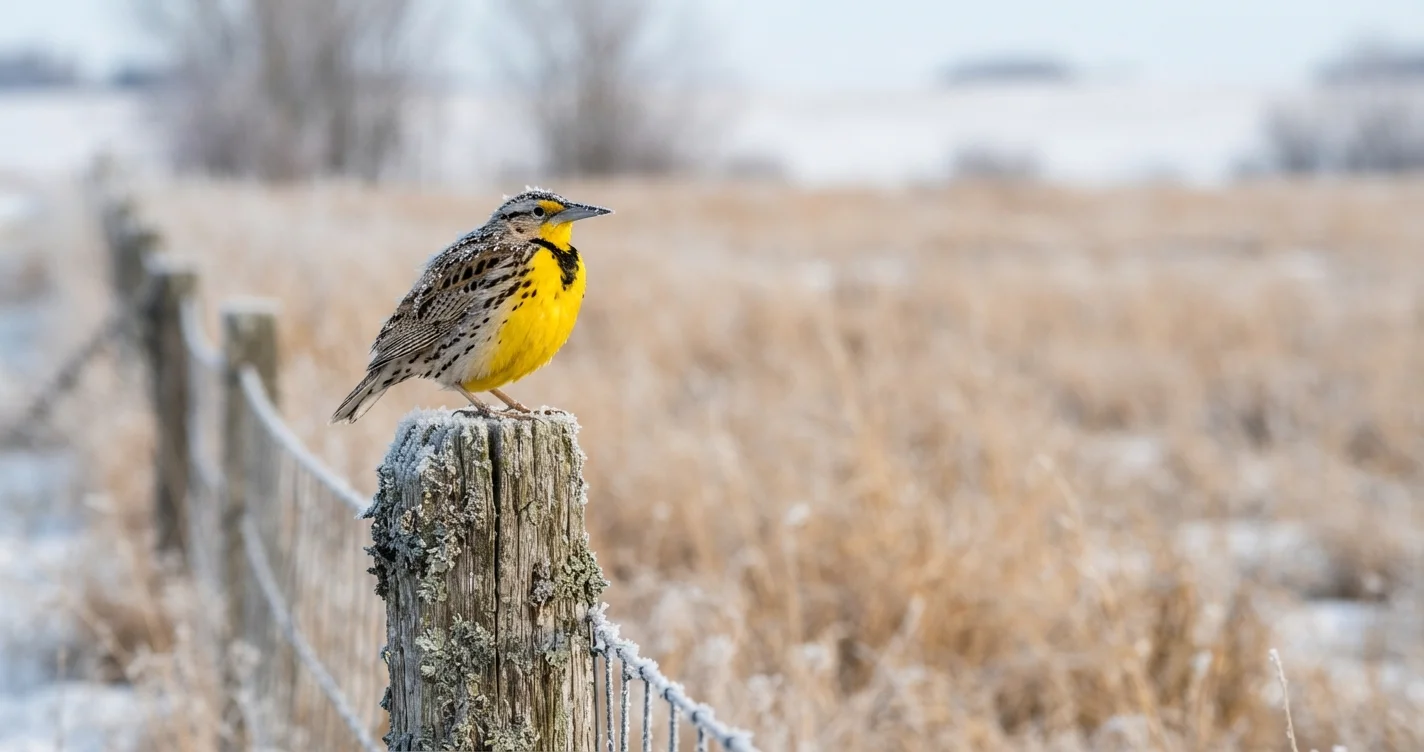
A quiet winter field may appear almost deserted until a group of brown birds suddenly rises from the dry grass. As they turn in flight, flashes of white tail feathers and golden-yellow breasts reveal an unexpected splash of color in the dormant landscape.
Among these birds may be the eastern meadowlark (Sturnella magna), a distinctive grassland species that changes its behavior as winter approaches.
While spring meadowlarks are famous for their clear, musical songs, winter brings a quieter chapter in their lives. Many individuals gather in loose flocks, search for seeds among dormant vegetation, and move across open fields in response to changing weather and food availability.
For wildlife enthusiasts, winter offers a fascinating opportunity to observe a different side of this remarkable American grassland bird.
Table of Contents
- Meet the Eastern Meadowlark
- Where Eastern Meadowlarks Spend the Winter
- Eastern Meadowlark Winter Behavior: The Science Behind Flocking
- How to Identify Eastern Meadowlarks in Winter
- Eastern vs. Western Meadowlarks
- What Meadowlarks Eat During Winter
- The Importance of Open Fields and Winter Grasslands
- In Your Own Yard: Supporting Grassland Birds
- Frequently Asked Questions
Meet the Eastern Meadowlark
Despite its name, the eastern meadowlark is not a true lark. It belongs to the blackbird family, Icteridae, which also includes orioles, grackles, and red-winged blackbirds.
Its striking yellow breast, dark V-shaped chest marking, and brown patterned back make it one of North America’s most recognizable grassland birds.
Eastern meadowlarks inhabit a variety of open landscapes, including pastures, hayfields, prairies, agricultural land, and grassy meadows.
A Bird Built for Life Among Grasses
The meadowlark’s relatively long bill, sturdy legs, and patterned upperparts are well suited to ground-level activity.
Its brown and buff feathers blend into dry grasses, helping conceal the bird while it searches for food or rests among vegetation.
During winter, this camouflage becomes particularly effective as fields turn golden brown and green vegetation disappears.
Seasonal Changes in Behavior
During spring and early summer, male meadowlarks frequently sing from fence posts, shrubs, and other elevated perches.
Winter behavior is often considerably less conspicuous.
Instead of defending breeding territories and singing regularly, meadowlarks may gather in groups and spend much of the day feeding on the ground.
Where Eastern Meadowlarks Spend the Winter
Eastern meadowlarks occur throughout much of the eastern and central United States, although their seasonal distribution varies by region.
The species is considered a partial migrant, meaning that some populations migrate while others remain in suitable habitats throughout the year.
Northern Populations Move South
Birds breeding in colder northern regions often move toward areas with milder winter conditions.
Snow cover and frozen ground can restrict access to insects and seeds, making southern grasslands more favorable during the colder months.
Migration distances vary considerably among individuals and populations.
Southern Populations May Remain Year-Round
Across parts of the southeastern United States, eastern meadowlarks can occupy suitable open habitats throughout the year.
Winter populations may include both resident birds and migrants arriving from farther north.
As a result, some southern fields become particularly interesting places to observe meadowlark groups during winter.
Productive Places to Look
During the colder months, promising locations include:
- Livestock pastures with mixed grass heights.
- Dormant hayfields and native prairies.
- Agricultural fields with leftover grain.
- Conservation areas with extensive grasslands.
- Open meadows with scattered fence posts.
Fields with accessible ground and abundant natural food often attract more activity than areas covered by persistent, deep snow.
Eastern Meadowlark Winter Behavior: The Science Behind Flocking
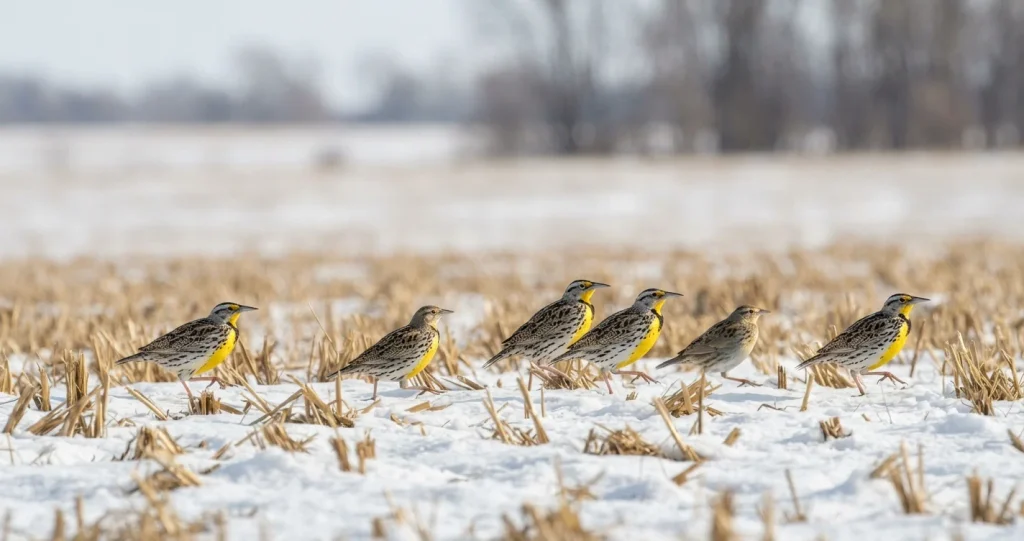
One of the most interesting seasonal changes among meadowlarks is the transition from territorial breeding behavior to communal winter feeding.
According to the Cornell Lab of Ornithology, winter flocks can occasionally contain up to 200 meadowlarks. All About Birds
Finding Food Together
During winter, food becomes increasingly unevenly distributed across the landscape.
One section of a field might contain abundant seeds, while another offers very little nourishment.
Moving in groups may help birds locate productive feeding areas by observing the activity of other individuals.
When several birds discover a promising patch of vegetation, others may gather nearby.
Improving Awareness of Predators
Open grasslands provide relatively few elevated hiding places.
Meadowlarks must remain alert to predators such as hawks while searching for food.
Flocking can offer potential advantages because multiple individuals may detect approaching threats more readily than a solitary bird.
However, larger groups can also attract the attention of predators.
Meeting Winter Energy Demands
Like other birds, meadowlarks must expend energy to maintain their body temperature during cold weather.
Shorter days also reduce the amount of time available for feeding.
Seeds and leftover agricultural grains provide valuable seasonal food when insects become less abundant.
Access to productive feeding grounds can therefore be particularly important during prolonged cold spells.
The Role of Winter Plumage
Eastern meadowlarks often appear less colorful during winter than during the breeding season.
Paler feather edges can partially obscure their distinctive chest markings, creating a more subdued appearance.
Combined with their patterned backs, this seasonal coloration makes them remarkably difficult to detect among dormant grasses.
How to Identify Eastern Meadowlarks in Winter
Recognizing meadowlarks requires more than simply looking for a yellow breast.
Their shape, movement, and flight patterns provide several useful identification clues.
Look for Five Distinctive Features
- Yellow breast: Often paler during the nonbreeding season.
- Black chest marking: A characteristic V-shaped pattern.
- Streaked back: Brown, buff, and dark markings provide camouflage.
- Long, pointed bill: Adapted for ground-level foraging.
- White outer tail feathers: Particularly noticeable during flight.
Adult eastern meadowlarks typically measure approximately 7.5–10.2 inches in length. All About Birds
Watch How They Fly
Meadowlarks often alternate rapid wingbeats with brief glides.
When moving between feeding locations, they frequently remain relatively close to the ground.
A flock rising from dormant vegetation may reveal conspicuous white flashes along the edges of the birds’ tails.
These flashes are especially useful when observing birds from a distance.
Listen for Calls
Although meadowlarks are generally less vocal during winter, they may still produce short, buzzy calls and rattling alarm sounds.
Familiarizing yourself with recordings before visiting a grassland can make identification easier.
Eastern vs. Western Meadowlarks
The eastern meadowlark closely resembles the western meadowlark (Sturnella neglecta).
Both species have yellow underparts, patterned brown backs, and dark chest markings.
Their similarities can make visual identification challenging, particularly during winter.
| Characteristic | Eastern meadowlark | Western meadowlark |
|---|---|---|
| Scientific name | Sturnella magna | Sturnella neglecta |
| Main US range | Eastern and central states | Western and central states |
| Typical habitat | Often moister grasslands | Often drier grasslands |
| Song | Clear, relatively simple whistles | More complex, flutelike notes |
| Facial markings | Generally less yellow in the malar area | Often more yellow in the malar area |
| Winter behavior | Flock formation | Flock formation |
In regions where their ranges overlap, vocalizations are often more reliable than plumage alone.
Birdwatchers should also be aware of the Chihuahuan meadowlark, which was recognized as a separate species in 2022. Audubon Field Guide
What Meadowlarks Eat During Winter
The meadowlark’s changing seasonal diet illustrates its ability to adapt to fluctuating food availability.
Seeds and Leftover Grain
During colder months, meadowlarks frequently consume plant-based foods, including ragweed seeds, spilled corn, and other agricultural grains.
Wild fruits may also supplement their diet.
Fields containing standing seed heads and scattered grain can provide important seasonal feeding opportunities.
Insects Remain Valuable
Although insects become less abundant during winter, meadowlarks continue searching for accessible invertebrates when conditions permit.
Mild weather may make some insects easier to locate near the soil surface.
An Unusual Way of Finding Food
Meadowlarks use a remarkable feeding technique known as gaping.
They insert their closed bills into soil or vegetation before opening them to expose concealed food.
This behavior allows them to uncover small organisms that other birds might overlook. All About Birds
By watching feeding meadowlarks through binoculars, you may observe them repeatedly probing the ground as they move through a field.
The Importance of Open Fields and Winter Grasslands
A dormant meadow may look unproductive to human eyes, yet its vegetation can provide valuable resources for wildlife throughout winter.
Standing Grasses Provide Natural Shelter
Uncut grasses can help create sheltered spaces near ground level.
Their stems and leaves provide concealment, while patches of shorter vegetation offer more accessible feeding areas.
A mixture of vegetation heights may support a wider variety of grassland birds.
Agricultural Fields Can Provide Seasonal Food
Harvested fields sometimes contain leftover grain that becomes available to wintering wildlife.
However, the ecological value of agricultural landscapes varies according to management practices, pesticide use, and the availability of nearby natural habitat.
The Disappearance of Grassland Habitats
Urban development, intensive agriculture, and the loss of native prairies have reduced suitable habitat across much of North America.
The Cornell Lab of Ornithology identifies the eastern meadowlark as a once-common bird experiencing substantial population declines.
Protecting existing grasslands and restoring native vegetation can contribute to the long-term conservation of this species.
In Your Own Yard: Supporting Grassland Birds
Although a typical suburban garden may be too small to attract a winter meadowlark flock, homeowners can still contribute to healthier habitats for grassland wildlife.
Leave Some Native Plants Standing
Consider allowing suitable native grasses and wildflowers to retain their stems and seed heads throughout winter.
Plants such as little bluestem, switchgrass, and regionally appropriate native wildflowers can provide seeds and shelter for various birds and insects.
Reduce Unnecessary Pesticide Use
Insects remain important components of meadowlark diets and grassland food webs.
Integrated pest management and targeted treatments can help preserve beneficial invertebrates.
Preserve Open Areas on Larger Properties
If you manage acreage, consider maintaining existing meadows and protecting suitable native grasslands.
Consult your local cooperative extension office about appropriate mowing schedules and habitat management.
Observe Winter Flocks Responsibly
For the best wildlife-watching experience, bring binoculars and scan open fields from designated trails or other permitted viewing locations.
Pay particular attention to field edges, exposed ground, and areas where snow has melted.
Maintain a comfortable distance from feeding birds, avoid repeatedly disturbing flocks, and respect private property.
Frequently Asked Questions
1. Do eastern meadowlarks migrate south for winter?
Some eastern meadowlarks migrate south, especially those breeding in colder northern regions. Many populations farther south remain in suitable habitats throughout the year. Migration behavior varies with geography and seasonal conditions.
2. How large are eastern meadowlark winter flocks?
Winter flocks vary considerably in size. Some contain relatively few individuals, while particularly large gatherings may reach approximately 200 birds. Food availability, habitat conditions, and regional populations influence flock size.
3. Do eastern meadowlarks visit backyard bird feeders?
Eastern meadowlarks may occasionally visit feeding areas offering suitable food, especially near open grasslands. However, they primarily forage on the ground, making fields, meadows, and pastures more promising observation locations than typical suburban feeding stations.
Conclusion
What initially appears to be an empty winter field may conceal dozens of remarkable birds moving quietly through the grass.
The eastern meadowlark demonstrates how seasonal migration, camouflage, flexible feeding habits, and flocking behavior help wildlife navigate the challenges of winter.
By preserving open landscapes and observing nature patiently, we can discover activity in places that seem dormant.
Sometimes, all it takes is a sudden flash of white tail feathers and a glimpse of golden-yellow plumage to reveal how much life remains hidden in a winter meadow.
External Sources
1. Winter Flocks of Up to 200 Meadowlarks
Eastern meadowlarks can gather in winter flocks of up to 200 birds, searching open fields for leftover seeds and grains. All About Birds. Cornell Lab of Ornithology. https://www.allaboutbirds.org/guide/Eastern_Meadowlark
2. The Hidden Clues to Identifying Meadowlarks
Eastern and western meadowlarks look remarkably similar, making their calls and geographical distribution particularly valuable identification clues. Audubon Field Guide. National Audubon Society. https://www.audubon.org/field-guide/bird/eastern-meadowlark.
3. An Unexpected Place to Spot Winter Flocks
Surprising fact: During winter, meadowlarks are often observed near livestock enclosures, where they search for spilled grain. Missouri Department of Conservation. Missouri Department of Conservation. https://mdc.mo.gov/discover-nature/field-guide/eastern-meadowlark.