
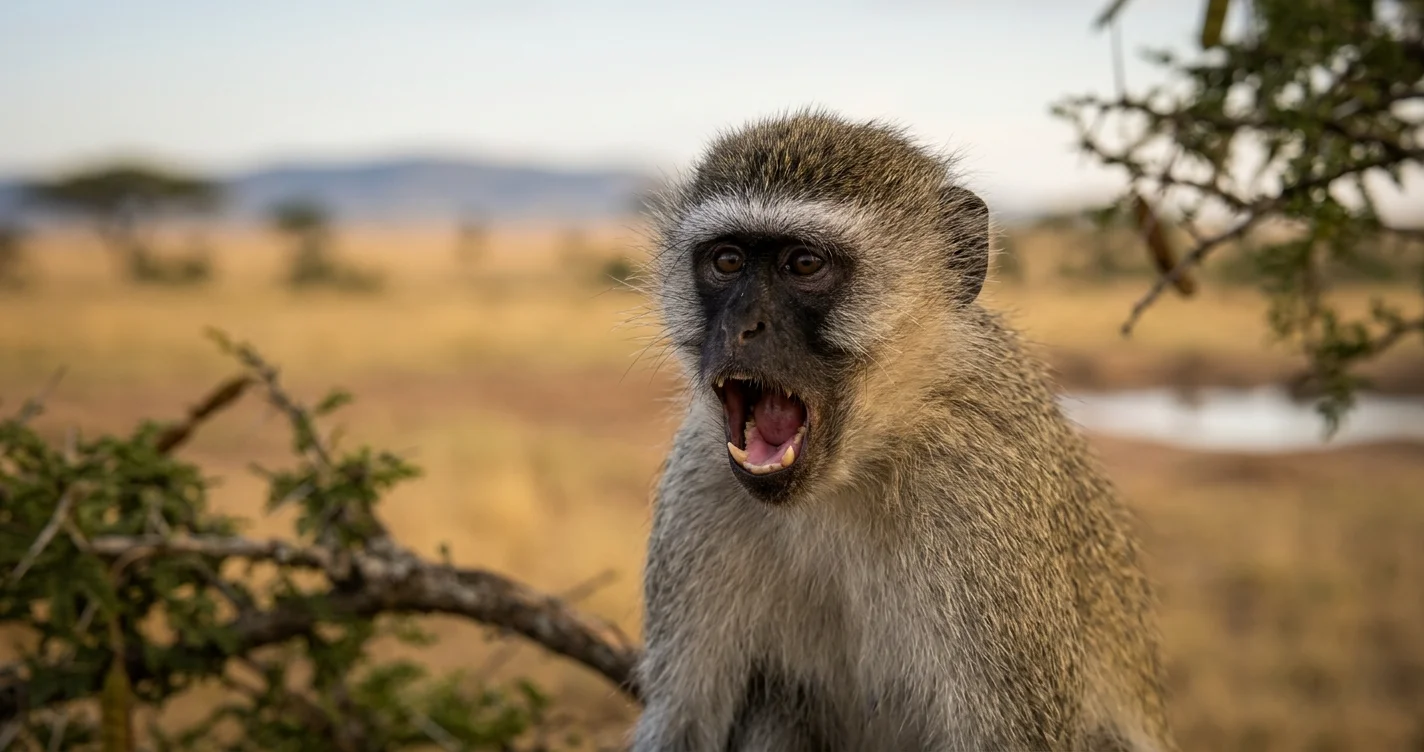
A monkey hears a warning call and races toward a tree. Moments later, another alarm sends it scanning the sky. A third sound makes it look toward the ground.
The difference is remarkable. The monkey has not necessarily seen a predator. It is responding to information carried in another animal’s voice.
This is the fascinating world of vervet monkey alarm calls, one of the best-known examples of meaningful vocal communication in wild animals.
For decades, scientists have studied how vervet monkeys respond to threats from leopards, eagles, and snakes. Their discoveries raise a compelling question about animal intelligence: Can an animal’s call communicate something specific about the world?
The answer reveals both the sophistication of animal communication and the important differences between animal signals and human language.
Table of Contents
- What Are Vervet Monkeys?
- The Famous Discovery of Vervet Monkey Alarm Calls
- How Vervet Monkey Alarm Calls Work: The Science of Meaning
- Do Vervet Monkeys Really Have Words?
- How Young Vervet Monkeys Learn Alarm Calls
- How Vervet Monkeys Compare With Other Animal Communicators
- Why Alarm Calls Matter for Survival
- What Alarm Calls Reveal About Animal Intelligence
- Threats to Vervet Monkeys and Their Habitats
- In Your Own Yard: Discovering Animal Alarm Calls
- Frequently Asked Questions
What Are Vervet Monkeys?
Vervet monkeys are social African primates belonging to the genus Chlorocebus. The name is commonly associated with Chlorocebus pygerythrus, although scientific and common-name usage across closely related African green monkeys can vary.
These monkeys inhabit a variety of African environments, including savannas, woodlands, and areas near rivers.
They are recognizable by their grayish or olive-colored coats, dark faces, and relatively long tails.
Life in Social Groups
Vervet monkeys live in groups containing multiple individuals.
Their social lives involve grooming, feeding, competition, cooperation, and vigilance.
Group members spend time searching for food while remaining alert to predators.
Because several animals share the same environment, a warning given by one individual can influence the behavior of many others.
Why Communication Matters
A monkey feeding on the ground cannot watch every direction simultaneously.
Other group members may notice danger first.
Vocal communication allows individuals to respond to threats that are outside their immediate field of vision.
However, producing a warning call may also attract attention, including the attention of predators.
Animal communication therefore involves trade-offs between information sharing, safety, and social relationships.

The Famous Discovery of Vervet Monkey Alarm Calls
During the 1970s and 1980s, researchers studying wild vervet monkeys in Kenya documented a striking pattern.
The monkeys produced different alarm calls in encounters with different classes of predators.
The classic research is associated with Dorothy Cheney, Robert Seyfarth, and Peter Marler.
Their work helped establish vervet monkeys as an important model for studying the relationship between animal signals and meaning.
Three Important Predator Categories
The best-known alarm-call distinctions involve three kinds of danger:
- Leopards and other serious terrestrial predators.
- Eagles and other threatening aerial predators.
- Snakes encountered near the ground.
The monkeys did not simply produce one identical sound whenever frightened.
Instead, researchers identified differences in vocalizations associated with different predator situations.
Different Calls, Different Responses
The reactions of nearby monkeys were particularly revealing.
A call associated with a leopard could prompt monkeys to seek safety in trees.
An eagle-associated call could make monkeys look upward or move toward cover.
A snake-associated call could encourage individuals to inspect the ground or adopt a more vigilant posture.
These patterns suggested that the calls conveyed information beyond a general state of excitement.
The Importance of Playback Experiments
Scientists tested the monkeys’ responses by playing recordings of alarm calls when the corresponding predators were absent.
This was an important experimental step.
If monkeys responded appropriately to a recorded call without seeing the danger, the sound itself must have provided information relevant to their behavior.
The experiments supported the interpretation that different calls were associated with different predator-related responses.
They did not, however, prove that vervet monkeys possess words in exactly the human sense.
How Vervet Monkey Alarm Calls Work: The Science of Meaning
Understanding these calls requires separating three connected processes: producing a sound, recognizing the sound, and deciding how to respond.
Together, these processes create a communication system that can influence survival.
Step 1: Detecting a Threat
A vervet monkey may notice a predator through vision, hearing, or other environmental cues.
The type of threat matters because different predators present different dangers.
A leopard approaching across the ground creates a different escape problem from an eagle descending from above.
The monkey’s response depends partly on the immediate situation.
Step 2: Producing a Distinctive Call
When a monkey encounters a threat, it may produce a vocalization associated with that kind of danger.
These calls have acoustic features that listeners can distinguish.
However, vocal behavior is not completely rigid.
Age, social context, predator behavior, and the caller’s circumstances may influence whether a call is produced and how it sounds.
Researchers therefore examine patterns across many observations rather than assuming that every encounter produces an identical signal.
Step 3: Hearing and Recognizing the Signal
Nearby monkeys detect the sound and process its acoustic characteristics.
The listener may recognize a familiar alarm-call type and associate it with a particular category of threat.
This interpretation is supported by experiments showing different responses to different recorded calls.
Importantly, the listener does not necessarily need to see the predator.
The call can influence behavior independently of direct visual evidence.
Step 4: Selecting an Escape Response
Different threats favor different defensive behaviors.
Classic predator-specific responses
| Threat | Typical response |
| Leopard | Move into trees or seek elevated safety |
| Eagle | Look upward or seek protective cover |
| Snake | Inspect the ground and remain vigilant |
These are classic research patterns, not guaranteed reactions in every encounter.
A successful response depends on the surrounding environment.
For example, moving into an exposed treetop may not be the safest response to an aerial predator.
The usefulness of an alarm signal comes from its relationship to the threat and the listener’s available options.
Step 5: Learning the Meaning of Calls
Young vervet monkeys do not necessarily use and interpret alarm calls with the same precision as experienced adults.
Research has documented developmental differences in alarm calling and responses.
Young monkeys may produce calls in a broader range of situations before their behavior becomes more selective.
Experience appears to contribute to the refinement of alarm-call use and interpretation.
This makes vervet communication particularly interesting: biological predispositions and learning may both influence the system.
Step 6: Responding to Context
Alarm calls are not interpreted in isolation from the world.
A monkey may consider the surrounding habitat, the caller, recent events, and other available information.
Researchers studying animal communication increasingly emphasize how signal meaning depends on context.
This helps explain why the same broad call category does not always produce an identical response.
The communication system is specialized, but it is not simply an automatic button that triggers one fixed action.
Do Vervet Monkeys Really Have Words?
The comparison between alarm calls and human words is fascinating, but it requires care.
Human words can refer to objects, actions, events, and abstract ideas across a wide variety of situations.
Vervet alarm calls are more limited.
Nevertheless, they demonstrate an important property: listeners can extract specific information from vocal signals.
What Is Functional Reference?
Scientists sometimes describe certain animal signals as functionally referential.
This term is used when a signal is reliably associated with a particular external event or category and causes listeners to respond in a way appropriate to that event.
Vervet alarm calls are a classic example.
The calls can provide information about predator-related circumstances even when listeners cannot directly observe the danger.
Why Functional Reference Is Not Human Language
Human language includes complex grammar, flexible combinations of words, and the ability to discuss things beyond immediate circumstances.
Vervet alarm calls have not been shown to possess this full set of properties.
Their communication is impressive without being equivalent to human speech.
Calling the signals “words” can be a useful analogy, provided the limitations are clear.
What Scientists Still Debate
Researchers continue to investigate whether animal calls primarily encode information about external events, the caller’s internal state, or a combination of both.
A call associated with a predator might reflect the animal’s perception of a particular threat rather than an intentional attempt to name that predator.
The listener’s interpretation may also depend on learned associations.
These possibilities are not mutually exclusive.
Modern research increasingly treats animal communication as a system involving both signal production and receiver interpretation.
How Young Vervet Monkeys Learn Alarm Calls
The development of alarm calling offers clues about the origins of communication.
Young monkeys must learn to navigate a dangerous environment while developing social and perceptual skills.
Early Mistakes and Broad Responses
Juveniles may respond to a wider range of moving animals or objects than adults.
Their vocal behavior can also be less selective.
These differences suggest that experience helps refine the relationship between particular threats and appropriate calls.
Learning From Group Members
Young monkeys live among adults that encounter predators and respond to alarms.
Observing these interactions may provide opportunities to learn which situations are dangerous.
Social experience can therefore influence how alarm calls are used and understood.
The Role of Development
Changes in vocal behavior may reflect maturation as well as learning.
Researchers must distinguish between improvements caused by experience and those associated with physical or neurological development.
This is one reason long-term field studies are valuable.
They allow scientists to observe individuals across different stages of life.
How Vervet Monkeys Compare With Other Animal Communicators
Vervet monkeys are not the only animals capable of producing informative alarm signals.
Researchers have documented sophisticated warning systems in birds, mammals, and other groups.
Prairie Dogs
Prairie dogs produce alarm calls that vary in response to different threats.
Some studies have reported acoustic variation associated with predator characteristics.
However, interpretations of the precision and meaning of these calls remain subjects of research.
Meerkats
Meerkats use alarm calls that can vary with predator type and perceived urgency.
Their communication helps group members respond to threats in open habitats.
The system illustrates how information about both danger category and urgency can influence defensive behavior.
Chickadees
North American chickadees produce alarm vocalizations that vary according to threatening situations.
Research has linked aspects of their calls to predator characteristics and risk.
Their communication provides an especially relevant example for American backyard birdwatchers.
What These Systems Share
Different species face different ecological challenges.
Yet many have evolved ways to influence the behavior of others through sound.
These systems show that meaningful animal communication is widespread, even though it does not necessarily involve human-like language.
Why Alarm Calls Matter for Survival
A warning signal can change the outcome of a predator encounter.
The value of the signal depends on how quickly and accurately listeners respond.
Faster Defensive Decisions
An individual that recognizes an alarm may begin responding before locating the predator.
This can reduce the delay between danger detection and protective action.
However, the benefit depends on the reliability of the signal and the available escape routes.
Social Benefits
Group living creates opportunities for individuals to benefit from the vigilance of others.
Alarm calls can spread information among animals that are feeding, resting, or temporarily distracted.
The consequences for individual fitness depend on social structure, predator pressure, and other ecological factors.
Costs of False Alarms
Reacting to every harmless disturbance can waste time and energy.
Frequent unnecessary escape behavior may interrupt feeding or other activities.
A communication system must therefore balance sensitivity to danger against the costs of responding unnecessarily.
What Alarm Calls Reveal About Animal Intelligence
Vervet monkeys demonstrate that animals can distinguish meaningful acoustic signals and adjust behavior accordingly.
This requires sensory discrimination, memory, and context-sensitive responses.
Recognizing Categories
The classic experiments suggest that monkeys distinguish between alarm signals associated with different predator classes.
This is evidence of sophisticated categorization in their communication system.
However, it does not reveal exactly how a monkey experiences or mentally represents each category.
Memory and Experience
Learning to respond appropriately requires retaining information from previous encounters.
Young monkeys may become more selective as they gain experience.
The relationship between learning, inherited tendencies, and social observation remains an important area of investigation.
Understanding Without Human Speech
An animal does not need human grammar to process useful information.
Vervet alarm calls demonstrate how communication can be adapted to specific ecological problems.
Their significance lies in what the system accomplishes, rather than how closely it resembles human conversation.
Threats to Vervet Monkeys and Their Habitats
Vervet monkeys are adaptable and can occupy varied environments, including some human-modified landscapes.
Nevertheless, local populations may face pressures associated with habitat change and human activity.
Habitat Fragmentation
The loss or separation of suitable vegetation can alter movement routes, food availability, and access to shelter.
These changes may also influence exposure to predators.
Human-Wildlife Conflict
Vervet monkeys sometimes forage near farms or settlements.
Crop damage and other interactions can lead to conflict with people.
Locally appropriate, nonlethal management and habitat planning can help reduce these problems.
The Value of Long-Term Research
Continued observation helps scientists understand how social behavior and communication respond to changing environments.
Long-term studies are particularly useful for separating individual variation from broader population patterns.
In Your Own Yard: Discovering Animal Alarm Calls
You do not need to travel to an African savanna to observe animals communicating about danger.
Many familiar North American birds and mammals produce warning signals.
Listen to Chickadees
Black-capped chickadees and related species are excellent subjects for backyard observation where they naturally occur.
Their vocalizations vary across situations.
Listen for changes in calling behavior when a predator or unfamiliar animal appears nearby.
Avoid deliberately exposing birds to threats or using repeated alarm-call playback.
Watch Squirrel Behavior
Tree squirrels often produce vocalizations in response to potential danger.
Notice whether nearby squirrels become alert, retreat, or change their movements after another individual calls.
Behavior can vary with species and circumstances.
Create a Wildlife-Friendly Garden
Native shrubs and trees provide shelter, food, and nesting opportunities.
A layered garden with appropriate vegetation can support birds and other animals.
Reducing unnecessary pesticides also helps maintain the insects that many wild birds depend on.
Keep a Nature Observation Journal
Record the date, weather, animal species, type of sound, and visible behavior.
Note whether a possible predator was present.
Repeated observations can reveal patterns, although they cannot establish the exact meaning of a call on their own.
The goal is careful observation rather than provoking alarm responses.
Frequently Asked Questions
1. Do vervet monkeys have a different alarm call for every predator?
No. Classic research identified distinct alarm-call patterns associated with broad predator categories, especially leopards, eagles, and snakes. This does not mean that vervet monkeys have a unique vocal label for every dangerous species.
2. Can baby vervet monkeys understand alarm calls?
Young vervet monkeys show alarm-related responses, but their calling and interpretation may be less selective than those of adults. Development and experience appear to help refine their behavior.
3. Are vervet monkey alarm calls considered a language?
Scientists generally describe them as a specialized animal communication system rather than a complete language like human speech. They can convey predator-related information, but there is no evidence that they possess the full grammar and open-ended expressive capacity of human language.
Conclusion
Return to that remarkable moment on the African savanna: one monkey hears a call and moves toward a tree, while another sound causes it to scan the sky.
The classic research on vervet monkey alarm calls shows that animals can respond to meaningful differences in vocal signals, even when the danger itself is hidden.
These discoveries helped transform scientific thinking about animal communication.
They suggest that the roots of meaningful signaling extend well beyond our own species, while also reminding us that human language has distinctive capabilities.
For wildlife enthusiasts, the lesson is simple. Animal sounds are not always random background noise. They may carry information that shapes how other animals move, feed, cooperate, and survive.
A warning cry in the trees can reveal an entire world of communication that we are only beginning to understand.
External Sources
1. Monkey Responses to Three Different Alarm Calls: Evidence of Predator Classification and Semantic Communication: Support the article’s central explanation of leopard, eagle, and snake alarm calls. The researchers used recorded calls to demonstrate different defensive responses even when predators were absent.
Robert M. Seyfarth, Dorothy L. Cheney, and Peter Marler — Science (1980).
Read the original study on PubMed
2. Vervet Monkey Alarm Calls: Semantic Communication in a Free-Ranging Primate
Explain how acoustically different calls are associated with distinct predator categories and how playback experiments established their informational value.
Robert M. Seyfarth, Dorothy L. Cheney, and Peter Marler — Animal Behaviour (1980). Read the research paper
3. Vocal Development in Vervet Monkeys: Support the section explaining how young vervet monkeys gradually develop more appropriate calling and listening responses, with experience and adult behavior contributing to learning.
Robert M. Seyfarth and Dorothy L. Cheney — Animal Behaviour (1986).