
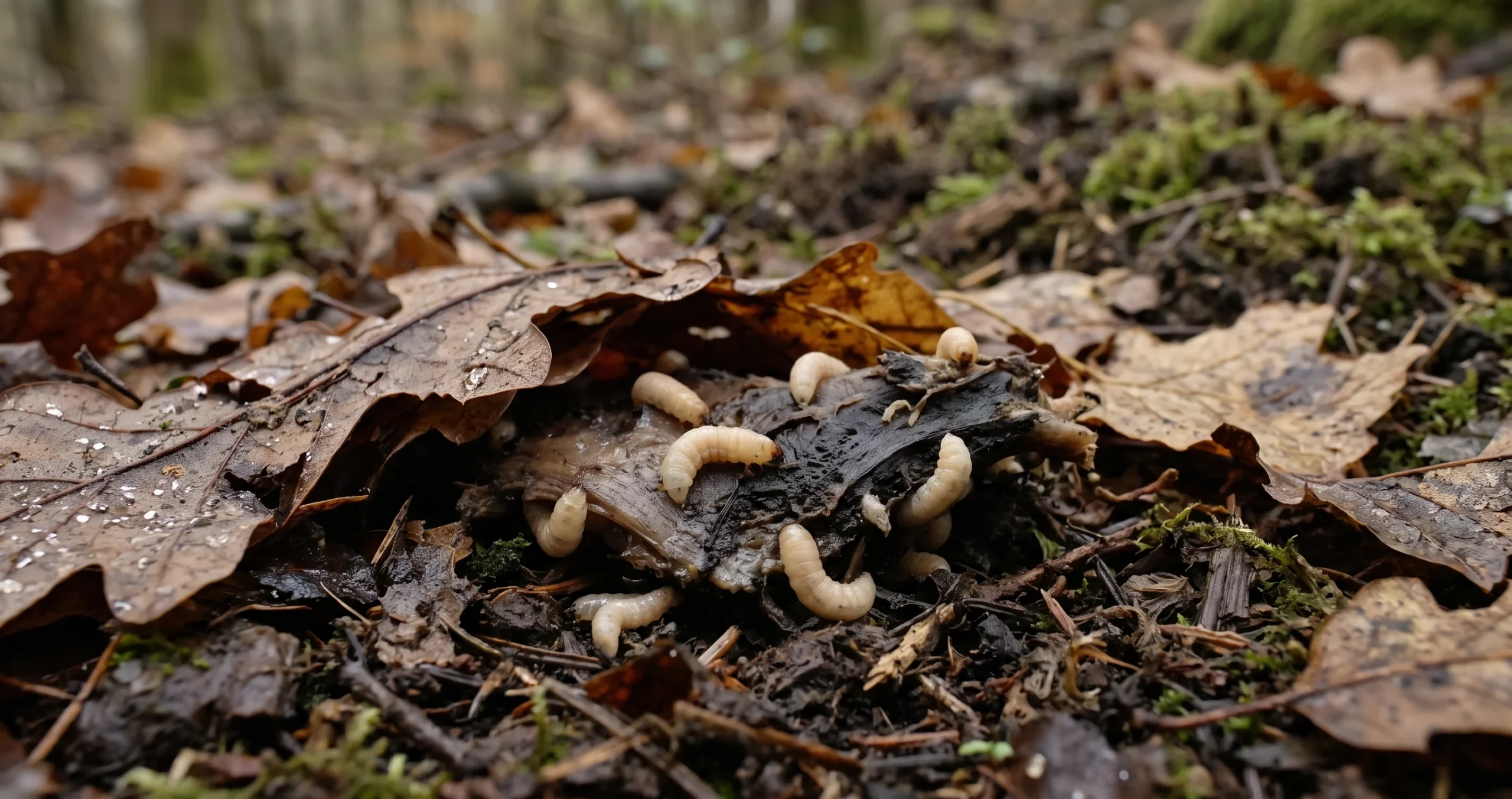
Some flies can locate decomposing animal remains by detecting chemical signals carried through the air, sometimes before a person notices any unusual smell. These insects use highly specialized sensory organs to recognize odors associated with suitable feeding and breeding sites.
Understanding how blowflies find dead animals reveals one of nature’s most fascinating chemical detection systems. Their ability to locate organic material supports reproduction, decomposition, and the recycling of nutrients throughout ecosystems.
Although blowflies are often dismissed as pests, they perform important ecological work. Their larvae help break down animal remains, while adult flies and developing larvae provide food for other wildlife.
Table of Contents
- What Are Blowflies?
- How Blowflies Find Dead Animals
- Why Blowflies Are Attracted to Animal Remains
- How Blowflies Lay Their Eggs
- The Blowfly Life Cycle Explained
- How Blowfly Larvae Help Decomposition
- Why Blowflies Matter in Natural Ecosystems
- How Blowflies Help Forensic Scientists
- Are Blowflies Dangerous to Humans?
- Blowflies in Gardens and Backyards
- Common Myths About Blowflies
- Frequently Asked Questions
- Conclusion
What Are Blowflies?
Blowflies belong to the insect family Calliphoridae, a group of true flies found across much of the world, including North America.
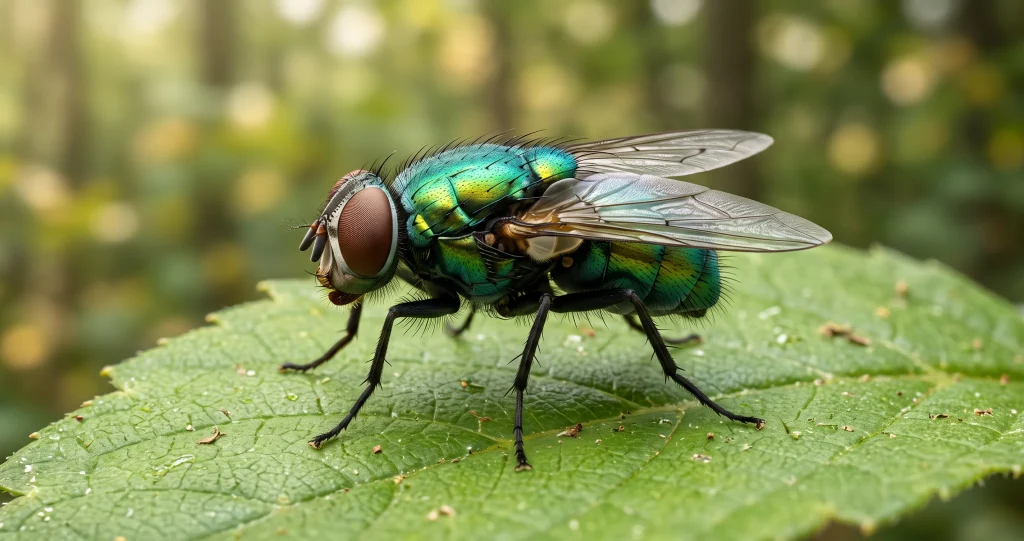
Many species are recognizable by their metallic green, blue, bronze, or copper-colored bodies. Green bottle flies often have brilliant emerald coloration, while blue bottle flies may display a darker, metallic blue abdomen.
Like other true flies, blowflies have one functional pair of wings, large compound eyes, short antennae, and specialized mouthparts. Their metallic appearance comes from the interaction of light with structures and pigments in their outer body covering.
However, not every shiny green fly is a blowfly. Several unrelated fly families also contain metallic species.
Blowflies occupy diverse habitats, including forests, grasslands, agricultural landscapes, cities, and suburban gardens. Some species are closely associated with animal remains, while others use different organic materials or have more specialized life histories.
How Blowflies Find Dead Animals
Blowflies do not recognize death in the human sense. Instead, they respond to chemical information that helps them locate potential food sources and suitable places for reproduction.
Detecting the Smell of Decomposition
When animal tissues begin decomposing, microorganisms and natural biochemical processes release volatile organic compounds, or VOCs.
These airborne molecules include a complex mixture of sulfur-containing compounds, nitrogen-containing chemicals, and other substances that change as decomposition progresses.
Some blowflies are attracted to particular combinations of these odors. The chemical mixture can provide information about the presence and condition of a potential resource.
Importantly, decomposition does not produce one universal odor that all blowflies detect equally. Different species respond to different chemical cues, and their preferences may change with reproductive condition and environmental circumstances.
The Sensory Role of Fly Antennae
A blowfly’s antennae contain specialized sensory structures called sensilla. Within these structures, sensory neurons detect certain airborne chemical molecules.
When odor molecules interact with the insect’s sensory receptors, they initiate nerve signals that are processed by the fly’s nervous system.
The fly can then adjust its movement in response to the chemical information.
This is not identical to human smell perception. It is an insect sensory system adapted to detecting biologically important environmental signals.
Blowflies also use visual information and contact-based chemical sensing when approaching and evaluating potential resources.
How Wind and Environmental Conditions Affect Detection
Airborne odors do not spread evenly through the environment.
Wind carries chemical molecules in irregular streams called odor plumes. A flying insect may encounter a plume, lose contact with it, and then adjust its flight to locate the source.
Temperature affects both decomposition and insect activity. Warm conditions can influence the release of volatile compounds, while cold weather may reduce fly movement.
Humidity, airflow, vegetation, and obstacles also affect how odors disperse.
Consequently, there is no scientifically reliable universal distance from which every blowfly can detect animal remains.
Arrival depends on the species, weather, habitat, accessibility, and the stage of decomposition.
Why Blowflies Are Attracted to Animal Remains
Animal remains can provide valuable resources for certain blowfly species.
Adult flies may visit decomposing material to obtain nutrients, while females may use suitable remains as places to deposit eggs.
The distinction matters because adult and larval blowflies have different feeding requirements.
Adults generally consume liquids or dissolved nutrients using specialized mouthparts. Their diets can include nectar, other sugary substances, and nutrient-rich liquids from organic material, depending on the species.
Larvae of many carrion-associated blowflies feed on animal tissue.
By locating an appropriate egg-laying site, a female gives her offspring access to food shortly after hatching.
This connection between chemical detection and reproduction explains much of the blowfly’s remarkable attraction to decomposition.
How Blowflies Lay Their Eggs
After locating a promising resource, a female blowfly may land and examine it using sensory information from her mouthparts and feet.
She assesses whether the substrate is suitable for her developing offspring.
Many carrion-associated species deposit groups of small, pale eggs in moist, protected areas. Such locations can help prevent the eggs from drying out.
The eggs hatch into larvae when environmental conditions permit.
Not every blowfly follows precisely this pattern. Some species use other breeding materials, and certain blowflies deposit living larvae rather than eggs.
The diversity of reproductive strategies within Calliphoridae is one reason broad generalizations about blowflies can be misleading.
The Blowfly Life Cycle Explained
Blowflies undergo complete metamorphosis, passing through distinct developmental stages.
Egg Stage
In egg-laying species, development begins inside small eggs deposited on a suitable substrate.
Temperature strongly influences embryonic development. Warmer conditions within a species’ tolerance range generally accelerate development, while cooler conditions slow it.
Larval Stage
Newly hatched larvae are commonly called maggots.
They have soft, elongated bodies and lack the jointed legs found in many other insect larvae.
In many blowfly species, larvae pass through three developmental stages called instars. Between stages, they molt as their bodies grow.
Carrion-feeding larvae consume animal tissue and associated nutrient-rich material, contributing to its breakdown.
Pupal Stage
After completing larval development, the insect enters the pupal stage.
The outer skin of the final larval stage hardens into a protective structure called a puparium. Inside, the insect undergoes substantial transformation.
Adult Stage
A fully developed adult emerges from the puparium, expands and hardens its wings, and eventually begins feeding and reproducing.
The duration of the entire life cycle varies considerably among species and environmental conditions.
Temperature is especially important, which is why developmental timing must never be treated as identical for every blowfly.
How Blowfly Larvae Help Decomposition
Decomposition is a complex ecological process involving microorganisms, insects, scavengers, and environmental conditions.
Blowfly larvae contribute by consuming and breaking down animal tissue. Their feeding activity changes the physical structure of the material, making portions more accessible to other decomposers.
Bacteria and fungi perform essential biochemical work throughout this process.
As organic matter breaks down, nutrients move into surrounding soil and become available to other organisms through ecological cycling.
Blowflies are therefore important participants in decomposition, but they are not the only organisms responsible.
The pace of decomposition depends on temperature, moisture, animal size, insect access, microbial activity, and many other factors.
Why Blowflies Matter in Natural Ecosystems
Blowflies connect several parts of a natural food web.
Their larvae help process animal-derived organic matter, while adult flies can become prey for spiders, birds, predatory insects, and other animals.
Larvae themselves are eaten by various predators and parasites.
By participating in decomposition, blowflies help return materials from dead organisms to wider ecological cycles.
This work complements the activities of bacteria, fungi, beetles, and vertebrate scavengers.
Their ecological importance illustrates a broader principle: an animal does not need to be beautiful or popular to perform an essential function.
In a healthy ecosystem, even organisms associated with decay can help support new life.
How Blowflies Help Forensic Scientists
The same biology that makes blowflies effective decomposers also makes them valuable in forensic investigations.
Forensic entomology is the scientific study of insects as evidence in legal investigations. Blowflies are especially useful because some species can locate and colonize exposed remains relatively early under suitable conditions.
Investigators can identify collected insects and examine their developmental stages. By comparing those stages with species-specific growth information and environmental temperatures, specialists can estimate how long the insects have been developing.
This is commonly used to estimate a minimum period of insect activity, sometimes called the minimum postmortem interval.
However, insect age does not automatically reveal the exact time of death. A delay between death and insect colonization may occur if remains are inaccessible, temperatures are unfavorable, or other environmental conditions interfere.
Species identification, temperature records, geographic location, and insect access must all be considered.
Are Blowflies Dangerous to Humans?
Most outdoor encounters with blowflies do not pose an immediate danger.
Blowflies do not sting, and common adult blowflies do not bite people. Nevertheless, some species can carry microorganisms mechanically after contacting contaminated material.
A fly moving between decomposing waste and uncovered food can therefore create sanitation concerns.
Certain fly species can also cause myiasis, a condition in which fly larvae infest living human or animal tissue. This is associated with particular species and circumstances, not ordinary contact with every blowfly.
The best precautions are straightforward: cover food, manage household waste, maintain window screens, and keep outdoor garbage containers closed.
Blowflies in Gardens and Backyards
Blowflies may appear around garbage bins, animal waste, discarded food, or decomposing animal remains.
Their presence does not automatically indicate that a garden is unhealthy. Many blowflies naturally move through outdoor environments while searching for food and breeding resources.
However, large numbers gathering repeatedly in one location may indicate a nearby source of decaying animal-derived material.
To discourage unwanted breeding, keep garbage lids tightly closed, remove exposed food scraps, clean waste containers, and manage pet waste promptly.
Ordinary plant-based compost is different from decomposing animal remains. A well-managed compost pile containing leaves, grass clippings, and suitable vegetable scraps supports a broad community of decomposers without necessarily attracting large numbers of carrion-associated blowflies.
For gardeners interested in nutrient cycling, our guide to chop-and-drop mulching explains another way organic matter returns to the soil.
You can also learn more about the relationship between organic materials and soil organisms in How the Mulch You Choose Changes Your Soil Beneath the Surface.
There is no need to eliminate every blowfly from an outdoor space. Responsible waste management addresses sanitation concerns while allowing natural decomposition processes to continue elsewhere.
Common Myths About Blowflies
Myth 1: Blowflies Appear Spontaneously From Dead Matter
Blowflies do not emerge spontaneously from decomposing material.
Adult flies reproduce by depositing eggs or, in certain species, larvae. The developing insects originate from their parents, not from the material itself.
Myth 2: All Blowflies Are Harmful
Some blowflies create sanitation or veterinary problems, but many also perform valuable ecological functions.
Their larvae contribute to decomposition, and adult flies form part of natural food webs.
Myth 3: Every Blowfly Detects Death From the Same Distance
No universal detection distance applies to all blowflies.
Species differences, weather, airflow, and chemical conditions influence how far odor signals travel and whether flies respond.
Myth 4: Maggots Are a Separate Kind of Animal
Maggots are the larvae of flies.
They represent one stage in an insect’s life cycle, eventually developing into pupae and then adults.
Myth 5: Blowflies Perform Decomposition Alone
Decomposition involves bacteria, fungi, insects, scavengers, and environmental processes.
Blowflies contribute significantly in some situations, but they are part of a larger ecological community.
Frequently Asked Questions
How do blowflies smell decomposing material?
Blowflies detect airborne chemical compounds through specialized sensory structures, particularly those associated with their antennae. Their nervous systems process these signals and help guide movement toward suitable resources.
How quickly can blowflies arrive?
Under favorable conditions, some blowflies can arrive within minutes of a resource becoming accessible. However, arrival varies with species, weather, habitat, season, and accessibility.
Why are some blowflies metallic green?
Their striking coloration results from optical interactions involving the insect’s outer body covering and pigments. The appearance varies among species, with some showing green, blue, bronze, or darker coloration.
Do all blowflies lay eggs on dead animals?
No. Although many species are associated with animal remains, the family Calliphoridae includes species with different breeding habits. Some use other organic substrates, and certain species deposit larvae rather than eggs.
Are blowflies important to the environment?
Yes. Many blowflies help break down animal-derived organic matter, support nutrient cycling, and provide food for other organisms.
How do forensic scientists use blowflies?
Forensic entomologists identify blowfly species and examine developmental stages to estimate the minimum period of insect colonization. These estimates depend on environmental conditions and must be interpreted alongside other evidence.
Conclusion
Understanding how blowflies find dead animals reveals an extraordinary connection between insect senses, reproduction, and ecosystem function.
These insects detect airborne chemicals associated with decomposition, use sensory information to locate suitable resources, and, in many species, deposit offspring where developing larvae can find food.
As those larvae grow, they help break down organic material alongside microorganisms and other scavengers. Blowflies also support food webs and provide valuable evidence for forensic scientists.
Their presence around household waste may require sensible sanitation, but their role in natural environments deserves recognition.
The next time a metallic green fly lands on a garden leaf, remember that this overlooked insect belongs to a group helping nature recycle the materials of one generation into the ecosystems that support the next.
External sources
- University of Minnesota Extension — Blow Flies — Identification, habitat, and sanitation. University of Minnesota Extension
- North Carolina State University — Forensic Entomology — Blowfly development and forensic applications. General Entomology
- National Institute of Justice — A Review of Bacterial Interactions With Blow Flies — Blowfly biology and interactions with microorganisms