
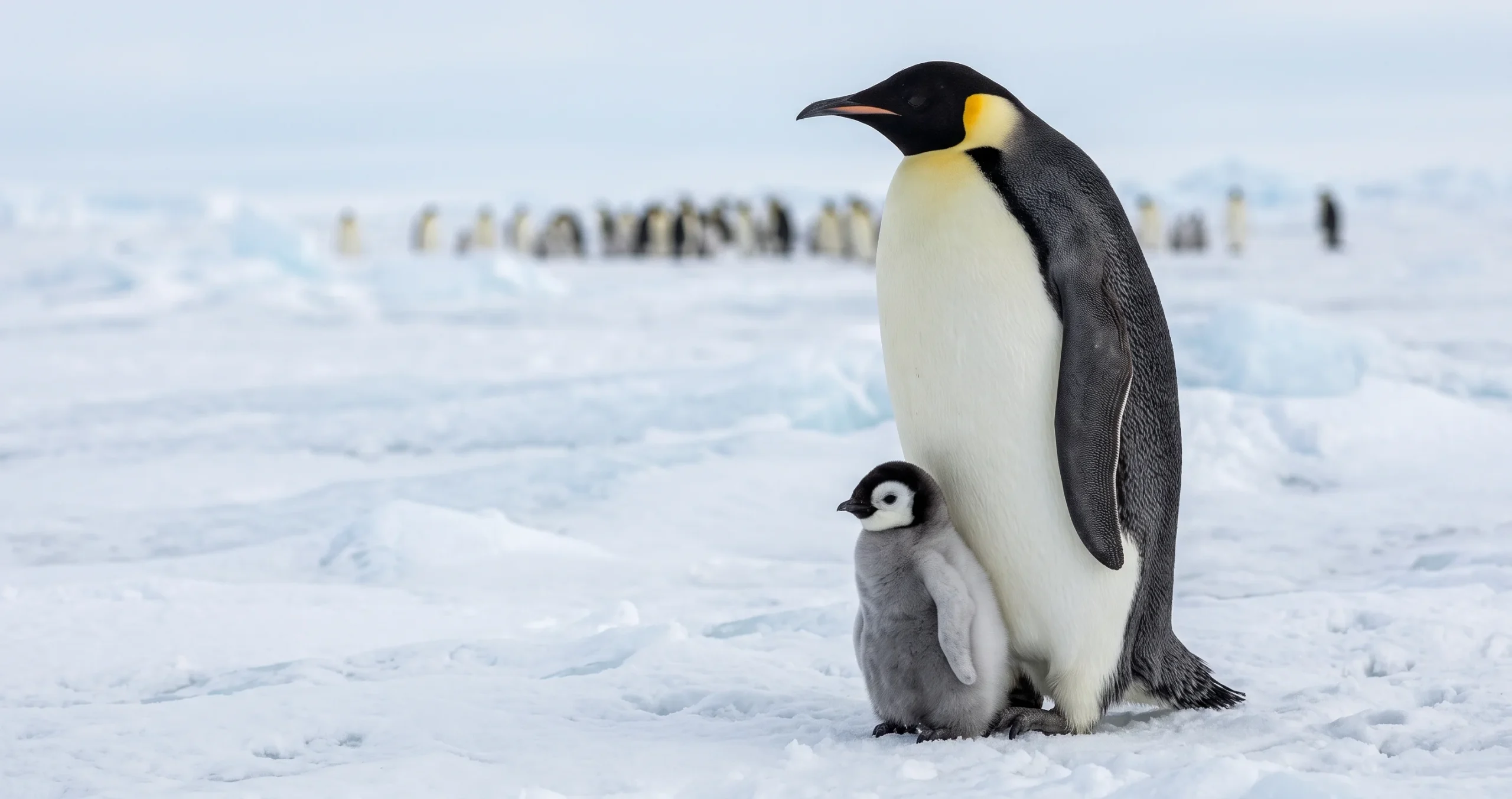
Penguins are among the most recognizable birds on Earth, yet the diversity of penguin species is far greater than their familiar black-and-white appearance suggests. Some survive the brutal Antarctic winter, others nest in underground burrows, and a few live on surprisingly warm coastlines near the equator.
Although every penguin is a flightless seabird adapted for swimming, different species have evolved remarkable ways to survive. Their strategies include protecting eggs on their feet, building carefully arranged pebble nests, diving into freezing water, and using ocean currents to find food.
In this guide, we’ll explore eight fascinating penguins, explain how to identify them, examine their habitats and breeding behaviors, and discover the challenges threatening their survival.
Table of Contents
- Meet Eight Remarkable Penguin Species
- How Penguins Stay Warm in Cold Water
- How Penguins Swim and Dive
- Penguin Breeding Strategies: Feet, Burrows, and Pebbles
- Threats and Penguin Conservation
- Common Myths About Penguins
- Frequently Asked Questions
- Conclusion
Meet Eight Remarkable Penguin Species
Penguins belong to the bird family Spheniscidae. Scientists recognize roughly 18 living species, although the exact total varies slightly depending on taxonomic classification.
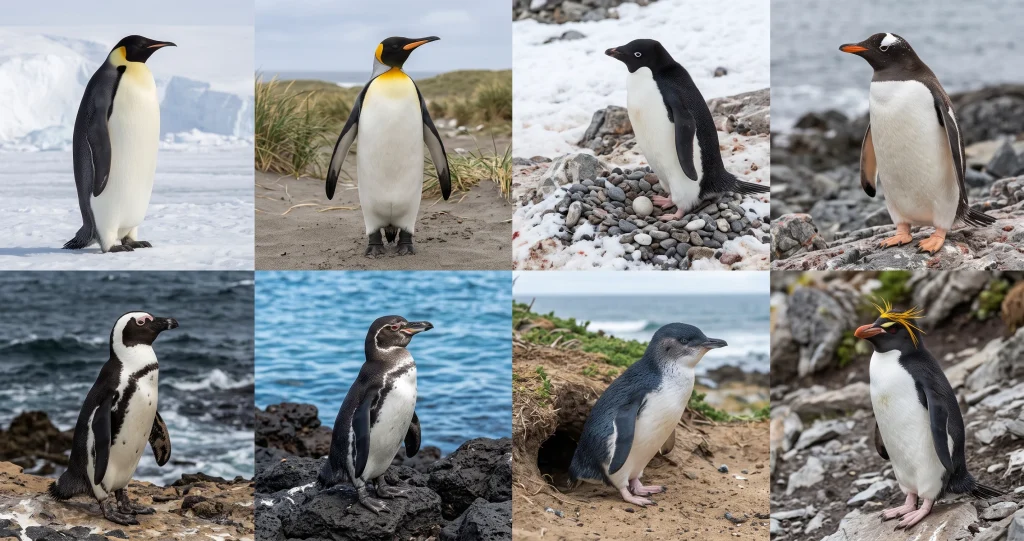
The following eight species demonstrate the remarkable diversity of penguin adaptations, from Antarctica’s frozen landscapes to the tropical Galápagos Islands.
1. Emperor Penguin — The Antarctic Winter Survivor
The emperor penguin (Aptenodytes forsteri) is the largest living penguin, reaching approximately four feet in height.
Its distinctive features include a black head, orange-yellow markings around the neck, and a pale belly.
Emperor penguins breed on Antarctic sea ice during the harsh winter, when temperatures and wind conditions can become extreme.
After the female lays a single egg, she transfers it to the male. He balances it on his feet beneath a warm brood pouch while she travels to the ocean to feed.
During incubation, males may fast for weeks, relying on stored body fat.
Their survival strategy combines exceptional insulation, communal huddling, and an unusual breeding schedule.
2. King Penguin — The Long-Distance Forager
The king penguin (Aptenodytes patagonicus) resembles the emperor penguin but is smaller and has brighter orange patches near its ears and upper chest.
King penguins inhabit subantarctic islands, including South Georgia, the Crozet Islands, and the Kerguelen Islands.
They typically breed on open ground rather than building conventional nests.
Like emperor penguins, king penguins incubate a single egg on their feet beneath a brood pouch.
However, their breeding cycle is unusually long, often taking more than a year from egg laying to chick independence.
This extended schedule means pairs cannot successfully raise a chick every calendar year.
King penguins are also accomplished divers, traveling into productive ocean waters to hunt fish and squid.
3. Adélie Penguin — The Pebble-Nest Builder
The Adélie penguin (Pygoscelis adeliae) is easily recognized by its black head and distinctive white ring around each eye.
It breeds around Antarctica, particularly in ice-free coastal areas during the austral summer.
Unlike emperor penguins, Adélies construct nests using small stones.
These pebble nests help keep eggs above wet ground and melting snow, reducing exposure to moisture.
Both parents participate in incubation and chick care.
Adélie penguins feed heavily on Antarctic krill, although their diet also includes fish and other marine organisms.
Their breeding success can be strongly influenced by local sea-ice conditions and access to feeding areas.
4. Gentoo Penguin — The Fast Underwater Hunter
Gentoo penguins (Pygoscelis papua, in the traditional classification) have a distinctive white marking extending across the top of the head and a bright orange-red bill.
They inhabit Antarctic Peninsula environments and numerous subantarctic islands.
Gentoos are powerful swimmers, capable of reaching impressive speeds during short underwater bursts.
They generally construct nests from pebbles, vegetation, or other locally available materials.
Pairs often lay two eggs, and both parents help incubate them and feed the chicks.
Gentoo penguins can show considerable flexibility in their diets, consuming krill, fish, and squid depending on local availability.
This adaptability may benefit some populations when ocean conditions change, although it does not eliminate environmental risks.
5. African Penguin — The Coastal Heat Specialist
The African penguin (Spheniscus demersus) lives along the coasts of southern Africa, particularly South Africa and Namibia.
Its black facial markings, pink patches above the eyes, and spotted white chest make it relatively easy to identify.
The pink skin above its eyes helps release excess heat as blood flow increases during warm conditions.
African penguins often nest in burrows, sheltered spaces, or artificial nest structures.
Historically, guano deposits provided suitable nesting material and shelter, but extensive guano removal damaged many nesting habitats.
Today, African penguins face serious conservation challenges, including food shortages, fishing pressures, and disturbance.
The species is classified as Critically Endangered by the IUCN.
6. Galápagos Penguin — The Equatorial Survivor
The Galápagos penguin (Spheniscus mendiculus) is one of the world’s smallest penguins and the only species naturally found living around the equator.
It inhabits the Galápagos Islands, especially waters influenced by cool, nutrient-rich currents.
Its relatively small size, narrow white facial markings, and black chest band distinguish it from larger relatives.
Living near the equator presents a very different challenge from surviving an Antarctic winter.
Galápagos penguins seek shade, use behaviors that help release heat, and depend on cool marine waters for feeding.
Their breeding activity is closely connected to food availability rather than a strictly predictable annual season.
Changes in ocean temperature, especially during strong El Niño events, can sharply reduce prey availability.
7. Little Penguin — The Smallest Penguin
The little penguin (Eudyptula minor) is the smallest living penguin, generally standing around 12–13 inches tall.
Its blue-gray upperparts distinguish it from the black-backed appearance of many other species.
Little penguins occur along southern Australian coastlines and around New Zealand, although classification of some populations remains under scientific discussion.
They commonly nest in burrows, rock crevices, or protected coastal vegetation.
Many return to shore after dark, which can help reduce exposure to some predators.
Their diet includes small fish, squid, and other marine prey.
Conservation efforts often focus on protecting nesting areas from introduced predators, human disturbance, and coastal development.
8. Macaroni Penguin — The Crested Colony Specialist
The macaroni penguin (Eudyptes chrysolophus) stands out because of its striking yellow-orange crest feathers extending from the forehead.
It breeds on subantarctic islands and parts of the Antarctic Peninsula region.
Macaroni penguins often gather in enormous, densely packed breeding colonies.
They generally lay two eggs, but the first is substantially smaller and rarely produces a surviving chick.
Their diet consists mainly of krill and other small marine animals.
These penguins depend on productive ocean ecosystems, making changes in prey distribution an important conservation concern.
How Penguins Stay Warm in Cold Water
Many penguin species spend substantial portions of their lives in water cold enough to cause rapid heat loss in poorly insulated animals.
Their survival depends on several complementary adaptations.
Dense Waterproof Plumage
Penguins have closely packed feathers that help protect the body from cold water.
They maintain their plumage through frequent preening, spreading protective secretions and keeping feathers properly aligned.
The feather structure helps trap insulating air, although compression during deep dives changes the amount of trapped air.
Insulating Body Fat
A layer of subcutaneous fat provides additional insulation and serves as an energy reserve.
This is especially important during periods when adults cannot feed regularly, such as incubation or molting.
Countercurrent Heat Exchange
Penguins can reduce heat loss through specialized blood circulation in their extremities.
Warm blood traveling toward the feet can transfer heat to cooler blood returning toward the body.
This helps conserve core body temperature while allowing the feet to function in cold environments.
Huddling Together
Emperor penguins famously form tightly packed groups during Antarctic winter storms.
By reducing exposure to wind and sharing the shelter created by the group, individuals conserve energy.
Penguins near the outside of a huddle may gradually move toward more protected positions.
How Penguins Swim and Dive
Penguins are flightless birds, but their wings have evolved into powerful flippers.
Instead of generating lift in air, these stiffened wings propel the birds through water.
Underwater Flight
Penguins move their flippers in coordinated strokes that resemble flying motions.
Their streamlined bodies reduce drag, while their feet and tails help with steering and balance.
Different species specialize in different diving patterns according to body size, prey type, and habitat.
Remarkable Diving Abilities
Emperor penguins are among the deepest-diving birds known, capable of descending more than 500 meters during exceptional dives.
Other penguins generally forage at shallower depths.
Their bodies possess physiological adaptations for storing and conserving oxygen during submersion.
However, penguins must return to the surface to breathe because they have lungs, not gills.
Penguin Breeding Strategies: Feet, Burrows, and Pebbles
Penguin reproduction varies considerably among species.
The differences reflect local climate, nesting habitat, predator exposure, and evolutionary history.
Eggs Balanced on Feet
Emperor and king penguins incubate their eggs on their feet beneath specialized brood pouches.
This keeps the eggs away from frozen or exposed ground.
The behavior is particularly important for emperor penguins, which breed during the Antarctic winter.
Burrow Nesting
African and little penguins commonly use burrows or sheltered cavities.
These sites can help protect eggs and chicks from excessive sunlight, weather, and certain predators.
Artificial nest boxes are sometimes used in conservation programs where natural shelter is limited.
Pebble Nests
Adélie and gentoo penguins frequently construct nests using pebbles.
The stones elevate eggs above wet surfaces and help define the nesting site.
Pebble collection can lead to disputes between neighboring penguins, particularly in crowded colonies.
Threats and Penguin Conservation
Penguins face different threats depending on their habitats and geographic ranges.
Climate Change
Changes in sea ice, ocean temperature, and marine food webs can affect penguin feeding and breeding.
Emperor penguins are particularly vulnerable to the loss of stable breeding sea ice.
Other species may experience shifts in prey availability or suitable nesting conditions.
Overfishing and Food Competition
Some penguin populations depend heavily on fish or krill that are also harvested commercially.
When food becomes scarce near breeding colonies, adults may need to travel farther to feed their chicks.
The severity of this problem varies between regions and fisheries.
Pollution and Habitat Disturbance
Oil spills, plastic pollution, coastal development, and human disturbance can damage penguin habitats.
Introduced predators, including cats, dogs, and rats, threaten some colonies, particularly those nesting in burrows.
Conservation Measures
Protection strategies include marine protected areas, responsible fisheries management, habitat restoration, and predator control.
Monitoring breeding success and population trends helps researchers identify colonies needing urgent protection.
Common Myths About Penguins
Several familiar claims about penguins are misleading or inaccurate.
Myth 1: All Penguins Live in Antarctica
Only some penguin species breed in Antarctica.
Others live in South America, southern Africa, Australia, New Zealand, and the Galápagos Islands.
Myth 2: Penguins Are Always Cold
Penguins have effective insulation, and species living in warm regions can actually struggle with overheating.
Shade-seeking and heat-releasing behaviors are important for tropical and temperate penguins.
Myth 3: Penguins Cannot Move Quickly
Penguins may appear awkward while walking, but they are agile, powerful swimmers.
Some species also move efficiently across ice by sliding on their bellies.
Myth 4: Penguins Mate for Life Without Exception
Many penguins form seasonal pair bonds, and some reunite with previous partners.
However, pair fidelity varies among species and breeding seasons.
Myth 5: All Penguins Build Nests
Emperor and king penguins do not build conventional nests.
Instead, they incubate their eggs on their feet.
Frequently Asked Questions
How many penguin species exist?
Approximately 18 living species are commonly recognized, although taxonomic revisions can change the total. Some recent classifications split populations previously treated as one species.
Which penguin is the largest?
The emperor penguin is the largest living species, reaching approximately four feet in height.
Which penguin is the smallest?
The little penguin is the smallest living penguin, standing roughly 12–13 inches tall.
Can penguins fly?
Penguins cannot fly through the air. Their wings have evolved into flippers specialized for underwater propulsion.
Do penguins have teeth?
No. Penguins have toothless bills, but backward-pointing structures inside their mouths help them grip slippery prey.
Are penguins endangered?
Conservation status varies by species. Some penguins remain relatively widespread, while others, including African and Galápagos penguins, face serious population threats.
Do penguins live at the North Pole?
No wild penguin populations naturally inhabit the Arctic. Penguins are native to the Southern Hemisphere, including regions near the equator.
Conclusion
The world’s penguins demonstrate how one family of birds can develop remarkably different survival strategies.
Emperor penguins endure Antarctic winters, king penguins follow extended breeding cycles, Adélies and gentoos build pebble nests, and African and Galápagos penguins cope with warmer environments.
Meanwhile, little penguins rely on sheltered coastal nesting sites, and macaroni penguins gather in enormous colonies supported by productive marine ecosystems.
Understanding these differences helps explain why penguin conservation cannot rely on a single approach.
Protecting penguins requires attention to the habitats, food supplies, breeding strategies, and environmental challenges unique to each species.
External Sources
1. British Antarctic Survey — Penguins: Covers penguin identification, geographic distribution, breeding strategies, and adaptations to Antarctic environments. British Antarctic Survey: Penguins.
2. Australian Antarctic Program — Adélie Penguin: Provides information about Adélie penguin distribution, breeding habitats, predators, feeding behavior, and population monitoring. Australian Antarctic Program: Adélie Penguin.
3. IUCN Red List — African Penguin: Documents the African penguin’s Critically Endangered conservation status and identifies the threats affecting its survival. IUCN Red List: African Penguin Assessment.