
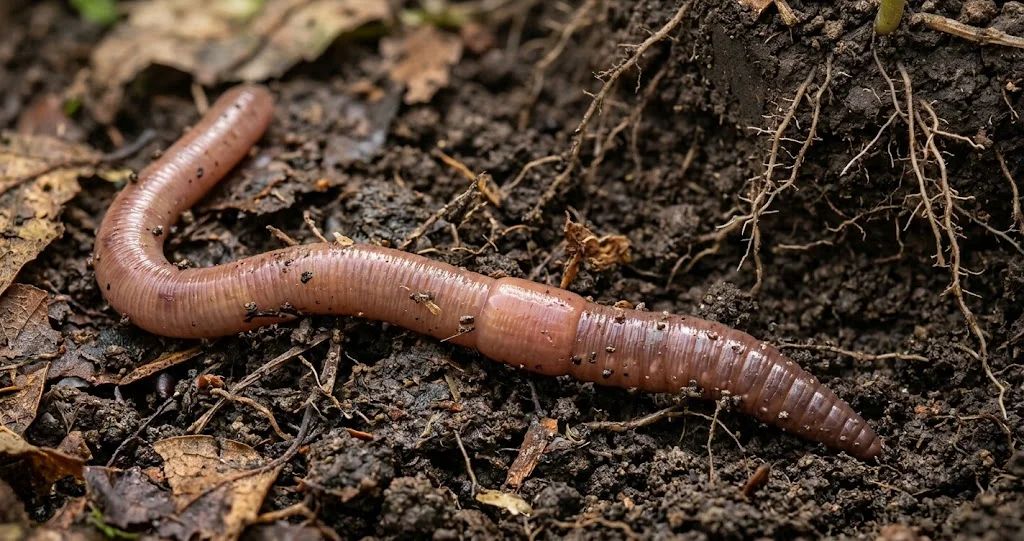
Earthworms have no lungs, no conventional eyes, and no skeleton made of bones. Yet they breathe, sense danger, move through dense soil, and circulate blood through a surprisingly sophisticated system. Understanding earthworm anatomy reveals how these familiar garden animals accomplish so much with bodies that look remarkably simple.
Beneath lawns, vegetable beds, and woodland floors, earthworms feed, burrow, and interact with the soil around them. Some improve soil structure and help recycle organic matter, while others can cause ecological problems when introduced into environments where they did not historically occur.
From breathing through moist skin to pumping blood with muscular vessels, their adaptations offer a fascinating look at life underground.
Table of Contents
- What Is an Earthworm?
- Earthworm Anatomy: How Worms Breathe Without Lungs
- How Earthworms Sense Their Surroundings Without Eyes
- The Five Pairs of Aortic Arches
- How Earthworms Move
- How Earthworms Eat and Digest Organic Matter
- How Burrows and Castings Affect Garden Soil
- How Gardeners Can Protect Earthworms
- Common Earthworm Myths
- Frequently Asked Questions
- Conclusion
What Is an Earthworm?
Earthworms are invertebrates belonging to the phylum Annelida, a group of segmented worms that also includes leeches and many marine worms.
Their bodies consist of numerous repeating segments, separated internally by partitions called septa in many species. This arrangement supports coordinated movement and helps organize internal structures.
Earthworms are not insects. They lack the six jointed legs, external skeleton, and three main body regions characteristic of insects.
Not All Earthworms Live the Same Way
Earthworm species occupy different ecological niches.
Surface-dwelling earthworms often live among decomposing leaves. Soil-dwelling species create temporary tunnels while feeding on organic material mixed into the soil.
Deep-burrowing species construct more persistent vertical tunnels and may pull fallen leaves into their burrows.
These differences matter because the effects of earthworms on soil depend partly on how each species feeds and moves.
Earthworm Anatomy: How Worms Breathe Without Lungs
One of the most remarkable features of earthworm anatomy is the absence of lungs.
Instead, most familiar terrestrial earthworms exchange respiratory gases through their skin, a process called cutaneous respiration.
How Oxygen Enters the Body
Oxygen from the surrounding environment dissolves in the moisture covering the worm’s skin.
It then diffuses across the body surface into nearby blood vessels, where it can be transported to tissues.
Carbon dioxide moves in the opposite direction and leaves through the skin.
For this system to function, the body surface must remain sufficiently moist.
Why Dry Soil Is Dangerous
When an earthworm becomes severely dehydrated, its skin can no longer support efficient gas exchange.
Dry conditions also disrupt other essential physiological processes.
Earthworms may respond by moving deeper into moist soil, reducing activity, or entering a state of dormancy, depending on the species.
Why Waterlogged Soil Can Also Cause Problems
Earthworms need oxygen, even though they lack lungs.
Water contains dissolved oxygen, but poorly aerated, saturated soil may not supply enough to meet their needs.
This helps explain why some earthworms emerge during heavy rain, although surface movement also reflects moisture conditions, species-specific behavior, and opportunities for dispersal.
How Earthworms Sense Their Surroundings Without Eyes
Earthworms do not have conventional image-forming eyes like humans.
Nevertheless, they can detect environmental signals that help them navigate underground and avoid danger.
Detecting Light
Many earthworms possess light-sensitive cells, especially near the front of the body.
These cells allow them to respond to changes in light intensity without forming detailed visual images.
Avoiding bright light can reduce exposure to drying conditions and surface predators.
Sensing Touch and Vibration
Sensory receptors in the body wall help earthworms respond to physical contact.
They may react to vibrations transmitted through soil, although sensitivity and behavioral responses vary among species.
These abilities help worms respond to disturbances in their immediate environment.
Detecting Chemicals
Earthworms also respond to chemical signals associated with their surroundings.
Chemical sensing can influence feeding, habitat selection, and avoidance behavior.
Rather than relying on a single sensory organ, earthworms combine information from multiple types of receptors.
The Five Pairs of Aortic Arches
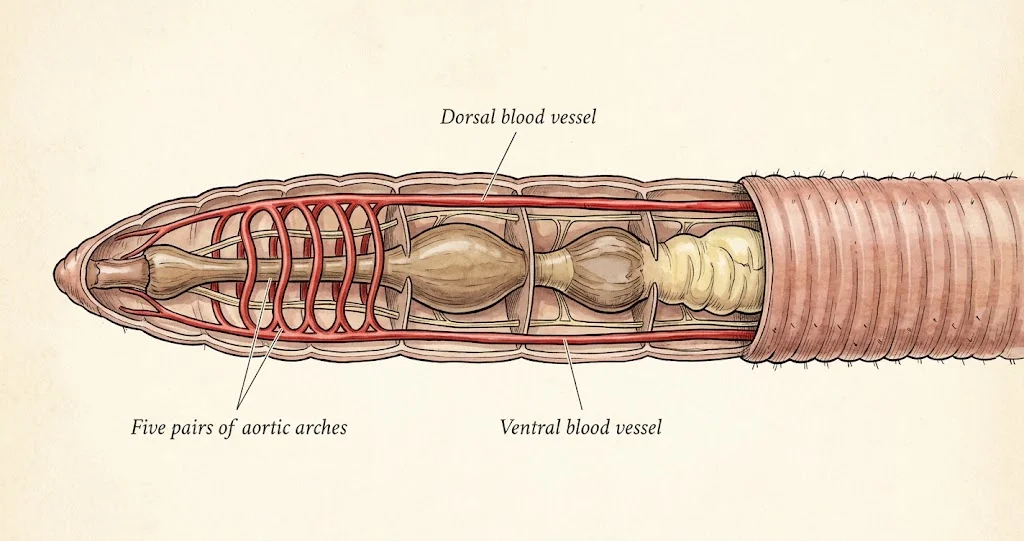
Earthworms have a closed circulatory system, meaning blood normally remains within vessels.
In commonly studied earthworms, major vessels run lengthwise through the body and connect through smaller vessels and muscular structures.
How Earthworm Blood Circulates
The dorsal blood vessel helps move blood toward the anterior end of the animal.
The ventral blood vessel distributes blood toward other parts of the body through branching vessels.
Muscular contractions maintain circulation and deliver oxygen and nutrients to tissues.
Are Earthworm Hearts Really Hearts?
Many educational diagrams describe earthworms as having five pairs of hearts.
More precisely, commonly studied species have five pairs of muscular aortic arches that help move blood between major vessels.
These structures perform pumping functions, but they are not five pairs of separate, chambered hearts like those found in vertebrates.
The exact number and arrangement of circulatory structures can vary among earthworm groups, so the familiar five-pair description should not be applied universally.
How Earthworms Move
Earthworms have no legs, but their bodies are exceptionally well suited to movement through soil.
Their locomotion depends on muscles, internal fluid pressure, and tiny bristles that grip surrounding surfaces.
A Hydrostatic Skeleton
Instead of rigid bones, earthworms use fluid-filled body compartments as a hydrostatic skeleton.
Circular muscles contract to make portions of the body longer and narrower.
Longitudinal muscles contract to shorten and widen those portions.
Alternating these contractions produces waves of movement along the body.
The Role of Chaetae
Most familiar earthworms have small bristles called chaetae, also known as setae.
These structures help anchor parts of the body against the surrounding soil while other segments extend or contract.
The combination of muscular movement and temporary anchoring allows an earthworm to push through surprisingly narrow spaces.
How Earthworms Eat and Digest Organic Matter
Earthworms feed on organic materials and associated microorganisms, but their diets differ among ecological groups.
Some consume decomposing leaves near the surface, while others swallow mineral soil containing organic matter.
The Digestive Journey
Food enters through the mouth and passes into the muscular pharynx.
In many familiar earthworms, it then moves through the esophagus into a crop, which temporarily stores material.
The gizzard uses muscular action, sometimes assisted by swallowed mineral particles, to grind food.
Digestion and nutrient absorption occur farther along the intestine.
Why Microorganisms Matter
Earthworms interact closely with bacteria, fungi, and other organisms involved in decomposition.
Their feeding can fragment organic material, mix it with soil, and change the conditions under which microorganisms operate.
Earthworms do not independently convert every fallen leaf into plant nutrients. Decomposition results from the combined activities of many soil organisms.
How Earthworm Burrows and Castings Affect Garden Soil
Earthworms are sometimes called ecosystem engineers because their activities can change the physical and biological characteristics of soil.
Their effects depend on the species, soil conditions, and surrounding ecosystem.
Burrows Improve Soil Movement
As earthworms tunnel, they create channels that may allow air and water to move through the soil more easily.
Some burrows also provide pathways for plant roots.
These effects can be especially useful in cultivated soils where compaction restricts drainage and root development.
Castings and Nutrient Cycling
Earthworm castings are material that has passed through an earthworm’s digestive tract.
They contain processed organic matter, mineral particles, and nutrients, although their composition varies with the worm’s diet and environment.
Castings can contribute to soil aggregation and nutrient cycling. They are not a complete replacement for balanced soil fertility management.
For a closer look at their gardening applications, read our guide to worm castings and their benefits for garden soil.
When Earthworms Can Harm Ecosystems
Not every earthworm benefits every environment.
Some northern North American hardwood forests developed after the last glaciation with few or no native earthworms. Thick layers of decomposing leaves became essential habitat for native plants and other organisms.
Introduced earthworms can consume these layers rapidly, altering soil conditions and affecting forest regeneration.
How Gardeners Can Protect Earthworms
Supporting earthworms starts with maintaining healthy soil rather than buying additional worms.
Add Suitable Organic Matter
Finished compost, shredded leaves, and appropriate organic mulches provide resources for soil organisms.
Organic materials also help protect the soil surface and moderate moisture fluctuations.
Maintain Balanced Moisture
Earthworms need moisture for respiration, but poorly drained soil can become oxygen deficient.
Water according to plant and soil needs, and improve drainage where persistent saturation occurs.
Reduce Unnecessary Disturbance
Frequent intensive tilling can disrupt burrows and expose earthworms to injury, drying, and predators.
Use cultivation only where needed, and protect soil with suitable vegetation or mulch.
Prevent Invasive Earthworm Spread
Do not release fishing bait worms into forests, waterways, or other natural habitats.
Avoid moving potentially contaminated soil, compost, or mulch between locations, especially where invasive jumping worms are a concern.
Responsible soil care supports garden biodiversity without unintentionally introducing harmful species.
Common Earthworm Myths
Myth 1: Cutting an Earthworm Creates Two Worms
An earthworm cut in half does not normally become two complete individuals.
Some species can regenerate limited damaged body regions, but the outcome depends on the species and location of the injury.
Severely injured worms often die.
Myth 2: Earthworms Always Drown in Rain
Earthworms breathe through moist skin and can survive submerged for varying periods when sufficient dissolved oxygen is available.
However, oxygen-poor water can be dangerous.
Rainfall may bring worms to the surface for several reasons, including changes in moisture, oxygen conditions, and opportunities to move.
Myth 3: Earthworms Have Five Complete Hearts
The familiar description refers to five pairs of muscular aortic arches in certain commonly studied species.
These structures help pump blood but are not identical to vertebrate hearts.
Myth 4: All Earthworms Are Good for Every Soil
Earthworms can benefit cultivated gardens, but introduced species can disrupt ecosystems that evolved without them.
Their ecological role must be considered in context.
Frequently Asked Questions
Do earthworms have brains?
Earthworms have a relatively simple nervous system, including cerebral ganglia near the front of the body and a ventral nerve cord. This system coordinates movement and sensory responses.
Do earthworms have blood?
Yes. Earthworms have a closed circulatory system, and many species possess respiratory pigments that help transport oxygen.
Can earthworms see light?
They can detect light using specialized sensory cells, but they do not form detailed images with conventional eyes.
How many hearts does an earthworm have?
Commonly studied earthworms are often described as having five pairs of aortic arches. Their circulatory anatomy varies among species.
Are earthworms good for compost?
Certain surface-dwelling species, particularly red wigglers, are well suited to vermicomposting. Deep-burrowing garden worms are not necessarily appropriate for worm bins.
Should gardeners buy earthworms for their soil?
Usually not. Improving soil conditions is generally preferable to introducing additional worms, especially where nonnative species may spread into natural ecosystems.
Conclusion
Earthworm anatomy demonstrates how an animal can survive without lungs, conventional eyes, or a rigid skeleton.
Moist skin supports respiration, specialized sensory cells detect environmental changes, muscular aortic arches help circulate blood, and coordinated muscles move the body through soil.
These adaptations also allow earthworms to influence decomposition, soil structure, and nutrient cycling.
For gardeners, the best approach is to protect soil health while respecting ecological differences between species and habitats.
Understanding these animals makes it easier to appreciate the complex biological world beneath an ordinary garden bed.
Internal Sources
- Worm Castings: Why Gardeners Call It Black Gold for Soil — Relevant to digestion, castings, and nutrient cycling.
- How the Mulch You Choose Changes Your Soil Beneath the Surface — Relevant to protecting earthworms through mulch and moisture management.
External Sources
- University of Minnesota Extension — Nightcrawlers — Earthworm burrows, aeration, castings, and nutrient cycling.
- University of Minnesota Extension — Earthworms — Earthworm ecology, major groups, and risks to native forests.
- University of Minnesota Extension — Promote Healthy Soil in Your Garden — Soil organisms, organic matter, and practical soil management.