
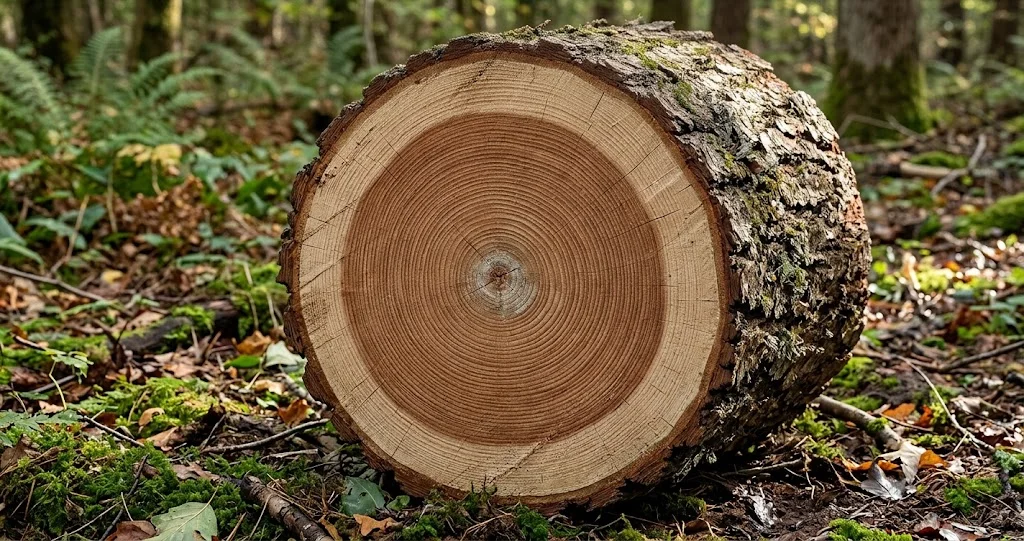
Most of the wood inside a mature tree trunk is no longer actively transporting water. Yet the tree remains alive because essential tissues responsible for growth, sugar movement, and water transport are concentrated in relatively narrow regions near the trunk’s outer edge.
Understanding tree trunk anatomy reveals how these layers work together to keep a tree growing, why seemingly minor bark injuries can become serious, and how everyday gardening practices can protect—or damage—the living tissues beneath the surface.
A tree trunk is much more than a wooden support. It is an organized system of protective tissues, transport pathways, and structural materials that connects the roots to the canopy.
Table of Contents
- Tree Trunk Anatomy: The Main Layers
- How Xylem Moves Water
- How Phloem Moves Sugars
- The Vascular Cambium: A Thin Growth Layer
- Why Trees Form Annual Growth Rings
- Sapwood vs. Heartwood
- What Happens When a Tree Is Girdled
- How Tree Wounds Heal
- Common Tree Care Mistakes
- How to Protect the Living Layers of Trees
- Common Myths About Tree Trunks
- Frequently Asked Questions
- Conclusion
Tree Trunk Anatomy: The Main Layers
A tree trunk contains several distinct tissues arranged around its central axis. Each contributes to protection, transport, growth, or mechanical support.
Although the exact organization varies among species, the following layers describe the familiar structure of many temperate hardwood trees.
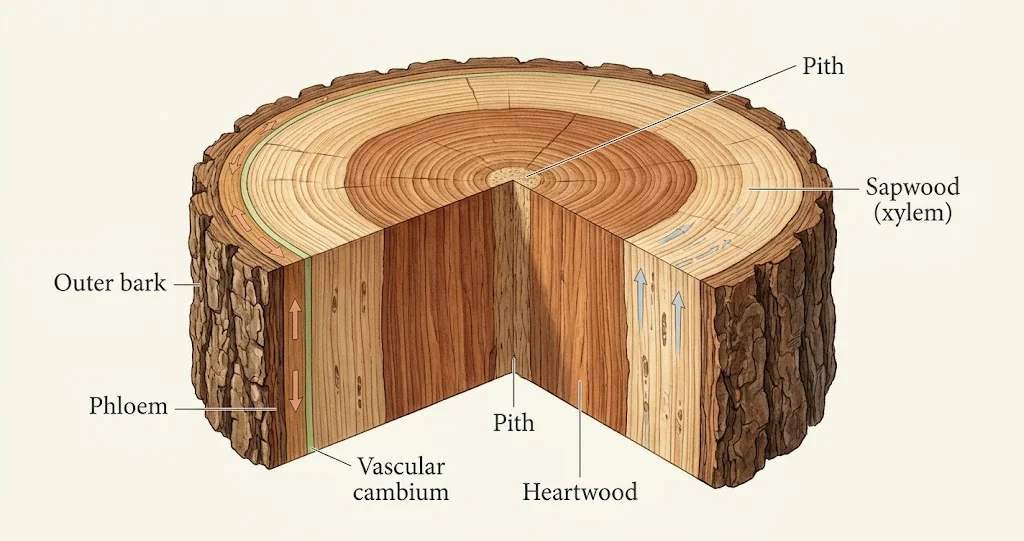
Outer Bark: The Protective Shield
Outer bark forms the trunk’s protective exterior. Depending on the species, it may be thick and deeply furrowed, thin and smooth, or capable of peeling in sheets.
This protective covering reduces physical injury, limits water loss from underlying tissues, and provides a barrier against many environmental hazards.
Inner Bark and Phloem
Beneath the outer bark lies living inner bark tissue that includes functional phloem.
Phloem transports sugars and other organic compounds between different parts of the tree.
As older phloem becomes compressed or loses function, it contributes to the development of bark.
Vascular Cambium
The vascular cambium is a remarkably thin layer of dividing cells positioned between secondary phloem and secondary xylem.
It produces new conducting and supporting tissues as the trunk increases in diameter.
Damage to this layer can interfere with the tree’s ability to replace tissues and expand normally.
Sapwood
Sapwood is the younger, outer portion of the secondary xylem.
It contains the main pathways through which water and dissolved minerals move upward from the roots.
Not every sapwood cell is alive. Most mature water-conducting cells are dead at maturity, while living parenchyma cells remain involved in storage and other functions.
Heartwood
Heartwood forms from older inner xylem that has ceased functioning in water transport.
It often contains compounds deposited during heartwood formation, sometimes giving it a darker color.
Heartwood contributes important structural support, even though it is no longer part of the active water-conducting system.
Pith
The pith occupies the central region of young stems and remains visible in many mature trunks.
It originates from primary stem tissues and is generally small compared with the surrounding wood.
Its appearance varies considerably among tree species.
How Xylem Moves Water
Trees must transport water from their roots to leaves that may be many feet above the ground.
This movement occurs primarily through functional xylem in the sapwood.
Water Movement Begins at the Roots
Roots absorb water from the surrounding soil. Water then enters the tree’s conducting tissues and travels toward branches and leaves.
In hardwoods, specialized conducting cells called vessel elements form vessels. Conifers primarily rely on conducting cells called tracheids.
Transpiration Pulls Water Upward
When water evaporates from leaf surfaces through stomata, it creates tension in the continuous water columns within the xylem.
Water molecules attract one another through cohesion, allowing this tension to be transmitted downward through the conducting system.
This process, called the cohesion-tension mechanism, is a major explanation for how tall trees move water upward without a central mechanical pump.
Water movement can be disrupted by drought, freezing, or air entering the conducting system.
How Phloem Moves Sugars
Leaves manufacture sugars through photosynthesis, but roots, developing fruits, and growing tissues also need energy.
Phloem distributes these products from areas of supply, called sources, to areas that consume or store them, called sinks.
Sugar Does Not Always Travel Downward
During active photosynthesis, mature leaves frequently export sugars toward roots and developing tissues.
However, stored carbohydrates can move toward emerging buds in spring, while developing fruits and seeds may draw sugars from nearby leaves.
Different phloem pathways can transport materials in different directions, depending on the tree’s needs.
Unlike the dead conducting cells of mature xylem, phloem transport depends on living sieve elements supported by associated cells.
The Vascular Cambium: A Thin Growth Layer
The vascular cambium is responsible for much of the increase in trunk diameter that occurs as a tree matures.
Its dividing cells generate new secondary xylem toward the inside and secondary phloem toward the outside.
How a Tree Becomes Thicker
Each growing season, cambial activity adds new wood to the trunk.
The accumulated xylem gradually becomes a substantial structural cylinder, while older phloem tissues are compressed and incorporated into bark or shed.
Cambial activity varies with temperature, water availability, species, and seasonal conditions.
Because this layer produces new vascular tissue, maintaining its integrity is essential for long-term tree growth.
Why Trees Form Annual Growth Rings
The concentric rings visible in many tree trunks result from changes in wood production over time.
In temperate climates, seasonal growth patterns often create recognizable boundaries between successive periods of cambial activity.
Earlywood and Latewood
Earlywood typically forms during the earlier portion of a growing season.
In many species, it contains conducting cells with relatively large internal openings and thinner walls.
Latewood generally develops later and often contains smaller conducting openings or thicker-walled cells.
These structural differences produce visible contrasts in a trunk cross-section.
Does Every Ring Represent One Year?
In many temperate trees, a complete growth ring corresponds approximately to one growing season.
However, interruptions in growth can create false rings, and some tropical species do not produce clearly defined annual rings.
Missing or difficult-to-identify rings can also occur.
Scientists studying tree age and past environmental conditions therefore use careful cross-dating and species-specific knowledge rather than simply assuming every visible line represents one calendar year.
Sapwood vs. Heartwood
Sapwood and heartwood are both forms of secondary xylem, but they perform different roles in a mature tree.
Sapwood contains functional water-conducting pathways and living cells involved in storage and metabolism.
Heartwood develops as older xylem loses its conducting function. It may accumulate substances that change its color and resistance to decay.
Why Heartwood Is Often Darker
In species such as walnut, heartwood can appear noticeably darker than surrounding sapwood.
Other species show little visible color difference.
Heartwood formation also varies with tree age, species, and environmental conditions. A darker center does not automatically indicate disease or rot.
What Happens When a Tree Is Girdled
Girdling occurs when a continuous band of bark and associated tissues is removed or severely damaged around a trunk.
It can result from equipment injuries, animals, constricting materials, or deliberate bark removal.
Why Girdling Is Dangerous
When functional phloem is interrupted around the entire circumference, sugars produced by the canopy can no longer move normally to tissues below the injury.
Roots may gradually exhaust their stored carbohydrates, reducing their ability to grow and function.
The vascular cambium may also be destroyed in the injured region.
Water can initially continue moving upward through intact xylem, so a girdled tree may retain green leaves for some time before declining.
Complete girdling can eventually kill a tree, although outcomes depend on injury severity, species, and whether any functional connections remain.
How Tree Wounds Heal
Trees do not repair injuries in the same way that human skin heals.
Instead, they respond by limiting the spread of damage and producing new tissues around the injured area.
Compartmentalization of Decay
Trees can form chemical and anatomical barriers that restrict the movement of decay organisms through wood.
This process is known as compartmentalization of decay in trees, commonly abbreviated CODIT.
Wound Closure
New growth may gradually extend from the edges of a wound, eventually covering exposed wood.
However, closure does not mean the damaged wood beneath has been restored to its original condition.
Large wounds may remain exposed for years, and decay can develop before they close.
Common Tree Care Mistakes
Understanding tree trunk anatomy makes several common landscaping mistakes easier to recognize.
Mulch Volcanoes
A mulch volcano is a mound of mulch piled directly against a tree trunk.
Persistent moisture against bark can contribute to unfavorable conditions, while deep mulch may interfere with normal gas exchange in the underlying soil.
Mulch should protect the root zone without burying the trunk.
Buried Root Flares
The root flare is the widening area where the trunk transitions into major structural roots.
Planting too deeply or adding excessive soil can bury this region, potentially contributing to root problems and poor establishment.
Lawn Mower and String Trimmer Damage
Repeated contact from mowing equipment can remove bark and injure the cambium.
Even small injuries become significant when they accumulate around the trunk.
A maintained mulch ring can reduce the need to operate equipment immediately beside the tree.
Improper Pruning
Removing large branches unnecessarily creates substantial wounds.
Flush cuts that remove the branch collar can interfere with natural wound closure.
Proper pruning preserves the branch collar and avoids unnecessary removal of healthy branches.
How to Protect the Living Layers of Trees
Healthy trees benefit from simple, consistent care rather than complicated treatments.
Plant at the Correct Depth
Locate the root flare before planting and position the tree so it remains visible at or slightly above the finished soil surface, as appropriate for site conditions.
Avoid covering the flare with additional soil after planting.
Apply Mulch Correctly
Spread organic mulch across the root zone in a broad, relatively shallow layer.
For many landscape trees, approximately 2–3 inches of coarse organic mulch is a practical starting point.
Keep mulch pulled back from direct contact with the trunk.
Water Newly Planted Trees Carefully
New trees need consistent moisture while their root systems establish.
Water deeply enough to moisten the developing root zone, then allow conditions to guide the next watering.
Avoid keeping soil continuously saturated.
Prevent Mechanical Injuries
Maintain a grass-free area around the trunk.
Remove temporary ties and supports when they are no longer necessary, and inspect protective wraps or guards to ensure they do not constrict growth.
A tree’s protective bark is valuable, but the living tissues beneath it are especially vulnerable to repeated injury.
Common Myths About Tree Trunks
Myth 1: All Wood Inside a Tree Is Alive
Much of the wood in a mature trunk consists of cells that are no longer living.
Sapwood contains living storage cells, but mature water-conducting cells are generally dead. Heartwood is older xylem that no longer conducts water.
Myth 2: Every Growth Ring Always Equals One Year
Growth rings often reflect annual cycles in temperate climates, but false rings, missing rings, and irregular seasonal patterns complicate interpretation.
Accurate dating may require comparing ring patterns across multiple samples.
Myth 3: Tree Wounds Need Paint
Routine wound paints and sealants are generally unnecessary and may interfere with natural wound responses.
Proper pruning and preventing injuries are usually more useful than coating exposed wood.
Certain disease-management situations may require specialized treatment based on local professional guidance.
Myth 4: A Tree Can Easily Survive Complete Girdling
Complete girdling can interrupt the supply of carbohydrates to roots and ultimately kill the tree.
Survival is not guaranteed simply because leaves remain green immediately after the injury.
Frequently Asked Questions
Which part of a tree trunk is alive?
The vascular cambium, functional phloem, and living cells within sapwood are important living tissues. Much of the structural wood consists of dead cells.
What carries water upward in a tree?
Functional xylem carries water and dissolved minerals from roots toward leaves. Transpiration helps generate the tension that drives this movement.
What carries sugar through a tree?
Phloem transports sugars and other organic compounds from sources to sinks, which may be located above or below the source.
Can a tree survive bark damage?
Yes, many trees survive localized bark injuries. The outcome depends on the size, depth, location, and extent of damage around the trunk.
Is dark heartwood a sign of disease?
Not necessarily. Dark heartwood is normal in many species because compounds accumulate as older xylem changes function.
How can homeowners protect tree trunks?
Maintain a mulch ring, keep the root flare exposed, prevent mower and trimmer contact, water appropriately, and use proper pruning techniques.
Conclusion
Tree trunk anatomy reveals a remarkable division of labor beneath the bark.
Xylem moves water, phloem distributes sugars, and the vascular cambium produces new tissues that allow the trunk to expand. Sapwood supports active transport, while heartwood provides lasting structural strength.
These layers explain why protecting bark, avoiding girdling, maintaining correct planting depth, and preventing mechanical damage are so important.
A tree may appear solid and unchanging from the outside, but just beneath its surface, a complex living system continually supports its growth and survival.