
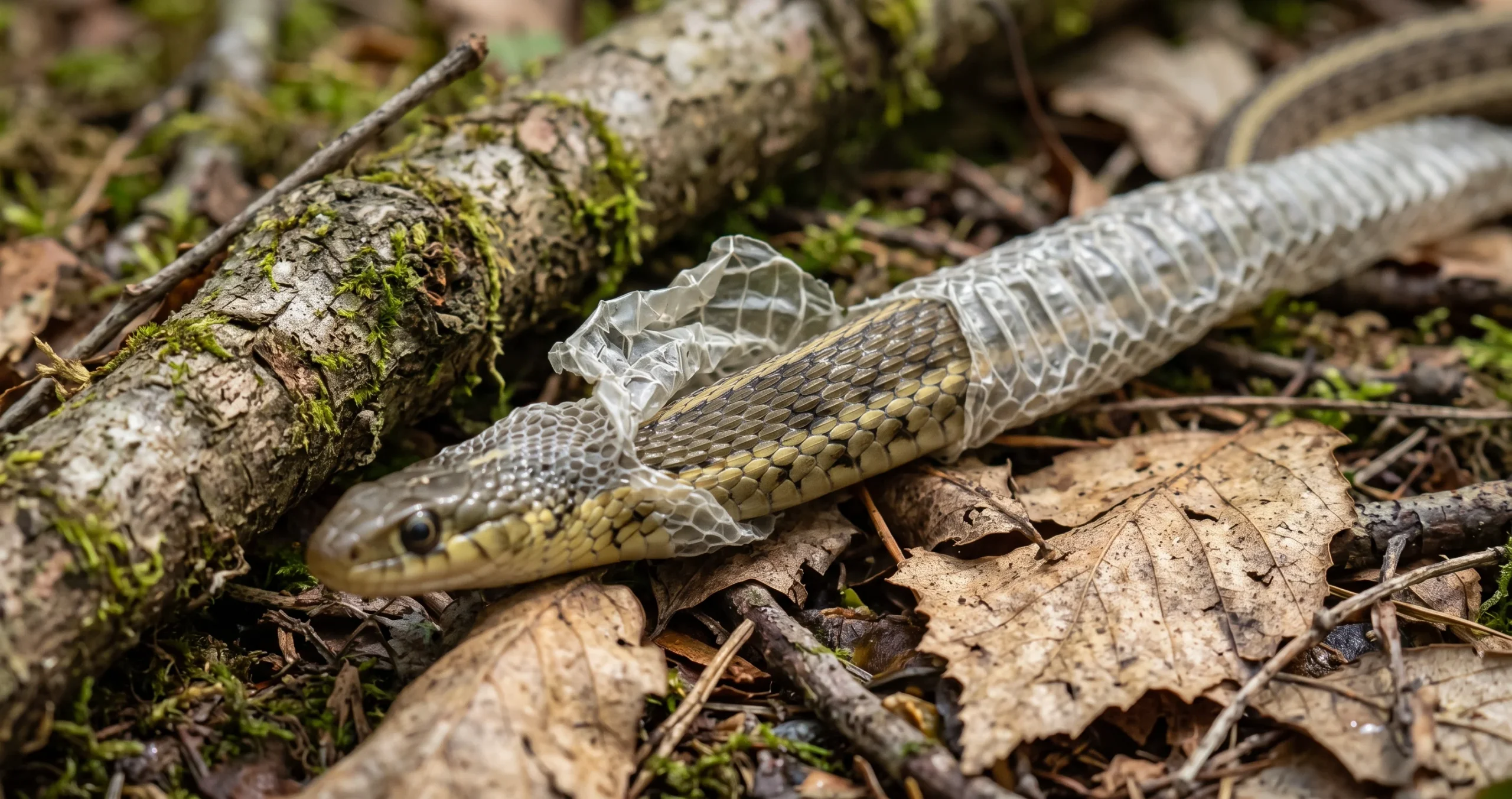
Finding an abandoned snakeskin in the grass can feel like discovering a ghostly copy of an animal that has vanished. The delicate covering may preserve the shape of individual scales, the outline of the head, and even the transparent coverings that once protected the snake’s eyes.
Understanding how snakes shed their skin reveals one of the most remarkable processes in reptile biology. Rather than simply stretching their skin forever, snakes periodically replace its outermost epidermal generation through a natural process called ecdysis.
This transformation involves cellular renewal, temporary changes in appearance, and carefully coordinated movements that help the snake emerge from its old covering. Although shedding is associated with growth, it also plays an important role in maintaining healthy skin throughout a snake’s life.
Table of Contents
- What Is Snake Shedding?
- The Structure of Snake Skin
- How Snakes Shed Their Skin: Seven Stages
- How Snakes Shed Their Eye Coverings
- Normal Shedding vs. Retained Skin
- Environmental Factors That Affect Shedding
- How Often Snakes Shed
- Why Some Snakes Shed in Pieces
- What an Abandoned Snakeskin Reveals
- Is Shedding Painful?
- Common Myths About Snake Shedding
- Safe Wildlife Observation
- Frequently Asked Questions
- Conclusion
What Is Snake Shedding?
Snake shedding, scientifically called ecdysis, is the periodic removal of an older outer epidermal generation. Beneath that covering, a newer epidermal generation has already developed.
Unlike mammals, which continuously lose small numbers of surface skin cells, snakes usually shed the old outer covering as a connected layer.
This process allows the outer protective surface to be renewed as the animal grows and its skin experiences normal wear.
However, snakes do not shed exclusively because they have become too large for their skin. Shedding continues throughout life, including after rapid juvenile growth has slowed.
The Structure of Snake Skin
Snake skin is a sophisticated protective covering composed of multiple tissue layers.
The deeper dermis provides structural support, while the epidermis forms the outer protective surface. Specialized epidermal layers contain keratin proteins that contribute to strength, flexibility, and resistance to water loss.
Scales Are Part of the Skin
A snake’s scales are not separate objects attached to its body. They are specialized folds and regions of the skin’s outer surface.
Their arrangement helps protect the animal and contributes to movement across different surfaces.
The scales on a snake’s belly are particularly important for locomotion because they interact with the ground as the snake moves.
A New Surface Forms Beneath the Old One
Before shedding, the epidermis develops a replacement generation beneath the older one.
A separation zone forms between the two generations, allowing the older outer covering to detach without removing the living tissues underneath.
This coordinated renewal is essential to understanding why a healthy snake can emerge with a complete, functional protective surface.
How Snakes Shed Their Skin: Seven Fascinating Stages
The shedding cycle is more complicated than simply pulling off an old layer of skin. Each stage involves physiological changes that prepare the animal for the final removal.
Stage 1: New Skin Begins Forming
The process starts before any obvious external changes appear.
Cells within the epidermis produce a new generation of skin beneath the existing outer covering. As development progresses, the old and new epidermal generations become separated by a specialized region.
During this period, the snake may look normal to an observer.
The exact timing depends on species, age, environmental conditions, and the individual’s physiology.
Stage 2: The Eyes Become Cloudy
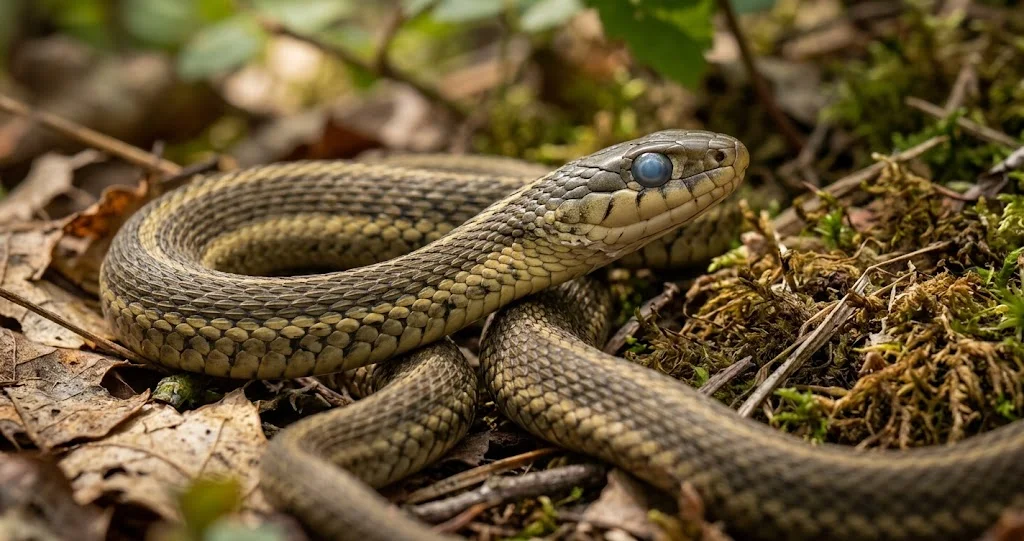
One of the most recognizable signs of an approaching shed is a cloudy or bluish appearance over the eyes.
This stage is commonly called the blue phase.
Snakes have transparent protective eye coverings called spectacles or brilles instead of movable eyelids. As fluid accumulates between the old and new epidermal generations, the eyes can temporarily appear milky or opaque.
The snake’s body coloration may also look duller than usual.
Stage 3: The Eyes Become Clear Again
After the cloudy phase, the eyes often return to a clearer appearance before the actual shedding occurs.
This change can surprise observers who assume that the snake has already finished shedding.
In reality, the old outer covering may still be present.
The temporary cloudiness diminishes as the separation process progresses and the fluid changes or is reabsorbed.
The snake is now approaching the stage when the old skin can be physically removed.
Stage 4: The First Tear Forms Around the Snout
When shedding begins, the snake often rubs its head against a suitable surface.
Rough bark, stones, or other textured objects can help loosen the old covering around the lips and snout.
Once the old skin begins separating around the head, the snake can work its way forward through the opening.
The new skin underneath is already formed, so the snake is not exposing raw tissue during a normal shed.
Stage 5: The Snake Rubs Against Rough Surfaces
After loosening the skin around its head, the snake moves forward against objects that provide resistance.
Branches, rocks, and uneven ground help hold the old covering in place while the snake advances.
The movement gradually pulls the old epidermal layer backward over the animal’s body.
This stage demonstrates how the snake combines normal locomotion with environmental friction to complete the shedding process.
Stage 6: The Old Skin Turns Inside Out
As the snake continues moving, the loosened covering commonly rolls backward and turns inside out.
This is similar to removing a long, tight sock by pulling it from one end.
The old skin may retain recognizable details of the snake’s scale arrangement, including the broad belly scales.
Stage 7: The Snake Emerges Completely
When shedding is successful, the old covering separates from the tail and remains behind.
The snake emerges with its newer outer skin exposed, often displaying clearer colors and a cleaner appearance.
An intact shed can resemble a nearly complete hollow replica of the animal.
However, shedding does not always produce one continuous piece, even in otherwise healthy snakes.
How Snakes Shed Their Eye Coverings
One of the most unusual features of snake shedding involves the eyes.
Unlike humans, snakes cannot blink because they lack movable eyelids. Their eyes are protected by transparent spectacles that form part of the skin.
During normal ecdysis, the older outer layer of each spectacle separates and is shed along with the rest of the outer epidermal covering.
A complete snakeskin may therefore contain two delicate transparent eye coverings near the head.
If an old spectacle remains attached, it is called a retained spectacle.
This condition can require veterinary attention in captive snakes. Owners should never attempt to peel an attached spectacle away, because improper removal can injure the eye.
Normal Shedding vs. Retained Skin
A normal shedding cycle generally leaves the snake with a renewed outer surface and no significant areas of old skin remaining attached.
Incomplete shedding is often described as dysecdysis.
Retained skin may appear as patches of old epidermis, especially around the tail, head, or other areas where separation has been unsuccessful.
When Incomplete Shedding Becomes a Problem
Persistent retained skin can sometimes constrict underlying tissues or contribute to other complications.
In captive reptiles, repeated incomplete shedding may indicate unsuitable environmental conditions, dehydration, nutritional problems, parasites, injury, or underlying disease.
The Merck Veterinary Manual provides veterinary reference information on reptile health and husbandry.
A reptile veterinarian should assess persistent shedding problems rather than relying on forceful manual removal.
Environmental Factors That Affect Shedding
Successful ecdysis depends on more than the development of new epidermal tissue.
Environmental conditions and overall health influence how effectively the old covering separates.
Humidity and Hydration
Appropriate humidity helps support normal skin condition and shedding.
However, different snake species have different moisture requirements. A desert-adapted species should not automatically receive the same humidity conditions as a tropical forest species.
Access to water and suitable microhabitats also matters.
Temperature
Snakes depend on environmental heat to regulate body temperature.
Temperatures outside a species’ suitable range can interfere with normal physiological processes, including digestion, activity, and skin renewal.
Captive snakes require appropriate temperature gradients rather than a single temperature throughout their enclosure.
Nutrition and General Health
Adequate nutrition supports normal tissue maintenance.
Illness, parasites, skin damage, and other health problems may interfere with the shedding cycle.
For captive animals, repeated shedding difficulties should prompt a review of husbandry and veterinary health.
How Often Do Snakes Shed Their Skin?
There is no universal shedding schedule for all snakes.
Young snakes often shed more frequently because they are growing rapidly. Adults may shed less often, although they continue renewing their outer skin throughout life.
Shedding frequency also varies with species, body condition, reproductive status, nutrition, and environmental conditions.
A snake experiencing rapid growth may undergo several shedding cycles while another individual of the same species sheds less frequently.
Therefore, claims that every snake sheds at a fixed monthly interval are misleading.
Why Some Snakes Shed in One Piece and Others in Pieces
A complete snakeskin is often associated with successful shedding, but the appearance of an abandoned skin does not always reveal the animal’s health.
The old covering may tear while the snake moves through rough vegetation or narrow spaces.
It may also break apart after being abandoned because of weather, trampling, or contact with other animals.
In captive snakes, repeated patchy shedding can indicate a problem, particularly when old skin remains attached to the body.
The distinction is between a discarded skin that has torn and skin that the snake has failed to remove.
What an Abandoned Snakeskin Can Reveal
Finding a shed snakeskin offers a fascinating opportunity to observe reptile anatomy without disturbing a living animal.
The covering may preserve scale shapes, the arrangement of belly scales, and details around the head.
Under suitable conditions, experienced researchers can sometimes use scale characteristics to help identify the species.
However, species identification from an incomplete or damaged skin can be difficult.
Can a Snakeskin Reveal the Snake’s Size?
An abandoned skin can provide a rough impression of the animal’s body proportions, but it is not an exact measurement of the living snake.
Shed skin can stretch during removal and change shape after drying.
Consequently, its length should not be treated as a precise record of the snake’s body length.
A snakeskin is also hollow, translucent, and extremely lightweight compared with a living animal.
Is Shedding Painful for Snakes?
Normal ecdysis is a natural physiological process and should not involve tearing healthy living tissue.
However, the shedding period may temporarily affect a snake’s comfort and behavior.
During the cloudy-eye phase, reduced visual clarity can make the animal more cautious or defensive.
Some snakes hide more frequently, reduce activity, or temporarily refuse food.
These behaviors do not necessarily indicate that shedding itself is painful.
In contrast, retained skin, inflammation, injury, or underlying disease may cause genuine discomfort and require attention.
Common Myths About Snake Shedding
Several popular beliefs misunderstand the biology of ecdysis.
Myth 1: Snakes shed only when they become too big. Growth influences shedding frequency, but epidermal renewal continues throughout life.
Myth 2: Snakes become blind permanently before shedding. Cloudy spectacles can temporarily reduce visual clarity, but the appearance normally clears.
Myth 3: Snakes leave their entire skin behind, including living tissue. Only the older outer epidermal generation is removed during normal shedding.
Myth 4: Every healthy snake sheds in one perfect piece. A shed can tear during removal or after being abandoned.
Myth 5: People should help wild snakes remove their skin. Handling can stress or injure the animal and may expose people to defensive bites.
Safe Wildlife Observation
A snake preparing to shed is best observed from a respectful distance.
Avoid touching, cornering, or attempting to move the animal. Never pull at loose skin or approach a snake simply because its eyes appear cloudy.
Wild snakes may be more defensive when their vision is temporarily impaired.
If you discover an abandoned snakeskin, photograph it where it lies and avoid reaching into hidden spaces where a living snake may be resting.
Respecting the animal’s space allows natural behavior to continue undisturbed.
Frequently Asked Questions
Why do snakes shed their skin?
Snakes shed to renew their outer epidermal covering. Growth is an important factor, especially in young snakes, but skin renewal also continues in adults.
How long does snake shedding take?
The duration varies among species and individuals. The preparatory stages may last days, while the final physical removal is often much shorter.
Why do snakes’ eyes turn blue before shedding?
Fluid between the old and new transparent eye coverings causes temporary cloudiness. The appearance normally clears before the old covering is shed.
Do snakes eat their shed skin?
Snakes generally leave their shed coverings behind. They are not normally known for routinely consuming their shed skin in the way some other reptiles may.
Can a snake shed without growing?
Yes. Adult snakes continue to renew their epidermis even after their most rapid growth period has ended.
Can you identify a snake from its shed skin?
Sometimes. Scale arrangement and other preserved features can help specialists identify a species, but incomplete or damaged skins may not provide enough information.
Conclusion:
Snake shedding is much more than a simple response to growth.
Through ecdysis, snakes develop a new epidermal generation, temporarily separate it from the old covering, and use body movement and friction to remove the outer layer.
The process can temporarily change their appearance and behavior, especially when their eyes become cloudy before shedding.
From the first signs of skin renewal to the delicate hollow covering left behind, every stage demonstrates the remarkable adaptations of reptile skin.
Understanding this process also encourages a more respectful view of snakes as complex animals with specialized biological needs.
External sources
1. Maderson (1965) — Histological Changes in the Epidermis of Snakes During the Sloughing Cycle. Foundational research on the cellular changes and epidermal generations involved in shedding.
2. Merck Veterinary Manual — Routine Health Care of Reptiles. Veterinary explanations of ecdysis, cloudy eye coverings, shedding behavior, and environmental care.
3. Merck Veterinary Manual — Disorders and Diseases of Reptiles. Veterinary information about dysecdysis, retained spectacles, and factors contributing to abnormal shedding.