
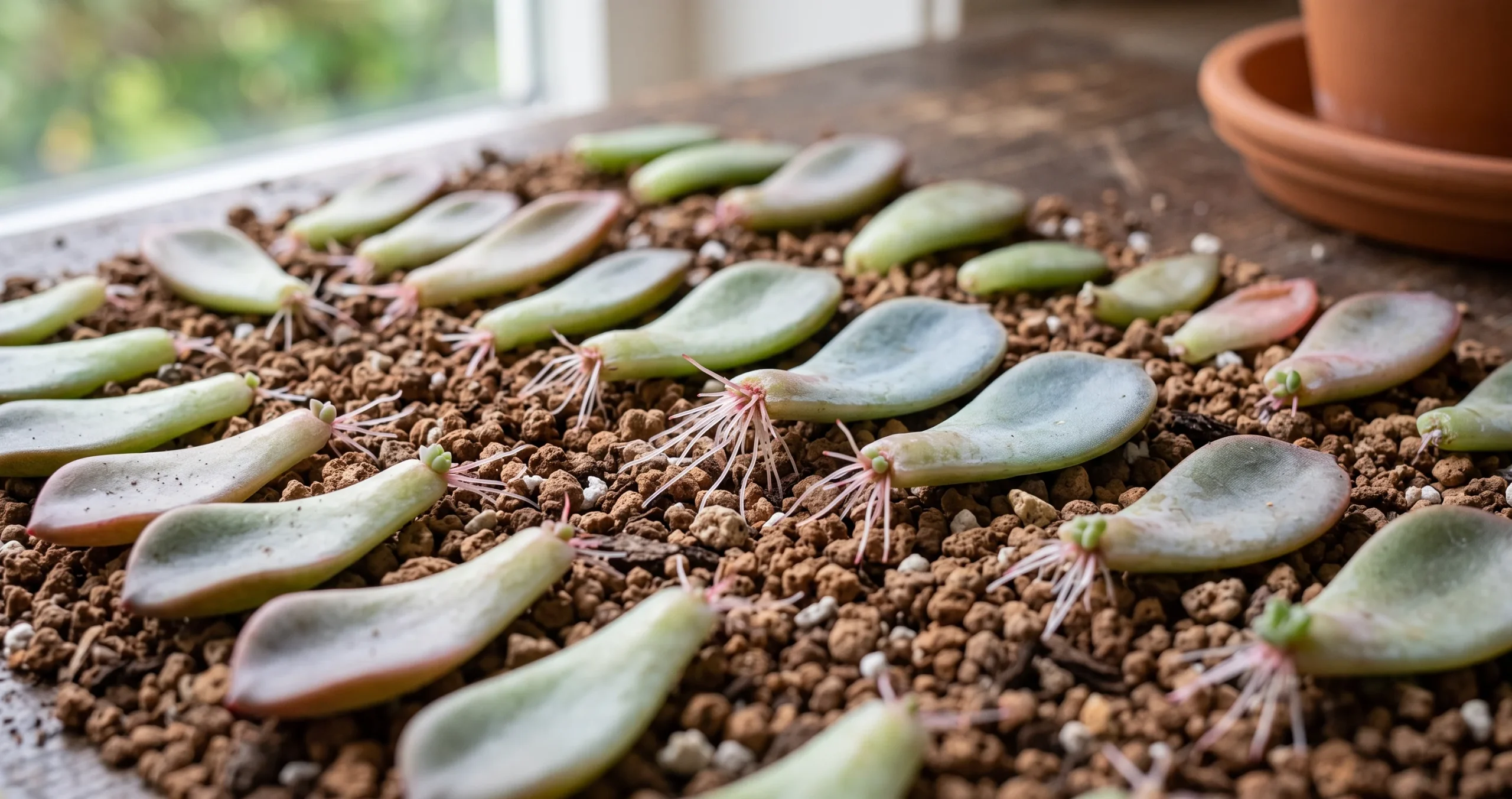
Learning propagating succulents leaf cuttings is one of the easiest ways to turn a healthy succulent into several new plants without buying anything new. A single intact leaf from the right species can develop roots, produce a tiny plantlet, and eventually become an independent succulent.
The process looks almost effortless, but success depends on several small details. The leaf must come away cleanly, the wound needs time to callus, moisture must be carefully controlled, and the new roots need bright but protected growing conditions.
This guide explains the complete process, from choosing and removing a leaf to caring for the new plantlet, along with the most common reasons succulent leaf propagation fails.
Table of Contents
- Can Every Succulent Grow From a Leaf?
- Best Succulents for Leaf Propagation
- Choosing a Healthy Leaf
- Proper Leaf Removal Technique
- Why Succulent Leaves Need to Callus
- Propagating Succulents Leaf Cuttings Step by Step
- Best Conditions for Root Development
- Watering Succulent Leaf Cuttings
- What Happens After Roots Appear
- When to Pot the New Succulent
- Common Reasons Leaf Propagation Fails
- How Long Succulent Leaf Propagation Takes
- FAQ
- Conclusion
Can Every Succulent Grow From a Leaf?
Before starting, it is important to understand that not every succulent can be propagated from a single leaf.
“Succulent” describes a broad group of plants that store water in fleshy leaves or stems. Different genera have different propagation abilities.
Many popular rosette-forming succulents can produce new plants from detached leaves. Echeveria, Graptopetalum, Pachyphytum, and many Sedum varieties are common examples.
Some succulents are better propagated through offsets, division, or stem cuttings instead.
The University of Minnesota Extension notes that many succulents can form new plants from detached leaves, while succulent propagation requirements vary among species.
This species difference explains why one succulent leaf may produce a complete new plant while another healthy-looking leaf may simply remain alive for months without forming a plantlet.
Identifying the plant before propagation can save considerable time.
Best Succulents for Leaf Propagation
Plants with thick, fleshy leaves that detach cleanly from the stem are often good candidates.
Common choices include:
- Echeveria
- Graptopetalum
- Graptoveria
- Pachyphytum
- Many Sedum species
The parent plant should be healthy and actively growing.
Avoid collecting propagation material from a plant showing extensive rot, severe pest damage, or serious stress. Healthy parent tissue gives the new plant the best possible start.
Mature leaves are generally preferable to tiny, newly developing leaves.
However, avoid choosing old leaves that are already yellowing, shriveled, translucent, or naturally dying at the bottom of the plant.
A plump, healthy leaf from the middle or lower portion of the rosette is usually a better candidate.
Choosing the Right Leaf for Propagation
A successful new plant begins with a healthy leaf.
Look for a leaf that is:
- Firm and plump
- Free from rot
- Free from obvious pests
- Undamaged
- Fully developed
- Typical in color for the plant
Avoid leaves with blackened areas or soft, translucent tissue.
One of the advantages of propagating succulents leaf cuttings is that several leaves can be started at the same time. Not every leaf will successfully develop a new plant, so propagating several healthy leaves improves the chances of success.
The next step is especially important.
The leaf needs to come away from the parent plant correctly.
Proper Leaf Removal Technique
Do not simply tear off part of a succulent leaf.
For species capable of leaf propagation, the entire leaf should generally separate cleanly at its attachment point.
Hold the leaf gently near its base, where it connects to the stem.
Carefully wiggle or twist the leaf from side to side while applying gentle pressure. The goal is to release the complete leaf rather than snapping it halfway across.
Inspect the base after removal.
It should look intact rather than torn or crushed.
If part of the leaf base remains attached to the parent stem, that leaf may be less likely to produce a new plant.
This small detail is one of the biggest differences between successful propagation and a tray filled with leaves that never develop plantlets.
Handle the leaves carefully. Succulent tissue contains stored moisture and can bruise when squeezed or crushed.
Once removed, resist the temptation to immediately bury the leaf in wet soil.
It needs time to heal first.
Why Succulent Leaves Need to Callus
The point where the leaf separated from the parent plant is a fresh wound.
Before rooting, allow this damaged surface to dry.
This process is commonly described as callousing.
Place the leaf somewhere dry with good air circulation and keep it away from harsh direct sunlight. Over the next several days, the exposed area at the base should become dry rather than remaining fresh and moist.
University of Minnesota Extension recommends allowing succulent cutting wounds to air-dry before placing the cutting into a rooting medium.
Why does this matter?
Freshly damaged succulent tissue exposed to excessive moisture can be vulnerable to decay. Allowing the wound to dry reduces the chance that a freshly removed leaf immediately sits against wet growing medium.
Do not put freshly removed leaves into a humid propagation dome.
Succulents already carry a substantial water reserve inside their fleshy tissues. They do not need the constantly humid environment commonly used for some leafy tropical cuttings.
Propagating Succulents Leaf Cuttings Step by Step
Once the leaf base has dried, the propagation stage can begin.
Step 1: Prepare a Shallow Container
Choose a shallow tray or small container with drainage.
Fill it with a loose, fast-draining succulent or cactus growing medium.
Good drainage is essential because succulent tissues are particularly vulnerable to problems caused by excessive moisture. University of Minnesota Extension recommends porous, well-drained growing media and containers with drainage holes for cacti and succulents.
Step 2: Place the Calloused Leaves on the Surface
Lay each leaf on top of the growing medium.
For many leaf-propagated succulents, there is no need to deeply bury the leaf.
The base should remain close to the surface so developing roots can reach the growing medium.
Leave some space between leaves so you can observe each one.
Step 3: Provide Bright, Indirect Light
Place the propagation tray somewhere bright without exposing the leaves to harsh midday sunlight.
Strong direct sunlight can overheat or dehydrate detached leaves before they have developed roots capable of supporting new growth.
At the same time, very dark conditions are not ideal.
Bright, indirect light provides a useful balance during early development.
Step 4: Wait for Roots
This stage requires patience.
Depending on the species and growing conditions, roots may begin developing from the base of the leaf before a visible plantlet appears.
In other cases, roots and tiny new leaves appear close together.
Avoid repeatedly picking up the leaf to check underneath it. Disturbing delicate new roots can damage them.
Step 5: Watch for a Plantlet
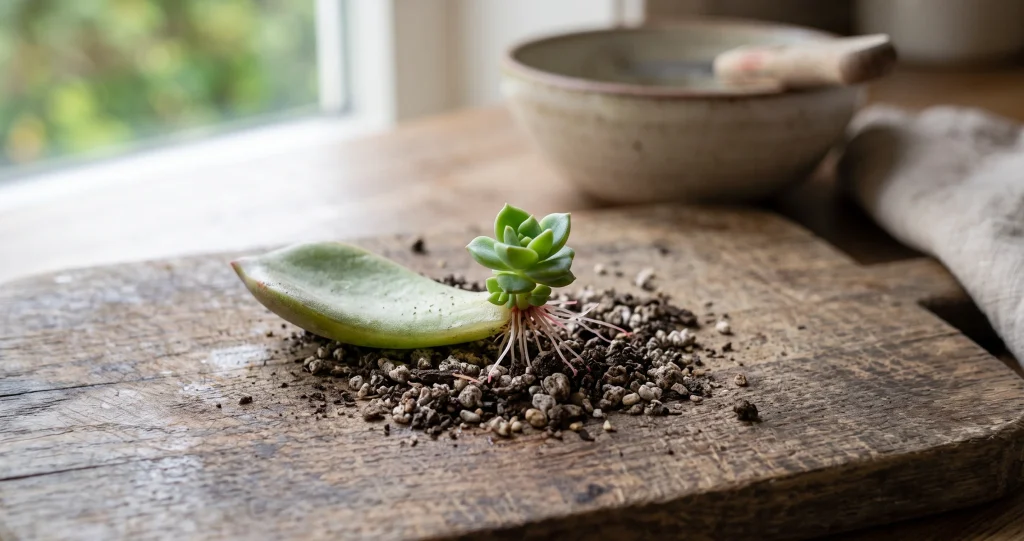
Eventually, a miniature cluster of leaves may emerge from the base of the original leaf.
This tiny growth is the beginning of the new succulent.
At this stage, the original leaf still serves an important purpose.
It contains stored moisture and nutrients that help support the developing plant.
Do not remove it.
Ideal Conditions for Root and Plantlet Development
Getting propagating succulents leaf cuttings started is only half the process. The developing plantlet also needs appropriate growing conditions.
Light
Provide plenty of bright, indirect light.
A bright windowsill with protection from intense direct sun can work well. If natural light is inadequate, a suitable grow light can provide supplemental illumination.
As the plantlet becomes established, it can gradually be introduced to the light conditions preferred by its species.
Sudden exposure to strong sunlight can scorch tender new growth.
Temperature
Normal warm indoor temperatures are suitable for many commonly grown succulents.
Avoid placing propagation trays against freezing windows, directly beside heating vents, or somewhere experiencing extreme temperature fluctuations.
Warm, stable conditions generally support active development.
Airflow
Good air circulation helps the growing medium dry appropriately.
A closed container with stagnant air and constant moisture creates very different conditions from the relatively dry environment most succulents prefer.
Growing Medium
Use a fast-draining medium.
The University of Minnesota Extension emphasizes that most cacti and succulents grow well in porous, well-drained mixtures and that excess water around their roots can quickly lead to decay.
Drainage becomes increasingly important once new roots enter the growing medium.
Watering Succulent Leaf Cuttings
Overwatering is one of the easiest ways to lose succulent leaf cuttings.
A detached succulent leaf contains its own water reserve.
Before roots appear, the leaf has a limited ability to take up additional moisture from the growing medium. Keeping the tray constantly wet therefore provides little benefit and can encourage decay.
Avoid saturating the propagation tray.
Once roots begin developing and entering the growing medium, small amounts of moisture can be provided when appropriate. The goal is not to maintain permanently wet soil.
As the plantlet matures, transition toward the normal watering pattern appropriate for the species: thorough watering followed by adequate drying.
Established succulents generally perform best when their growing medium is allowed to dry between waterings.
Avoid automatically misting the leaves every day. Constant surface moisture is not necessary for most succulent leaf propagation and can work against the dry, well-aerated conditions these plants favor.
What Happens After Roots Appear?
Roots are an exciting milestone, but they do not mean the propagation process is finished.
Small roots typically emerge from the base of the original leaf and move toward the growing medium.
Soon afterward, a miniature rosette or cluster of leaves may appear.
Sometimes the plantlet appears before substantial roots are visible. Both patterns can occur.
Leave the original mother leaf attached.
Over time, the new plant draws on the moisture and energy stored in it. The original leaf gradually becomes thinner, wrinkled, and dry.
This is normal.
Do not pull it away while it is still firm and supplying resources to the plantlet.
Eventually, it may become completely dry and detach with almost no resistance.
At that point, the young succulent is becoming an independent plant.
When to Pot the New Succulent
There is no need to rush transplantation.
A tiny plantlet with only minimal roots is easier to damage than a more established young succulent.
Wait until the plant has developed a reasonable root system and several small leaves.
Then transfer it carefully into a small container containing well-drained succulent potting mix.
Choose a container with a drainage hole.
Oversized containers are unnecessary for tiny succulents and can hold considerably more wet growing medium than their small root systems require.
After transplanting, continue providing bright light and careful watering.
As the plant matures, gradually move toward the normal care requirements of that particular species.
For more practical propagation and plant-care guides, visit Secrets of the Green Garden.
Common Reasons Succulent Leaf Propagation Fails
Even when propagating succulents leaf cuttings correctly, not every leaf becomes a new plant.
Some losses are normal.
However, repeated failures usually point toward one of several common problems.
The Leaf Was Torn During Removal
A leaf that breaks before separating cleanly at its base may fail to develop a plantlet.
Use gentle twisting rather than pulling aggressively.
The Leaf Was Planted Before Callousing
Placing a fresh wound directly against damp growing medium increases the risk of decay.
Give the wound time to dry first.
Too Much Water
A soft, translucent, yellowing, or blackening leaf may indicate excessive moisture or rot.
Remember that a succulent leaf already contains stored water.
More water does not automatically mean faster rooting.
Too Little Light
Extremely dark conditions can result in weak development.
Provide bright, indirect light during propagation.
Too Much Direct Sun
The opposite extreme can also cause problems.
A detached leaf has no established root system to replace water efficiently. Intense direct sun can cause excessive dehydration or scorching.
The Wrong Succulent Was Used
Some species simply do not reliably produce new plants from individual leaves.
A failed leaf does not always indicate poor technique.
Research the propagation method appropriate for the species.
The Leaf Was Already Weak
Yellowing, diseased, pest-damaged, or badly dehydrated leaves are poor propagation material.
Start with healthy, mature leaves whenever possible.
The Leaf Was Disturbed Repeatedly
New succulent roots can be extremely delicate.
Constantly lifting the leaf to inspect its progress can damage emerging roots. Once positioned, leave the cutting relatively undisturbed.
How Long Does Succulent Leaf Propagation Take?
There is no universal timetable.
Species, temperature, light, season, and the condition of the original leaf all influence the process.
Roots may begin appearing within several weeks under favorable conditions, while complete development into a recognizable young succulent takes considerably longer.
Colorado State University Extension notes that succulent and other cuttings can require several weeks for adequate root development, with temperature influencing the rooting period.
Do not discard a firm, healthy-looking leaf simply because nothing has happened after a week or two.
Succulent propagation rewards patience.
The original leaf may appear unchanged for some time before roots or new growth become visible.
FAQ About Propagating Succulents From Leaves
Do Succulent Leaves Need to Callus Before Propagation?
Allowing the wound to air-dry before rooting is recommended for many succulent cuttings.
This is especially useful because excessive moisture around fresh succulent tissue can encourage decay.
Should Succulent Leaf Cuttings Be Put in Water?
For the common soil-based leaf propagation method, water is unnecessary.
Allow the leaf to callus and place it over a well-drained propagation medium.
Should Succulent Leaves Be Buried?
Usually, the entire leaf should not be buried.
For many commonly propagated succulents, placing the leaf on the surface with its base close to the growing medium is sufficient.
How Often Should Succulent Leaf Cuttings Be Watered?
Avoid keeping them constantly wet.
Before roots develop, the leaf relies heavily on its internal water reserves. Once roots and a plantlet are established, provide moisture carefully while maintaining excellent drainage.
Should Succulent Leaf Cuttings Be Misted Every Day?
Daily misting is generally unnecessary.
Constant moisture can create conditions favorable to decay. Succulent propagation differs from propagation methods that require continuously humid conditions.
Should the Original Leaf Be Removed?
Leave it attached while it remains healthy enough to support the new plantlet.
The mother leaf naturally shrivels as its stored resources are used. Remove it only when it is completely dry and separates easily.
Can a Broken Succulent Leaf Still Grow?
It depends on where the damage occurred and on the species.
For reliable results, begin with a complete leaf that has separated cleanly from the parent stem.
Why Did My Succulent Leaf Grow Roots but No New Plant?
Root formation does not guarantee that a plantlet will develop.
Species differences, damage to the leaf base, environmental conditions, or simple biological variation can result in a leaf producing roots without successfully forming a new shoot.
Conclusion
Propagating succulents leaf cuttings can transform one healthy parent plant into an entire collection, but success depends more on patience than constant attention.
Start by choosing a succulent known to reproduce from individual leaves. Select a healthy, mature leaf and remove it carefully so the base remains intact.
Allow the wound to callus before placing the leaf on a fast-draining growing medium. Keep it in bright, indirect light, avoid excessive moisture, and resist the urge to continually move the leaf while roots are forming.
Once a plantlet develops, allow the original leaf to remain attached until it naturally shrivels. The young succulent can then gradually transition into its own small container and normal succulent care.
Not every leaf will succeed, and that is normal. Starting with several healthy leaves, maintaining dry and well-drained conditions, and giving them enough time greatly improves the chances of watching a single leaf develop into a completely new succulent.
External Sources :